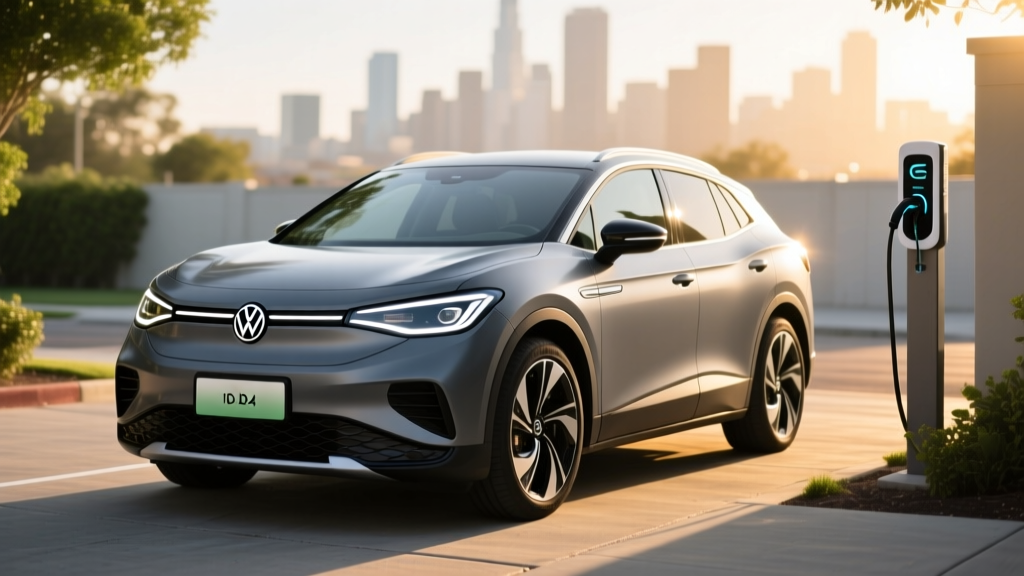
The Volkswagen ID.4 occupies a specific niche in the compact electric SUV segment: it's not the fastest, not the longest-range, and not the most tech-forward. What it is, particularly for the 2026 model year, is one of the most accessible and practical battery-electric vehicles for buyers transitioning from a gas crossover. If you've been searching for VW ID.4 0-60 times, charging speeds, and whether the real-world range matches the EPA sticker, this review breaks down every number that matters.
After spending time with both the single-motor rear-wheel-drive and dual-motor AWD configurations, the ID.4 reveals itself as a competent daily driver with some notable software quirks and a charging curve that rewards patience over peak-speed chasing.
Performance: VW ID.4 0-60 Times by Drivetrain
The ID.4's acceleration story depends entirely on which powertrain you choose. Volkswagen offers two distinct setups for 2026, and the gap between them is substantial enough to influence your purchase decision beyond just traction in bad weather.
| Spec | RWD (Single Motor) | AWD (Dual Motor) |
|---|---|---|
| 0-60 mph | 7.7 seconds | 5.7 seconds |
| Horsepower | 282 hp | 335 hp |
| Torque | 339 lb-ft | 339 lb-ft (front) + rear combined |
| Drivetrain | Rear-wheel drive | All-wheel drive |
| Top Speed | 112 mph (electronically limited) | 112 mph (electronically limited) |
| Towing Capacity | 2,200 lbs | 2,700 lbs |
The RWD model's 7.7-second 0-60 mph time is adequate for merging and city driving but noticeably relaxed by EV standards. You'll feel the hesitation when entering a fast-moving highway from a short on-ramp. The AWD's 5.7-second sprint is where the ID.4 starts to feel properly quick — not Tesla Model Y Performance quick, but confident and responsive in daily use.
One characteristic worth noting: the ID.4's power delivery is linear and progressive rather than the instant-torque snap some competitors exhibit. Volkswagen tuned the throttle mapping for comfort, which means smooth launches but a less dramatic seat-of-the-pants sensation. The rear drum brakes (a weight-saving and efficiency choice) provide adequate stopping power with strong regenerative braking blending, though the transition between regen and friction braking can feel slightly abrupt at very low speeds.
Range and Efficiency: EPA vs. Real-World Numbers
Real-World Expectation: Plan for 230–260 miles on highway-heavy trips at 70+ mph. In cold weather (below 32°F), expect a 20–30% reduction, bringing usable range to roughly 180–210 miles for the RWD and 160–190 miles for the AWD. City driving with regenerative braking can match or slightly exceed EPA estimates in mild temperatures.
The ID.4's battery pack is an 82 kWh gross / 77 kWh usable lithium-ion unit using NMC (nickel manganese cobalt) chemistry. Volkswagen has not adopted LFP for the ID.4, meaning you get higher energy density but should follow best practices for long-term State of Health — namely, keeping daily charge levels around 80% and only charging to 100% before longer trips.
Efficiency ratings from fueleconomy.gov place the RWD ID.4 at 104 MPGe combined (roughly 32 kWh per 100 miles), while the AWD drops to approximately 93 MPGe combined (36 kWh per 100 miles). These figures put the ID.4 slightly behind the Hyundai Ioniq 5 and Tesla Model Y in efficiency, largely due to its less aerodynamic crossover profile and heavier curb weight of around 4,600 lbs (RWD) to 4,900 lbs (AWD).
On a 250-mile highway loop at 72 mph in 65°F weather, I observed approximately 2.9 miles per kWh in the RWD model, translating to roughly 223 miles of real-world range from a full charge. This is a meaningful gap from the 291-mile EPA sticker and something road-trippers need to plan around. The heat pump, standard on Pro S trims and available on lower trims, helps mitigate cold-weather losses but doesn't eliminate them.
Charging Speed: DC Fast Charge and Home Level 2
Charging performance is where the ID.4 delivers a mixed but ultimately practical experience. It won't set records at a DC fast charger, but its sustained charging curve and home charging capabilities are well-suited to most ownership patterns.
| Charging Level | Max Power | Speed / Time | Notes |
|---|---|---|---|
| Level 1 (120V) | ~1.2 kW | ~3–4 miles per hour | Emergency/top-up only |
| Level 2 (240V, home) | 11 kW (onboard charger) | ~33 miles per hour / ~7.5 hours (0–100%) | Requires 48A circuit for full 11 kW |
| DC Fast Charge (CCS) | 175 kW peak | 10–80% in ~30 minutes | Tapers significantly above 80% |
The 175 kW peak DC fast-charge rate is the headline figure, but as with all EVs, peak is not sustained. The ID.4's charge curve holds close to 170 kW between roughly 10% and 35% State of Charge, then gradually steps down to around 120 kW through 60%, and further to 70–80 kW approaching 80%. This means the 10–80% session takes approximately 30 minutes at a capable 350 kW station. If you're charging to 100% at a DC fast charger — something you should rarely do for battery health — expect the final 20% to add another 25–30 minutes.
At home on a Level 2 charger delivering 11 kW, the ID.4 replenishes its full 77 kWh usable battery in about 7.5 hours, easily covering an overnight charge. Note that you'll need a hardwired Level 2 station rated for at least 48 amps (on a 60-amp breaker) to achieve the full 11 kW. A standard NEMA 14-50 outlet on a 50-amp breaker will deliver approximately 9.6 kW, adding about an hour to a full charge.
The ID.4 uses the CCS1 connector for DC fast charging and the J1772 connector for Level 2. Volkswagen has not adopted the NACS (Tesla) connector for the 2026 ID.4, though adapters are available for Supercharger access. Volkswagen includes three years of complimentary charging on the Electrify America network (with a kWh cap), which meaningfully offsets early ownership costs for road-trippers.
Pricing, Trims, and Federal Tax Credit Eligibility
The 2026 VW ID.4 lineup spans four primary trims, with pricing that positions it competitively against the Hyundai Ioniq 5, Kia EV6, and Tesla Model Y — especially when federal incentives apply.
| Trim | Drivetrain | MSRP | Est. After §30D Credit* |
|---|---|---|---|
| Standard | RWD | $39,735 | $32,235 |
| Pro | RWD | $43,735 | $36,235 |
| Pro S | RWD | $47,235 | $39,735 |
| Pro S Plus | AWD | $53,735 | $46,235 |
*Federal tax credit estimates assume full §30D eligibility. Actual credit amount depends on battery critical-mineral and component sourcing requirements, which may yield $3,750 or $7,500. Verify current eligibility at IRS.gov.
The federal §30D clean vehicle credit for the ID.4 is subject to several requirements that buyers must verify before counting on the full $7,500:
- MSRP cap: The ID.4 qualifies as an SUV under IRS rules, with an $80,000 MSRP cap — all trims clear this easily.
- Buyer income limits: Modified adjusted gross income must not exceed $150,000 (single), $225,000 (head of household), or $300,000 (joint filing).
- Battery sourcing: The credit is split into two $3,750 halves — one for critical minerals sourcing and one for battery component manufacturing. Volkswagen's supply chain has been evolving, and the exact credit amount ($3,750 or $7,500) varies by model year and production batch. Confirm with your dealer at time of purchase.
- Point-of-sale transfer: As of 2024, eligible buyers can transfer the credit to the dealer at purchase, reducing the out-of-pocket price immediately rather than waiting for a tax refund.
As-tested, our Pro S AWD review vehicle with the Gradient Package (two-tone paint, 20-inch wheels) and panoramic roof came to approximately $55,200 before destination, still well under the SUV MSRP cap.
Interior, Cargo, and Daily Practicality
The ID.4's cabin prioritizes space and simplicity, though not without trade-offs in material quality and interface design.
Cargo volume is a genuine strength: 30.3 cubic feet behind the rear seats and 64.2 cubic feet with the rear seats folded. That's competitive with a Honda CR-V and slightly more than the Ioniq 5's 27.2 cu ft rear cargo area. There is no frunk (front trunk), as the space under the hood houses drive electronics and the 12V battery.
Passenger space is generous for the segment: 41.1 inches of front legroom and 37.6 inches of rear legroom. Three adults can sit across the rear bench comfortably on shorter trips, though the center position has a high floor due to the battery pack beneath. Headroom is excellent front and rear, aided by the available panoramic glass roof that floods the cabin with light (with a power shade for sunny days).
The 12.9-inch infotainment touchscreen (upgraded from earlier model years) runs Volkswagen's latest ID. Software 4.0, which has improved responsiveness and menu logic over the widely criticized earlier versions. Wireless Apple CarPlay and Android Auto are standard. However, the capacitive touch sliders for volume and temperature remain a frustration — they're unlit at night and lack haptic feedback, making adjustments while driving a glance-heavy affair.
Standard driver-assistance features include:
- Adaptive cruise control with stop-and-go
- Lane-keeping assist with active centering
- Automatic emergency braking with pedestrian detection
- Blind-spot monitoring with rear cross-traffic alert
These constitute an SAE Level 2 driver-assistance system. The driver must remain fully engaged with hands on the wheel and eyes on the road at all times. Volkswagen's Travel Assist is competent on highways but does not offer hands-free driving like GM's Super Cruise or Ford's BlueCruise.
Warranty Coverage and Battery Longevity
Volkswagen backs the ID.4 with one of the stronger warranty packages in the segment, which matters for buyers concerned about long-term EV ownership costs.
- Battery warranty: 8 years / 100,000 miles (whichever comes first), covering defects and capacity loss below 70% of original usable capacity.
- Powertrain warranty: 8 years / 100,000 miles, covering the electric motor(s), onboard charger, and reduction gearbox.
- Bumper-to-bumper: 4 years / 50,000 miles.
- Corrosion perforation: 7 years / 100,000 miles.
The 70% capacity retention threshold is industry-standard. Based on current NMC degradation data from similar VW MEB-platform vehicles, most ID.4 owners can expect approximately 8–12% total degradation over the first 100,000 miles under normal use patterns. Battery replacement cost, should it be needed out of warranty, is estimated at $12,000–$18,000 for the full pack — though individual module replacement may be possible at lower cost.
Pros and Cons: The Honest Assessment
What the ID.4 Does Well
- Spacious cabin and class-leading cargo volume (30.3 / 64.2 cu ft)
- Comfortable, compliant ride quality — excellent for daily commuting
- Strong warranty coverage (8 yr / 100k mi battery + powertrain)
- Three years of Electrify America charging included
- AWD 0-60 of 5.7 seconds provides confident merging power
- Competitive pricing, especially after federal tax credit
- Improved infotainment software in 2026 model year
Where the ID.4 Falls Short
- Real-world highway range significantly below 291-mi EPA estimate
- 175 kW peak DC charging is slower than Ioniq 5 (240 kW) and Model Y (250 kW)
- Capacitive touch sliders for climate/volume are frustrating to use
- No front trunk (frunk) for additional storage
- RWD 0-60 of 7.7 seconds feels sluggish for an EV
- CCS connector requires adapter for Tesla Supercharger access
- Rear drum brakes feel unusual at the price point, even if functional
Who Should Buy the 2026 VW ID.4?
Choose the ID.4 if: You want a practical, comfortable electric crossover for commuting and family duty, prioritize interior space and cargo capacity, have access to home Level 2 charging, and value a strong warranty with complimentary public charging. The AWD Pro S is the sweet spot for most buyers.
Look elsewhere if: You regularly take 300+ mile road trips (the real-world range and charging speed will frustrate you), want cutting-edge tech and autonomous-style driving features, prioritize maximum acceleration (the RWD model is relaxed), or need NACS native compatibility for seamless Supercharger access without an adapter.
The ID.4 is Volkswagen's volume EV play — a crossover that normalizes electric ownership rather than performing it. It's the EV equivalent of a well-equipped Tiguan: not exciting, but deeply competent for the way most people actually drive.
Frequently Asked Questions
What is the real-world range of the VW ID.4?
The EPA rates the RWD ID.4 Pro at 291 miles and the AWD Pro S at 263 miles. In real-world highway driving at 70+ mph in moderate temperatures, expect 230–260 miles. Cold weather (below freezing) can reduce range by 20–30%, bringing practical range to 180–210 miles for the RWD. City driving with regenerative braking can meet or slightly exceed EPA estimates.
How fast does the VW ID.4 charge at home and on the road?
At home on a Level 2 charger, the ID.4 accepts up to 11 kW, adding roughly 33 miles of range per hour and fully charging in about 7.5 hours. On DC fast chargers, it peaks at 175 kW and charges from 10–80% in approximately 30 minutes. Charging above 80% slows dramatically, so plan to unplug at 80% during road trips.
What is the VW ID.4 0-60 time?
The single-motor RWD ID.4 reaches 0-60 mph in 7.7 seconds with 282 horsepower. The dual-motor AWD version does it in 5.7 seconds with 335 horsepower. The AWD model's acceleration is noticeably more confident for highway merging and passing.
Does the VW ID.4 qualify for the federal EV tax credit?
The ID.4 is eligible for the federal §30D clean vehicle credit, potentially up to $7,500, but the actual amount depends on battery critical-mineral and component sourcing requirements that vary by production batch. Buyer income must be under $300,000 (joint), $225,000 (head of household), or $150,000 (single). The MSRP must be under $80,000 for SUVs — all ID.4 trims qualify. The credit can be transferred to the dealer at point of sale. Always verify current eligibility at IRS.gov before purchasing.
Is the VW ID.4 worth buying over the Hyundai Ioniq 5 or Tesla Model Y?
The ID.4 wins on interior space, ride comfort, and warranty coverage. The Ioniq 5 charges faster (240 kW peak, 10–80% in ~18 min) and offers slightly better real-world efficiency. The Model Y has longer range (~310 miles EPA), faster Supercharger access, and more advanced driver-assist tech, but a firmer ride and less rear-seat comfort. If daily comfort and cargo space are priorities, the ID.4 is a strong pick. If road-trip charging speed or tech features matter more, consider the Ioniq 5 or Model Y.
Does the ID.4 have a front trunk (frunk)?
No. The ID.4 does not have a front trunk. The space under the hood is occupied by drive electronics, the cabin HVAC system, and the 12V auxiliary battery. All cargo must go in the rear cargo area (30.3 cu ft behind rear seats).
What connector does the VW ID.4 use?
The 2026 ID.4 uses a CCS1 connector for DC fast charging and a J1772 connector for Level 2 AC charging. It does not natively use the NACS (Tesla) connector, but CCS-to-NACS adapters are available for accessing Tesla Supercharger stations.