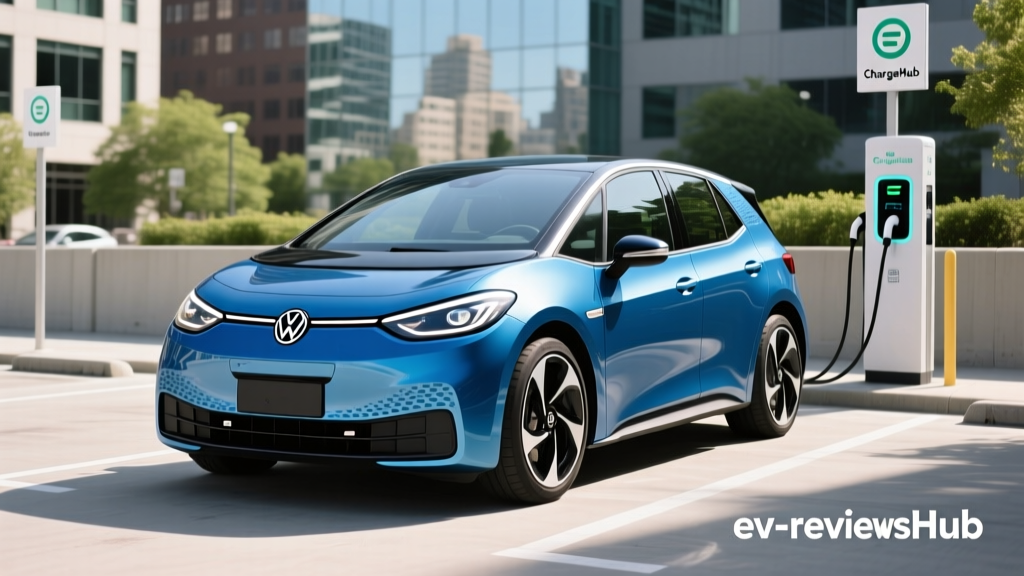
If you've spent any time browsing European EV forums or watching international auto shows, you've almost certainly encountered the Volkswagen ID.3 — VW's compact electric hatchback that has been one of Europe's best-selling EVs since its 2020 launch. Naturally, American EV shoppers are asking: is the VW ID.3 available in the USA?
The short answer, as of 2026, is no. Volkswagen has not brought the ID.3 to the American market, and the company has signaled no concrete plans to do so. But the question persists because the ID.3 fills a gap in VW's US lineup: an affordable, compact, city-friendly electric hatchback. Below, we break down exactly what the ID.3 offers, why VW has kept it across the Atlantic, and what American buyers can get instead.
VW ID.3 Specs at a Glance (European Market)
Before we dig into the "why not USA" question, here's what the ID.3 actually delivers in its home market. These figures reflect the current 2026 European-spec model with the mid-range Pro S battery.
| Spec | Value |
|---|---|
| WLTP Range | Up to 559 km (~347 mi WLTP) |
| Estimated EPA Range (if rated) | ~260–280 mi (estimated) |
| Battery (Usable) | 77 kWh (NMC chemistry) |
| Motor / Drivetrain | 204 hp / 286 hp (GTX), RWD |
| 0–100 km/h (0–62 mph) | 7.1 sec (Pro S) / 5.9 sec (GTX) |
| Max DC Fast Charge | 135 kW (Pro) / 175 kW (GTX) |
| 10–80% DC Charge Time | ~29 min (Pro) / ~26 min (GTX) |
| AC Level 2 Charging | 11 kW (3-phase, Europe) |
| Length / Width / Height | 167.8" / 71.2" / 61.3" |
| Cargo Volume | 13.6 cu ft (385 L) seats up |
| Curb Weight | ~3,990 lb (1,810 kg) |
| Starting Price (Germany) | €43,950 (~$47,500 USD) |
A note on range figures: Europe uses the WLTP testing cycle, which produces more optimistic range numbers than the US EPA cycle. A WLTP-rated 347-mile ID.3 Pro S would likely receive an EPA sticker of roughly 260–280 miles if VW submitted it for US certification. This is a critical distinction for any American cross-shopping European EV data.
Battery, Charging, and Efficiency Deep Dive
The ID.3 is offered in Europe with two main battery sizes. The base Pro trim carries a 58 kWh usable NMC (nickel manganese cobalt) battery, while the Pro S steps up to a 77 kWh usable NMC pack. A sportier GTX variant uses the same 77 kWh pack with a more powerful rear motor.
VW uses an NMC chemistry across the ID.3 lineup rather than the LFP (lithium iron phosphate) found in some competitors like the base Tesla Model 3. NMC offers higher energy density (more range in a smaller, lighter pack) but is generally less tolerant of frequent 100% charges. VW recommends daily charging to 80% for NMC longevity, reserving 100% for longer trips.
Charging Speed: Adequate, Not Class-Leading
DC fast charging is where the ID.3 shows its age relative to newer 800-volt competitors. The Pro peaks at 135 kW on a CCS2 connector (Europe's standard), while the GTX bumps this to 175 kW. On a capable charger, the Pro S goes from 10% to 80% in about 29 minutes; the GTX shaves that to roughly 26 minutes.
| Charge Level | Pro (58 kWh) | Pro S / GTX (77 kWh) |
|---|---|---|
| AC Level 2 (3-phase 11 kW) | ~6 hrs 0–100% | ~7.5 hrs 0–100% |
| DC Fast Peak kW | 135 kW | 135 kW (Pro S) / 175 kW (GTX) |
| 10–80% DC Time | ~30 min | ~29 min / ~26 min (GTX) |
| Miles Added per 15 min DC | ~90 mi (est.) | ~110 mi (est.) |
For context, the Hyundai Ioniq 5 (sold in the US) peaks at 240 kW on its 800V architecture and hits 10–80% in about 18 minutes. The ID.3's 400V platform is functional but falls behind the current class standard for fast-charging speed. On a road trip, that 10-minute gap per stop adds up.
Efficiency-wise, European testing pegs the Pro S at roughly 16.3 kWh/100 km, which translates to approximately 3.8 miles per kWh or about 120 MPGe (estimated). This is competitive with other compact EVs — not far off a Chevy Bolt EUV's efficiency — though it trails the Tesla Model 3's class-leading ~4.0 mi/kWh.
Why VW Hasn't Brought the ID.3 to America
This is the question that drives every "vw id3 usa" search, and the answer involves a mix of market strategy, regulatory cost, and product positioning.
The American Preference for Crossovers
US car buyers have overwhelmingly shifted to crossovers and SUVs. The compact hatchback segment — where the ID.3 lives — is one of the weakest in America. VW's US product team has prioritized the ID.4 compact crossover, which is built at VW's Chattanooga, Tennessee plant and qualifies for certain incentives tied to domestic manufacturing. The ID.4 offers more cargo room, available AWD, and crossover styling that resonates with American buyers.
Regulatory and Certification Costs
Bringing a European vehicle to the US requires separate crash testing (NHTSA and IIHS), EPA range and emissions certification, Federal Motor Vehicle Safety Standards (FMVSS) compliance modifications, and CCS1 connector adaptation (versus Europe's CCS2). For a vehicle in a weak US segment, VW has calculated that these costs don't justify the projected sales volume.
The ID.4 Fills the Slot
VW's American EV strategy centers on the ID.4 (and the upcoming ID.7 sedan and ID.Buzz van). The ID.4 starts around $39,735 in 2026, offers up to 291 miles of EPA range, and is eligible for the federal §30D tax credit (subject to income and MSRP caps). VW has little incentive to cannibalize ID.4 sales with a smaller, cheaper hatchback that would need to be imported from Germany — likely at a higher cost due to tariffs.
What You Can Buy in the US Instead
If the ID.3's concept appeals to you — a compact, efficient, affordable EV for commuting and city driving — here are the closest US-market alternatives:
| Vehicle | EPA Range | Battery | DC Peak kW | Base MSRP |
|---|---|---|---|---|
| VW ID.4 (Pro S) | 291 mi | 82 kWh (NMC) | 175 kW | $39,735 |
| Hyundai Ioniq 5 (SE) | 303 mi | 77.4 kWh (NMC) | 240 kW | $42,600 |
| Tesla Model 3 (RWD) | 272 mi | 60 kWh (LFP) | 170 kW | $38,990 |
| Chevy Equinox EV (LT) | 315 mi | 85 kWh (NMC) | 150 kW | $33,600 |
| Nissan Leaf (SV Plus) | 212 mi | 62 kWh (NMC) | 100 kW | $36,190 |
The Chevy Equinox EV is arguably the closest spiritual successor to what an American ID.3 would be — compact-ish, affordable, and efficient — though it's styled as a small crossover. The Tesla Model 3 offers similar interior volume and efficiency but in a sedan body. If you specifically want VW's electric driving experience, the ID.4 is the brand's US-market answer, and it's genuinely a strong vehicle for families who don't need a massive SUV.
Tax Credits and Pricing: Why Import Status Matters
Even if VW imported the ID.3 to the US, its eligibility for the §30D federal tax credit would be highly uncertain. Under current IRS rules, the credit (up to $7,500) requires:
- MSRP caps: $55,000 for sedans/hatchbacks, $80,000 for SUVs/trucks
- Buyer income limits: $150,000 single / $300,000 married filing jointly
- Battery component sourcing: Increasingly strict North American manufacturing and critical-mineral requirements that phase in annually through 2029
- Final assembly: Must occur in North America to qualify
Since the ID.3 is built in Zwickau, Germany, it would fail the final-assembly requirement outright, making it ineligible for the $7,500 credit regardless of battery sourcing. This is a major competitive disadvantage against vehicles like the US-built ID.4, Tesla Model 3 (Fremont/Austin), and the Hyundai Ioniq 5 (now built in Georgia).
The ID.3's European starting price of roughly €43,950 (~$47,500) would likely translate to a US MSRP of $45,000–$50,000 after accounting for shipping, compliance modifications, and dealer margins. Without the tax credit, that's significantly more than a Chevy Equinox EV or Tesla Model 3 — making the business case even weaker for VW.
Interior, Tech, and Daily Livability
For those curious about what they're missing, the ID.3's interior is a mixed bag that reflects VW's ongoing software struggles and subsequent improvements.
What Works
- Spacious cabin for its footprint: At 167.8 inches long, the ID.3 is shorter than a Golf, but its dedicated MEB EV platform pushes the wheels to the corners, creating rear legroom that rivals a mid-size sedan (~37.6 inches).
- Tight turning circle: The rear-wheel-drive layout and short overhangs give the ID.3 a 33.5-foot turning diameter — excellent for city driving and tight parking structures.
- Updated ID. Software 4.0: VW's 2024+ models feature a significantly improved infotainment system with larger touchscreens (12.9-inch on Pro S), faster response times, and persistent climate controls on the steering wheel — addressing the biggest complaints from early ID.3 owners.
- Travel Assist (Level 2 ADAS): Adaptive cruise control with lane centering works well on European motorways. Note: this is SAE Level 2 driver assistance, meaning you must keep your hands on the wheel and eyes on the road at all times.
Notable Drawbacks
- Cargo space is modest: At 13.6 cubic feet with seats up, the ID.3 trails the ID.4 (30.3 cu ft) and most crossovers. Fold the rear seats and you get roughly 44.7 cu ft — adequate but not generous.
- Plasticky lower interior: While the dashboard and upper door panels use soft-touch materials, the lower cabin is dominated by hard, scratchy plastics — a common complaint in European reviews.
- No front trunk (frunk): The MEB platform's front-end packaging leaves no room for a frunk, unlike the Tesla Model 3 or Hyundai Ioniq 5.
- CCS2 connector in Europe: Not relevant for US buyers, but worth noting that European ID.3s use a different physical DC connector than the CCS1 standard used in North America.
✅ Pros (If It Were Available)
- Tight city dimensions with roomy cabin
- Competitive efficiency (~120 MPGe est.)
- Comfortable, quiet ride quality
- Improved infotainment (2024+ models)
- Tight turning circle for urban parking
- Strong Euro NCAP safety rating (5 stars)
❌ Cons
- Not available in the USA
- DC charging speed trails 800V competitors
- Modest cargo volume for the footprint
- No frunk
- Hard plastics in lower cabin
- Would likely miss §30D tax credit
Will the VW ID.3 Ever Come to the USA?
As of early 2026, Volkswagen has made no official announcement regarding a US launch of the ID.3. Industry analysts consider it unlikely for several reasons:
- Segment mismatch: American demand for compact hatchbacks continues to erode. VW's US sales data overwhelmingly favors crossovers (ID.4, Tiguan, Atlas).
- Manufacturing logistics: VW's Chattanooga plant is configured for the ID.4 and Atlas. Retooling for a smaller vehicle or importing from Germany at volume doesn't pencil out.
- Tariff exposure: Imported EU-built vehicles face a 2.5% US tariff, and potential future tariff changes could make the economics worse.
- MEB platform evolution: VW's next-generation SSP platform (expected ~2028) may bring new models that are designed from the start for global markets, including North America.
If VW does eventually bring a compact EV to the US, it's more likely to be a small crossover (think "ID.2 SUV") than a hatchback, reflecting market realities. Until then, the ID.3 remains a European-market exclusive — a capable EV that simply doesn't fit the American buying equation.
Frequently Asked Questions
Can I import a VW ID.3 to the USA privately?
Technically, you could attempt to import one under the NHTSA's 25-year rule or show-and-display exemption, but neither applies to a new vehicle. A brand-new ID.3 cannot be legally registered for road use in the US without full FMVSS compliance, which VW has not pursued. Gray-market imports are essentially not a viable path.
What is the closest VW EV I can buy in America?
The VW ID.4 is VW's primary US electric offering, with EPA ranges of 245–291 miles depending on trim, starting at $39,735. It's a larger, more practical crossover built in Tennessee. The ID.Buzz (electric minivan) launched in the US for 2025, and the ID.7 sedan is expected to follow.
Does the VW ID.3 qualify for the US federal EV tax credit?
No. Even if VW sold the ID.3 in the US, it is assembled in Zwickau, Germany, which fails the §30D final-assembly-in-North-America requirement. It would not qualify for the $7,500 federal credit under current IRS rules.
How does the ID.3 compare to the Tesla Model 3?
The ID.3 is a hatchback; the Model 3 is a sedan — different body styles for different needs. The ID.3 offers a more upright seating position and tighter dimensions for city use, while the Model 3 delivers more range (272–341 mi EPA), faster Supercharger access (via NACS), and a more mature software ecosystem. The Model 3 also starts lower ($38,990) and qualifies for the federal tax credit.
What battery chemistry does the ID.3 use?
The ID.3 uses NMC (nickel manganese cobalt) lithium-ion cells supplied primarily by LG Energy Solution and SK On. NMC offers higher energy density than LFP but benefits from daily charging limited to 80% to maximize long-term battery health. VW provides an 8-year / 100,000-mile (160,000 km) battery warranty in Europe, guaranteeing at least 70% capacity retention.
Is the VW ID.3 worth waiting for?
There is no indication VW plans to bring the ID.3 to the US, so waiting is not a practical strategy. The US EV market already offers strong alternatives at competitive prices: the Chevy Equinox EV for affordability, the Hyundai Ioniq 5 for fast charging, the Tesla Model 3 for efficiency and Supercharger access, and VW's own ID.4 for brand loyalty with American assembly and tax-credit eligibility.