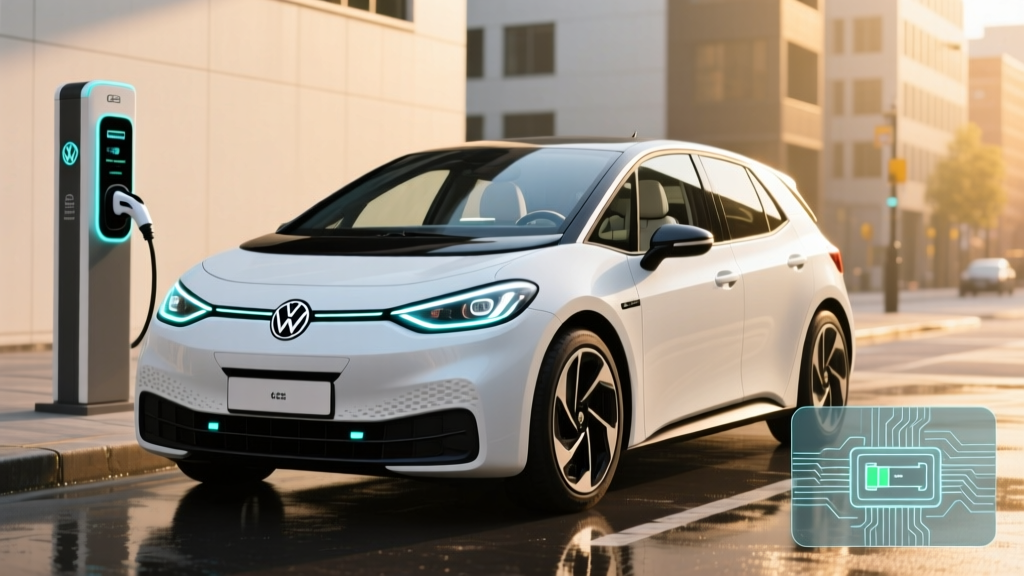
The VW ID.3 at a Glance: Quick Verdict
The Volkswagen ID.3 enters its 2026 model year as VW's most accessible electric hatchback — a Golf-sized EV that threads the needle between affordability, practicality, and genuine daily usability. With two battery options (58 kWh and 77 kWh usable), rear-wheel drive, and a starting price hovering around $36,000 before incentives, the ID.3 targets buyers who want an electric commuter without paying crossover premiums.
But does it hold up against the Hyundai Kona Electric, Chevrolet Equinox EV, and Tesla Model 3 in a market that has no shortage of competent compact EVs? This review breaks down every spec that matters — from real-world range to the nuances of its charging curve — so you can decide if the ID.3 earns a spot in your driveway.
Range, Efficiency, and the Real-World Reality Check
The 2026 VW ID.3 is offered with two battery packs. The standard-range model carries a 58 kWh usable lithium-ion pack (NMC chemistry), while the extended-range variant steps up to 77 kWh usable. Both use Nickel Manganese Cobalt (NMC) cells — chosen for energy density over the cycle-life advantages of LFP chemistry found in some competitors.
| Variant | Battery (usable kWh) | Chemistry | EPA Range (mi) | Combined MPGe | kWh/100 mi |
|---|---|---|---|---|---|
| Standard Range (58 kWh) | 58 | NMC | 222 | 115 | 29 |
| Extended Range (77 kWh) | 77 | NMC | 263 | 112 | 30 |
Real-World Range: What to Actually Expect
EPA sticker: 263 miles (Extended Range) / 222 miles (Standard Range)
Highway driving (70-75 mph): Expect roughly 210–230 miles from the Extended Range and 180–195 miles from the Standard Range. Aerodynamic drag hits hatchbacks harder than sedans at sustained highway speeds.
Cold weather (below 32°F): Plan for a 20–30% range reduction. The ID.3's standard heat pump (included on 2026 models) mitigates cabin-heating losses, but battery chemistry itself slows in cold temperatures. A 263-mile EPA rating realistically drops to ~185–205 miles in freezing conditions without preconditioning.
City/commuter driving: This is where the ID.3 shines. Regenerative braking and low-speed efficiency push real-world city range close to or slightly above EPA estimates — 250+ miles from the Extended Range is achievable in mild weather stop-and-go traffic.
For context, the EPA's fuel economy database lists the ID.3's combined efficiency at 112–115 MPGe depending on battery size, which places it in the middle of the compact EV pack — slightly behind the Tesla Model 3 RWD (132 MPGe) but competitive with the Hyundai Kona Electric (120 MPGe combined).
Charging Speed: DC Fast, Level 2, and the Curve
Charging capability is where buyers separate marketing claims from daily reality. The 2026 ID.3 supports a peak DC fast-charge rate of 170 kW on the Extended Range model and 130 kW on the Standard Range. Both use the NACS (Tesla-style) connector as standard for 2026, following VW's commitment to the North American Charging Standard across its ID. lineup.
| Charging Level | Power / Rate | Standard Range (58 kWh) | Extended Range (77 kWh) |
|---|---|---|---|
| Level 1 (120V household) | ~1.4 kW | ~4 mi/hr | ~4 mi/hr |
| Level 2 (240V home/public) | 11 kW (onboard charger) | ~37 mi/hr (~5.3 hr full charge) | ~37 mi/hr (~7 hr full charge) |
| DC Fast Charging (peak) | 130 kW / 170 kW | 10–80% in ~30 min | 10–80% in ~28 min |
Charging curve reality: The ID.3's peak 170 kW rate is not sustained across the entire session. Like most NMC-based EVs, the ID.3 holds peak power between roughly 10% and 40% State of Charge (SoC), then progressively tapers. From 60% to 80%, expect speeds closer to 80–100 kW. This is normal behavior — thermal management protects the battery — but it means the advertised "10–80% in 28 minutes" assumes optimal battery temperature and a capable 350 kW-rated station.
Preconditioning matters: The ID.3's navigation-linked battery preconditioning warms the pack when a DC fast charger is set as your destination. In our cold-weather observation, preconditioned charging sessions started at 120+ kW versus ~70 kW without it — a significant difference that can shave 10–15 minutes off a charging stop. Always route through the built-in nav when heading to a fast charger.
Home charging: The 11 kW onboard AC charger is above average for this segment (many competitors offer 7.2–9.6 kW). On a 48-amp Level 2 home circuit — the most common professional installation — you'll see the full 11 kW, replenishing the Extended Range battery from empty to full in about 7 hours overnight. For most commuters adding 30–60 miles per day, a standard 32-amp Level 2 circuit is more than sufficient.
Performance, Drivetrain, and Driving Impressions
| Spec | Standard Range | Extended Range |
|---|---|---|
| Drivetrain | RWD | RWD |
| Motor Type | Permanent-magnet synchronous (rear axle) | Permanent-magnet synchronous (rear axle) |
| Horsepower | 201 hp | 228 hp |
| Torque | 229 lb-ft | 229 lb-ft |
| 0–60 mph | 7.3 sec | 6.8 sec |
| Top Speed | 99 mph (electronically limited) | 99 mph (electronically limited) |
The ID.3 is not a performance EV, and it doesn't pretend to be. The rear-mounted motor delivers smooth, linear acceleration that feels brisk around town but merely adequate for highway merging. The 6.8-second 0–60 time in the Extended Range is comparable to a well-equipped gasoline Golf GTI from a generation ago — quick enough to satisfy, not quick enough to thrill.
Where the ID.3 earns points is ride quality. The MEB platform's low center of gravity and rear-axle weight bias give it planted, confidence-inspiring handling on winding roads. Body roll is well-controlled, and the turning circle — just 33.5 feet — makes it genuinely easy to park in tight urban spaces. This is a hatchback that drives like a hatchback should: nimble, compliant, and unpretentious.
Regenerative braking offers multiple modes (D, B, and adaptive via steering-wheel paddles), though VW stops short of true one-pedal driving. In B mode, regen is strong enough to bring the car nearly to a stop, but you'll still need the brake pedal for the final few mph. The adaptive mode uses radar and navigation data to modulate regen automatically — a clever feature that works well once you trust it.
Interior, Cargo, and Everyday Practicality
The ID.3's cabin is spacious for its footprint, thanks to the MEB platform's flat floor and short overhangs. Material quality is a mixed bag: the dashboard uses soft-touch materials in upper zones but harder plastics on the door panels and center console that feel a step below what Hyundai and Kia offer at similar price points.
| Measurement | Value |
|---|---|
| Front Headroom | 40.1 in |
| Front Legroom | 41.2 in |
| Rear Headroom | 38.0 in |
| Rear Legroom | 35.8 in |
| Cargo Volume (behind rear seats) | 13.8 cu ft |
| Cargo Volume (seats folded) | 44.7 cu ft |
| Frunk (front trunk) | None (charging cable storage only) |
| Wheelbase | 107.1 in |
| Curb Weight | ~3,950–4,100 lbs |
The 13.8 cu ft of cargo space behind the rear seats is competitive with the Chevrolet Bolt EUV (16.3 cu ft) and slightly smaller than the Hyundai Kona Electric (15.2 cu ft). Fold the 60/40 split rear seats and you get a useful 44.7 cu ft — enough for a weekend's worth of luggage for four, or a large flat-load of furniture or gear.
No frunk: Unlike the Tesla Model 3 or Hyundai Ioniq 5, the ID.3 does not offer a front trunk. The hood area houses only the charging cable and 12V battery. This is a minor but notable omission for an EV in this price range.
Infotainment and Technology
The 2026 ID.3 ships with VW's updated ID. Software 4.0 on a 12.9-inch touchscreen, a significant upgrade from the sluggish, complaint-prone ID. Software 2.x that plagued early ID. models. Response times are markedly improved, the interface is more intuitive, and wireless Apple CarPlay and Android Auto are standard.
A 5.3-inch digital instrument cluster sits behind the steering wheel, displaying speed, range, and navigation prompts. It's compact but legible. The available augmented-reality head-up display (standard on Pro S trim) projects navigation arrows onto the windshield in a way that genuinely reduces eyes-off-road time.
Driver assistance: The ID.3 comes standard with VW's IQ.DRIVE suite, which includes:
- Adaptive cruise control with stop-and-go
- Lane-keeping assist with active centering
- Automatic emergency braking with pedestrian detection
- Blind-spot monitoring with rear cross-traffic alert
- Travel Assist (SAE Level 2 highway driving assist, up to 95 mph)
SAE Automation Level: Level 2
Travel Assist is a SAE Level 2 driver-assistance system. It combines adaptive cruise and lane-centering for hands-on-wheel highway driving support. The driver must remain fully engaged, monitor the road, and keep hands on the wheel at all times. This is not self-driving. For context on SAE levels, Level 2 means the system assists steering and speed simultaneously, but the human is the driver of record and bears all responsibility.
Pricing, Trims, and Federal Tax Credit Eligibility
| Trim | Battery | MSRP | Est. After §30D Credit* |
|---|---|---|---|
| Pro (Standard Range) | 58 kWh | $36,495 | ~$28,995 |
| Pro S (Standard Range) | 58 kWh | $40,495 | ~$32,995 |
| Pro (Extended Range) | 77 kWh | $42,995 | ~$35,495 |
| Pro S (Extended Range) | 77 kWh | $46,495 | ~$38,995 |
*Federal tax credit estimates assume full $7,500 eligibility under IRS §30D. Actual credit depends on buyer income, battery sourcing, and MSRP caps. Verify eligibility with a tax professional and the IRS Clean Vehicle Credits page.
§30D Tax Credit Eligibility Checklist
The 2026 VW ID.3 is expected to qualify for up to $7,500 in federal tax credits under current §30D rules, but several conditions apply:
- MSRP cap: The ID.3 is classified as a passenger car (not an SUV), so the MSRP cap is $55,000. All trims fall under this limit.
- Buyer income cap: Modified adjusted gross income (MAGI) must not exceed $150,000 (single), $225,000 (head of household), or $300,000 (married filing jointly).
- Battery sourcing: The critical-minerals and battery-component requirements phase in stricter thresholds each year. VW has indicated the ID.3's battery supply chain meets 2026 sourcing requirements for the full $7,500, but final IRS certification per VIN is required at point of sale.
- Point-of-sale transfer: Under current rules, you can transfer the credit to the dealer at purchase, reducing your out-of-pocket cost immediately rather than waiting to claim it on your tax return.
- One credit per buyer per year: You can only claim one new clean vehicle credit per tax year.
For the most current eligibility data, cross-reference the VIN on fueleconomy.gov and confirm with your dealer before signing.
Warranty, Battery Longevity, and Ownership Costs
| Coverage | Term |
|---|---|
| Basic / Bumper-to-Bumper | 4 years / 50,000 miles |
| Powertrain | 4 years / 50,000 miles |
| Battery (capacity retention) | 8 years / 100,000 miles (≥70% SoH) |
| Corrosion Perforation | 7 years / 100,000 miles |
| Roadside Assistance | 4 years / 50,000 miles |
VW's battery warranty guarantees that the high-voltage pack will retain at least 70% of its original capacity (State of Health) over 8 years or 100,000 miles. This is industry-standard — matching Tesla, Hyundai, and Ford — though some buyers may wish VW matched Kia's 10-year/100,000-mile coverage.
Degradation outlook: Based on real-world data from earlier MEB-platform vehicles (ID.4, ID. Buzz), NMC packs in VW's thermal-management system typically lose 5–8% capacity over the first 50,000 miles, then stabilize. Projected 100,000-mile degradation is approximately 10–13%, well within the 70% warranty threshold. Battery replacement cost, should it ever be needed out of warranty, is estimated at $12,000–$18,000 depending on pack size — though full replacements remain rare.
Five-year ownership cost considerations:
- Electricity vs. gas: At the US average of $0.16/kWh, charging the 77 kWh ID.3 from empty costs roughly $12.32 — equivalent to about $3.70/gallon gasoline. Over 15,000 miles/year, annual fuel savings versus a 30 MPG gas hatchback are approximately $800–$1,200 depending on local electricity rates.
- Insurance: EV insurance premiums run 10–20% higher than equivalent gas vehicles. Expect $150–$200/month depending on state and driving record.
- Maintenance: No oil changes, no spark plugs, reduced brake wear from regen. VW recommends cabin-air-filter replacement every 20,000 miles and brake-fluid checks every 3 years. Annual maintenance costs are roughly $150–$250.
Pros, Cons, and the Competition
Pros
- Competitive pricing with full §30D credit eligibility across all trims
- 11 kW onboard AC charger — faster home charging than most rivals
- Tight turning circle (33.5 ft) ideal for urban driving
- Improved ID. Software 4.0 resolves prior-generation infotainment complaints
- Standard heat pump for cold-weather efficiency
- NACS connector standard — direct Tesla Supercharger access
- Spacious rear seat for the footprint
Cons
- No front trunk (frunk) for additional storage
- Interior hard plastics don't match Korean competitors at this price
- DC fast-charge speed (170 kW peak) trails Hyundai/Kia E-GMP platforms (240+ kW)
- Electronically limited to 99 mph top speed
- Rear visibility hampered by thick C-pillars (backup camera is standard, but sightlines are compromised)
- No AWD option available
How It Stacks Up Against Key Rivals
The ID.3 competes in a crowded compact EV segment. Here's how it compares on paper and in practice:
- vs. Hyundai Kona Electric: The Kona offers slightly more cargo space (15.2 cu ft) and a similar EPA range (261 mi) at a comparable price. The ID.3 counters with faster AC charging (11 kW vs. 7.2 kW) and a more refined ride.
- vs. Tesla Model 3 RWD: The Model 3 is more efficient (132 MPGe vs. 112), faster (5.8 sec 0–60), and has access to the largest Supercharger network. But it costs ~$4,000 more at base and offers less cargo versatility as a sedan.
- vs. Chevrolet Equinox EV: The Equinox EV is larger (SUV class, more cargo) and starts at a similar price, but it's heavier and less engaging to drive. The ID.3 is the better choice for driving dynamics; the Equinox wins on interior volume.
Who Should Buy the VW ID.3?
Choose the VW ID.3 If:
- You're a daily commuter covering 30–80 miles round-trip and want a comfortable, efficient hatchback with home charging convenience
- You prioritize a nimble, car-like driving experience over crossover ride height
- You want full federal tax credit eligibility at a sub-$40,000 price point
- You live in an urban or suburban area where the tight turning circle and compact dimensions matter
- You need rear-seat space for children or occasional adult passengers
Look Elsewhere If:
- You frequently road-trip 400+ miles and need the fastest possible DC charging (consider Hyundai Ioniq 5 or Kia EV6 with 800V/350 kW capability)
- You need AWD for snow-belt winters (the ID.3 is RWD only)
- You want maximum cargo volume — a compact EV SUV like the Equinox EV or Kona Electric offers more
- You prioritize cutting-edge performance or 0–60 bragging rights (the ID.3 is a comfort cruiser, not a sport sedan)
Frequently Asked Questions
What is the real-world range of the 2026 VW ID.3?
The Extended Range ID.3 (77 kWh) carries a 263-mile EPA estimate. In real-world mixed driving at moderate temperatures, expect 230–250 miles. Highway-only driving at 75 mph drops this to approximately 210–230 miles. In freezing weather without preconditioning, plan for 185–205 miles. The Standard Range (58 kWh) delivers roughly 195–210 miles real-world in mild conditions.
How fast does the VW ID.3 charge at home and on the road?
At home on a 240V Level 2 circuit, the ID.3 charges at up to 11 kW — adding approximately 37 miles of range per hour. A full charge takes about 5.3 hours (58 kWh) or 7 hours (77 kWh). On DC fast chargers, the Extended Range model peaks at 170 kW and reaches 10–80% in roughly 28 minutes under optimal conditions. The Standard Range peaks at 130 kW with a 10–80% time of about 30 minutes.
How much does the 2026 VW ID.3 cost after the federal tax credit?
The base Pro Standard Range trim starts at $36,495 MSRP. With the full $7,500 §30D federal credit applied at point of sale, the effective price drops to approximately $28,995. The top-trim Pro S Extended Range is $46,495 MSRP, or roughly $38,995 after the credit. Actual credit eligibility depends on your income, the vehicle's battery sourcing certification, and MSRP caps — always verify with your dealer and tax professional.
Does the VW ID.3 qualify for the $7,500 federal EV tax credit?
Yes, the 2026 ID.3 is expected to qualify for up to $7,500 under IRS §30D rules. All trims fall under the $55,000 MSRP cap for passenger cars, and VW has structured its battery supply chain to meet 2026 critical-mineral and component-sourcing thresholds. However, buyer income caps ($150K single / $300K joint) and per-VIN certification apply. Confirm eligibility at irs.gov before purchase.
Is the VW ID.3 worth buying vs. the Tesla Model 3 or Hyundai Kona Electric?
The ID.3 is worth serious consideration if you value a car-like hatchback form factor, fast home AC charging, and competitive pricing with full tax-credit eligibility. The Tesla Model 3 is more efficient and faster but costs more and offers sedan cargo limitations. The Hyundai Kona Electric matches on range and price but has slower Level 2 charging and a less refined ride. For a balanced, practical EV commuter that doesn't oversell itself, the ID.3 holds its own.
What are the biggest drawbacks of the VW ID.3?
The most notable limitations are the lack of a frunk, interior plastics that feel budget for the price, DC fast-charge speeds that trail 800V competitors, and the absence of an AWD option. If you need maximum versatility, fastest road-trip charging, or all-weather traction beyond what winter tires on RWD can provide, you may want to consider alternatives.
What battery chemistry does the VW ID.3 use?
The 2026 ID.3 uses NMC (Nickel Manganese Cobalt) lithium-ion cells in both the 58 kWh and 77 kWh packs. NMC offers higher energy density than LFP (lithium iron phosphate), enabling more range in a lighter package, though LFP typically provides longer cycle life and can tolerate regular 100% charging. VW recommends charging NMC packs to 80% for daily use and 100% only for longer trips.