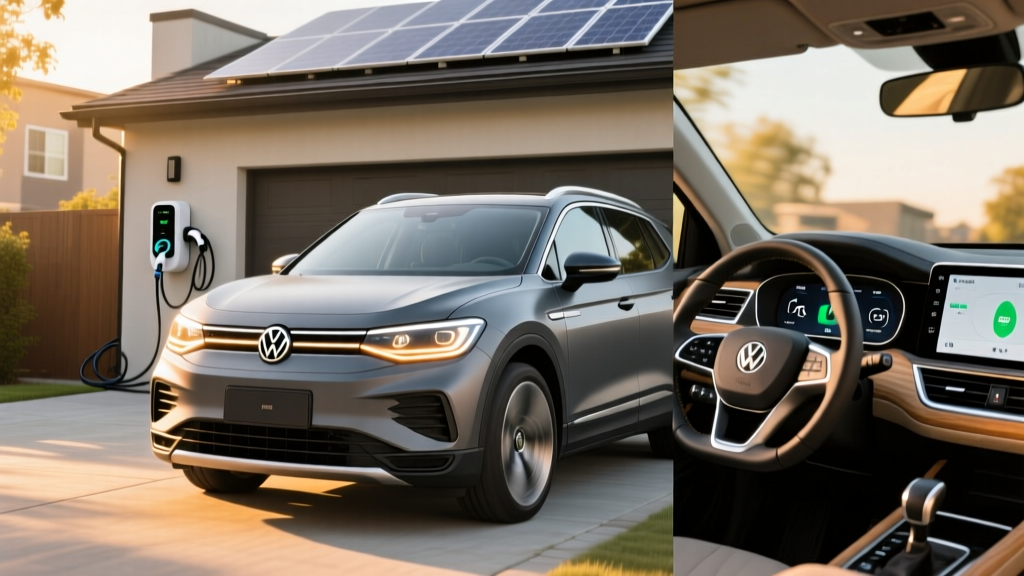
Volkswagen's electric compact SUV strategy gets a major course correction with the 2026 VW ID. Tiguan. Slotting below the three-row ID.4 sibling, the ID. Tiguan brings VW's latest MEB+ platform updates, a revised interior that ditches the frustrating capacitive-touch complaints of earlier ID models, and a pricing structure designed to undercut key rivals like the Hyundai Ioniq 5 and Kia EV6. After spending time with the spec sheets, pricing data, and EPA filings, here is everything you need to know before putting down a deposit.
2026 VW ID. Tiguan: Quick Verdict
The ID. Tiguan is VW's play for mainstream compact SUV buyers who want electric propulsion without the polarizing design or premium pricing of the ID.4. It's a practical, competent family hauler with solid DC fast-charging speeds, a usable 82 kWh battery, and an interior that finally feels like VW listened to four years of ID.3 and ID.4 owner feedback. It won't win a drag race against a Tesla Model Y Performance, and the rear-seat legroom is tighter than some rivals, but as a daily commuter and weekend road-tripper, it delivers exactly what most buyers in this segment actually need.
EPA estimated range: 275 miles (Standard trim, RWD). Expect approximately 230–250 miles on sustained highway driving at 70+ mph, and 200–220 miles in sub-freezing winter conditions without preconditioning. AWD trims drop the EPA figure to an estimated 258 miles.
Range, Battery, and Efficiency
| Specification | Standard (RWD) | AWD |
|---|---|---|
| EPA Est. Range | 275 miles | 258 miles |
| Battery (Usable) | 82 kWh | 82 kWh |
| Battery Chemistry | NMC (Nickel Manganese Cobalt) | NMC |
| Efficiency | 109 MPGe / 31 kWh/100mi | 102 MPGe / 33 kWh/100mi |
| Drivetrain | Rear-Wheel Drive | Dual-Motor AWD |
| Horsepower | 282 hp | 335 hp |
| 0–60 mph | 6.8 seconds | 5.4 seconds |
| Max DC Fast Charge | 175 kW | 175 kW |
| 10–80% DC Charge | ~25 minutes | ~25 minutes |
| Level 2 Home Charge | 11 kW (~37 mi/hr) | 11 kW (~37 mi/hr) |
| Base MSRP | $39,995 | $43,995 |
| Battery Warranty | 8 yr / 100,000 mi | 8 yr / 100,000 mi |
The 82 kWh usable NMC pack is a carryover evolution of the MEB architecture, now with improved thermal management that helps sustain charging speeds in both hot and cold conditions. VW has not offered an LFP (lithium iron phosphate) variant for the US market, which means you get the higher energy density of NMC but should follow best practices: avoid routinely charging to 100% and try to keep daily state of charge between 20% and 80% to maximize long-term battery health.
Efficiency at 31 kWh per 100 miles (RWD) is competitive but not class-leading — the Hyundai Ioniq 5 achieves roughly 28 kWh/100mi thanks to its lighter curb weight and more aerodynamic profile. In real-world mixed driving, expect to use about 3.2 kWh per mile of range on the highway and closer to 3.8 kWh/mile in aggressive city-and-highway combined use with climate control running.
Charging Speeds: DC Fast and Home Level 2
| Charging Level | Power (kW) | Speed | Best For |
|---|---|---|---|
| Level 1 (120V) | ~1.4 kW | ~5 miles per hour | Emergency / overnight trickle |
| Level 2 (240V, 48A) | 11 kW | ~37 miles per hour | Home daily charging |
| DC Fast Charge | Peak 175 kW | 10–80% in ~25 min | Road trips, quick top-ups |
The 175 kW peak DC fast-charge rate is a meaningful improvement over the original ID.4's 125 kW cap, but it's important to understand the charge curve. The ID. Tiguan will sustain close to peak rate from roughly 10% to 50% state of charge, then begin tapering. From 50% to 80%, expect average rates closer to 110–130 kW. Above 80%, charging slows dramatically to protect battery health — a 10–90% session will take roughly 40 minutes, not the 25 minutes VW quotes for 10–80%.
On the NACS front, VW has confirmed that 2026 model-year ID vehicles sold in North America will feature the Tesla NACS charge port natively, granting access to the Tesla Supercharger network (now the largest and most reliable DC fast-charging network in the US) without an adapter. This is a significant practical advantage over CCS-only competitors still relying on Electrify America's less consistent uptime.
For home charging, the 11 kW onboard charger means a full 0–100% charge takes approximately 8.5 hours on a properly installed Level 2 home charger (240V, 48-amp circuit). Most owners will plug in each evening and wake up with a full battery — a 200-mile daily commute is easily replenished overnight. If your home electrical panel is older or maxed out, budget $500–$2,000 for a panel upgrade, on top of the typical $600–$1,200 for the charger unit and professional installation.
Performance and Driving Dynamics
The single-motor RWD variant delivers 282 horsepower to the rear wheels, providing a 0–60 mph time of 6.8 seconds. That's adequate for highway merging and confident passing, but it won't feel sporty next to a Tesla Model Y Long Range (5.0 seconds) or a dual-motor Ioniq 5 (5.1 seconds). The dual-motor AWD trim bumps output to 335 hp and drops the 0–60 to 5.4 seconds, which is genuinely quick for a family crossover.
Ride quality is where VW traditionally excels, and the ID. Tiguan continues that trend. The MEB+ platform's low center of gravity and rear-biased weight distribution give it a planted, composed feel on twisty roads — more refined than the Toyota bZ4X and noticeably quieter at highway speeds than the Nissan Ariya. Regenerative braking offers multiple levels via steering-wheel paddles, but VW still does not offer true one-pedal driving that brings the car to a complete stop, a feature many EV owners have come to expect.
Interior, Cargo, and Technology
VW has overhauled the infotainment system for the 2026 ID. Tiguan, moving to a 12.9-inch touchscreen running the latest VW ID. Software 4.0. The capacitive-touch steering wheel controls that plagued early ID models have been replaced with physical buttons — a welcome change. Wireless Apple CarPlay and Android Auto are standard, and the system now supports over-the-air updates for feature improvements and bug fixes.
Cargo space measures 23.8 cubic feet behind the second row and 64.2 cubic feet with the rear seats folded. Rear-seat legroom comes in at 37.6 inches, which is adequate for adults but falls short of the Hyundai Ioniq 5's generous 41.7 inches. There is a small front trunk (frunk) offering approximately 2.1 cubic feet — enough for charging cables and a small bag, but not the deep well you'll find in a Ford Mustang Mach-E.
Driver assistance comes via VW's IQ.DRIVE suite, which includes adaptive cruise control with stop-and-go, lane-centering assist, automatic emergency braking, and blind-spot monitoring. This is a SAE Level 2 system — it assists with steering and speed but requires the driver to remain fully engaged and hands on the wheel at all times. It is not self-driving. The system is competent on highways but less assertive in lane changes than GM's Super Cruise or Ford's BlueCruise.
VW IQ.DRIVE is a Level 2 driver-assistance system. The driver must remain attentive, keep hands on the wheel, and be prepared to take over at any moment. This is not autonomous driving.
Pricing, Trims, and Federal Tax Credit Eligibility
| Trim | Drivetrain | MSRP | Est. After §30D Credit* |
|---|---|---|---|
| S (Base) | RWD | $39,995 | ~$32,495 |
| SE | RWD | $42,995 | ~$35,495 |
| SE AWD | AWD | $43,995 | ~$36,495 |
| SEL Premium | AWD | $48,495 | ~$40,995 |
*Estimated after federal §30D tax credit. Eligibility is not guaranteed and depends on multiple factors.
The 2026 VW ID. Tiguan is expected to qualify for the IRS §30D federal EV tax credit, which provides up to $7,500. Under current rules, this credit can be transferred to the dealer at the point of sale, effectively reducing your purchase price at the dealership rather than waiting until tax filing. However, eligibility hinges on several requirements:
- MSRP Cap: SUVs must have an MSRP at or below $80,000 — all ID. Tiguan trims clear this threshold.
- Buyer Income Cap: Modified adjusted gross income must not exceed $150,000 (single), $225,000 (head of household), or $300,000 (joint filers).
- Battery Component Sourcing: A percentage of battery components must be manufactured or assembled in North America, and critical minerals must meet sourcing thresholds. VW has been working to localize its supply chain, but final 2026 compliance depends on the specific build batch — confirm with your dealer at time of purchase.
- One Credit Per VIN: The credit can only be claimed once per vehicle, and you cannot have claimed another clean vehicle credit in the prior three years.
Always verify current eligibility on irs.gov and consult a tax professional, as sourcing rules tighten annually and manufacturer compliance can shift between model years.
Pros and Cons
- NACS native port = full Supercharger access
- Composed, quiet highway ride quality
- Competitive base price under $40K
- Physical buttons replace frustrating touch controls
- Strong 8-year/100,000-mile battery warranty
- Practical cargo space for a compact SUV
- Rear legroom trails Ioniq 5 and EV6
- No true one-pedal driving to full stop
- 175 kW peak charge rate trails 200+ kW rivals
- Small frunk limits front storage utility
- IQ.DRIVE less refined than BlueCruise/Super Cruise
- NMC chemistry requires SoC management for longevity
Who Should Buy the 2026 VW ID. Tiguan?
Choose the ID. Tiguan if: You want a European-tuned compact EV SUV with a comfortable ride, native Supercharger access, and a sub-$40K starting price. It's ideal for daily commuters covering 40–80 miles round-trip who can charge at home overnight, and for families who take occasional 200–250-mile road trips with one planned DC fast-charge stop.
Look elsewhere if: You regularly need maximum rear-seat space for tall teenagers or adults (check the Ioniq 5), you want the fastest possible DC charging for frequent long road trips (consider the Kia EV6 with its 240 kW peak), or you need a third row (step up to the ID.4 or Kia EV9).
For towing, the ID. Tiguan is rated at approximately 2,200 pounds with the factory tow package — enough for a small utility trailer or a pair of jet skis, but not a camping trailer. If towing is a priority, the Ford Mustang Mach-E (up to 3,500 lbs with the right configuration) or the Rivian R2 (when it arrives) will serve you better.
How It Stacks Up Against Competitors
The ID. Tiguan enters one of the most competitive segments in the EV market. Against the Hyundai Ioniq 5 (EPA 303 miles, starting ~$42,000), it trades range and rear-seat space for a lower entry price and a more traditional SUV silhouette. The Kia EV6 offers sharper styling and faster charging (240 kW peak) but at a higher starting price. The Tesla Model Y remains the segment benchmark for efficiency and Supercharger ecosystem integration, though its aging interior and firm ride give the VW an opening with comfort-focused buyers.
The Subaru Solterra and Toyota bZ4X — which share a platform — offer standard AWD and competitive pricing but suffer from slower DC charging (~100 kW peak) and lower real-world range, making them harder to recommend for road-trip-heavy owners. The Nissan Ariya is a comfortable cruiser but its CCS-only charging and slower DC rates put it at a growing disadvantage as NACS becomes the North American standard.
Frequently Asked Questions
What is the real-world range of the VW ID. Tiguan?
The EPA estimates 275 miles for the RWD trim and 258 miles for AWD. In real-world highway driving at 70+ mph, expect 230–250 miles. In cold weather (below 32°F) without battery preconditioning, range can drop to 200–220 miles. Preconditioning the battery before departure — which the ID. Tiguan supports via scheduled departure settings — can recover a meaningful portion of that winter loss.
How fast does the ID. Tiguan charge at home and on the road?
At home on a Level 2 charger (240V, 48A), the ID. Tiguan charges at up to 11 kW, adding roughly 37 miles of range per hour — a full charge takes about 8.5 hours. On DC fast chargers, it peaks at 175 kW and can go from 10% to 80% in approximately 25 minutes, though the charge curve tapers significantly above 50% SoC.
Does the VW ID. Tiguan qualify for the $7,500 federal tax credit?
The ID. Tiguan is expected to qualify for the full $7,500 §30D credit, and VW's pricing falls well under the $80,000 SUV MSRP cap. However, your personal eligibility depends on income limits ($150K single / $300K joint), and the vehicle must meet battery component and critical mineral sourcing requirements that can vary by production batch. Always verify with your dealer and check irs.gov before purchasing.
Is the ID. Tiguan worth buying over the ID.4?
If you don't need a third row, the ID. Tiguan offers a more modern interior, slightly better efficiency, and a lower starting price than the ID.4. The ID.4 makes more sense for families with three or more children or those who regularly carry adult passengers in a third row. For couples and small families, the ID. Tiguan is the sharper value proposition.
Does the ID. Tiguan have a NACS or CCS charge port?
The 2026 model-year ID. Tiguan sold in North America comes with a native NACS (Tesla-style) charge port, giving direct access to the Tesla Supercharger network without an adapter. This is a significant advantage for road-trip charging reliability over CCS-only competitors.
What is the battery warranty on the ID. Tiguan?
Volkswagen covers the high-voltage battery for 8 years or 100,000 miles, whichever comes first, against defects and excessive capacity loss (typically defined as dropping below 70% of original capacity). The basic vehicle warranty is 4 years / 50,000 miles.