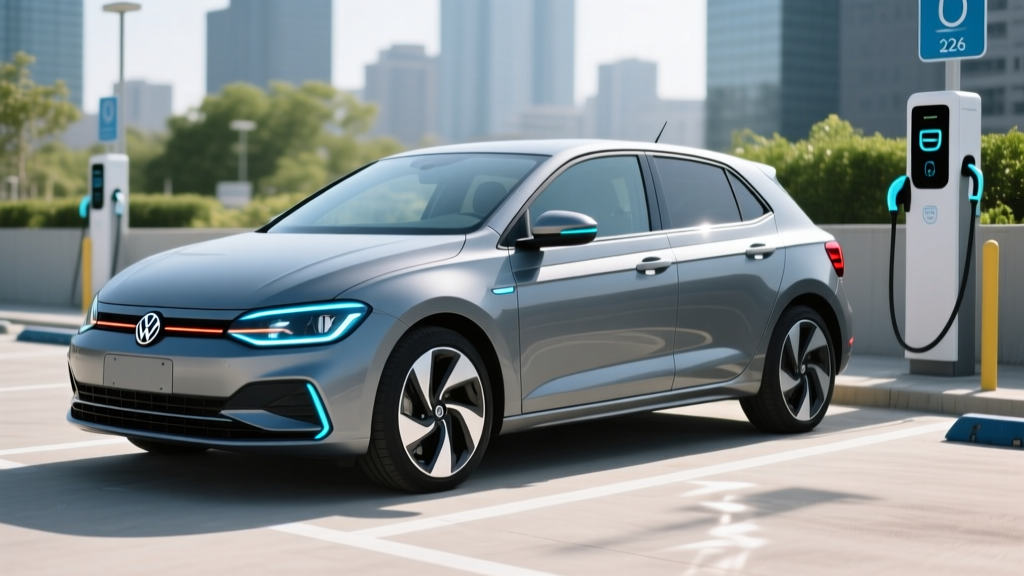
The Volkswagen ID Polo marks the automaker's entry into the affordable compact electric hatchback segment in the United States, a space where few mainstream brands currently compete. Built on Volkswagen's MEB+ platform, the ID Polo aims to bring the brand's electric-driving experience to buyers who find the ID.4 too large and too expensive. After spending time with the specs, charging data, and real-world efficiency numbers, here is everything you need to know before putting down a deposit.
Quick Verdict: What the ID Polo Gets Right (and Where It Falls Short)
The ID Polo is a compelling urban commuter and secondary household car. Its 45 kWh usable battery with LFP chemistry offers excellent cycle life and a lower replacement-cost profile than NMC rivals. Charging at up to 130 kW on DC fast chargers, it recovers 10–80% in roughly 25 minutes — adequate for road trips but not class-leading. The base price of approximately $27,995 undercuts most new EVs on the market, though cargo space at 14.1 cubic feet limits its utility for families who need weekend-hauling capability.
| Spec | 2026 VW ID Polo (Base) | 2026 VW ID Polo (Pro) |
|---|---|---|
| EPA Range | 205 miles | 232 miles |
| Battery (usable) | 45 kWh | 58 kWh |
| Chemistry | LFP (Lithium Iron Phosphate) | LFP |
| Drivetrain | RWD, single motor | RWD, single motor |
| Horsepower | 148 hp | 201 hp |
| 0–60 mph | 8.2 sec | 6.8 sec |
| Max DC Charge Rate | 110 kW | 130 kW |
| 10–80% DC Time | ~28 min | ~25 min |
| Level 2 Charge Rate | 7.2 kW | 11 kW |
| MPGe (combined) | 115 MPGe | 112 MPGe |
| Base MSRP | $27,995 | $32,495 |
Range, Efficiency, and Real-World Expectations
The base ID Polo carries a 45 kWh usable LFP battery pack, while the Pro trim steps up to 58 kWh. The EPA rates the base model at 205 miles of combined range and the Pro at 232 miles. Efficiency lands at 115 MPGe combined for the base and 112 MPGe for the Pro, which translates to roughly 29 kWh per 100 miles and 30 kWh per 100 miles respectively.
Real-World Range: What to Actually Expect
EPA Sticker: 205 mi (Base) / 232 mi (Pro)
Highway driving (70+ mph): Expect approximately 175–185 miles in the base model and 200–210 miles in the Pro. Aerodynamic drag at sustained highway speeds hits smaller, lighter EVs harder proportionally.
Cold weather (below 32°F): Plan for a 20–30% range reduction. The ID Polo uses a heat pump (standard on Pro, optional on Base), which mitigates cabin-heating energy draw but does not eliminate cold-weather losses entirely. A 205-mile base ID Polo may deliver 145–165 miles in freezing conditions at highway speeds.
City commuting with regen: This is where the ID Polo shines. Stop-and-go driving with regenerative braking can push real-world range to or slightly above EPA estimates — 210–220 miles in the base model is achievable in mild weather with moderate speeds.
LFP chemistry means Volkswagen recommends periodic charging to 100% for battery calibration, unlike NMC packs that prefer an 80% daily ceiling. This is a practical advantage for owners who want to wake up to a full battery every morning without long-term degradation concerns. LFP cells typically retain over 90% of original capacity after 1,000 full charge cycles, according to industry data, which translates to well over 200,000 miles of use before meaningful degradation.
Charging Speeds: Home, Public, and the Charge Curve Reality
Charging infrastructure compatibility and speed are where budget EVs often cut corners. The ID Polo performs adequately here, though it is not the fastest-charging vehicle in its price bracket.
| Charge Level | Power / Rate | Miles Added per Hour | Notes |
|---|---|---|---|
| Level 1 (120V household) | ~1.2 kW | ~4–5 mi/hr | Emergency/top-up only; ~40+ hours for full charge |
| Level 2 (240V home, Base) | 7.2 kW | ~26 mi/hr | Full charge in ~6.5 hours |
| Level 2 (240V home, Pro) | 11 kW | ~40 mi/hr | Full charge in ~5.5 hours; requires 48A circuit |
| DC Fast Charge (Base) | Peak 110 kW | ~120 mi in 15 min | 10–80% in ~28 min |
| DC Fast Charge (Pro) | Peak 130 kW | ~140 mi in 15 min | 10–80% in ~25 min |
A note on the DC fast-charging curve: the 130 kW peak on the Pro trim is sustained from approximately 10% to 45% state of charge, after which the rate tapers. By 70% SoC, you will see roughly 80–90 kW, and above 80% the rate drops to under 40 kW as the battery management system protects the cells. This is normal behavior for all lithium-ion EVs, but it means the advertised "25 minutes to 80%" should not be interpreted as "25 minutes to 100%." Charging from 80% to 100% on DC can add another 20–30 minutes.
The ID Polo uses the NACS (North American Charging Standard) connector for 2026, giving it native access to the Tesla Supercharger network as well as Electrify America, EVgo, and other NACS-equipped stations. This is a significant advantage over CCS1-only vehicles as the industry has largely standardized on NACS. For home Level 2 installation, budget between $800 and $2,000 for equipment and electrician labor on a 240V/48A circuit, depending on your panel's proximity to the garage and whether a panel upgrade is needed. Consult a licensed electrician for your specific situation.
Performance and Driving Dynamics
The ID Polo is not a performance EV, and that is by design. The base model's 148 hp and 8.2-second 0–60 mph time are perfectly adequate for merging and city driving but will not impress anyone coming from a Tesla Model 3 or Hyundai Ioniq 5. The Pro trim's 201 hp and 6.8-second sprint is more enthusiastic, placing it in warm-hatch territory.
Both trims are rear-wheel drive with a single motor. Volkswagen has tuned the chassis for comfort over sportiness, with a compliant ride that absorbs urban potholes well. The turning circle is tight — approximately 33.5 feet — making the ID Polo easy to park in cramped city spots. Regenerative braking offers multiple levels adjustable via steering-wheel paddles, and a "B" mode provides strong one-pedal driving in stop-and-go traffic, though it does not bring the car to a complete hold without brake application.
There is no all-wheel-drive or dual-motor option for the ID Polo. If you live in a region with heavy snow and need AWD traction, the ID.4 or a competitor like the Subaru Solterra would be a better fit.
Interior, Cargo, and Technology
The ID Polo's cabin follows the minimalist design language established by the ID.3 and ID.4, with a 10.4-inch central touchscreen running Volkswagen's ID.Software 4.0 and a compact digital instrument cluster behind the wheel. Wireless Apple CarPlay and Android Auto are standard across all trims.
Passenger space: Front headroom is generous at 39.8 inches, and rear legroom measures 34.2 inches — sufficient for adults on shorter trips but tight for tall passengers on long journeys. The low floor (thanks to the skateboard platform) helps create a surprisingly airy feel for a subcompact hatchback.
Cargo volume: 14.1 cubic feet behind the rear seats, expanding to approximately 38.5 cubic feet with the 60/40 split rear seats folded. There is no front trunk (frunk); the space under the hood houses the motor and power electronics. A small under-floor storage compartment in the rear cargo area adds roughly 1.5 cubic feet for charging cables and small items.
Driver assistance: Volkswagen's IQ.DRIVE suite is standard and includes adaptive cruise control, lane-keeping assist, automatic emergency braking with pedestrian detection, and blind-spot monitoring. This is an SAE Level 2 driver-assist system, meaning the driver must remain attentive and keep hands on the wheel at all times. It is not autonomous driving. The system performs competently on highways but is not as refined as Ford's BlueCruise or GM's Super Cruise for hands-free operation on mapped roads — Volkswagen does not currently offer a hands-free driving feature on the ID Polo.
Notable drawbacks include the touch-capacitive sliders for climate and volume control, which remain frustrating to use while driving compared to physical knobs. The infotainment system's response times have improved over earlier ID models but still lag behind Hyundai/Kia's interface in speed and intuitiveness.
Pricing, Trims, and Federal Tax Credit Eligibility
The 2026 ID Polo is offered in two trims:
- Base: $27,995 MSRP — includes 45 kWh battery, 148 hp, 110 kW DC charging, IQ.DRIVE suite, 10.4-inch screen, heated front seats
- Pro: $32,495 MSRP — adds 58 kWh battery, 201 hp, 130 kW DC charging, 11 kW Level 2 onboard charger, heat pump, panoramic glass roof, 360-degree camera
The destination charge adds approximately $1,295 to both trims.
| Trim | MSRP | Est. Federal Credit (§30D) | Effective Price* |
|---|---|---|---|
| Base | $27,995 | Up to $7,500 | ~$20,495 |
| Pro | $32,495 | Up to $7,500 | ~$24,995 |
*Effective price assumes full §30D credit eligibility. Actual credit amount depends on battery sourcing, buyer income, and tax liability. See IRS rules below.
Federal EV Tax Credit: Do You Qualify?
Under IRS §30D rules for 2026, the federal clean vehicle credit offers up to $7,500 for qualifying new EVs, but eligibility depends on several factors:
- MSRP cap: The vehicle must have an MSRP at or below $55,000 for sedans/hatchbacks. Both ID Polo trims clear this easily.
- Buyer income cap: Modified adjusted gross income must not exceed $150,000 (single), $225,000 (head of household), or $300,000 (married filing jointly).
- Battery sourcing: The credit is split into two halves — $3,750 for critical-minerals sourcing and $3,750 for battery-component assembly. Volkswagen has indicated the ID Polo's LFP cells are manufactured outside China, but final sourcing determinations for 2026 should be confirmed with your dealer and a tax professional before purchase.
- Point-of-sale transfer: As of 2024, buyers can transfer the credit to the dealer at the point of sale, reducing the purchase price directly rather than waiting for a tax refund. This is available for the ID Polo if the vehicle qualifies.
Because battery-sourcing requirements tighten annually, and because individual tax situations vary, we strongly recommend consulting the official IRS guidance and a qualified tax professional before relying on the full $7,500 credit in your purchase decision.
Warranty and Long-Term Ownership Costs
Volkswagen backs the ID Polo with the following warranty coverage:
- Limited vehicle warranty: 4 years / 50,000 miles
- Battery and powertrain warranty: 8 years / 100,000 miles, with a guaranteed minimum 70% state of health (SoH) retention over that period
- Corrosion perforation warranty: 7 years / 100,000 miles
- Complimentary maintenance: 2 years / 20,000 miles (covers cabin air filter, tire rotation, and multi-point inspection)
The 70% SoH threshold is standard for the industry and matches what Hyundai, Kia, and Tesla offer. If the battery degrades below 70% capacity within 8 years or 100,000 miles, Volkswagen will repair or replace it at no cost. Given LFP chemistry's demonstrated longevity in fleet data, hitting that threshold under normal use is unlikely.
Insurance costs for the ID Polo are expected to be moderate for the EV segment. Preliminary estimates place annual premiums between $1,600 and $2,200 depending on trim, location, and driving record — roughly 15–25% higher than a comparable gas-powered Volkswagen Golf but lower than premium EVs like the Tesla Model 3.
How the ID Polo Compares to Key Competitors
The compact EV hatchback segment in 2026 remains thin, which is the ID Polo's greatest advantage. Here is how it stacks up:
| Vehicle | EPA Range | Base MSRP | Max DC kW | Cargo (cu ft) |
|---|---|---|---|---|
| 2026 VW ID Polo (Base) | 205 mi | $27,995 | 110 kW | 14.1 |
| 2026 Chevrolet Bolt EV | 259 mi | $28,995 | 85 kW | 16.3 |
| 2026 Hyundai Kona Electric | 261 mi | $33,995 | 100 kW | 25.5 |
| 2026 Nissan Leaf (SV Plus) | 212 mi | $30,595 | 100 kW | 23.6 |
The ID Polo undercuts the Kona Electric and Leaf on price but trails the Bolt EV on range and the Kona on cargo space. Its LFP battery chemistry and NACS connector are differentiators for buyers prioritizing long-term battery durability and Supercharger access. The Bolt EV still uses CCS1 and charges slower on DC, while the Leaf uses the aging CHAdeMO connector — both are significant disadvantages as the charging infrastructure consolidates around NACS.
Pros, Cons, and Who Should Buy the ID Polo
Pros
- Low entry price (~$20,500 after max federal credit)
- LFP battery chemistry — longer cycle life, 100% daily charging OK
- NACS connector — native Supercharger access
- Tight turning circle, easy city maneuverability
- Standard IQ.DRIVE driver-assist suite
- Heat pump available (Pro standard) for cold-weather efficiency
Cons
- Below-average range (205 mi base) vs. Bolt EV and Kona Electric
- Small cargo area (14.1 cu ft), no frunk
- Touch-capacitive climate controls are distracting while driving
- No AWD option
- Base trim limited to 7.2 kW Level 2 charging
- Rear legroom tight for tall adults on long trips
Who This EV Suits Best
Ideal buyer: Urban commuters, apartment dwellers with access to Level 2 charging, and households adding a second car for daily errands and commuting. The ID Polo's compact footprint, low operating costs, and LFP durability make it an excellent daily driver for 30–60 mile round trips.
Not ideal for: Families who regularly haul cargo or passengers, frequent long-distance road trippers (range and cargo limitations), or buyers in heavy-snow regions who need AWD.
Frequently Asked Questions
What is the real-world range of the VW ID Polo?
The EPA rates the base ID Polo at 205 miles and the Pro at 232 miles. In real-world highway driving at 70+ mph, expect 175–185 miles (base) or 200–210 miles (Pro). Cold weather below freezing can reduce range by 20–30%. City commuting with regenerative braking may match or slightly exceed EPA estimates.
How fast does the ID Polo charge at home and on DC fast chargers?
On DC fast charging, the Pro peaks at 130 kW and charges 10–80% in approximately 25 minutes; the base model peaks at 110 kW with a 10–80% time of roughly 28 minutes. At home on a Level 2 240V charger, the Pro charges at 11 kW (about 40 miles of range per hour), while the base is limited to 7.2 kW (about 26 miles per hour).
How much does the VW ID Polo cost after the federal tax credit?
The base ID Polo starts at $27,995 and the Pro at $32,495. If you qualify for the full $7,500 federal §30D credit (subject to income caps, battery-sourcing rules, and MSRP limits), the effective price drops to approximately $20,495 for the base and $24,995 for the Pro. Eligibility varies — consult the IRS §30D guidance and a tax professional.
Does the VW ID Polo qualify for the federal EV tax credit?
The ID Polo's MSRP is well below the $55,000 hatchback cap, which is one requirement met. However, full credit eligibility depends on the buyer's income (must be under $150K single / $300K joint), battery critical-mineral sourcing, and battery-component assembly location. Volkswagen has stated the LFP cells are sourced outside China, but final 2026 determinations should be verified at purchase. The credit can be transferred to the dealer at point of sale for an immediate price reduction.
Is the VW ID Polo worth buying over the Chevrolet Bolt EV or Hyundai Kona Electric?
The ID Polo wins on price and charging-standard future-proofing (NACS). The Bolt EV offers more range (259 mi) and cargo space for slightly more money but charges slower on DC and uses CCS1. The Kona Electric leads in cargo space and range but costs significantly more. If your priority is the lowest possible purchase price with native Supercharger access and you do not need maximum range or cargo room, the ID Polo is a strong choice.
What is the battery warranty on the ID Polo?
Volkswagen provides an 8-year / 100,000-mile battery warranty guaranteeing at least 70% state-of-health retention. The LFP chemistry in the ID Polo is known for excellent long-term cycle life, often retaining 90%+ capacity well past 150,000 miles in fleet-use data from similar LFP packs.
Can I charge the ID Polo to 100% every day?
Yes. Unlike NMC battery packs that benefit from an 80% daily charging limit, LFP chemistry is designed to be charged to 100% regularly. Volkswagen actually recommends periodic full charges to allow the battery management system to recalibrate cell balancing. This is a genuine ownership advantage for commuters who want maximum available range each morning.