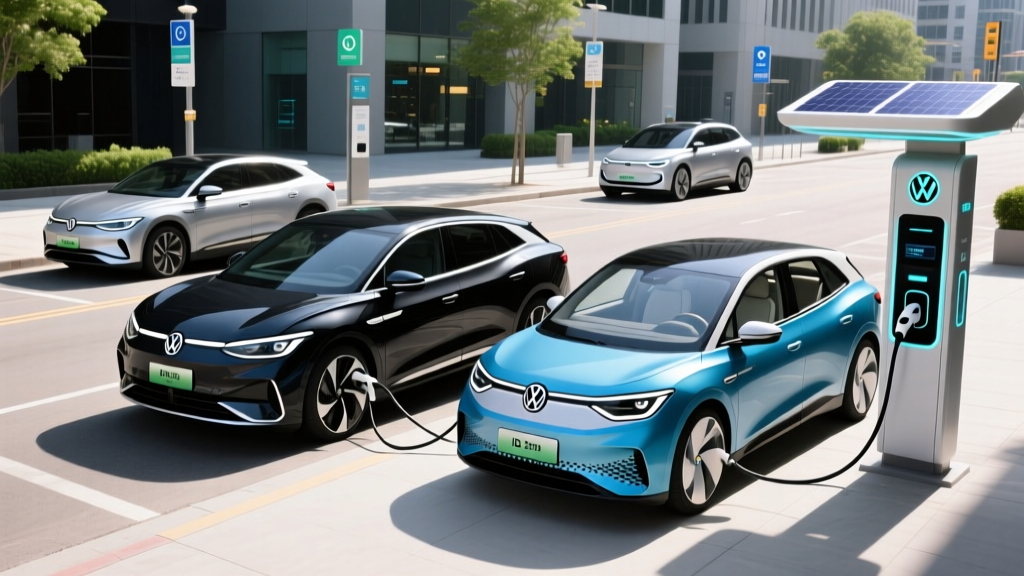
If you have been searching for every VW ID concept to hit the road, 2026 is the year Volkswagen finally converts its electric vision into a full showroom lineup. The ID.4 crossover is now a veteran, the retro-styled ID. Buzz microbus is turning heads at school drop-offs, and the ID.7 sedan brings a legitimate Tesla Model S alternative to the midsize segment. But concept-car gloss fades fast once you plug in at a real DC fast charger on a freezing January morning. This review dissects what each VW ID concept-derived production model actually delivers in range, charging speed, efficiency, and ownership value right now.
2026 VW ID Lineup at a Glance: Specs, Pricing, and Range
| Spec | ID.4 (AWD Pro S) | ID. Buzz (Pro S) | ID.7 (Pro S) |
|---|---|---|---|
| EPA Range | 263 mi | 234 mi | 342 mi |
| Battery (usable) | 82 kWh (NMC) | 91 kWh (NMC) | 86 kWh (NMC) |
| Max DC Fast Charge | 175 kW | 175 kW | 200 kW |
| 10-80% DC Time | ~28 min | ~30 min | ~26 min |
| Level 2 Home Rate | 11 kW (~37 mi/hr) | 11 kW (~33 mi/hr) | 11 kW (~41 mi/hr) |
| 0-60 mph | 5.4 sec | 7.3 sec | 6.5 sec (RWD) |
| Horsepower | 295 hp | 282 hp | 282 hp |
| Drivetrain | AWD dual-motor | RWD / AWD avail. | RWD / AWD avail. |
| MPGe (combined) | 104 MPGe | 90 MPGe | 118 MPGe |
| EPA Efficiency | 32 kWh/100mi | 37 kWh/100mi | 28 kWh/100mi |
| Cargo Volume | 30.3 cu ft (rear up) | 81.2 cu ft (seats folded) | 19.8 cu ft trunk |
| Base MSRP | $46,195 | $59,995 | $52,695 |
| Battery Warranty | 8 yr / 100,000 mi | 8 yr / 100,000 mi | 8 yr / 100,000 mi |
All three models ride on Volkswagen's MEB platform, which uses nickel-manganese-cobalt (NMC) lithium-ion battery cells. NMC chemistry delivers higher energy density than LFP (lithium iron phosphate), giving these vehicles competitive range in a manageable package size — but NMC batteries prefer not to sit at 100% state of charge for extended periods. VW recommends daily charging to 80% for longevity, reserving full charges for road-trip days.
Charging Speed: DC Fast Charging and Home Level 2
Charging speed is where concept-car promises meet highway rest-stop reality. VW has upgraded the ID.7's thermal management system to sustain a 200 kW peak on DC fast chargers, a meaningful improvement over the ID.4's 175 kW ceiling. Here is what that looks like in practice:
| Charging Level | Power / Rate | Miles Added per Hour | Best Use Case |
|---|---|---|---|
| Level 1 (120V) | ~1.4 kW | ~4 mi/hr | Overnight top-off, emergencies |
| Level 2 (240V, 48A) | 11 kW | 33-41 mi/hr | Home daily charging, workplace |
| DC Fast (peak) | 175-200 kW | ~650-750 mi/hr (at peak) | Road trips, rapid top-ups |
The critical nuance is the charge curve. The ID.7 hits 200 kW only between roughly 10-30% state of charge, then tapers progressively. From 30-60%, expect sustained speeds around 140-160 kW; from 60-80%, the rate drops to roughly 80-100 kW. This is why VW quotes 10-80% times rather than peak kW alone — the ID.7's ~26-minute 10-80% session is competitive with the Hyundai Ioniq 6 but trails the Kia EV6's 18-minute performance on 350 kW chargers.
For home Level 2 charging, all three models accept 11 kW via a 48-amp hardwired station on a 60-amp circuit. A full overnight charge from 20-80% takes roughly 5-6 hours. If your home electrical panel maxes out at a 32-amp circuit (7.7 kW), plan on 7-8 hours for the same session — still sufficient for daily driving, but worth factoring into your home charger installation budget.
Real-World Range: What the EPA Sticker Doesn't Tell You
The ID.7's 342-mile EPA rating makes it the range king of the VW ID family, but efficiency in the real world depends heavily on driving style and climate. On a 70°F day at 65 mph on flat terrain, owners report achieving 310-330 miles — close to the sticker. Push that to 80 mph on the interstate, and expect 260-280 miles. Drop the temperature to 20°F with the heat pump running, and 240-260 miles is the realistic floor before you need a charger.
The ID. Buzz, with its brick-like aerodynamics (a 0.29 Cd coefficient compared to the ID.7's slippery 0.23 Cd), suffers more at highway speeds. Its 234-mile EPA rating translates to roughly 190-210 miles at 75 mph in cold weather — adequate for suburban family duty but limiting for un-planned road trips. The ID.4 sits in the middle: its 263-mile EPA figure delivers roughly 220-240 miles in mixed highway driving.
Pricing, Tax Credits, and Total Cost of Ownership
VW's pricing strategy positions the ID.4 as the volume player, the ID.7 as the premium sedan, and the ID. Buzz as a lifestyle vehicle with a premium to match. Federal tax credit eligibility under IRS §30D depends on MSRP caps, buyer income limits, and battery component/critical mineral sourcing requirements that shift annually.
| Model & Trim | Base MSRP | §30D Credit Eligibility* | Effective Price** |
|---|---|---|---|
| ID.4 Pro (RWD) | $40,795 | Up to $7,500 (if sourcing reqs met) | ~$33,295 |
| ID.4 Pro S AWD | $46,195 | Up to $7,500 (if sourcing reqs met) | ~$38,695 |
| ID.7 Pro S | $52,695 | Up to $7,500 (if sourcing reqs met) | ~$45,195 |
| ID. Buzz Pro S | $59,995 | Up to $7,500 (if sourcing reqs met) | ~$52,495 |
*§30D eligibility requires: buyer AGI under $150K single / $300K joint; vehicle MSRP under $55K (sedans) or $80K (SUVs/vans); battery components and critical minerals meeting phased-in domestic sourcing thresholds. The ID. Buzz qualifies under the $80K van/SUV cap. The ID.7 sedan must stay under $55K — higher trims may exceed this. Always verify current-year rules at fueleconomy.gov and consult a tax professional.
**Effective price assumes full $7,500 credit applied at point of sale. Actual credit may be reduced if critical mineral or battery component thresholds are not fully met in the current compliance year.
How the VW ID Lineup Compares to Key Competitors
The VW ID concept lineage competes in three distinct segments. Here is how the production models stack up against the benchmarks:
The ID.7 wins on interior space and ride comfort but trails the Model 3 in charging infrastructure access and the Ioniq 6 in DC charging speed (26 min vs 18 min 10-80%). Choose the ID.7 if you prioritize cabin serenity and traditional build quality over raw charging performance.
The ID.4 is the most affordable entry point after credits but has the slowest DC charging in the group. The Model Y dominates Supercharger access; the Ioniq 5 offers faster 800V charging. The ID.4 suits budget-conscious buyers who charge primarily at home.
The ID. Buzz is the only fully electric minivan with retro character, but its 234-mile range is a real limitation vs the EV9's 304 miles. The Pacifica PHEV eliminates range anxiety entirely. The Buzz is best as a secondary family vehicle with reliable home charging.
Technology, Driver Assists, and Interior
Every 2026 VW ID model runs the latest version of VW's ID. Software 4.0 on a 12.9-inch (ID.4/ID.7) or 12.9-inch (ID. Buzz) infotainment display. The system now supports wireless Apple CarPlay and Android Auto, over-the-air updates, and a revised voice assistant that actually responds to natural speech. The ID.7 adds an augmented-reality head-up display that overlays navigation arrows onto the road ahead — genuinely useful, not gimmicky.
On the driver-assist front, VW's Travel Assist combines adaptive cruise control with lane centering and operates up to 95 mph on divided highways. This is a SAE Level 2 system — your hands must stay on the wheel and your eyes on the road at all times. It is not self-driving. VW does not currently offer a hands-off system comparable to GM's Super Cruise or Ford's BlueCruise, which allow supervised hands-free operation on pre-mapped highways. If hands-free highway driving is a priority, that is a meaningful gap in the VW ID lineup.
Interior quality is a VW strong point. The ID.7's cabin uses recycled microfiber headliners, soft-touch surfaces on the dash and door uppers, and ambient lighting with 30 color options. The ID. Buzz's two-tone dashboard and flat floor create an airy, van-culture atmosphere that no competitor matches. Cargo space is generous across the board: the ID.4 offers 30.3 cubic feet behind the rear seats (expanding to 64.2 cu ft folded), while the ID. Buzz delivers up to 81.2 cu ft with seats stowed — genuine microbus utility.
Battery Longevity, Warranty, and Ownership Costs
VW backs the battery pack and electric drivetrain in all ID models with an 8-year/100,000-mile warranty, covering defects and capacity loss below 70% of original capacity. This matches the industry standard set by Hyundai and Tesla. Based on real-world data from early ID.4 owners (now at 3-4 years of service), NMC packs in the MEB platform are showing degradation rates of roughly 1-2% per year under normal use — projecting to approximately 85-90% state of health at the 8-year mark, well above the warranty threshold.
Insurance costs run 15-25% higher than comparable gas vehicles, a pattern consistent across the EV segment. Maintenance, however, is dramatically lower: no oil changes, no transmission fluid, and regenerative braking extends pad life to 80,000+ miles in typical driving. VW's scheduled maintenance for the ID.4 costs roughly $400-500 over the first five years (cabin air filter, brake fluid check, tire rotation), compared to $2,000+ for a gas-powered Tiguan over the same period.
Pros and Cons of the 2026 VW ID Lineup
- ID.7 delivers a genuine 340+ mile EPA range at a competitive price
- Heat pump standard on Pro S trims reduces cold-weather range loss
- ID. Buzz offers the only all-electric minivan with real cargo versatility
- Comfortable ride quality and cabin isolation rival premium brands
- Point-of-sale tax credit transfer reduces upfront cost significantly
- Strong 8-year/100,000-mile battery warranty
- DC fast-charging speed (175-200 kW) lags Hyundai/Kia 800V rivals
- No hands-free Level 2+ driving system like Super Cruise or BlueCruise
- Infotainment still has occasional lag despite software updates
- ID. Buzz range (234 mi EPA) limits road-trip utility
- ID.7 higher trims risk exceeding $55K sedan MSRP cap for §30D credit
- Public charging reliability depends on Electrify America network quality
Who Should Buy a VW ID Model?
Choose the ID.7 if: You are cross-shopping the Tesla Model 3 or Hyundai Ioniq 6 but prefer a quieter cabin, more rear-seat space, and a sedan with genuine 300+ mile real-world range. Ideal for business travelers and daily commuters covering 40-80 miles per day.
Choose the ID. Buzz if: You need a three-row family hauler with electric running costs, your daily driving stays under 150 miles, and you have reliable Level 2 home charging. It is a lifestyle purchase as much as a practical one — and that is fine.
Frequently Asked Questions
What is the real-world range of the VW ID.7?
The ID.7's EPA estimate is 342 miles. In real-world mixed driving at moderate temperatures, expect 310-330 miles. At sustained highway speeds (75+ mph) in cold weather, plan for 240-270 miles before needing a charge.
How fast does the VW ID.4 charge on a DC fast charger?
The ID.4 peaks at 175 kW and charges from 10-80% in approximately 28 minutes on a compatible 200+ kW station. Charging slows significantly above 80% to protect battery health — plan to unplug at 80% on road trips for the best time-to-distance ratio.
Does the VW ID. Buzz qualify for the federal EV tax credit?
The ID. Buzz falls under the $80,000 MSRP cap for SUVs/vans, so it qualifies on price. However, full §30D credit eligibility also depends on your income (under $300K joint / $150K single), battery component sourcing, and critical mineral requirements. Verify current-year rules on fueleconomy.gov before purchasing.
Is the VW ID.7 worth buying over a Tesla Model 3?
The ID.7 offers a quieter, more traditionally finished interior and more rear-seat headroom. The Model 3 offers faster Supercharger network access and slightly quicker DC charging. If charging infrastructure access is your top concern, Tesla still has an edge. If cabin comfort and build quality matter more, the ID.7 is a strong alternative.
What is the battery warranty on VW ID models?
All 2026 VW ID models carry an 8-year/100,000-mile battery and powertrain warranty that covers defects and capacity loss below 70% of original capacity. This aligns with the industry standard.
Can I charge a VW ID vehicle at a Tesla Supercharger?
As of 2026, VW ID models use the CCS1 connector. Tesla has begun opening select Supercharger stalls to non-Tesla EVs via the built-in Magic Dock adapter, but availability is limited to specific stations. VW has not announced a NACS (Tesla connector) adoption timeline. Check the Tesla app or PlugShare for real-time Supercharger compatibility at your local stations.