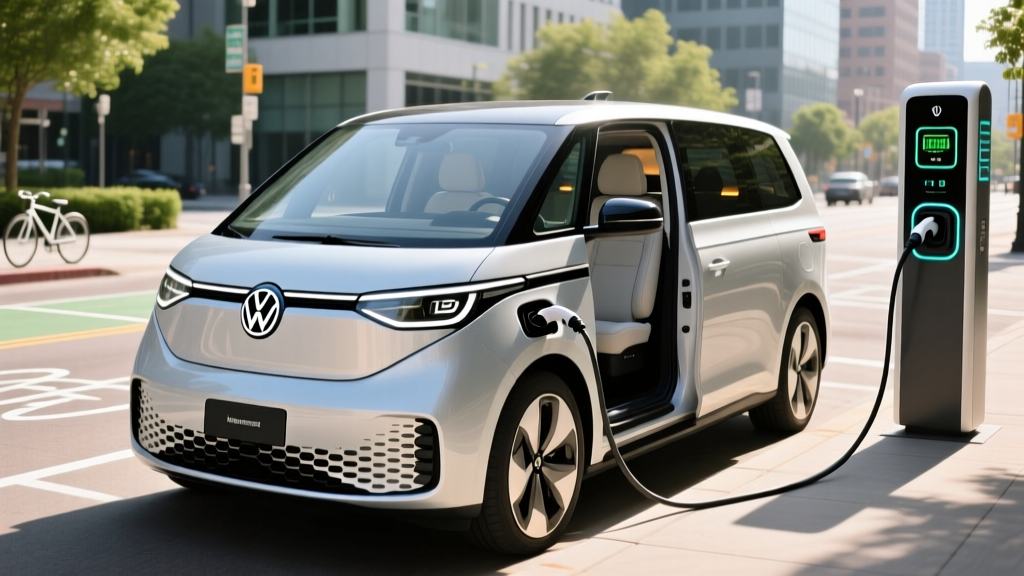
The Volkswagen ID Buzz is not trying to be the longest-range or quickest electric vehicle on the market. It is trying to be something else entirely: a three-row, retro-styled electric van that seats up to seven, hauls serious cargo, and does it with a personality no crossover can match. For 2026, VW continues to offer the ID Buzz in the U.S. market with a 91-kWh (usable) battery, rear-wheel and all-wheel-drive configurations, and a starting price that places it firmly in premium minivan territory.
But nostalgia does not charge batteries or move families across state lines. This review breaks down the exact numbers that matter — EPA range versus what you will actually see on the highway in January, the real charging-curve behavior at a DC fast charger, and the tax-credit math that determines whether the ID Buzz is a smart buy or a very expensive conversation piece.
Range, Battery & Real-World Efficiency
The 2026 VW ID Buzz uses a 91-kWh usable lithium-ion NMC (nickel manganese cobalt) battery pack mounted beneath the floor. This is the same MEB-platform architecture that underpins the ID.4, but stretched and reconfigured for the Buzz's longer wheelbase.
| Spec | RWD (Standard) | AWD (4Motion) |
|---|---|---|
| Battery (usable) | 91 kWh (NMC) | 91 kWh (NMC) |
| EPA Range | 234 miles | 231 miles |
| MPGe (combined) | 87 MPGe | 84 MPGe |
| Energy consumption | 39 kWh/100 mi | 40 kWh/100 mi |
| Drivetrain | Rear-wheel drive | Dual-motor AWD |
The EPA rates the RWD ID Buzz at 234 miles and the AWD at 231 miles. In real-world driving, plan for less. On a 70-mph highway run in moderate temperatures (65-75°F), expect roughly 195-215 miles before you need to plug in. In cold weather (below 32°F), that number drops to approximately 165-185 miles due to cabin heating demands and reduced battery chemistry efficiency. City driving with heavy regenerative braking gets you closest to the EPA sticker — potentially 220-230 miles in stop-and-go traffic. The Buzz's boxy aerodynamic profile (high frontal area and flat rear end) is the primary highway-range penalty.
At 39-40 kWh per 100 miles, the ID Buzz is less efficient than a Tesla Model Y (roughly 28 kWh/100 mi) or even the similarly sized Kia EV9 (35 kWh/100 mi). That is the cost of the van's shape and weight — over 5,500 pounds curb weight for the AWD. For context, that efficiency translates to roughly $5.85-$6.00 per 100 miles at the national average electricity rate of $0.15/kWh, compared to about $12-$14 for a gas minivan getting 22 mpg combined at $3.20/gallon.
Charging Speed: DC Fast Charge & Home Level 2
Charging speed is where the ID Buzz shows both its strengths and its MEB-platform limitations. The van supports a peak DC fast-charge rate of 170 kW on a CCS1 connector (via the standard J3400/NACS port adapter included with the vehicle, or directly at NACS-equipped Tesla Superchargers with VW's approved adapter).
| Charging Level | Power / Rate | Time / Range Added |
|---|---|---|
| Level 1 (120V household) | ~1.2 kW | ~3-4 miles per hour |
| Level 2 (240V, 48A home charger) | 11 kW (onboard charger) | ~26-28 miles per hour; full charge in ~9 hours |
| DC Fast Charge (peak) | 170 kW | 10-80% in approximately 26 minutes |
| DC Fast Charge (sustained avg.) | ~110-120 kW avg. | 80-100% tapers significantly; adds ~15 min |
The 10-80% time of approximately 26 minutes is respectable but not class-leading. The Kia EV9, for comparison, achieves 10-80% in roughly 20 minutes thanks to its 800V architecture versus the Buzz's 400V MEB platform. In practice, the ID Buzz holds close to its peak 170 kW rate between roughly 10-40% state of charge, then tapers to around 120 kW through 60%, and drops further above 80%. This is standard NMC charge-curve behavior, but it means a 10-90% charge takes closer to 38-42 minutes at a fast charger — plan your road-trip stops accordingly.
For home charging, the onboard 11-kW AC charger is a strong point. On a 48-amp Level 2 home charger (the most common residential install on a 60-amp circuit), you will add roughly 26-28 miles of range per hour, meaning an overnight session from 20% to full takes about 8-9 hours. This is more than adequate for daily use, and most owners will wake up to a full battery every morning.
For a detailed breakdown of Level 2 home charger installation costs, including panel-upgrade scenarios, see our home charging installation guide.
Performance & Drivetrain
The ID Buzz is not a performance vehicle, and VW does not pretend otherwise. Here is what the powertrain delivers:
| Spec | RWD | AWD (4Motion) |
|---|---|---|
| Horsepower | 282 hp | 335 hp (combined) |
| Torque | 406 lb-ft | 406 lb-ft (combined) |
| 0-60 mph | 7.9 seconds | 6.7 seconds |
| Top speed | 99 mph (electronically limited) | 99 mph |
| Towing capacity | Not rated for towing (U.S.) | Not rated for towing (U.S.) |
The RWD model's single rear-mounted APP550 permanent-magnet motor delivers 282 horsepower — more than adequate for merging and city driving. The AWD variant adds a front induction motor for a combined 335 hp and a 6.7-second 0-60 time that feels genuinely quick when you account for the Buzz's minivan silhouette. Instant electric torque makes the Buzz feel lighter on its feet than its 5,500-pound curb weight suggests, particularly in the 0-40 mph range where most daily driving happens.
One notable omission: the U.S.-spec ID Buzz is not rated for towing. European-market versions can tow up to 2,200 pounds, but VW has not certified the U.S. variant. If you need an electric family hauler that can pull a small trailer, the Kia EV9 (up to 5,000 lbs with the GT-Line AWD) or Rivian R1S are better options.
Interior Space, Cargo & Practicality
This is where the ID Buzz justifies its existence and its price. The three-row cabin offers genuine minivan-level space with a flat floor (no transmission tunnel) that creates an airy, open feel.
- Seating: Standard 7-passenger configuration (2-3-2 layout) on Pro S and Pro S Plus trims; available 6-passenger (2-2-2) with second-row captain's chairs on 1st Edition
- Cargo behind 3rd row: 18.4 cu ft
- Cargo behind 2nd row (3rd row folded): 64.2 cu ft
- Max cargo (2nd & 3rd folded): 117.8 cu ft
- Second-row legroom: 39.6 inches
- Third-row legroom: 33.5 inches
- Front trunk (frunk): Not available — the MEB platform's front inverter and HVAC components occupy the space
Third-row legroom at 33.5 inches is competitive with the Chrysler Pacifica and slightly better than the Kia Carnival, making it usable for adults on shorter trips. The 18.4 cu ft behind the third row is enough for a week's groceries or two large suitcases, and the flat load floor when seats fold makes the Buzz excellent for bulky cargo runs.
The trade-off is the lack of a frunk. With no front trunk, charging cables and accessories must live in the rear cargo area or under the second-row seat. This is a common MEB-platform limitation (the ID.4 also lacks a frunk), but it is a missed opportunity in a vehicle this size.
Pricing, Trims & Federal Tax Credit
The 2026 VW ID Buzz is offered in three trims in the U.S. market:
| Trim | Drivetrain | MSRP (incl. destination) | Key Features |
|---|---|---|---|
| Pro S | RWD | $59,995 | 91-kWh battery, power sliding doors, heated front seats, 12.9" infotainment |
| Pro S Plus | RWD or AWD (+$3,800) | $63,495 (RWD) / $67,295 (AWD) | Panoramic glass roof, ventilated front seats, Harman Kardon audio, 360° camera |
| 1st Edition | AWD | $69,995 | Two-tone heritage paint, captain's chairs, exclusive interior trim, head-up display |
These prices place the ID Buzz in direct competition with the Kia EV9 (starting ~$56,000), the Toyota Sienna hybrid (starting ~$38,000, but not electric), and premium electric SUVs like the Tesla Model X (starting ~$80,000). The Buzz is not cheap, and VW is positioning it as a lifestyle vehicle rather than a budget EV.
As of the 2026 tax year, the VW ID Buzz's eligibility for the up-to-$7,500 federal EV tax credit depends on several factors under IRS §30D rules:
- MSRP cap: The ID Buzz qualifies as a "van" under IRS classification, with an MSRP cap of $80,000 (all trims fall under this limit).
- Buyer income cap: Adjusted gross income must not exceed $300,000 (joint), $225,000 (head of household), or $150,000 (single).
- Battery sourcing requirements: The credit is split into two $3,750 halves — one for critical-mineral sourcing and one for battery-component manufacturing. VW has been working to localize its supply chain through its PowerCo battery subsidiary, but confirm current-year sourcing compliance directly with your VW dealer or a tax professional before relying on the full $7,500. Partial credit ($3,750) may apply if only one half of the sourcing requirements is met.
- Point-of-sale transfer: If eligible, you can transfer the credit to the dealer at purchase, reducing your out-of-pocket cost immediately rather than waiting for a tax refund.
If you qualify for the full $7,500 credit and apply it at point of sale, the Pro S RWD effectively starts at $52,495 — a meaningful reduction that brings it closer to a well-equipped Kia EV9 Land AWD (~$59,900 before any credit). However, state and local incentives vary widely and are not covered here; check your state's energy office or AFDC incentive database for specifics.
Tech, Driver Assistance & Safety
The ID Buzz uses VW's latest ID.Software 4.0 infotainment system, which represents a meaningful improvement over the laggy, buggy ID.Software 3.x that plagued early ID.4 models. The 12.9-inch center touchscreen is responsive, the capacitive-touch steering wheel controls are less frustrating than prior VW implementations, and wireless Apple CarPlay and Android Auto are standard.
Standard driver-assistance features under the IQ.DRIVE suite include:
- Adaptive cruise control with stop-and-go
- Lane-keeping assist with centering
- Automatic emergency braking with pedestrian detection
- Blind-spot monitoring with rear cross-traffic alert
- Travel Assist (combined lane-centering + adaptive cruise for highway use)
All IQ.DRIVE and Travel Assist features are SAE Level 2 driver-assistance systems. This means the driver must remain fully engaged, keep hands on the wheel (or demonstrate attentiveness), and be prepared to take over at any moment. The ID Buzz does not offer hands-free driving like GM's Super Cruise or Ford's BlueCruise. Do not treat it as autonomous.
Safety ratings from the NHTSA and IIHS were pending at the time of this review's publication for the U.S.-spec model. European-market ID Buzz variants earned a 5-star Euro NCAP rating, which provides a useful proxy, but U.S. crash-test structures and requirements differ. Check NHTSA.gov and IIHS.org for updates as tests are completed.
Warranty & Long-Term Battery Outlook
| Coverage Area | Term |
|---|---|
| Basic (bumper-to-bumper) | 4 years / 50,000 miles |
| Powertrain | 4 years / 50,000 miles |
| Battery pack | 8 years / 100,000 miles (retains ≥70% capacity) |
| Corrosion perforation | 7 years / 100,000 miles |
| Roadside assistance | 4 years / 50,000 miles |
The battery warranty guarantees that the 91-kWh NMC pack will retain at least 70% of its original capacity over 8 years or 100,000 miles, whichever comes first. This is industry-standard and matches the coverage offered by most competitors (Hyundai, Kia, Ford, and Tesla all offer similar 8-year/100,000-mile battery warranties). VW's PowerCo battery division manufactures the cells, and early data from European-market ID Buzz fleets suggests degradation is tracking in line with MEB-platform expectations — roughly 2-3% loss per year under normal use patterns.
One ownership consideration: VW's basic and powertrain warranty at 4 years/50,000 miles is below the industry leaders. Hyundai and Kia offer 5-year/60,000-mile basic and 10-year/100,000-mile powertrain coverage. If you plan to keep the Buzz beyond 50,000 miles, an extended warranty or certified-pre-owned program may be worth evaluating.
Who Should Buy the VW ID Buzz — And Who Shouldn't
Choose the ID Buzz if:
- You need three rows and genuine minivan cargo space in an EV
- You value distinctive design and the emotional connection of the Microbus heritage
- Your daily driving is under 180 miles round-trip with home charging
- You want sliding doors and a flat floor for kid/cargo logistics
- You primarily drive in urban and suburban environments
Look elsewhere if:
- You regularly drive 250+ miles between charging stops on road trips
- You need towing capability (not rated in U.S.)
- You want class-leading DC fast-charge speed (the EV9's 800V system is quicker)
- Budget is a primary concern — the Sienna hybrid delivers similar space at half the price
- You want hands-free highway driving (BlueCruise or Super Cruise vehicles are better)
Frequently Asked Questions
What is the real-world range of the VW ID Buzz?
The EPA rates the RWD ID Buzz at 234 miles and the AWD at 231 miles. In real-world highway driving at 70 mph in moderate temperatures, expect 195-215 miles. In freezing conditions, plan for 165-185 miles. City driving with regenerative braking can approach the EPA figure.
How fast does the ID Buzz charge?
On a DC fast charger, it peaks at 170 kW and charges from 10-80% in about 26 minutes. On a 48-amp Level 2 home charger, it adds roughly 26-28 miles per hour, with a full charge taking about 9 hours. It uses a CCS1/J3400 (NACS) port.
Does the VW ID Buzz qualify for the $7,500 federal tax credit?
It may, but eligibility depends on your income (capped at $300K joint / $150K single), the vehicle's MSRP (all trims are under the $80K van cap), and battery-component/critical-mineral sourcing compliance under current-year IRS §30D rules. Confirm with your dealer and a tax professional before relying on the credit.
Is the ID Buzz worth buying over the Kia EV9?
The EV9 offers more range (up to 304 miles EPA on Long Range RWD), faster 800V charging (10-80% in ~20 min), towing capability (up to 5,000 lbs), and a lower starting price (~$56,000). The ID Buzz wins on interior versatility with sliding doors, a lower load floor, distinctive styling, and a more car-like driving position. It comes down to whether you prioritize practicality-per-dollar (EV9) or design character and van practicality (Buzz).
Can the VW ID Buzz tow?
No. The U.S.-spec ID Buzz is not rated for towing. European versions can tow up to 2,200 lbs, but VW has not certified the U.S. variant for towing. If towing is a priority, consider the Kia EV9 or Rivian R1S.
Does the ID Buzz have a frunk?
No. The MEB platform's front-mounted power electronics and HVAC components leave no room for a front trunk. All cargo must go in the rear.