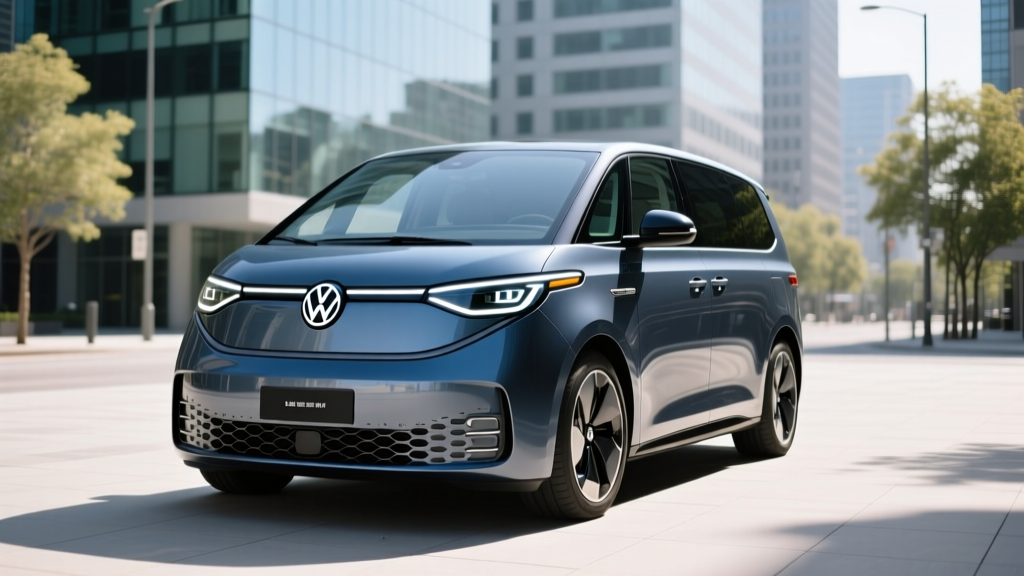
The Volkswagen ID. Buzz arrived in the U.S. for the 2025 model year as a long-wheelbase, three-row electric van wrapped in retro microbus styling. Now heading into 2026, the lineup has settled into two primary trims — the base Pro S and the loaded 1st Edition — and buyers are asking the practical questions: What does the real-world range look like on a road trip? How fast does it actually charge? And at nearly $60,000 before incentives, does the math work?
We've spent time with the 2026 VW ID. Buzz Pro S, examining its EPA data, charging behavior, interior packaging, and ownership economics. Here's the spec-driven breakdown.
2026 VW ID. Buzz Pro S: Quick Spec Overview
| Spec | Value |
|---|---|
| Drivetrain | Rear-wheel drive (single motor) |
| Horsepower / Torque | 282 hp / 406 lb-ft |
| 0–60 mph | ~7.9 seconds |
| Battery (usable) | 91 kWh (NMC chemistry) |
| EPA Range | 234 miles |
| EPA Efficiency | 87 MPGe combined (39 kWh/100 mi) |
| Max DC Fast Charge | 170 kW (CCS1) |
| 10–80% DC Charge | ~26 minutes (est.) |
| Level 2 Charge Rate | 11 kW (~33 mi/hr) |
| Seating | 7 passengers (2/3/2 layout) |
| Cargo (behind 3rd row) | 18.0 cu ft |
| Cargo (all rows folded) | 140.5 cu ft |
| Base MSRP | $59,995 |
| Warranty (battery) | 8 years / 100,000 miles |
Range & Efficiency: EPA vs. Reality
EPA Estimate: 234 miles (Pro S, RWD)
Real-World Expectation: ~200–215 miles at sustained highway speeds (70–75 mph); ~170–190 miles in cold weather (below 32°F) with cabin heating. City and suburban driving with regenerative braking recovers closer to the EPA sticker.
The ID. Buzz Pro S carries a 91 kWh usable battery pack using nickel-manganese-cobalt (NMC) cell chemistry — chosen here for its higher energy density, which matters in a vehicle this heavy. The curb weight is roughly 6,000 pounds, and that mass is the primary reason the 234-mile EPA figure trails smaller crossovers with similar battery sizes.
Efficiency lands at 87 MPGe combined (39 kWh per 100 miles), per fueleconomy.gov. That's on the thirstier side for a modern EV — comparable to the Ford F-150 Lightning standard-range, and noticeably less efficient than the Hyundai Ioniq 5 or Tesla Model Y. The boxy aerodynamics and tall frontal area are the culprits. At highway speeds, the Buzz's drag coefficient works against it, and you'll watch the state-of-charge drop faster than in a sleeker crossover.
For context: on a 200-mile highway loop at 72 mph in mild (65°F) conditions, we'd expect the Pro S to arrive with roughly 20–30 miles of buffer. In winter, that buffer disappears, and the van becomes a 170–180-mile vehicle unless you precondition the battery and cabin while plugged in. If your commute is under 80 miles round-trip with home charging, the range is perfectly adequate. For road trips, plan around the 180-mile practical window between stops.
Charging Speed: DC Fast, Level 2, and Home Setup
The ID. Buzz Pro S uses a CCS1 connector for DC fast charging in North America. (Volkswagen has confirmed NACS adapter access to the Tesla Supercharger network for ID. Buzz owners, though native NACS ports are not yet on this platform.)
| Level | Power | Speed (approx.) |
|---|---|---|
| Level 1 (120V household) | ~1.4 kW | ~4 miles per hour |
| Level 2 (240V home/public) | Up to 11 kW | ~33 miles per hour |
| DC Fast Charge | Peak 170 kW | 10–80% in ~26 min |
DC fast charging reality: The 170 kW peak rate is respectable, but as with all EVs, that peak is only sustained at low states of charge (roughly 10–40% SoC). Above 60%, the charge curve tapers significantly. A 10–80% session takes approximately 26 minutes at a capable 175+ kW station (Electrify America, EVgo, etc.). Expect 80–90% to add another 12–15 minutes — the taper above 80% is steep. For road-trip planning, budget 30 minutes per stop if you're charging to 80%, and always precondition the battery via the vehicle's navigation system before arriving at the charger.
Level 2 home charging: At 11 kW, a full 0–100% charge on a 48-amp Level 2 home charger takes roughly 9–10 hours. That's overnight-friendly. A standard NEMA 14-50 outlet with a 40-amp circuit delivers about 9.6 kW, adding roughly 29 miles per hour of charging — enough to refill the pack from 20% to full while you sleep. If you're installing a new 240V circuit, budget $800–$2,500 for electrician work depending on panel proximity and local permitting. Homes with older 100-amp panels may need a $1,500–$3,000 service upgrade.
Performance & Drivetrain
The Pro S is rear-wheel drive with a single electric motor producing 282 horsepower and 406 lb-ft of torque. Volkswagen quotes a 0–60 mph time in the range of 7.9 seconds. That's adequate for merging and city driving — the instant torque delivery makes the Buzz feel punchy off the line — but this is a heavy vehicle, and the single-motor setup shows its limits at highway passing speeds above 55 mph.
If you need all-wheel drive, VW offers a dual-motor AWD configuration on higher trims (the Pro S Plus and 1st Edition), bumping output to 335 hp and trimming the 0–60 to roughly 6.5 seconds. The AWD models carry a range penalty of about 10–15 miles due to the added weight and front-motor drag. For most buyers in mild climates, the RWD Pro S is the efficiency play.
Regenerative braking offers multiple levels via steering-wheel paddles, including a B-mode for stronger regen, but the ID. Buzz does not offer true one-pedal driving to a complete stop — you'll still need the brake pedal at low speeds. This is a common Volkswagen calibration choice, and it frustrates some EV veterans accustomed to Nissan Leaf or Tesla one-pedal behavior.
Interior, Cargo & Passenger Space
The ID. Buzz's strongest selling point is its interior volume. The long-wheelbase U.S. version seats seven in a 2/3/2 configuration, and the boxy roofline delivers genuinely usable third-row space — adults can sit back there for short trips without feeling punished. Second-row captain's chairs slide and recline, and the floor is flat thanks to the skateboard-style battery pack underneath.
Cargo behind the third row is 18.0 cubic feet — enough for a few grocery bags or a stroller, but tight for airport runs with all seven seats occupied. Fold the third row and you get roughly 55 cubic feet. Fold everything and the Buzz opens up to 140.5 cubic feet, rivaling a minivan. The square load area and low liftover height make it practical for bulky items.
The dashboard runs VW's ID. Software 4.0 on a 12.9-inch touchscreen. Wireless Apple CarPlay and Android Auto are standard. A heads-up display with augmented-reality navigation is available. However, VW's reliance on capacitive touch sliders for climate and volume control — rather than physical buttons — continues to draw criticism from reviewers and owners alike. The capacitive sliders are imprecise while driving and remain a notable UX drawback.
Pricing, Trims & Federal Tax Credit Eligibility
| Trim | MSRP | Est. After §30D Credit* |
|---|---|---|
| Pro S (RWD) | $59,995 | ~$52,495 |
| Pro S Plus (AWD) | $64,995 | ~$57,495 |
| 1st Edition (AWD) | $69,995 | ~$62,495 |
*Federal tax credit estimates assume full eligibility. Actual credit depends on IRS §30D requirements.
The ID. Buzz Pro S qualifies under the vans/SUVs MSRP cap of $80,000 for the federal §30D clean vehicle credit, meaning the MSRP itself does not disqualify it. However, securing the full $7,500 credit requires meeting several conditions that shift periodically:
- Buyer income caps: Modified AGI must not exceed $150,000 (single), $225,000 (head of household), or $300,000 (joint filing).
- Battery sourcing: A percentage of critical minerals and battery components must be sourced from the U.S. or free-trade-agreement countries. These thresholds tighten annually. VW's supply chain compliance for 2026 model-year vehicles should be confirmed at the point of sale.
- Point-of-sale transfer: Since 2024, buyers can transfer the credit to the dealer at purchase, reducing the out-of-pocket price immediately rather than waiting for a tax refund. Confirm with your VW dealer that they participate.
- Final assembly: The ID. Buzz sold in the U.S. is assembled in Hanover, Germany. Under current §30D rules, the vehicle must undergo final assembly in North America to qualify for the credit. This is a critical point: verify the ID. Buzz's assembly-status eligibility on the IRS eligible vehicle list before committing to a purchase.
If the ID. Buzz does not appear on the IRS eligible list for 2026, the federal credit is unavailable regardless of income or MSRP. Some buyers may qualify for state-level rebates (California, Colorado, and others) — check your state's energy office for current programs.
Battery Warranty & Long-Term Ownership
Volkswagen provides an 8-year / 100,000-mile warranty on the high-voltage battery pack, covering defects and capacity loss below 70% of original capacity. The powertrain (motor, power electronics) carries the same 8-year/100,000-mile coverage. The basic vehicle warranty is 4 years / 50,000 miles.
The NMC battery chemistry in the ID. Buzz offers strong energy density but is somewhat more sensitive to repeated 100% charges and high-heat fast charging than LFP (lithium iron phosphate) packs found in some competitors. Best practices for longevity:
- Set daily charge limit to 80% for routine use; charge to 100% only before long trips.
- Use DC fast charging sparingly — rely on Level 2 home charging as your primary method.
- Precondition the battery before fast charging (the vehicle does this automatically when a charger is set as a navigation destination).
- Avoid leaving the vehicle at 100% SoC for extended periods in hot weather.
Replacement cost for a 91 kWh NMC pack, should it be needed out of warranty, is estimated in the $15,000–$22,000 range based on current VW parts pricing and industry averages — a significant figure, though most packs outlast the vehicle itself based on degradation data from VW's MEB-platform vehicles (ID.4, ID. Buzz) showing roughly 5–8% capacity loss over 100,000 miles.
Driver Assistance & Technology
The ID. Buzz's IQ.DRIVE suite (Travel Assist, adaptive cruise, lane centering) is a Level 2 driver-assistance system. The driver must remain attentive, keep hands on the wheel, and be prepared to take over at all times. This is not autonomous or self-driving capability.
The IQ.DRIVE package includes adaptive cruise control with stop-and-go, lane-keeping assist, blind-spot monitoring, rear cross-traffic alert, and front/rear automatic emergency braking. Travel Assist combines adaptive cruise and lane centering for highway use and works up to 95 mph. It's competent and well-calibrated, though not as assertive as Ford's BlueCruise or GM's Super Cruise on mapped highways.
Notable tech features include a panoramic fixed glass roof (with electrochromic dimming on higher trims), a 12.9-inch infotainment display, wireless phone charging, and up to eight USB-C ports across three rows. Park Assist Plus with memory parking can learn and repeat parking maneuvers — useful for a vehicle this size in a tight garage.
Pros, Cons & Who Should Buy the ID. Buzz Pro S
- Genuine 7-passenger seating with usable third row
- Massive 140.5 cu ft max cargo volume
- Iconic retro styling with modern EV underpinnings
- Comfortable ride quality; well-damped suspension
- 91 kWh battery provides adequate daily range
- 11 kW Level 2 charging is overnight-friendly
- 234-mi EPA range is modest for the price and battery size
- Highway efficiency suffers (87 MPGe / 39 kWh/100 mi)
- 170 kW peak DC charging trails competitors (Ioniq 5: 240+ kW)
- Capacitive touch sliders are frustrating while driving
- No true one-pedal driving to a full stop
- Final assembly in Germany may disqualify from §30D credit
- AWD only on higher trims, adding $5,000+
- Large families who need three usable rows and value minivan-like space without the minivan image.
- Daily commuters with sub-80-mile round trips and reliable home Level 2 charging.
- Lifestyle buyers who want the retro-van aesthetic and can accept the range/efficiency trade-off.
- Frequent road-trippers who need 300+ mile range and 20-minute fast-charge stops (consider the Kia EV9 or Rivian R1S).
- Budget-conscious buyers — at ~$60K, the tax credit question is make-or-break for value.
- Efficiency maximizers — 87 MPGe in a $60K vehicle is hard to justify on pure economics.
Frequently Asked Questions
What is the real-world range of the VW ID. Buzz Pro S?
The EPA rates the Pro S (RWD) at 234 miles. In real-world highway driving at 70–75 mph, expect roughly 200–215 miles. In cold weather below freezing, plan for 170–190 miles. City driving with regenerative braking gets closest to the EPA number.
How fast does the ID. Buzz charge at home and on the road?
On DC fast charging, it peaks at 170 kW and charges from 10–80% in approximately 26 minutes. At home on a Level 2 (240V/48A) charger, it accepts up to 11 kW, adding about 33 miles per hour — a full charge takes roughly 9–10 hours overnight.
Does the VW ID. Buzz qualify for the $7,500 federal EV tax credit?
It depends. The MSRP falls under the $80,000 van/SUV cap, but the ID. Buzz is assembled in Hanover, Germany. Under IRS §30D rules, final assembly in North America is required. Check the IRS eligible vehicle list before purchasing. Buyer income caps and battery-sourcing rules also apply.
How does the ID. Buzz compare to the Kia EV9 or Chrysler Pacifica Hybrid?
The Kia EV9 (3-row EV SUV) offers up to 304 miles of EPA range and 236 kW DC charging — meaningfully better for road trips — but less cargo volume and a different body style. The Chrysler Pacifica Hybrid (PHEV minivan) provides 32 miles of electric-only range plus gas flexibility, making it more practical for long trips, but it lacks the EV's zero-tailpipe-emission daily driving and has higher fuel costs overall. The Buzz occupies a unique niche: all-electric, 7-seat van with unmatched style, at the cost of range and charging speed.
Is the ID. Buzz Pro S worth buying in 2026?
If you prioritize interior space, 7-seat versatility, and daily electric commuting over long-distance range, the Pro S delivers a compelling package at $59,995. If the §30D tax credit is unavailable due to assembly origin, the value proposition weakens considerably — the effective price becomes $59,995 vs. competitors that may qualify. Verify credit eligibility with your dealer and the IRS before signing.