The Volkswagen ID. Buzz arrived in the U.S. for the 2025 model year as the first retro-styled electric minivan on the market, and its 2026 carryover pricing keeps it in a unique but expensive niche. If you've been searching how much is a VW ID. Buzz, the short answer is that the 2026 model starts at $59,995 before destination and incentives, with fully loaded variants pushing past $70,000. That positions it firmly against premium three-row EVs rather than mainstream minivans.
But price is only part of the equation. Below, we break down every trim, the real-world range you can actually expect (hint: it's less than the EPA sticker on the highway), DC fast-charging behavior, federal tax credit eligibility under current IRS §30D rules, and whether this electric microbus makes sense for your household versus a Tesla Model X, Kia EV9, or a plug-in hybrid minivan like the Chrysler Pacifica Hybrid.
2026 VW ID. Buzz Pricing by Trim
Volkswagen offers the 2026 ID. Buzz in three trims, all built on the long-wheelbase (LWB) platform exclusive to North America. A short-wheelbase version sold in Europe is not available in the U.S. market.
| Trim | Drivetrain | Base MSRP | With Destination ($1,395) |
|---|---|---|---|
| Pro S (RWD) | Rear-Wheel Drive | $59,995 | $61,390 |
| Pro S Plus (RWD) | Rear-Wheel Drive | $63,495 | $64,890 |
| 1st Edition / Pro S Plus 4Motion (AWD) | Dual-Motor AWD | $67,995 | $69,390 |
Destination charges add $1,395 across the board. Dealer-installed accessories, paint upgrades (two-tone heritage colors run ~$1,200 extra), and roof rack crossbars can push an AWD 1st Edition past $72,000 out the door before taxes and registration.
Estimated Out-of-Pocket After Federal Tax Credit
| Trim | MSRP + Dest. | Est. §30D Credit* | Effective Price |
|---|---|---|---|
| Pro S RWD | $61,390 | Up to $7,500 | ~$53,890 |
| Pro S Plus RWD | $64,890 | Up to $7,500 | ~$57,390 |
| Pro S Plus AWD | $69,390 | Up to $7,500 | ~$61,890 |
*Credit eligibility depends on buyer income caps, battery critical-mineral and component sourcing requirements, and MSRP caps. The ID. Buzz qualifies under the vans/minivans MSRP cap of $80,000. Always verify current-year rules at IRS.gov §30D and confirm with a tax professional. Point-of-sale transfer is available through participating dealers.
Range, Battery, and Real-World Efficiency
The 2026 ID. Buzz uses a 91 kWh usable lithium-ion battery pack (gross capacity ~95 kWh) with NMC (nickel manganese cobalt) chemistry. VW has not offered an LFP variant for the U.S. market, meaning you get higher energy density but should follow the 80% daily charge limit recommendation to preserve long-term cell health.
| Trim / Drivetrain | EPA Range | MPGe (Combined) | kWh/100 mi |
|---|---|---|---|
| Pro S / Pro S Plus (RWD) | 234 miles | 87 MPGe | 38 |
| Pro S Plus 4Motion (AWD) | 219 miles | 82 MPGe | 41 |
Real-World Range: What to Actually Expect
EPA sticker: 234 mi (RWD) / 219 mi (AWD)
In mixed suburban driving at moderate temperatures, owners typically see 210–225 miles from the RWD model. On sustained 70–75 mph highway runs, expect that to drop to 185–200 miles due to the Buzz's tall, boxy aerodynamic profile (Cd ~0.29 is good for a van, but frontal area is enormous). In freezing weather (below 32°F) with cabin heating, plan for 160–180 miles of usable range. The heat pump — standard on U.S. models — helps mitigate cold-weather loss compared to resistance heating, but physics wins out on a vehicle this large.
Efficiency of 38–41 kWh/100 miles is unremarkable for a three-row EV but expected given the Buzz's ~6,000 lb curb weight and minivan proportions. For context, the Kia EV9 GT-Line AWD achieves 37 kWh/100 mi, and the Tesla Model X lands at 36 kWh/100 mi — neither dramatically better despite sleeker designs.
Charging Speeds: DC Fast, Level 2, and Level 1
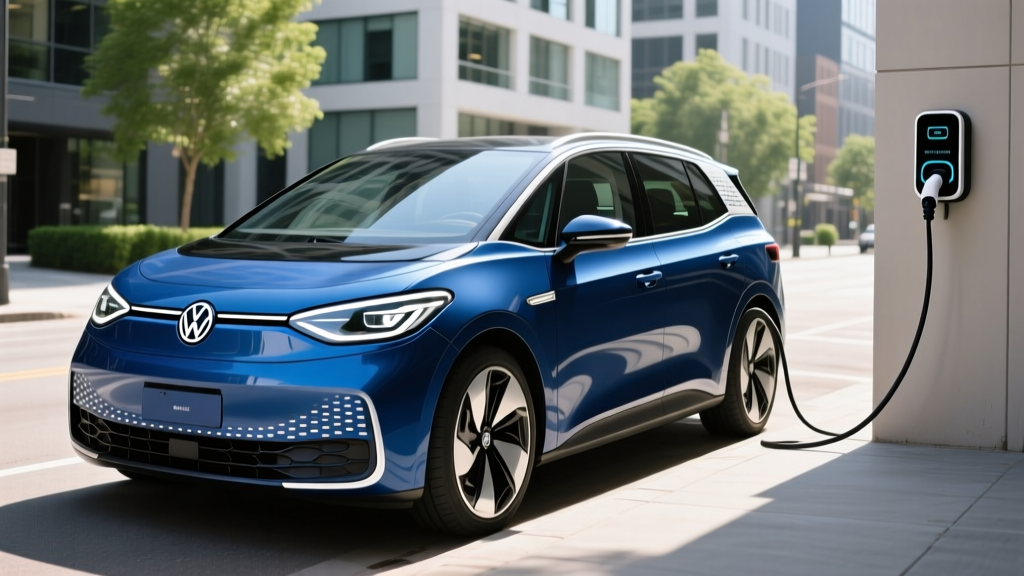
The ID. Buzz supports a peak DC fast-charge rate of 200 kW on compatible CCS or NACS-equipped stations (2026 models ship with NACS ports natively, ending the CCS adapter dependency of early 2025 units). However, peak rate is not sustained rate.
| Charging Level | Power / Rate | Speed (Approx.) |
|---|---|---|
| Level 1 (120V household) | ~1.4 kW | ~3–4 miles/hour |
| Level 2 (240V home/public) | 11 kW (onboard charger max) | ~24–27 miles/hour; full charge in ~9 hrs |
| DC Fast Charge (peak) | 200 kW | 10–80% in ~26 minutes |
The 10–80% time of approximately 26 minutes is competitive but not class-leading. The Hyundai Ioniq 9 and Kia EV9 (both on 800V architectures) manage 10–80% in roughly 18–20 minutes at 350 kW chargers. The Buzz's 400V electrical architecture limits its peak charge rate, and like all EVs, the charge curve tapers significantly above 80% SoC — a full 80–100% top-off can add another 25+ minutes.
For home charging, an 11 kW onboard charger means a dedicated 48-amp Level 2 circuit (hardwired, 60-amp breaker) will replenish the pack in about 9 hours — fine for overnight charging but slower than some competitors offering 11.5–19.2 kW onboard chargers. Budget roughly $800–$1,500 for a quality Level 2 home station plus licensed electrician installation, and potentially $2,000–$4,000 more if your electrical panel needs a 200-amp upgrade.
Performance and Drivetrain
| Spec | RWD (Pro S / Pro S Plus) | AWD (Pro S Plus 4Motion) |
|---|---|---|
| Powertrain | Single rear motor | Dual motor (front + rear) |
| Horsepower | 282 hp | 335 hp |
| Torque | 413 lb-ft | 413 lb-ft (rear) + front assist |
| 0–60 mph | ~7.9 seconds | ~6.5 seconds |
| Top Speed | 99 mph (electronically limited) | 99 mph |
| Towing Capacity | Not rated | Not rated |
Acceleration is adequate for merging and passing but not thrilling — this is a family cruiser, not a performance EV. The 6.5-second 0–60 time for the AWD model feels brisk around town thanks to instant electric torque, but the Buzz's weight is noticeable during hard acceleration above 50 mph. Steering is light and geared toward comfort, and the turning radius is surprisingly manageable for a 195-inch-long vehicle.
Notably, VW does not rate the ID. Buzz for towing in the U.S. market. If you need a three-row EV that can pull a trailer, the Kia EV9 (up to 5,000 lbs with the tow package) or the Rivian R1S remain your options.
Interior Space, Cargo, and Practicality
The long-wheelbase U.S. ID. Buzz seats up to seven passengers in a 2-3-2 configuration (six in available captain's chair layouts). Interior dimensions make the most of the EV skateboard platform's flat floor:
- Cargo (behind 3rd row): 18.2 cu ft
- Cargo (3rd row folded): 55.0 cu ft
- Cargo (all rear rows folded): 111.4 cu ft
- Front headroom: 41.7 inches
- 2nd-row legroom: 39.6 inches
- 3rd-row legroom: 33.5 inches
Third-row space is tight for adults on long trips — fine for kids or occasional use, but the Chrysler Pacifica Hybrid and Toyota Sienna offer more generous third-row dimensions. The flat load floor and wide rear hatch opening make cargo hauling excellent, and the available power-sliding doors and power tailgate are practical for families. A front trunk (frunk) is notably absent — VW uses that space for HVAC and power electronics, so small-item storage relies on a modest cabin shelf and door pockets.
Technology, Safety, and Driver Assistance
The 2026 ID. Buzz runs VW's Software 4.0 infotainment system on a 12.9-inch center touchscreen with a 5.3-inch digital instrument cluster. Wireless Apple CarPlay and Android Auto are standard, and the system supports over-the-air updates. The capacitive touch sliders for volume and climate that frustrated early ID.4 owners have been improved with backlighting and better responsiveness, though physical knob enthusiasts will still grumble.
Driver assistance falls under VW's IQ.DRIVE suite, which is an SAE Level 2 system — meaning the driver must remain fully engaged with hands on the wheel and eyes on the road at all times.
⚠️ IQ.DRIVE Is Not Self-Driving
Travel Assist (adaptive cruise + lane centering) is a Level 2 driver-assist feature. It does not navigate autonomously, handle complex urban intersections, or replace an attentive driver. You are legally and operationally responsible for the vehicle at all times. For context, only Level 4 services like Waymo operate without a human driver — and those are geofenced robotaxis, not consumer vehicles.
Standard safety tech includes automatic emergency braking with pedestrian detection, blind-spot monitoring, rear cross-traffic alert, lane-keeping assist, and Park Assist Plus (semi-automated parking). The ID. Buzz earned strong marks in European Euro NCAP testing; U.S. NHTSA and IIHS ratings for the 2026 model year should be confirmed as they become available.
Warranty and Battery Coverage
| Coverage | Term |
|---|---|
| Limited Vehicle Warranty | 4 years / 50,000 miles |
| Powertrain Warranty | 4 years / 50,000 miles |
| High-Voltage Battery | 8 years / 100,000 miles (70% capacity retention guarantee) |
| Roadside Assistance | 4 years / 50,000 miles |
The battery warranty guarantees that the pack will retain at least 70% of its original capacity over 8 years or 100,000 miles — the industry-standard threshold. NMC chemistry typically degrades 10–15% over the first 100,000 miles under normal use, so the 70% floor is conservative but protects against outlier degradation. Replacement cost for the full pack, if out of warranty, is estimated at $15,000–$22,000 including labor based on current VW parts pricing, though module-level repair may be possible at lower cost.
Pros, Cons, and Who Should Buy the ID. Buzz
✅ Pros
- Iconic retro styling — nothing else looks like it on the road
- Spacious, flat-floor cabin with versatile cargo/passenger layouts
- Standard heat pump for better cold-weather efficiency
- Eligible for up to $7,500 federal tax credit (under $80K van MSRP cap)
- NACS native port — direct Tesla Supercharger access without adapter
- Comfortable ride quality and surprisingly tight turning radius
❌ Cons
- High starting price ($59,995+) for a minivan without luxury badge
- Range drops significantly at highway speeds and in cold weather
- 400V architecture limits DC fast-charge speed vs 800V rivals
- No frunk; no towing rating in the U.S.
- Third row is tight for adults on longer trips
- Infotainment still relies heavily on touch-sensitive controls
Who Is the VW ID. Buzz For?
Choose the ID. Buzz if: You want a stylish, comfortable electric family hauler for suburban and around-town use, you can charge at home overnight, your typical daily driving is under 150 miles, and the retro design brings you genuine joy every time you walk up to it.
Look elsewhere if: You regularly road-trip 300+ miles between charges (the Kia EV9 or Tesla Model X offer more range and faster charging), you need to tow, you need a usable adult-sized third row (Pacifica Hybrid), or you want the best efficiency per dollar (an Ioniq 5 or EV6 will cost far less to fuel).
Frequently Asked Questions
What is the real-world range of the 2026 VW ID. Buzz?
The EPA rates the RWD model at 234 miles and the AWD at 219 miles. In real-world mixed driving, expect 210–225 miles from the RWD. Sustained highway driving at 70+ mph drops that to roughly 185–200 miles, and freezing winter conditions can reduce range to 160–180 miles even with the standard heat pump.
How fast does the ID. Buzz charge at home and on DC fast chargers?
On a DC fast charger, it peaks at 200 kW and charges from 10–80% in approximately 26 minutes. At home on a Level 2 (240V) station, the 11 kW onboard charger adds roughly 24–27 miles of range per hour, fully recharging the battery in about 9 hours. Level 1 (standard 120V outlet) adds only 3–4 miles per hour — useful for emergencies but impractical as a primary charging method.
How much does the VW ID. Buzz cost after the federal tax credit?
If you qualify for the full $7,500 §30D credit, the Pro S RWD drops from $61,390 (with destination) to roughly $53,890, and the top AWD 1st Edition falls from ~$69,390 to ~$61,890. Eligibility requires meeting buyer income caps ($150K single / $300K joint for new vehicles), the vehicle must be under the $80,000 MSRP cap for vans (which it is), and the battery must meet critical-mineral and component sourcing thresholds that change annually. Verify current rules at IRS.gov before purchasing.
Does the 2026 VW ID. Buzz qualify for the federal EV tax credit?
The ID. Buzz is expected to qualify for up to $7,500 under §30D as a van under the $80,000 MSRP cap. However, the exact credit amount depends on the battery's critical-mineral and foreign-entity-of-concern sourcing compliance for the current tax year, as well as your personal income. The point-of-sale transfer option lets you apply the credit as a down-payment reduction at participating dealerships rather than waiting until tax filing.
Is the VW ID. Buzz worth buying vs. the Kia EV9 or Tesla Model X?
It depends on your priorities. The Kia EV9 (starting ~$55,000) offers similar three-row space, faster 800V charging (10–80% in ~18 min), a 5,000-lb tow rating, and slightly better range — but lacks the Buzz's character and design appeal. The Tesla Model X (starting ~$80,000) delivers more range (~330 mi), vastly faster Supercharger access, and a usable adult third row, but costs significantly more and has a polarizing interior. The Chrysler Pacifica Hybrid (~$50,000) remains the pragmatic choice if you need 32 miles of electric-only commuting plus unlimited gas range for road trips without charging stops. The ID. Buzz wins on style, comfort, and feel-good factor — just know you're paying a design premium.
What are the biggest drawbacks of the ID. Buzz?
The primary complaints are real-world highway range falling well short of the EPA sticker, relatively slow DC fast charging compared to 800V competitors, the lack of a frunk, no U.S. towing rating, and a price that pushes into luxury territory without luxury-brand cachet. The touch-heavy infotainment interface also remains a friction point for some owners.
Final Verdict
So how much is a VW ID. Buzz in 2026? Between roughly $54,000 and $70,000 depending on trim, options, and whether you capture the full federal tax credit. That's a lot of money for a minivan — but it's also the only EV on the road that turns every parking lot into a conversation starter while hauling seven people and their gear with zero tailpipe emissions.
If the range, charging speed, and price align with your daily routine and you value design and character over spec-sheet dominance, the ID. Buzz delivers an ownership experience no competitor can match. If you need maximum road-trip efficiency, towing capability, or the lowest cost per mile, the Kia EV9 or a plug-in hybrid minivan may serve you better. Either way, test-drive the Buzz with your family and your typical cargo — the smiles-per-mile factor is real, but so are the trade-offs.
Sources: EPA Fuel Economy, IRS Clean Vehicle Credits, Volkswagen USA