Quick Answer: Is the VW ID. Buzz the Right EV Van for You?
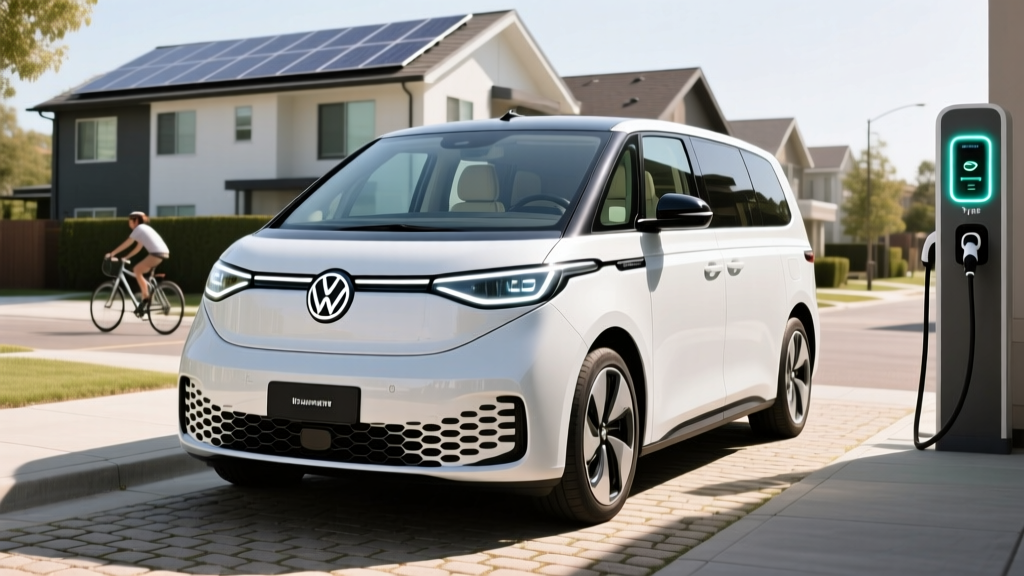
The 2026 Volkswagen ID. Buzz is a three-row electric minivan starting at $59,995 (Pro S trim) with an EPA-estimated 234 miles of range from its 91 kWh (usable) NMC battery. It peaks at 170 kW DC fast charging (10–80% in roughly 26 minutes) and offers standard AWD with 330 hp. It qualifies as a practical family hauler if you can charge at home and your typical trips stay under 200 miles. If you regularly tow, drive in extreme cold, or lack home charging access, you'll need to weigh its limitations carefully before buying.
Range, Battery, and What You'll Actually See on the Road
The ID. Buzz Pro S AWD carries a 91 kWh usable lithium-ion NMC (nickel manganese cobalt) battery pack. VW's official EPA rating puts combined range at 234 miles, but real-world results depend heavily on conditions:
EPA Sticker: 234 miles (combined)
Real-World Highway (70 mph, mild weather): ~200–210 miles
Cold Weather (below 32°F, highway): ~165–185 miles
City / Suburban (moderate speeds, regen use): ~230–240 miles
The ID. Buzz's boxy shape creates more aerodynamic drag than a sleek crossover, which hurts highway efficiency. Expect roughly 2.0–2.2 kWh/mile at sustained 70 mph speeds — that's notably thirstier than the Tesla Model X (~1.8 kWh/mi) or even the Chrysler Pacifica Hybrid in electric-only mode. If your commute is mostly suburban at 35–50 mph, you'll land closer to the EPA sticker. On long interstate road trips, plan conservatively around 190 miles between stops.
| Spec | Value |
|---|---|
| EPA Range (combined) | 234 miles |
| Battery (usable) | 91 kWh, NMC chemistry |
| Drivetrain | Dual-motor AWD, 330 hp, 406 lb-ft torque |
| 0–60 mph | 5.7 seconds |
| Max DC Fast Charge Rate | 170 kW (peak) |
| 10–80% DC Fast Charge Time | ~26 minutes |
| Level 2 Charge Rate | 11 kW (AC onboard charger) |
| Level 2 Full Charge Time (0–100%) | ~9 hours |
| EPA Efficiency | 87 MPGe combined |
| Seating | 7 passengers (3 rows) |
| Cargo (behind 3rd row) | 18.2 cu ft |
| Cargo (3rd row folded) | 75.5 cu ft |
| Towing Capacity | Not rated for towing |
| Base MSRP (Pro S AWD) | $59,995 |
| Battery / Powertrain Warranty | 8 years / 100,000 miles |
Charging: Home Setup and Public Network Reality
The ID. Buzz uses the NACS (Tesla-style) connector for both AC and DC charging in North America starting with the 2025 model year, giving it native access to the Tesla Supercharger network — a significant advantage over CCS-only vehicles now that most legacy CCS stations are slower to expand.
Home Level 2 Charging
With its 11 kW onboard charger, the ID. Buzz can accept up to 48 amps on a hardwired Level 2 home station. A full 0–100% charge takes roughly 9 hours. In practice, most owners arriving home at 20–30% state of charge will reach 80–90% overnight in 5–6 hours.
Home install reality check: A 48-amp Level 2 charger (such as the ChargePoint Home Flex or Wall Connector) costs $500–$700 for the unit. Professional installation by a licensed electrician typically runs $800–$2,000 for a straightforward setup on an existing 200-amp panel. If your home has a 100-amp panel, expect a $1,500–$3,000 panel upgrade. Always get a quote from a licensed electrician before purchasing equipment.
DC Fast Charging on the Road
The ID. Buzz peaks at 170 kW at DC fast chargers, which is respectable but not class-leading. Here's the charging-curve reality that spec sheets hide:
- 10–40% SoC: Sustains near 170 kW peak
- 40–60% SoC: Tapers to ~130–140 kW
- 60–80% SoC: Drops to ~80–100 kW
- Above 80%: Slows sharply to protect battery — not recommended for road trips
Preconditioning the battery (via the navigation system's charge-stop routing) is essential to hitting peak rates. Arriving at a fast charger without preconditioning — especially in cold weather — can cut your charge speed in half. On a 300-mile road trip, plan one 25–30 minute stop at a 150+ kW charger to go from ~15% to ~80%.
| Level | Power | Miles Added per Hour | Best Use Case |
|---|---|---|---|
| Level 1 (120V household) | ~1.4 kW | ~4–5 mi/hr | Emergency / trickle only |
| Level 2 (240V, 48A) | 11 kW | ~32–36 mi/hr | Daily home charging |
| DC Fast (150+ kW station) | Up to 170 kW | ~190+ mi in 26 min (10–80%) | Road trips |
ID. Buzz vs. Gas Minivan vs. PHEV: Cost and Practicality Compared
The ID. Buzz competes in a minivan segment dominated by the Toyota Sienna (hybrid), Honda Odyssey (gas), and Chrysler Pacifica (PHEV/gas). Here's how they stack up on the metrics that matter to family-hauler buyers:
| Metric | VW ID. Buzz (EV) | Toyota Sienna (HEV) | Chrysler Pacifica PHEV |
|---|---|---|---|
| Base MSRP | $59,995 | $39,840 | $51,095 |
| EPA Range / MPG | 234 mi / 87 MPGe | 36 MPG combined | 32 mi electric + 30 MPG gas |
| Fuel/Energy Cost per Mile* | ~$0.045 (home charging) | ~$0.095 | ~$0.06 (blended) |
| Annual Fuel/Energy (15k mi) | ~$675 | ~$1,425 | ~$900 |
| Estimated 5-Year Fuel Savings vs. Sienna | +$3,750 | Baseline | +$2,625 |
| Maintenance (5-year est.) | ~$1,500 | ~$3,500 | ~$3,200 |
| Seating | 7 | 7–8 | 7 |
| Towing | Not rated | 3,500 lbs | 3,600 lbs |
| AWD Available | Standard | Optional | No |
*Based on $0.15/kWh home electricity and $3.40/gal gas. Actual costs vary by region and utility rate.
The ID. Buzz carries a roughly $20,000 price premium over the Sienna hybrid. Even with lower fuel and maintenance costs, the math is challenging: over 5 years and 75,000 miles, you'll save approximately $5,000–$6,000 in fuel and maintenance — not enough to close the purchase-price gap. The ID. Buzz's value proposition is less about total cost parity and more about the driving experience (instant torque, quiet cabin, one-pedal driving) plus the environmental benefit of zero tailpipe emissions.
Federal Tax Credit and Total Purchase Cost
As of 2026, the VW ID. Buzz's eligibility for the §30D federal EV tax credit (up to $7,500) depends on several factors that change regularly. Here's the checklist based on current IRS rules:
- MSRP cap: Vans/minivans classified as SUVs face an $80,000 MSRP cap — the ID. Buzz at $59,995 qualifies on price.
- Buyer income limits: AGI must not exceed $150,000 (single), $225,000 (head of household), or $300,000 (joint filers).
- Battery sourcing: Critical minerals and battery component requirements phase in annually. VW has worked to localize supply chains, but confirm current-year eligibility on fueleconomy.gov before purchasing.
- Point-of-sale transfer: If eligible, you can transfer the credit to the dealer at purchase for an immediate price reduction rather than waiting for a tax refund.
- Assembly: The ID. Buzz sold in the U.S. is assembled in Hanover, Germany — final assembly outside North America may affect credit eligibility depending on current-year rules.
Important: Because the ID. Buzz is assembled in Germany, its §30D eligibility is uncertain under current battery-sourcing and final-assembly rules. Always verify on the IRS website or consult a tax professional before counting on the credit in your purchase budget. If the credit does apply, the effective price drops to roughly $52,495.
Real-World Ownership: What First-Time EV Van Buyers Must Know
Home Charging Is Non-Negotiable for Most Buyers
If you can install a Level 2 charger at home, the ID. Buzz works seamlessly as a daily driver — plug in at night, wake up to 200+ miles every morning. If you rely solely on public charging, the 170 kW charge rate and ~200-mile real-world highway range mean you'll stop more often than owners of longer-range EVs like the Rivian R1T or Tesla Model X. Public charging also costs significantly more ($0.30–$0.48/kWh at DC stations vs. ~$0.15/kWh at home), which erodes the fuel-cost advantage.
Cold Weather Cuts Range Hard
The ID. Buzz uses a resistive PTC heater rather than a heat pump (standard on some competitors). In sustained sub-freezing temperatures, expect 20–30% range loss. A 234-mile EPA rating becomes roughly 165–185 miles in winter highway driving. If you live in the upper Midwest or Northeast, this is a real constraint for winter road trips. Preconditioning while still plugged in at home mitigates some of this loss.
Insurance Costs More Than a Gas Minivan
EV insurance premiums run 15–25% higher than comparable gas vehicles due to higher repair costs and battery replacement considerations. Expect annual premiums in the $1,800–$2,400 range depending on your state, driving record, and coverage level. Get quotes before purchasing.
No Towing Rating
VW does not rate the U.S.-spec ID. Buzz for towing. If you need to pull a small trailer, bike rack hitch, or camper, the Sienna (3,500 lbs) or Pacifica (3,600 lbs) remain the only minivan options. This is a significant limitation for active families.
| Myth | Fact |
|---|---|
| "It has 300 miles of range." | The European WLTP rating is higher; the U.S. EPA rates it at 234 miles combined, with real-world highway closer to 200. |
| "It charges as fast as a Tesla." | At 170 kW peak, it's slower than the Model X (~250 kW) and Hyundai Ioniq 9 (~200+ kW). Expect 26 min for 10–80%, not 15. |
| "I'll definitely get the $7,500 tax credit." | German assembly and evolving battery-sourcing rules make credit eligibility uncertain. Verify before purchasing. |
| "It can tow like other minivans." | The U.S.-spec ID. Buzz is not rated for towing. Zero-pound tow capacity. |
| "It's cheaper to own than a Sienna." | Lower fuel/maintenance costs don't offset the ~$20K price premium over 5 years. The ID. Buzz costs more to own overall. |
Driving, Tech, and Interior Practicality
The ID. Buzz's dual-motor AWD powertrain produces 330 hp and 406 lb-ft of torque, delivering a 5.7-second 0–60 mph time — quick for a minivan. Throttle response is instant and linear, making highway merging and city driving effortless compared to the CVT drone of hybrid minivans.
Inside, VW uses a 12.9-inch infotainment touchscreen with wireless Apple CarPlay and Android Auto. The second row slides and reclines, and the third row fits adults on shorter trips. However, cargo space behind the third row (18.2 cu ft) is tighter than the Sienna (33.5 cu ft) or Pacifica (32.3 cu ft). You'll fold the third row frequently for big-box-store runs.
Driver assistance comes via VW's IQ.DRIVE suite — a SAE Level 2 system including adaptive cruise, lane centering, and automatic emergency braking. This is a driver-assist system requiring active supervision, not a self-driving feature. VW's Travel Assist works well on highways but does not support hands-free driving like GM's Super Cruise or Ford's BlueCruise.
ADAS Limitation Notice: The ID. Buzz's IQ.DRIVE is a Level 2 driver-assistance system per NHTSA/SAE definitions. The driver must keep hands on the wheel and eyes on the road at all times. It does not handle construction zones, unmapped roads, or severe weather autonomously.
The Decision Framework: Should You Buy the ID. Buzz?
Buy the VW ID. Buzz if:
- You have home Level 2 charging and drive mostly suburban/city routes under 180 miles round-trip
- You want a distinctive, fun-to-drive electric family hauler with standard AWD
- You don't need to tow anything
- You value low running costs and zero tailpipe emissions over lowest purchase price
- You can access Tesla Superchargers via NACS for road trips
Choose the Toyota Sienna Hybrid instead if:
- You need maximum cargo space, 8-passenger seating, or 3,500-lb towing
- You lack reliable home charging access
- Your budget is closer to $40,000–$50,000
- You take frequent 400+ mile road trips and don't want to plan charging stops
- You live in an area with extreme cold and limited public charging infrastructure
Consider the Chrysler Pacifica PHEV if:
- You want 32 miles of electric-only range for school runs and errands, with gas backup for road trips
- You want to reduce emissions without committing fully to an EV
- You need towing capability (3,600 lbs)
Frequently Asked Questions
What is the real-world range of the VW ID. Buzz EV van?
The EPA rates the 2026 ID. Buzz at 234 miles combined. In real-world highway driving at 70 mph, expect roughly 200–210 miles. In cold weather below freezing, that drops to 165–185 miles. City driving with regenerative braking can match or slightly exceed the EPA estimate.
Does the VW ID. Buzz qualify for the $7,500 federal tax credit?
Eligibility is uncertain. The ID. Buzz is assembled in Germany, and §30D credit rules include battery-sourcing and critical-mineral requirements that change annually. Check the current eligibility list on fueleconomy.gov and consult a tax professional before assuming the credit applies to your purchase.
How long does it take to charge the ID. Buzz at home?
On a 48-amp Level 2 home charger (11 kW), a full 0–100% charge takes about 9 hours. Most daily top-ups from 20–80% take 5–6 hours overnight. Level 1 (standard 120V outlet) adds only 4–5 miles per hour and is not practical for daily use.
Can the VW ID. Buzz tow a trailer?
No. The U.S.-spec ID. Buzz is not rated for towing. If towing is a requirement, consider the Toyota Sienna (3,500 lbs) or Chrysler Pacifica (3,600 lbs).
Is the ID. Buzz self-driving?
No. The IQ.DRIVE system is SAE Level 2 driver assistance. It provides adaptive cruise control and lane centering but requires the driver to remain fully engaged with hands on the wheel and eyes on the road at all times.
How does the ID. Buzz compare to the Tesla Model X as a family EV?
The Model X offers more range (320+ mi EPA), faster charging (~250 kW), towing capability (5,000 lbs), and more cargo room, but starts around $80,000+. The ID. Buzz is more affordable and has a more practical minivan layout, but sacrifices range, charge speed, and towing.