The All-Electric VW Bus in 60 Seconds
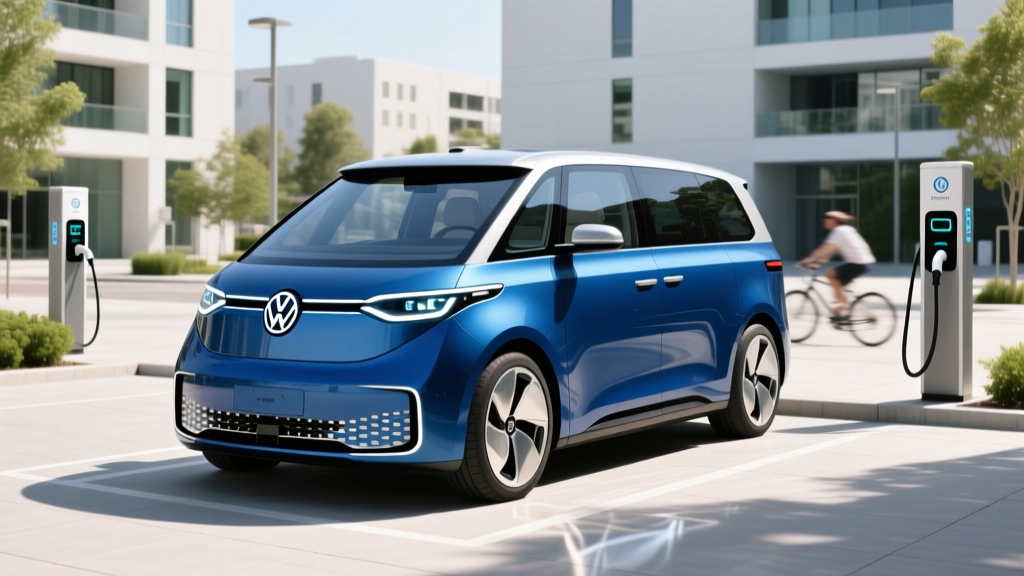
The all-electric VW Bus — officially the ID. Buzz — is a three-row, retro-styled electric minivan built on Volkswagen's MEB platform. For 2026, the U.S.-spec long-wheelbase ID. Buzz carries a 91 kWh (usable) NMC battery, an EPA-estimated 231 miles of range (RWD Pro S trim), and DC fast-charging capability up to 200 kW. Pricing starts at $59,995 before destination and incentives. It's a compelling family hauler with standout design and a spacious cabin, but buyers should weigh its premium price and mid-pack range against rivals like the Kia EV9 and Chrysler Pacifica Hybrid.
Range, Battery & Efficiency: What the Numbers Actually Mean
The 2026 ID. Buzz uses a floor-mounted lithium-ion pack with NMC (nickel-manganese-cobalt) chemistry. Here are the official and real-world figures:
| Spec | ID. Buzz Pro S (RWD) | ID. Buzz Pro S Plus (AWD) |
|---|---|---|
| Usable Battery Capacity | 91 kWh (NMC) | 91 kWh (NMC) |
| EPA Range | 231 mi | 218 mi |
| Real-World Highway (~70 mph) | ~190–210 mi | ~175–195 mi |
| Cold-Weather Range (below 30°F) | ~160–180 mi | ~150–170 mi |
| MPGe (Combined) | 87 MPGe | 82 MPGe |
| Efficiency (kWh/100 mi) | ~38 kWh/100 mi | ~41 kWh/100 mi |
| Motor Output | 282 hp (210 kW) | 335 hp (250 kW) |
| 0–60 mph | ~7.9 sec | ~6.5 sec |
Real-World Range Reality Check
The EPA's 231-mile figure is measured on a mixed driving cycle. On sustained highway trips at 70+ mph, expect roughly 190–210 miles in the RWD model. In freezing temperatures (below 30°F), cabin heating and battery conditioning can reduce range by 20–30%, dropping effective range to around 160–180 miles. The ID. Buzz's boxy aerodynamic profile (higher drag coefficient than sleeker EVs) amplifies highway-speed energy consumption. Plan road trips around 170-mile legs for a comfortable buffer.
The ID. Buzz does not use LFP (lithium iron phosphate) chemistry. NMC offers higher energy density — important for packaging a large battery in a minivan footprint — but it does mean Volkswagen recommends daily charging to 80% for optimal long-term battery health, reserving 100% for longer trips.
Charging Speeds: Home and DC Fast Charging
Understanding the difference between kW (power, or charge rate) and kWh (energy, or battery capacity) is essential. The ID. Buzz's 91 kWh battery needs energy; the charger's kW rating determines how fast that energy flows.
| Charging Level | Power (kW) | Time (Approx.) | Miles Added |
|---|---|---|---|
| Level 1 (120V household) | 1.4 kW | ~65 hrs (0–100%) | ~4 mi/hr |
| Level 2 (240V, 48A) | 11.5 kW | ~8.5 hrs (0–100%) | ~33 mi/hr |
| DC Fast Charge (peak) | 200 kW | ~26 min (10–80%) | ~150+ mi in 20 min |
The ID. Buzz uses the NACS (North American Charging Standard) connector, giving it native access to Tesla's Supercharger network — a significant advantage for road trips. At a DC fast charger, the ID. Buzz peaks around 200 kW, but like all EVs, it follows a charging curve: the rate is highest between roughly 10–40% state of charge and tapers significantly above 80%. A 10–80% session takes approximately 26 minutes under ideal conditions (preconditioned battery, warm ambient temperature, available charger capacity).
Preconditioning matters. The ID. Buzz can warm its battery before a fast-charging stop when a charger is set in the navigation system. Skipping this step — especially in cold weather — can reduce peak charge rates by 30–50%, stretching a 26-minute stop to 40 minutes or more.
Pricing, Trims & Federal Tax Credit Eligibility
The 2026 ID. Buzz is offered in three trims:
| Trim | Drivetrain | Base MSRP |
|---|---|---|
| Pro S | RWD | $59,995 |
| Pro S Plus | AWD | $64,995 |
| 1st Edition | AWD | $69,995 |
All trims include destination charges. The federal §30D EV tax credit may apply, but eligibility is not guaranteed for every buyer or every unit. Under current IRS rules, the credit (up to $7,500) depends on:
- MSRP cap: Vans qualify under the $80,000 cap (the ID. Buzz is classified as a van/SUV — verify on the sticker).
- Buyer income limits: AGI must not exceed $300,000 (joint), $225,000 (head of household), or $150,000 (individual).
- Battery sourcing: Critical minerals and battery components must meet phased-in percentages from U.S. or FTA-partner countries. Volkswagen has been working to qualify, but sourcing requirements tighten annually.
- Point-of-sale transfer: Eligible buyers can transfer the credit to the dealer at purchase, reducing the out-of-pocket price immediately.
Check the latest eligibility status at fueleconomy.gov and consult a tax professional before relying on the credit.
ID. Buzz vs. Gas Minivan vs. PHEV: Cost & Capability Compared
The ID. Buzz doesn't compete in a vacuum. Families cross-shopping three-row transport typically consider gas minivans (Toyota Sienna, Honda Odyssey) and the Chrysler Pacifica Hybrid (PHEV). Here's how they stack up on key ownership metrics:
| Metric | VW ID. Buzz (RWD) | Toyota Sienna (HEV) | Chrysler Pacifica PHEV |
|---|---|---|---|
| Base MSRP | $59,995 | $38,085 | $51,095 |
| EPA Range / Fuel Economy | 231 mi / 87 MPGe | 36 MPG combined | 32 mi electric + 30 MPG gas |
| Annual Fuel/Energy Cost (12k mi) | ~$620 (at $0.15/kWh) | ~$1,170 (at $3.50/gal) | ~$900 (mixed) |
| 5-Year Fuel/Energy Cost | ~$3,100 | ~$5,850 | ~$4,500 |
| Maintenance (5-Year Est.) | ~$1,500 | ~$3,500 | ~$3,800 |
| Third-Row Seating | Yes (3 rows) | Yes (3 rows) | Yes (3 rows) |
| Towing Capacity | Not rated (est. 2,500 lb) | 3,500 lb | 3,600 lb |
5-Year Total Cost of Ownership Estimate
| Category | ID. Buzz RWD | Sienna HEV | Pacifica PHEV |
|---|---|---|---|
| Purchase Price (after est. credit) | $52,495* | $38,085 | $43,595* |
| Fuel/Energy (5 yr) | $3,100 | $5,850 | $4,500 |
| Maintenance (5 yr) | $1,500 | $3,500 | $3,800 |
| Insurance (5 yr est.) | $12,500 | $8,500 | $9,500 |
| Est. Depreciation (5 yr) | $22,000 | $14,000 | $18,000 |
| Total 5-Year Cost | ~$91,595 | ~$69,935 | ~$79,395 |
*Assumes full $7,500 federal credit applied at point of sale. Actual credit eligibility varies. Insurance estimates are averages; get personal quotes. Depreciation is estimated based on segment trends.
The ID. Buzz wins on energy and maintenance costs — no oil changes, fewer moving parts, and electricity that costs roughly half what gasoline does per mile. However, the higher purchase price, steeper insurance premiums (common for EVs), and potentially faster depreciation mean the total-cost gap narrows significantly over five years. The Sienna HEV remains the most economical choice for budget-focused families. The Pacifica PHEV splits the difference, offering 32 miles of electric-only commuting with a gas backup for road trips.
Real-World Ownership: What First-Time EV Buyers Need to Know
Buying the all-electric VW Bus is different from buying a gas minivan. Here are the practical realities:
Home Charging Is the Backbone
Level 2 home charging (240V, 48A) adds roughly 33 miles of range per hour — enough to fully replenish the ID. Buzz overnight. Installation costs typically run $800–$2,500 for a straightforward setup (panel has capacity, short conduit run). If your electrical panel needs an upgrade to 200A, add $1,500–$3,500. Always get a quote from a licensed electrician before committing to the vehicle.
If you live in an apartment or lack off-street parking, the ID. Buzz becomes significantly harder to own. Relying solely on public DC fast charging adds time (26+ minutes per session, plus travel to/from the charger) and cost (public DC rates of $0.35–$0.55/kWh can push per-mile costs above those of a gas minivan).
Cold Climate Considerations
If you live where winters regularly dip below freezing, plan for 20–30% range loss. The ID. Buzz uses a heat pump for cabin heating (more efficient than resistive heating), but battery chemistry still loses efficiency in the cold. Preconditioning while plugged in at home mitigates some loss. In extreme cold (-10°F or below), expect closer to 150 miles of effective range.
Driving Pattern Fit
The ID. Buzz excels as a daily family hauler: school runs, grocery trips, and commutes under 100 miles round-trip. For frequent 400+ mile road trips, the 231-mile EPA range means at least two charging stops, adding 45–60 minutes of total trip time compared to one gas stop. If long road trips are a weekly occurrence, a PHEV or gas minivan may be more practical.
Common Misconceptions About the Electric VW Bus
| Myth | Fact |
|---|---|
| "The battery will need replacing in 5 years and cost $20,000." | VW covers the battery with an 8-year/100,000-mile warranty guaranteeing at least 70% capacity retention. Real-world NMC degradation data from similar MEB-platform vehicles shows roughly 5–8% loss over 100,000 miles. Full replacement is rare and typically covered under warranty within that window. |
| "It's a van, so it can tow my boat." | The U.S.-spec ID. Buzz has limited official towing ratings. European models are rated for ~2,200 lb (braked), but U.S. towing certification may differ. Verify with VW before purchasing for towing duty. |
| "I'll save money immediately compared to my gas minivan." | The ID. Buzz's $60K+ starting price is $20K+ above a base Sienna. Fuel and maintenance savings are real (~$2,750 over 5 years), but they don't close the purchase-price gap in five years. The break-even point is typically 8–10 years, and only with home charging. |
| "The $7,500 tax credit applies to everyone." | Eligibility depends on buyer income (AGI caps), battery sourcing requirements (tightening annually), and vehicle MSRP classification. Not every ID. Buzz or every buyer qualifies in every model year. Always verify at purchase. |
| "Fast charging is always 200 kW." | 200 kW is the peak rate, achievable only with a preconditioned battery at a compatible charger, typically between 10–40% SoC. The average rate across a 10–80% session is closer to 130–150 kW. Charger availability and ambient temperature also affect speed. |
Decision Framework: Is the All-Electric VW Bus Right for You?
Choose the ID. Buzz If:
- You have home Level 2 charging (garage or driveway with 240V access).
- Your daily driving is under 150 miles round-trip, with occasional longer trips you don't mind adding charging time to.
- You want a distinctive, spacious three-row EV with car-like driving dynamics and low running costs.
- You value NACS Supercharger access for road-trip charging convenience.
- You're comfortable with the premium price and understand the 5-year total cost may exceed a gas or hybrid minivan.
Choose a Gas/HEV Minivan (Sienna, Odyssey) If:
- You lack reliable home charging access.
- You regularly drive 400+ miles in a single trip and don't want charging stops.
- You need maximum towing capacity (3,500+ lb).
- Budget is the top priority — the Sienna HEV saves $20K+ at purchase and $20K+ in depreciation over 5 years.
Choose the Pacifica PHEV If:
- You want electric-only commuting (32 mi) but gas flexibility for road trips.
- You have home charging but also take frequent long trips.
- You want to reduce fuel costs without range compromise.
Interior, Tech & Safety Snapshot
The ID. Buzz offers a configurable three-row cabin with seating for up to seven (captain's chairs in the second row on higher trims). Cargo space behind the third row is approximately 18.2 cu ft, expanding to 80+ cu ft with both rear rows folded — competitive with gas minivans.
Tech highlights include a 12.9-inch infotainment touchscreen, wireless Apple CarPlay/Android Auto, a digital cockpit display, and VW's IQ.DRIVE suite of driver-assistance features. Note: IQ.DRIVE is a SAE Level 2 driver-assist system — it includes adaptive cruise control and lane centering, but the driver must remain fully engaged and hands on the wheel. It is not autonomous driving.
For safety ratings, check the latest results from NHTSA and IIHS as crash-test results are finalized for the U.S.-spec long-wheelbase model.
Battery Warranty & Long-Term Ownership
Volkswagen provides the following coverage on the ID. Buzz:
- Battery warranty: 8 years / 100,000 miles (whichever comes first), with a minimum 70% state-of-health (SoH) retention guarantee.
- Limited vehicle warranty: 4 years / 50,000 miles.
- Scheduled maintenance: VW offers a limited complimentary maintenance plan for the first two years or 20,000 miles (verify current terms with dealer).
NMC batteries in VW's MEB platform have demonstrated moderate degradation in European fleet data — typically 5–8% capacity loss over the first 100,000 miles. Following best practices (avoiding frequent 100% charges, minimizing DC fast-charging sessions when Level 2 is available, preconditioning in cold weather) can help maintain battery health over the long term.
Frequently Asked Questions
What is the real-world range of the all-electric VW Bus?
The EPA rates the 2026 ID. Buzz RWD at 231 miles. In real-world highway driving at 70 mph, expect roughly 190–210 miles. In cold weather (below 30°F), plan for 160–180 miles. The AWD model is rated at 218 miles EPA, with proportionally lower real-world figures.
How long does it take to charge the VW ID. Buzz at home?
On a Level 2 home charger (240V, 48A, 11.5 kW), a full 0–100% charge takes approximately 8.5 hours. Most owners charge from 20–80% overnight, which takes roughly 5 hours — easily accomplished during a typical night's parking.
Does the VW ID. Buzz qualify for the $7,500 federal tax credit?
It may, but eligibility depends on current IRS §30D rules including buyer income limits, battery sourcing requirements, and vehicle MSRP classification. The ID. Buzz's MSRP is below the $80,000 van/SUV cap, but battery component and critical mineral sourcing thresholds must be met for each specific model year. Verify at fueleconomy.gov at time of purchase and consult a tax professional.
Can the VW ID. Buzz use Tesla Superchargers?
Yes. The U.S.-spec ID. Buzz is equipped with the NACS connector, providing native access to the Tesla Supercharger network without an adapter. This is one of the strongest road-trip charging advantages for the ID. Buzz.
Is the VW ID. Buzz self-driving?
No. The ID. Buzz comes with VW's IQ.DRIVE suite, which is a SAE Level 2 driver-assistance system. It provides adaptive cruise control and lane-keeping assistance, but the driver must remain fully attentive, with hands on the steering wheel, at all times. It does not drive itself.
What does home charger installation cost for the ID. Buzz?
A Level 2 (240V) home charger installation typically costs $800–$2,500 if your electrical panel has sufficient capacity. A panel upgrade to 200A adds $1,500–$3,500. Get a site-specific quote from a licensed electrician. The charger unit itself (e.g., ChargePoint Home Flex, Emporia Vue) costs $400–$700.
How does the ID. Buzz compare to the Kia EV9 as an electric three-row?
The Kia EV9 starts lower (from ~$54,900), offers up to 304 miles of EPA range (Light RWD Long Range), and charges at up to 236 kW on NACS. The ID. Buzz offers more distinctive styling, a more spacious third row, and greater cargo volume, but at a higher price with less range. If range and value are priorities, the EV9 leads. If space and character matter most, the ID. Buzz wins.