The New VW Bus Electric: Quick Verdict
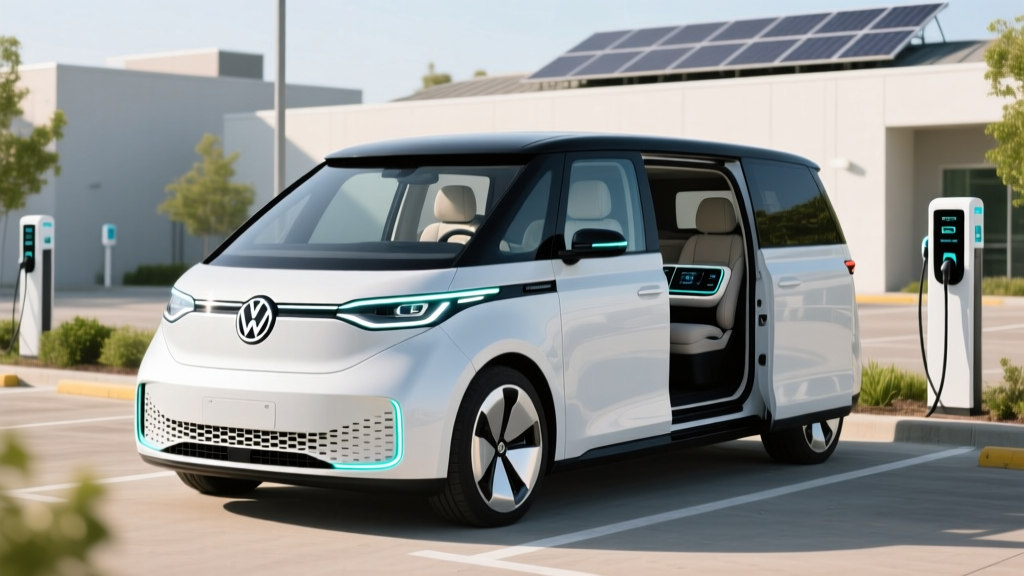
Bottom line: The 2026 Volkswagen ID. Buzz is the production realization of the "new VW bus electric" search — a 3-row, retro-styled electric minivan built on VW's MEB platform. It delivers an EPA-estimated 234 miles of range (RWD Pro S trim), a 91 kWh usable battery, and DC fast charging up to 200 kW (10–80% in ~26 minutes). Pricing starts at $59,995 before destination, with the AWD 4Motion variant at $64,995. It qualifies for a partial or full §30D federal tax credit depending on battery sourcing and buyer income, though buyers should verify eligibility at IRS.gov before purchase.
Who it's for: Families wanting a distinctive 3-row EV with strong cargo versatility and moderate road-trip capability. Who should skip: Buyers needing 300+ mile range or frequent long-distance towing.
Range, Battery, and Real-World Efficiency
The ID. Buzz is powered by a 91 kWh usable lithium-ion battery pack (NMC chemistry) mounted in the floor. The rear-wheel-drive Pro S trim earns an EPA-estimated 234 miles, while the AWD 4Motion drops to approximately 220 miles due to the added front motor and weight.
EPA Sticker vs. Reality:
- EPA combined: 234 miles (RWD) / ~220 miles (AWD)
- Real-world highway (70 mph, mild weather): ~195–210 miles
- Cold weather (30°F, highway): ~160–180 miles
- Efficiency: ~2.4–2.6 kWh/mile (roughly 79–83 MPGe combined)
The ID. Buzz's boxy aerodynamics (Cd ~0.29) and 5,500+ lb curb weight penalize highway efficiency more than sleeker crossovers like the Hyundai Ioniq 5 or Tesla Model X. Plan charging stops conservatively on road trips — expect 175–190 usable miles between stops in mixed driving.
| Spec | RWD Pro S | AWD 4Motion |
|---|---|---|
| EPA Range | 234 mi | ~220 mi |
| Battery (usable) | 91 kWh NMC | 91 kWh NMC |
| Horsepower | 282 hp | 335 hp |
| 0–60 mph | ~7.9 sec | ~6.5 sec |
| Peak DC Charge Rate | 200 kW | 200 kW |
| 10–80% DC Fast Charge | ~26 min | ~26 min |
| Level 2 Charge (11 kW) | ~9.5 hrs (0–100%) | ~9.5 hrs |
| Cargo (behind 3rd row) | 18.4 cu ft | 18.4 cu ft |
| Cargo (max, seats folded) | 163.7 cu ft | 163.7 cu ft |
| Towing Capacity | 2,500 lbs | 2,500 lbs |
| Base MSRP | $59,995 | $64,995 |
| Battery/Powertrain Warranty | 8 yr / 100,000 mi | 8 yr / 100,000 mi |
Charging Speed and Infrastructure Reality
The ID. Buzz uses the CCS1 connector standard. Its peak DC fast-charge rate of 200 kW is competitive for a minivan but trails the Hyundai Ioniq 5's 240 kW (which charges 10–80% in ~18 minutes). The charge curve is typical of MEB-platform vehicles: it holds near peak power from roughly 10–40% State of Charge (SoC), then tapers progressively. Above 80%, charging slows dramatically — expect 80–100% to take an additional 20+ minutes. Preconditioning the battery (via the navigation-routed charging feature) warms the pack before arrival at a DC fast charger, which can improve charge speed by 15–25% in cold weather.
| Level | Power | Miles Added per Hour | Use Case |
|---|---|---|---|
| Level 1 (120V household) | ~1.4 kW | ~3–4 mi/hr | Emergency / overnight top-off |
| Level 2 (240V, 48A home charger) | ~11 kW | ~25–28 mi/hr | Daily home charging |
| DC Fast Charge (CCS) | Up to 200 kW | ~450+ mi/hr (peak) | Road trips |
Home charging setup: Most ID. Buzz owners will need a Level 2 home charger (240V, 48-amp circuit on a 60-amp breaker) to fully replenish the 91 kWh battery overnight. Expect $800–$2,500 for a quality Level 2 unit plus professional installation, potentially more if your electrical panel needs a 200-amp upgrade ($1,500–$3,500). Without home charging, daily ownership becomes significantly less convenient — relying on public DC fast charging adds time and cost.
ID. Buzz vs. Gas Minivan: Cost and Practicality Comparison
How does the electric VW bus stack up against a conventional minivan like the Toyota Sienna (a hybrid) or Chrysler Pacifica? Here's a 5-year ownership comparison assuming 15,000 miles/year, $3.50/gallon gas, and $0.14/kWh home electricity:
| Category | VW ID. Buzz (RWD) | Toyota Sienna Hybrid AWD | Chrysler Pacifica PHEV |
|---|---|---|---|
| Base MSRP | $59,995 | $39,085 | $51,095 |
| Est. Federal Tax Credit (§30D) | Up to $7,500* | $0 | Up to $7,500* |
| Effective Purchase Price | ~$52,495 | $39,085 | ~$43,595 |
| Fuel/Energy (5 yr) | ~$3,940 (home charging) | ~$7,290 (36 MPG combined) | ~$4,800 (mixed EV/gas) |
| Maintenance (5 yr) | ~$1,800 | ~$3,200 | ~$2,800 |
| Insurance (5 yr est.) | ~$12,500 | ~$9,000 | ~$10,500 |
| Est. 5-Year Total Cost | ~$70,735 | ~$58,575 | ~$61,695 |
*§30D tax credit eligibility depends on buyer income caps ($150K single / $300K joint AGI), MSRP caps ($80K for vans/SUVs), and battery critical-mineral and component sourcing requirements that shift annually. Verify at fueleconomy.gov and with a tax professional. Point-of-sale transfer is available at participating dealers.
Key takeaway: The ID. Buzz costs more upfront even after the tax credit, but saves roughly $3,350 in fuel and $1,400 in maintenance over 5 years versus the Sienna. Insurance is notably higher for the ID. Buzz — EV premiums average 20–35% above comparable ICE vehicles. The total-cost gap narrows if you drive more than 15K miles/year or have access to cheap/free workplace charging.
Common Misconceptions About the ID. Buzz
| Myth | Fact |
|---|---|
| "It gets 234 miles on the highway." | The 234-mile EPA figure is a combined city/highway cycle. Sustained 75-mph highway driving yields ~195–210 miles in mild weather, less in heat or cold. |
| "The $7,500 tax credit is automatic." | §30D has income caps, MSRP caps, and battery-sourcing requirements that change yearly. Some buyers will qualify for $3,750 or $0. Always verify before signing. |
| "It charges as fast as a Tesla." | The ID. Buzz peaks at 200 kW (CCS), while the Tesla Model X charges at up to 250 kW (NACS) on the Supercharger network. Real-world 10–80% times: ~26 min (ID. Buzz) vs. ~22 min (Model X). |
| "I don't need home charging." | Public DC fast charging costs $0.35–$0.55/kWh vs. ~$0.14/kWh at home. Exclusive public charging nearly doubles your per-mile energy cost and adds 30+ minutes per session. |
| "EV batteries need replacing every few years." | VW warranties the ID. Buzz battery for 8 years/100,000 miles against dropping below 70% capacity. Industry data shows modern NMC packs typically retain 85–90% capacity at 100K miles. |
Real-World Ownership: What First-Time EV Buyers Should Know
Home charging is non-negotiable for convenience. If you can install a Level 2 charger in your garage or driveway, the ID. Buzz becomes effortlessly practical — plug in at night, wake up with a full "tank." If you live in an apartment or lack dedicated parking, daily EV ownership requires planning around public chargers. Check the AFDC station locator for CCS-compatible fast chargers near your routes.
Cold weather bites hard on a boxy EV. The ID. Buzz's large frontal area and heavy curb weight amplify cold-weather range loss. Expect 25–35% range reduction at 20°F compared to the EPA sticker. The heat pump (standard on US models) helps cabin efficiency but can't eliminate the physics of cold battery chemistry. Preconditioning while plugged in mitigates this.
Road trips require more planning than a gas minivan. With ~190 real-world highway miles between stops, you'll charge roughly every 2.5–3 hours on an interstate trip. The CCS network (Electrify America, EVgo, ChargePoint) has improved but still trails Tesla's Supercharger network in reliability and coverage. VW includes a complimentary Electrify America charging period with new ID. Buzz purchases — factor this into early ownership costs.
Insurance is higher — shop early. Get quotes before purchasing. EV insurance premiums reflect higher repair costs and battery replacement values. Expect $2,200–$3,000/year depending on your profile, versus $1,600–$2,000 for a Sienna.
Decision Framework: Should You Buy the ID. Buzz?
Choose the VW ID. Buzz if:
- You have home Level 2 charging (or can install it)
- You want a distinctive 3-row EV with excellent cargo space (163.7 cu ft max)
- Most of your driving is within 150 miles of home with occasional 250-mile road trips
- You value design and driving refinement over maximum range-per-dollar
- You qualify for the §30D tax credit, bringing effective price closer to $52K
Consider a gas/hybrid minivan instead if:
- You lack reliable home charging access
- You regularly drive 400+ miles in a day or tow more than 2,500 lbs
- Your budget is firm below $45K (the Sienna starts ~$39K with no credit needed)
- You live in a region with sparse CCS fast-charging infrastructure
- You need maximum highway range without planning stops (Sienna: 600+ miles per tank)
Consider the Chrysler Pacifica PHEV if:
- You want 32 miles of electric-only range for school runs, then gas flexibility for road trips
- Your daily driving is short but you take 3–4 long trips per year
- You want to reduce fuel costs without committing to full EV infrastructure
Frequently Asked Questions
Does the new VW electric bus qualify for the $7,500 federal tax credit?
Potentially. The ID. Buzz falls under the §30D van/SUV category ($80K MSRP cap). Eligibility depends on your adjusted gross income (under $150K single / $300K joint), the vehicle's battery critical-mineral and component sourcing percentages (which change annually), and purchasing from a qualified dealer. The credit can now be transferred at point of sale as an instant discount. Confirm current eligibility at IRS.gov and with your tax professional before committing.
How long does it take to charge the ID. Buzz at home?
On a 240V Level 2 home charger (11 kW), a full 0–100% charge takes approximately 9.5 hours. Most owners arriving home with 20–30% remaining will reach full charge in 6–7 hours — easily overnight. A standard 120V outlet (Level 1) adds only 3–4 miles per hour, which is impractical as a primary charging method for a 91 kWh battery.
Is the ID. Buzz good for road trips?
It's adequate but not class-leading. With ~190 real-world highway miles between charges and a 26-minute 10–80% DC fast charge, plan for a stop every 2.5–3 hours. This is manageable for family trips (kids need breaks anyway) but slower than a gas minivan's 500+ mile range and 5-minute fill-up. CCS charging infrastructure along major interstates is generally reliable but verify your specific routes beforehand.
What is the ID. Buzz battery replacement cost?
Full battery pack replacement is estimated at $15,000–$22,000 out of warranty, though module-level repair may cost significantly less. However, most owners will never need this — the 8-year/100,000-mile warranty covers capacity loss below 70%, and degradation data from similar MEB-platform vehicles suggests 85–90% capacity retention at 100K miles. Plan to own the vehicle within the warranty period for peace of mind.
Does the ID. Buzz have self-driving capability?
No. The ID. Buzz features VW's IQ.DRIVE suite, which is an SAE Level 2 driver-assistance system — it provides adaptive cruise control, lane centering, and emergency braking, but the driver must remain fully engaged with hands on the wheel and eyes on the road at all times. It is not autonomous or "self-driving" in any capacity.
How does the ID. Buzz compare to the Tesla Model X as a 3-row EV?
The Model X offers significantly more range (EPA ~335 mi), faster charging (250 kW NACS, Supercharger access), and more horsepower. However, it starts at ~$80,000+ (before credit), has less maximum cargo volume, and its falcon-wing doors can be impractical in tight garages. The ID. Buzz is more affordable, more distinctive, and more practical for cargo — but gives up ~100 miles of range and access to the Supercharger network.