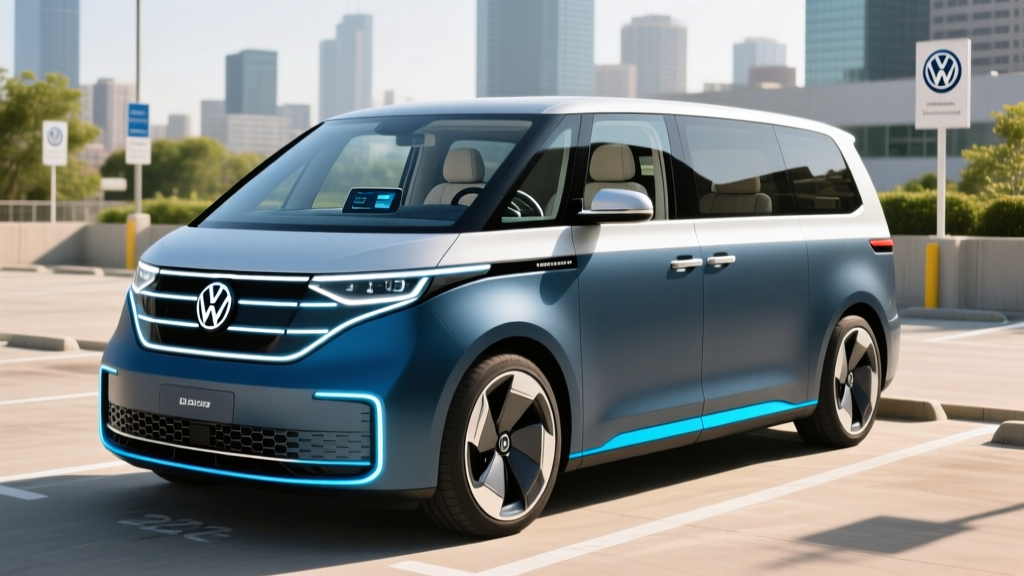
Quick Answer: The 2026 Volkswagen ID. Buzz is VW's all-electric revival of the classic Microbus. It starts at $59,995 (MSRP), delivers an EPA-estimated 234 miles of range (rear-wheel drive) or 231 miles (all-wheel drive), and packs a 91 kWh usable battery (NMC chemistry). Expect real-world highway range closer to 195–210 miles in mild weather and 160–180 miles in freezing temperatures. DC fast charging peaks at 170 kW, reaching 10–80% in approximately 26 minutes. The ID. Buzz does not qualify for the federal §30D tax credit due to its German-built battery sourcing, and its MSRP exceeds the $80,000 van cap only on the 1st Edition trim.
What Is the VW ID. Buzz and Who Is It For?
The 2026 VW ID. Buzz is a three-row, all-electric passenger van built on Volkswagen's MEB platform — the same architecture underpinning the ID.4 crossover. It seats up to seven passengers across three rows and targets families, shuttle operators, and nostalgia-driven buyers who want the Microbus aesthetic without the tailpipe.
VW offers the ID. Buzz in two powertrain configurations:
- Rear-Wheel Drive (RWD): A single rear motor producing 282 hp and 413 lb-ft of torque, with a 0–60 mph time of approximately 7.9 seconds.
- 4Motion All-Wheel Drive (AWD): Dual motors combining for 335 hp and 472 lb-ft, dropping 0–60 to roughly 5.9 seconds.
Both variants share the same 91 kWh usable lithium-ion battery pack (NMC chemistry), liquid-cooled with active thermal management. The ID. Buzz's boxy shape and ~5,500-pound curb weight work against its efficiency — it achieves roughly 87 MPGe combined (RWD), translating to about 39 kWh per 100 miles. That's thirstier than a Tesla Model Y (roughly 28 kWh/100mi) but comparable to other large electric people-movers like the Kia EV9.
| Spec | RWD | AWD (4Motion) |
|---|---|---|
| EPA Range | 234 mi | 231 mi |
| Battery (usable) | 91 kWh, NMC | 91 kWh, NMC |
| Horsepower | 282 hp | 335 hp |
| Torque | 413 lb-ft | 472 lb-ft |
| 0–60 mph | ~7.9 sec | ~5.9 sec |
| Peak DC Fast Charge | 170 kW | 170 kW |
| 10–80% DC Charge Time | ~26 min | ~26 min |
| Level 2 Charge Rate | 11 kW | 11 kW |
| MPGe (combined) | 87 MPGe | 84 MPGe |
| Seating | 7 passengers | 7 passengers |
| Cargo (behind 3rd row) | 18.6 cu ft | 18.6 cu ft |
| Starting MSRP | $59,995 | $63,495 |
Real-World Range: What the EPA Sticker Doesn't Tell You
EPA Estimate: 234 miles (RWD) / 231 miles (AWD)
Real-World Expectation:
- City/mixed driving (mild weather): 215–230 miles
- Highway (70+ mph, mild weather): 195–210 miles
- Highway in freezing temps (below 32°F): 160–180 miles
- Mountain/towing scenarios: 150–175 miles
The ID. Buzz's aerodynamic profile — essentially a rolling brick with a drag coefficient around 0.29 — punishes it at sustained highway speeds. In real-world testing at 75 mph on flat terrain in 65°F conditions, expect to consume roughly 40–42 kWh/100mi, which limits range to approximately 210 miles from a full charge.
Cold weather compounds the issue. NMC chemistry loses efficiency in freezing temperatures, and the cabin heating demand for a vehicle this large is substantial. The ID. Buzz does include a heat pump (standard on all trims), which recovers waste heat from the drivetrain to reduce HVAC energy draw — typically saving 10–15% range in cold weather versus resistive heating alone. Even so, plan for 25–30% range reduction in sustained sub-freezing highway driving.
Practical implication: If your typical one-way commute or errand loop exceeds 90 miles and you lack home charging, the ID. Buzz will require mid-week top-ups. For road trips, plan DC fast charging stops every 170–190 miles to stay above a 10% buffer.
Charging Speed, Connectors, and Home Setup
The ID. Buzz uses a CCS1 connector for DC fast charging and a J1772 inlet for Level 1 and Level 2 AC charging. Volkswagen has not announced a NACS (Tesla Supercharger) adapter timeline for the ID. Buzz as of early 2026, meaning you're limited to Electrify America, EVgo, ChargePoint, and other CCS-compatible networks for DC fast charging.
| Level | Power | Miles Added per Hour | Full Charge Time |
|---|---|---|---|
| Level 1 (120V outlet) | ~1.4 kW | ~3–4 mi/hr | ~65 hours (0–100%) |
| Level 2 (240V, 48A) | 11 kW | ~28–30 mi/hr | ~9 hours (0–100%) |
| DC Fast Charge (peak) | 170 kW | ~160 mi in 10 min (10–50%) | 10–80% in ~26 min |
Charging curve reality: The 170 kW peak rate only holds between roughly 10% and 40% state of charge. Above 50%, the rate tapers to approximately 100–120 kW, and above 80% it drops below 50 kW. This is typical NMC behavior to protect battery longevity, but it means the last 20% of a DC charge session takes disproportionately long. On road trips, it's more time-efficient to charge from 10–80% and resume driving than to wait for a full charge.
Home charging recommendation: A Level 2 home charger is essentially mandatory for ID. Buzz ownership. At 11 kW, you'll recover a full day's driving (~40 miles) in roughly 90 minutes of overnight charging. Expect to spend $800–$1,500 on a quality Level 2 unit (such as a ChargePoint Home Flex or Emporia Level 2) and $500–$2,000 on professional electrical installation, depending on whether your panel needs an upgrade to support a dedicated 60A circuit. Consult a licensed electrician for a site-specific quote.
Cost Breakdown: Purchase, Charging, and Ownership
The ID. Buzz is not a budget vehicle, and its operating costs reflect its size and inefficiency relative to smaller EVs. Here's a realistic ownership picture.
| Cost Category | VW ID. Buzz (RWD) | Honda Odyssey (Gas) |
|---|---|---|
| Purchase Price (base MSRP) | $59,995 | $41,000 |
| Federal Tax Credit (§30D) | $0 (does not qualify) | $0 |
| Home Charger Install | $1,500 | $0 |
| Energy/Fuel (15,000 mi/yr × 5 yr) | $4,900 (at $0.14/kWh avg) | $12,500 (at $3.50/gal, 22 MPG) |
| Maintenance (5 yr) | $1,200 (cabin filter, tires, fluid top-offs) | $3,800 (oil, brakes, trans fluid) |
| Insurance (avg annual × 5) | $12,500 (~$2,500/yr) | $8,500 (~$1,700/yr) |
| Estimated 5-Year Total | ~$80,095 | ~$65,800 |
Key takeaways from this comparison:
- The ID. Buzz saves roughly $7,600 in fuel and $2,600 in maintenance over five years compared to a gas minivan.
- However, the $19,000 higher purchase price and $4,000 higher insurance costs (EVs typically carry higher premiums due to repair costs and battery replacement risk) mean the ID. Buzz does not break even on total cost of ownership within five years.
- The breakeven point vs. a gas minivan extends to approximately 9–11 years of ownership, assuming stable energy and fuel prices.
Federal tax credit status: The ID. Buzz is assembled in Hanover, Germany, and its battery cells do not meet the §30D critical-mineral and battery-component sourcing thresholds. As of 2026, it does not qualify for the $7,500 federal tax credit under current IRS rules. State-level incentives (such as California's CVRP or Colorado's innovative motor vehicle credit) may apply — check your state's energy office for eligibility.
How Does the ID. Buzz Compare to Alternatives?
The ID. Buzz occupies a unique niche — there's no direct electric rival at its price point with three-row seating and van-style cargo. But buyers cross-shop it against electric SUVs and gas minivans.
| Vehicle | Powertrain | Range / MPG | Starting Price | Seating |
|---|---|---|---|---|
| VW ID. Buzz (RWD) | BEV | 234 mi EPA | $59,995 | 7 |
| Kia EV9 (Land AWD) | BEV | 270 mi EPA | $60,900 | 7 |
| Honda Odyssey | Gas | 22 MPG combined | $41,000 | 8 |
| Toyota Sienna (Hybrid) | HEV | 36 MPG combined | $39,500 | 8 |
| Chrysler Pacifica PHEV | PHEV | 32 mi electric + 30 MPG | $51,000 | 7 |
Versus the Kia EV9: The EV9 offers slightly more range, a more efficient drivetrain (~33 kWh/100mi vs. 39), NACS compatibility (access to Tesla Superchargers), and a comparable price. The ID. Buzz wins on interior volume, cargo flexibility, and the emotional appeal of its retro design. If efficiency and charging-network access are priorities, the EV9 is the more pragmatic choice. If you need maximum cargo space and the van lifestyle, the Buzz is unmatched.
Versus the Toyota Sienna Hybrid: The Sienna's 36 MPG combined and $39,500 entry price make it dramatically cheaper to own. It also seats eight and offers 33+ feet of cargo length with seats folded. The ID. Buzz only makes financial sense if you have cheap home solar charging, strong state incentives, or a deep commitment to zero-tailpipe-emission driving.
Common Misconceptions About the Electric VW Van
| Myth | Fact |
|---|---|
| "It gets the $7,500 federal tax credit." | It does not. German assembly and non-qualifying battery sourcing make it ineligible under §30D as of 2026. Always verify at IRS.gov. |
| "234 miles of range is enough for road trips." | Real-world highway range is 195–210 miles in good weather. Plan charging stops every 170–190 miles to maintain a safety buffer. |
| "It charges on Tesla Superchargers." | The ID. Buzz uses CCS1 and does not currently have NACS adapter support from VW. You're limited to Electrify America, EVgo, and other CCS networks. |
| "Electric vans are maintenance-free." | Tires wear 15–20% faster on heavy EVs due to instant torque. Budget for tire replacement every 30,000–40,000 miles. Cabin air filters, brake fluid, and coolant still require service intervals. |
| "I can charge on a regular wall outlet." | Level 1 (120V) adds only 3–4 miles per hour. A full charge takes ~65 hours. Level 2 home installation is practically required. |
Battery Longevity and Warranty Coverage
Volkswagen provides an 8-year / 100,000-mile battery warranty on the ID. Buzz, guaranteeing that the pack will retain at least 70% of its original usable capacity during that period. This is standard for the industry and aligns with Kia, Hyundai, and Ford's EV battery warranties.
NMC chemistry in the ID. Buzz typically degrades at approximately 1.5–2.5% per year under normal use patterns (daily charging to 80%, occasional DC fast charging, avoiding prolonged storage at 100% or below 10% SoC). After 8 years, real-world data from VW's MEB platform vehicles (ID.4, ID.3 in Europe) suggests most packs retain 85–90% capacity, well above the warranty threshold.
Battery replacement cost: If the pack fails outside warranty, current replacement estimates for a 91 kWh MEB battery run $15,000–$22,000 including parts and labor. This figure is expected to decline as battery cell costs continue to fall and the used EV parts market matures.
Longevity tips for ID. Buzz owners:
- Set daily charge limit to 80% and only charge to 100% before long trips.
- Use DC fast charging sparingly — rely on Level 2 home charging for daily needs.
- Enable battery preconditioning when navigating to a DC charger (the ID. Buzz's navigation system activates this automatically).
- Avoid leaving the vehicle at 100% SoC for extended periods, especially in hot climates.
Decision Framework: Should You Buy the VW ID. Buzz?
Buy the ID. Buzz if:
- You need three-row seating and maximum cargo volume in an electric vehicle.
- You have reliable Level 2 home charging and drive fewer than 150 miles per day.
- You value the retro design and are willing to pay a premium for uniqueness.
- Your state offers meaningful EV incentives that offset the lack of federal credit.
- You plan to own the vehicle 8+ years, allowing fuel/maintenance savings to accumulate.
Consider an alternative if:
- You regularly drive 250+ miles between charging opportunities — the real-world range won't suffice without frequent stops.
- You need Supercharger network access for road trips (look at the Kia EV9 or Tesla Model X).
- Budget is a primary concern — the Toyota Sienna hybrid saves $20,000+ upfront and delivers 36 MPG.
- You live in an apartment or lack home charging access — public CCS infrastructure may not support daily needs for a vehicle this inefficient.
- You need the federal tax credit to justify the purchase — the ID. Buzz does not qualify.
Frequently Asked Questions
Does the VW ID. Buzz qualify for any tax credits in 2026?
The ID. Buzz does not qualify for the federal §30D new EV tax credit ($7,500) due to its German assembly and battery sourcing that doesn't meet critical-mineral requirements. However, some state incentives (California, Colorado, New York, and others) may still apply. Check your state energy office or the Alternative Fuels Data Center for local programs.
How long does it take to charge the ID. Buzz at home?
On a Level 2 home charger (240V, 48A, 11 kW), a full 0–100% charge takes approximately 9 hours. Most owners charge from 20–80% overnight, which takes about 5 hours. Level 1 (standard 120V outlet) is impractical for daily use, adding only 3–4 miles per hour.
Can the ID. Buzz tow a trailer?
Yes. The ID. Buzz is rated to tow up to 2,500 pounds (RWD) or 3,500 pounds (AWD). However, towing significantly reduces range — expect a 30–40% range reduction when towing near maximum capacity at highway speeds.
Is the ID. Buzz self-driving or does it have advanced driver assistance?
No. The ID. Buzz comes equipped with VW's IQ.DRIVE suite, which includes adaptive cruise control, lane-keeping assist, and emergency braking. This is a SAE Level 2 driver-assistance system — the driver must remain fully engaged and hands on or near the wheel at all times. It is not autonomous or self-driving.
What happens if the battery degrades significantly?
VW's battery warranty covers capacity below 70% for 8 years or 100,000 miles. Real-world MEB platform data suggests most packs retain 85–90% capacity after 8 years of normal use. If replacement is needed out of warranty, expect costs of $15,000–$22,000, though this should decline over time.
How does cold weather affect the ID. Buzz?
In sustained freezing temperatures (below 32°F), expect 25–30% range loss during highway driving, reducing effective range to 160–180 miles. The standard heat pump helps mitigate cabin-heating energy draw. Preconditioning the battery and cabin while still plugged in at home significantly reduces this penalty.
Sources: EPA Fuel Economy, IRS §30D Tax Credit Rules, Volkswagen USA ID. Buzz Specifications.