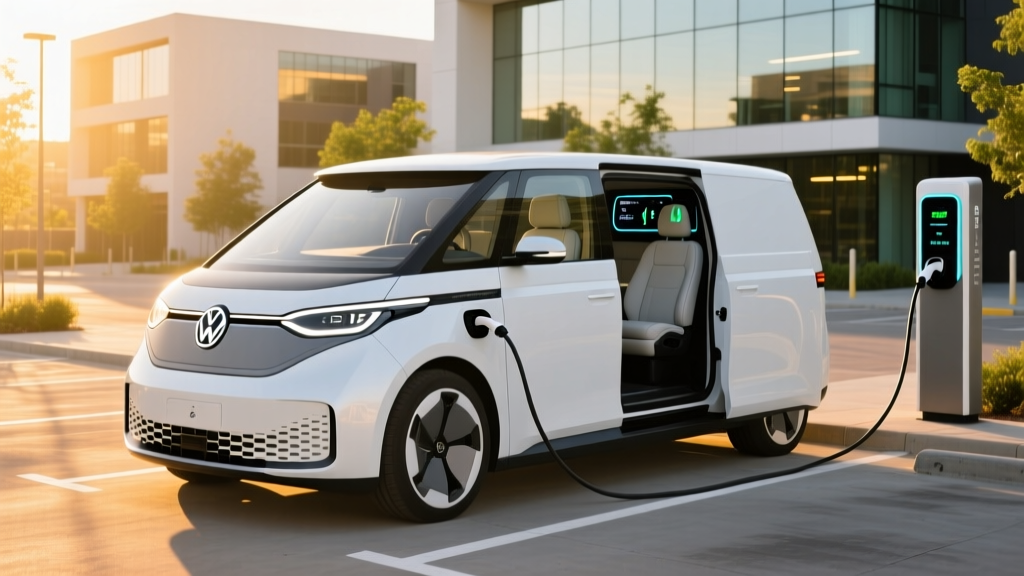
The retro-styled VW ID. Buzz electric van arrived in the United States for the 2025 model year, translating the iconic Microbus silhouette into a three-row, battery-electric people hauler. Built on Volkswagen's MEB platform and assembled in Hannover, Germany, the ID. Buzz is the first electric minivan sold in America — and it enters a market where minivan buyers have had exactly zero plug-in options until now.
But nostalgia doesn't charge your battery or fold your third row. After spending time with the specs, EPA data, and real-world driving dynamics, here's what prospective buyers actually need to know about range, charging speed, pricing, and whether this van earns its premium sticker.
Range and Efficiency: EPA Numbers vs. Reality
The 2025 VW ID. Buzz is available in rear-wheel-drive (RWD) and 4MOTION all-wheel-drive (AWD) configurations. The RWD model carries an EPA-estimated range of 234 miles, while the AWD version drops to 231 miles — a negligible difference on paper, but both figures land well below the 250+ mile threshold many family EV buyers consider a baseline.
EPA sticker: 234 miles (RWD) / 231 miles (AWD)
Highway driving (70-75 mph): Expect ~190-210 miles. The ID. Buzz's boxy aerodynamics penalize efficiency at speed.
Cold weather (below 32°F): Anticipate 165-190 miles with cabin heating active. The van lacks a heat pump on base trims, relying on resistive heating that draws heavily from the pack.
City/suburban mixed driving: Closest to EPA — roughly 220-235 miles with regen braking engaged.
Efficiency clocks in at 87 MPGe combined (RWD), translating to roughly 38 kWh per 100 miles. For context, the Chrysler Pacifica Hybrid PHEV achieves 82 MPGe in electric mode but can fall back on its gas engine. The ID. Buzz has no such safety net — when the battery depletes, you're parked.
The usable battery capacity is 86 kWh (91 kWh gross), using NMC (nickel manganese cobalt) chemistry. VW has not offered an LFP option, which means the pack prioritizes energy density over the extended cycle life and cobalt-free sourcing that LFP provides. For a vehicle this heavy — curb weight exceeds 5,800 pounds — the NMC choice makes sense for packaging, but buyers who planned to keep the van for 15+ years should note that NMC packs typically show slightly more calendar degradation than LFP over long time horizons.
Charging Speed: DC Fast Charging and Home Setup
Charging performance is where the ID. Buzz reveals both its strengths and its MEB-platform limitations.
| Charging Level | Power / Rate | Time / Miles Added |
|---|---|---|
| Level 1 (120V household) | ~1.4 kW | ~3-4 miles per hour |
| Level 2 (240V home/public) | 11 kW (onboard charger max) | ~30 miles per hour; full charge ~9 hours |
| DC Fast Charge (CCS) | Peak 170 kW | 10-80% in ~26 minutes |
The 170 kW peak DC fast-charge rate is adequate but not class-leading. Competitors like the Kia EV9 peak at 236 kW and hit 10-80% in roughly 20 minutes. The ID. Buzz's charge curve is relatively flat through 50% SoC, then tapers noticeably past 80% — a common NMC pattern to protect cell longevity, but it means that 80-100% top-up adds substantial time on road trips.
On a Level 2 home charger (the 48A / 11.5 kW units common in residential installs), the 11 kW onboard charger caps intake. You'll recover from 20% to full overnight in about 8-9 hours — perfectly adequate for daily use, provided your commute doesn't regularly exceed 150 miles round-trip.
The ID. Buzz uses the CCS1 connector for DC fast charging. VW has committed to transitioning to NACS (Tesla-style) for future models, but the 2025 ID. Buzz ships with CCS. Adapters are available for Tesla Supercharger access, and VW includes a complimentary Electrify America charging credit with new purchases.
Performance and Drivetrain
| Specification | RWD | AWD (4MOTION) |
|---|---|---|
| Horsepower | 282 hp | 330 hp |
| 0-60 mph | ~7.9 seconds | ~6.5 seconds |
| Drivetrain | Rear motor, RWD | Dual motor, AWD |
| Curb Weight | ~5,826 lbs | ~6,058 lbs |
| Towing Capacity | Not rated | Not rated |
The RWD model's single rear motor delivers 282 hp — adequate for merging and city driving, but you'll feel the van's mass when climbing grades or attempting quick highway lane changes. The AWD's dual-motor setup bumps output to 330 hp and shaves over a second off the 0-60 time, making it the more confident choice for mountain passes or heavy cargo loads.
Neither variant is rated for towing — a significant omission for a vehicle this size. If you need to pull a small trailer or boat, the Kia EV9 (towing up to 5,000 lbs when properly equipped) or a body-on-frame electric truck is a better fit.
Interior Space, Cargo, and Tech
The ID. Buzz is a genuine three-row vehicle, but the third row is best suited for children or occasional use. Key dimensions:
- Cargo behind 3rd row: 18.2 cu ft
- Cargo behind 2nd row (3rd row folded): 75.5 cu ft
- Maximum cargo (all rear seats folded): 131.5 cu ft
- Second-row legroom: 39.6 inches
- Third-row legroom: 32.7 inches
The second-row captain's chairs slide and recline, offering generous adult comfort. The third row, however, is tight for anyone over 5'6" on longer trips. Compared to the Chrysler Pacifica or Toyota Sienna, the ID. Buzz sacrifices roughly 10-15 cu ft of maximum cargo volume — the trade-off for its shorter overall length and tighter turning radius.
Infotainment runs on VW's IDL 4.0 system with a 12.9-inch touchscreen. Wireless Apple CarPlay and Android Auto are standard. The driver gets a 5.3-inch digital cluster. Available features include a head-up display, Harman Kardon premium audio, and a panoramic fixed-glass roof with electrochromic dimming.
Driver assistance falls under IQ.DRIVE, VW's Level 2 ADAS suite. It includes adaptive cruise control with stop-and-go, lane centering, automatic emergency braking with pedestrian detection, and Travel Assist (which combines ACC and lane centering for highway use). This is a hands-on, eyes-on system — not self-driving — and it requires continuous driver supervision per NHTSA guidelines for Level 2 automation.
Pricing, Trims, and Federal Tax Credit Eligibility
The ID. Buzz is positioned as a premium electric van, and pricing reflects that ambition.
| Trim | Drivetrain | MSRP | Est. After §30D Credit* |
|---|---|---|---|
| Pro S (base) | RWD | $59,995 | $52,495 |
| Pro S Plus | RWD | $63,495 | $55,995 |
| 1st Edition | AWD | $69,995 | $62,495 |
*Prices include destination. Tax credit estimates assume full $7,500 §30D eligibility — see caveats below.
- MSRP cap: Vans fall under the $80,000 cap for SUVs/vans — the ID. Buzz qualifies on price.
- Buyer income limits: $300,000 (married filing jointly), $225,000 (head of household), $150,000 (single).
- Battery sourcing: Critical minerals and battery components must meet escalating domestic-content thresholds. VW sources cells from SK On and LG Energy Solution; consult the IRS clean vehicle credit page for the current year's approved vehicle list, as eligibility can shift with supply-chain changes.
- Point-of-sale transfer: Buyers can transfer the credit to the dealer at purchase, reducing the upfront price rather than waiting for a tax refund.
- North American assembly: The ID. Buzz is built in Germany, which may affect eligibility depending on current-year final assembly rules. Verify on fueleconomy.gov before purchasing.
The German assembly point is the biggest variable. The §30D credit requires final assembly in North America, and while VW has pursued various compliance pathways, buyers should confirm the ID. Buzz's current eligibility status directly on the IRS and DOE vehicle lookup tools before signing paperwork. Do not rely on dealer assurances alone.
Warranty and Battery Longevity
Volkswagen backs the ID. Buzz with:
- Battery warranty: 8 years / 100,000 miles (whichever comes first), guaranteeing a minimum of 70% capacity retention.
- Powertrain warranty: 8 years / 100,000 miles.
- Bumper-to-bumper: 4 years / 50,000 miles.
The 70% retention threshold at 8 years is industry-standard. Real-world MEB data from the ID.4 (which shares the platform) suggests most packs retain 90%+ capacity at 50,000 miles, with degradation curves flattening after the initial 10-15% loss in the first two years. NMC chemistry generally holds up well under moderate use, but frequent DC fast charging above 80% SoC and regular exposure to extreme heat will accelerate wear.
Pros, Cons, and Who Should Buy
- Only all-electric three-row minivan on the US market
- Distinctive retro styling with strong curb appeal
- Comfortable second-row captain's chairs with ample legroom
- 11 kW Level 2 onboard charger (faster than many competitors)
- Tight 36.2-foot turning circle for easy urban maneuvering
- Standard IQ.DRIVE Level 2 driver-assist suite
- 234-mile EPA range is below average for a $60K+ EV
- 170 kW peak DC charge speed trails the Kia EV9 and others
- Third row is cramped for adults on longer trips
- No towing capacity
- German assembly may jeopardize §30D tax credit eligibility
- No heat pump on base trims hurts cold-weather range
- High starting price for the class
Buy it if: You want a stylish, all-electric daily driver for school runs, weekend activities, and suburban commuting under 120 miles round-trip — and you value the three-row minivan format without wanting a PHEV or gas engine.
Look elsewhere if: You regularly drive 200+ miles between charges, need towing capability, want the fastest DC charging for road trips, or require a genuinely spacious third row for adults. The Kia EV9 (300-mile range, 5,000-lb towing, faster charging) or Chrysler Pacifica Hybrid (gas backup, lower price) may serve you better.
Competitive Landscape: ID. Buzz vs. Alternatives
The ID. Buzz occupies a narrow lane. Here's how it stacks up against the closest alternatives:
| Attribute | VW ID. Buzz (RWD) | Kia EV9 (LR RWD) | Chrysler Pacifica Hybrid |
|---|---|---|---|
| Powertrain | BEV | BEV | PHEV |
| EPA Range / EV Mode | 234 mi | 300 mi | 32 mi electric + gas |
| DC Fast Charge (peak) | 170 kW | 236 kW | N/A (Level 2 only) |
| Starting MSRP | $59,995 | $54,900 | $42,995 |
| Third Row | Tight | Usable for adults | Spacious |
| Towing | None | 5,000 lbs | 3,600 lbs |
The Kia EV9 is the ID. Buzz's most direct electric rival: it offers more range, faster charging, a usable third row, and towing — at a lower starting price. The ID. Buzz wins on minivan-specific conveniences (sliding doors, lower step-in height, flat load floor) and sheer personality. The Pacifica Hybrid eliminates range anxiety entirely with its gas engine but requires you to plug in regularly to capture its efficiency advantage.
Frequently Asked Questions
What is the real-world range of the VW ID. Buzz electric van?
The EPA rates the RWD ID. Buzz at 234 miles. In real-world highway driving at 70+ mph, expect roughly 190-210 miles. In cold weather below freezing with cabin heat, plan for 165-190 miles. City and suburban driving with regenerative braking can approach the EPA figure.
How fast does the VW ID. Buzz charge?
On a DC fast charger, the ID. Buzz peaks at 170 kW and reaches 10-80% in approximately 26 minutes. On a Level 2 home charger (240V, 48A), the 11 kW onboard charger adds about 30 miles per hour, filling the pack from empty in roughly 9 hours.
Does the VW ID. Buzz qualify for the $7,500 federal EV tax credit?
Eligibility is uncertain due to the ID. Buzz's German assembly. The §30D credit requires North American final assembly, and while the MSRP and buyer income may qualify, the assembly location is a potential disqualifier. Always verify on fueleconomy.gov and consult a tax professional before relying on the credit.
Is the VW ID. Buzz worth buying over the Kia EV9?
If you prioritize minivan features — power sliding doors, low load floor, easy child-seat access — the ID. Buzz offers something the EV9's SUV format cannot. If range, charging speed, towing, and third-row space are your top criteria, the EV9 is the more capable and less expensive electric vehicle.
What are the biggest drawbacks of the VW ID. Buzz?
The 234-mile EPA range is modest for the price. DC charging tops out at 170 kW, which is slower than rivals. The third row is tight for adults. There is no towing capability. And the German build location may disqualify it from the federal tax credit.
Does the ID. Buzz have self-driving capability?
No. The IQ.DRIVE system is a Level 2 driver-assist suite per SAE classification. It provides adaptive cruise and lane centering but requires the driver to remain fully engaged — hands on or near the wheel, eyes on the road — at all times.