Quick Answer: Is the Electric VW Van Worth Buying?
The 2026 Volkswagen ID. Buzz is a three-row electric minivan starting at $61,545, delivering an EPA-estimated 234 miles of range (RWD Pro S trim) from a 91 kWh usable NMC battery. It DC fast-charges at up to 200 kW, adding 10–80% in roughly 26 minutes. Compared to the gas Honda Odyssey or Toyota Sienna hybrid, the ID. Buzz costs more upfront but saves roughly $1,400–$1,700 annually on fuel and has dramatically lower maintenance costs. However, real-world highway range drops to approximately 185–200 miles, and cold-weather driving can shave another 20–30% off that figure. The ID. Buzz currently does not qualify for the $7,500 federal §30D tax credit due to battery-sourcing requirements. If you need a three-row family hauler with zero tailpipe emissions and can charge at home, it's a compelling option. If you regularly tow or drive 300+ miles in a single day in winter, a hybrid minivan may serve you better.
What Is the Electric VW Van? The 2026 ID. Buzz Explained
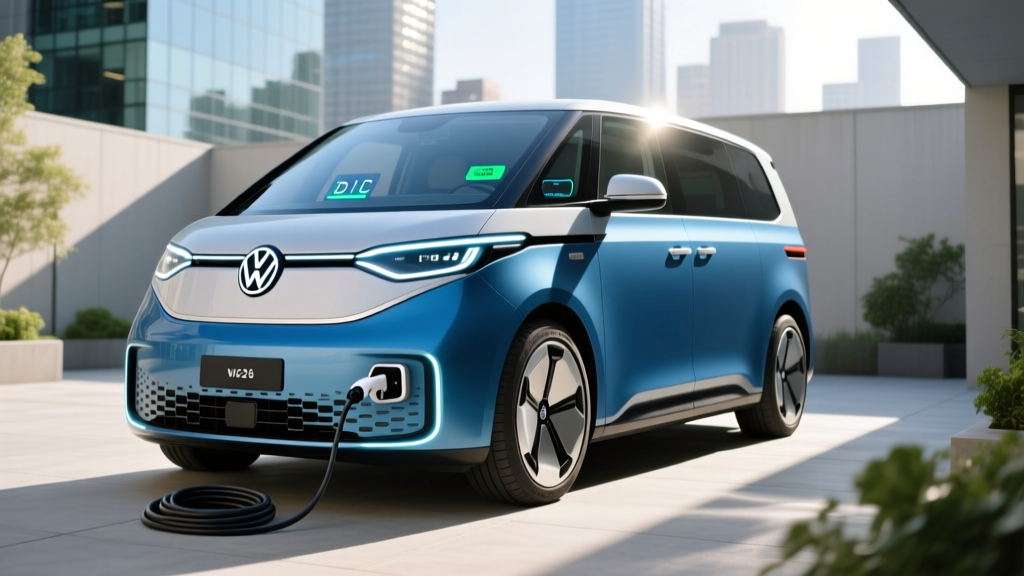
The electric VW van — officially the Volkswagen ID. Buzz — is VW's all-electric revival of its iconic Microbus, now built on the company's MEB platform. For the 2026 model year, it's sold exclusively in the United States as a long-wheelbase (LWB) three-row passenger van with seating for up to seven. It is not a compact two-row Euro-market van; the U.S. version is significantly larger, closer in dimensions to a Chrysler Pacifica or Kia Carnival.
Two powertrain configurations are available: rear-wheel drive (RWD) with a single 282-hp motor, and 4Motion all-wheel drive (AWD) with dual motors producing 335 hp. Both use the same 91 kWh (usable) nickel-manganese-cobalt (NMC) lithium-ion battery pack.
| Spec | RWD Pro S | AWD Pro S Plus |
|---|---|---|
| Base MSRP | $61,545 | $67,045 |
| EPA Range | 234 miles | 216 miles |
| Battery (usable) | 91 kWh NMC | 91 kWh NMC |
| Peak DC Fast Charge | 200 kW | 200 kW |
| 10–80% DCFC Time | ~26 minutes | ~26 minutes |
| Level 2 AC Charge Rate | 11 kW (7.7 kW standard) | 11 kW (7.7 kW standard) |
| Horsepower | 282 hp | 335 hp |
| 0–60 mph | 7.3 sec | 5.9 sec |
| MPGe (combined) | 90 MPGe | 85 MPGe |
| Battery Warranty | 8 yr / 100,000 mi | 8 yr / 100,000 mi |
| Federal Tax Credit (§30D) | Not eligible* | Not eligible* |
*As of 2026, the ID. Buzz does not meet the critical-minerals and battery-component sourcing requirements under IRS §30D. Always verify current eligibility at irs.gov before purchase.
Real-World Range: What You'll Actually Get
The EPA sticker says 234 miles for the RWD model, but real-world conditions tell a different story — as they do with every EV.
EPA vs. Reality: 2026 ID. Buzz RWD
EPA Estimate: 234 miles
Mixed driving (city + suburban): ~215–230 miles
Sustained 70–75 mph highway: ~185–200 miles
Cold weather (below 30°F), highway: ~145–165 miles
Towing (max 2,500 lbs): ~130–155 miles
At highway speeds, the ID. Buzz's boxy aerodynamic profile works against it. The minivan shape creates more drag than a sleek crossover like the Hyundai Ioniq 5, so efficiency drops notably above 65 mph. In cold weather, the NMC battery requires more energy for thermal conditioning, and cabin heating draws substantial power — even with the available heat pump on higher trims.
The 91 kWh usable capacity is generous, which provides a buffer against range loss. But if your typical winter commute is 80+ miles round-trip with no mid-day charging, the AWD model's lower EPA rating (216 miles) combined with cold-weather loss could leave you with under 150 miles of practical range. Plan accordingly.
Charging the ID. Buzz: Speed, Connectors & Home Setup
The ID. Buzz uses the NACS (Tesla-style) charging connector for the 2026 model year, aligning with Volkswagen's transition to the North American Charging Standard. This means native access to Tesla Supercharger stations (now open to non-Tesla EVs) in addition to Electrify America, EVgo, and other networks using NACS adapters or native cables.
| Level | Power | Miles Added/Hour | Typical Use |
|---|---|---|---|
| Level 1 (120V) | 1.4 kW | ~4 mi/hr | Emergency / overnight trickle |
| Level 2 (240V, 32A) | 7.7 kW | ~23 mi/hr | Standard home charger |
| Level 2 (240V, 48A) | 11 kW | ~33 mi/hr | Upgraded home / workplace |
| DC Fast Charge | Up to 200 kW | ~550 mi/hr (peak) | Road trips, 10–80% in ~26 min |
A full Level 2 charge from empty to 100% at 11 kW takes approximately 8.5 hours — ideal for overnight charging. At the standard 7.7 kW rate, expect closer to 12 hours.
Charging curve reality: The ID. Buzz peaks at 200 kW only between roughly 10–30% state of charge. From 30–60% it sustains around 130–150 kW, and above 80% it tapers sharply to under 50 kW to protect battery health. That 10–80% time of ~26 minutes assumes you arrive at the charger with a preconditioned battery (use the built-in navigation routing to a DC fast charger to enable preconditioning automatically).
Home charging cost: Installing a dedicated 240V/48A Level 2 home charger typically costs $1,200–$2,800 total (equipment, electrician labor, permit), assuming your electrical panel has capacity. A panel upgrade to 200A can add $1,500–$3,500. Always get a site assessment from a licensed electrician.
ID. Buzz vs. Gas and Hybrid Minivans: The Cost Comparison
The most common question from minivan shoppers: does the electric VW van actually save money compared to a Toyota Sienna hybrid or a conventional gas minivan like the Honda Odyssey? Here's the data.
| Category | VW ID. Buzz RWD | Toyota Sienna Hybrid AWD | Honda Odyssey (Gas) |
|---|---|---|---|
| Base MSRP | $61,545 | $39,645 | $40,690 |
| Federal Tax Credit | $0 | $0 | $0 |
| Energy/Fuel (5 yrs)* | $4,900 | $7,800 | $12,100 |
| Maintenance (5 yrs) | $1,800 | $3,600 | $4,100 |
| Insurance (5 yrs, avg) | $10,200 | $8,400 | $8,700 |
| Estimated Depreciation | $28,500 | $17,800 | $19,200 |
| Total 5-Year Cost | $106,945 | $77,245 | $84,790 |
*Energy costs assume $0.16/kWh national average for home charging and 20% DC fast-charging at $0.40/kWh; gas at $3.45/gal. Actual costs vary significantly by region and driving pattern. Source: fueleconomy.gov data and AAA ownership cost methodology.
The numbers show a clear pattern: the ID. Buzz costs substantially more to purchase and depreciates faster (typical of luxury-priced EVs), but it saves $7,200+ in fuel and maintenance over five years. The gap narrows if electricity costs are high in your area or if you drive significantly fewer than 15,000 miles annually.
Where the ID. Buzz wins financially: High-mileage commuters in states with cheap electricity (under $0.12/kWh) and access to state/local incentives (e.g., California's CVRP, Colorado's state EV credit). If you drive 20,000+ miles per year and charge at home, the fuel savings alone can exceed $2,500 annually.
Where hybrids win: If you can't charge at home, live in a charging desert, regularly drive 300+ miles in a day, or need to tow more than 2,500 lbs. The Sienna hybrid's 35 MPG combined and 530-mile total range are hard to beat for road-trip-heavy families.
Federal Tax Credit & Incentive Reality
As of the 2026 model year, the Volkswagen ID. Buzz does not qualify for the $7,500 federal EV tax credit under IRS §30D. The vehicle's battery components and critical minerals do not currently meet the domestic-sourcing thresholds mandated by the Inflation Reduction Act.
§30D Federal Tax Credit Requirements (2026)
- MSRP cap: Vans/minivans must be under $80,000 (ID. Buzz qualifies at $61,545 base)
- Buyer income cap: $150K single / $225K head of household / $300K joint filers
- Battery component sourcing: Must be manufactured or assembled in North America (ID. Buzz battery is sourced from overseas suppliers — fails this requirement)
- Critical minerals: Must be extracted or processed in the U.S. or a free-trade-agreement country (partial compliance)
- Point-of-sale transfer: If eligible, credit can be applied at the dealer to reduce out-of-pocket cost
However, the ID. Buzz may qualify for state-level incentives depending on your location. States like California, Colorado, Massachusetts, and New York offer additional rebates or tax credits that can reduce the purchase price by $2,000–$7,500. Check your state energy office or the Alternative Fuels Data Center for current programs. Some utilities also offer $500–$1,500 rebates for home charger installation.
Common Misconceptions About the Electric VW Van
| Myth | Fact |
|---|---|
| "It's a tiny retro van like the old Microbus" | The U.S. ID. Buzz is 195.1 inches long — larger than a Honda Odyssey. It seats seven and has 18.4 cu ft of cargo behind the third row. |
| "You can charge it at any Tesla Supercharger" | With the 2026 NACS connector, yes — the ID. Buzz natively accesses V3 and V4 Superchargers without an adapter. But always check the Tesla app for station availability and NACS-cable-equipped stalls. |
| "The battery will need replacing in 5 years" | VW warranties the battery for 8 years/100,000 miles with a minimum 70% capacity retention. Industry data shows NMC packs typically retain 85–90% after 100,000 miles under normal use. Replacement, if ever needed, currently runs $15,000–$22,000. |
| "It qualifies for the $7,500 federal tax credit" | As of 2026, it does not meet battery-sourcing requirements. Always check fueleconomy.gov for the latest eligibility list. |
| "EVs have zero maintenance" | You still need tire rotations (EVs wear tires faster due to weight and torque), cabin air filter changes, brake fluid checks, and windshield washer fluid. But you eliminate oil changes, transmission service, spark plugs, and exhaust repairs. |
Who Should Buy the ID. Buzz — And Who Shouldn't
Decision Framework: Is the Electric VW Van Right for You?
Choose the ID. Buzz if:
- You can install a Level 2 home charger and your daily driving is under 150 miles round-trip
- You want a three-row electric family vehicle and value VW's driving dynamics and interior design
- You live in a mild or moderate climate (cold-weather range loss is a factor below 30°F)
- You want to eliminate gas station visits and reduce your household carbon footprint
- Your state offers additional EV incentives that bridge the price gap with hybrid minivans
Choose a hybrid minivan (Sienna, Pacifica PHEV) if:
- You cannot charge at home (apartment, street parking, no 240V outlet access)
- You regularly drive 300+ miles in a single day and don't want to plan charging stops
- You live in extreme cold (consistently below 15°F) where range loss exceeds 30%
- You need to tow more than 2,500 lbs (the ID. Buzz's max tow rating is 2,500 lbs; the Odyssey handles 3,500 lbs)
- Your budget is under $50,000 and you need the lowest total cost of ownership
First-Time EV Buyer Tips for the ID. Buzz
If the ID. Buzz is your first electric vehicle, here's what to prepare for:
- Get a professional home charging assessment before buying. A licensed electrician should evaluate your panel capacity, the distance from panel to garage/driveway, and whether a 200A panel upgrade is needed. Budget $1,200–$2,800 for a standard install, up to $5,000+ if a panel upgrade is required.
- Download charging network apps before your first road trip. The ID. Buzz's built-in navigation integrates with Electrify America, but you'll also want the Tesla app (for Supercharger access), PlugShare (for finding any charger), and EVgo/ChargePoint apps as backups.
- Learn to precondition. When navigating to a DC fast charger, the ID. Buzz automatically warms or cools the battery for optimal charging speed. If you skip preconditioning, your first 10 minutes at a 200 kW charger may only draw 60–80 kW.
- Expect higher insurance premiums. EV insurance typically runs 15–25% higher than comparable gas vehicles due to repair costs and battery replacement risk. Get quotes from Geico, Progressive, and State Farm before purchasing — EV-specific insurers like Tesla Insurance (where available) can sometimes offer competitive rates.
- Don't obsess over 100% charging. For daily driving, charge to 80% to preserve long-term battery health. Use 100% only when you need maximum range for a road trip. The ID. Buzz's infotainment system lets you set a charge limit.
Frequently Asked Questions
How long does it take to charge the VW ID. Buzz at home?
With a 48A Level 2 home charger (11 kW), a full charge from 0–100% takes approximately 8.5 hours. With a standard 32A charger (7.7 kW), it takes about 12 hours. Most owners charge overnight and wake up to a full battery every morning.
Does the ID. Buzz have a frunk (front trunk)?
No. The ID. Buzz does not have a front trunk. All cargo space is in the rear — 18.4 cu ft behind the third row, expanding to 75.5 cu ft with the second and third rows folded. This is competitive with the Chrysler Pacifica but less than the Honda Odyssey's maximum cargo volume.
Can the ID. Buzz tow?
Yes, but modestly. The maximum tow rating is 2,500 lbs (braked trailer). That's sufficient for a small utility trailer, a pair of jet skis, or a light camping trailer, but not a full-size boat or large travel trailer. Expect range to drop by 35–45% when towing near maximum capacity.
What is the ID. Buzz's safety rating?
The 2026 ID. Buzz has not yet been rated by NHTSA or IIHS at the time of publication. The European-market short-wheelbase version earned a 5-star Euro NCAP rating. The U.S. LWB version includes standard automatic emergency braking, lane-keeping assist, adaptive cruise control, and blind-spot monitoring. Check nhtsa.gov for updated crash-test results.
Will the ID. Buzz qualify for the tax credit in the future?
Volkswagen has indicated it is working to localize battery supply chains for U.S.-built models. If battery sourcing shifts to meet §30D requirements, the ID. Buzz could become eligible in a future model year. However, tax credit rules also change with legislation — consult a tax professional and check the IRS clean vehicle credit page for current rules before assuming eligibility.
How does the ID. Buzz handle in snow and ice?
The AWD 4Motion model provides confident traction in snow, with dual motors distributing torque to both axles. The vehicle's 5,800+ lb curb weight helps with stability. However, winter tires are strongly recommended in regions with sustained snow and ice — the stock all-season tires prioritize efficiency over winter grip. Expect 20–30% range loss in sustained sub-freezing temperatures regardless of drivetrain.