Quick Answer: The 2026 Volkswagen ID. Buzz is VW's all-electric reinterpretation of the classic Microbus, seating up to seven with a distinctive, lounge-style cabin. It carries a 91 kWh (usable) NMC battery delivering an EPA-estimated 234 miles of range (RWD) or 231 miles (AWD), peaks at 170 kW DC fast charging (10–80% in ~26 minutes), and starts at $61,495 before destination. It does not currently qualify for the full $7,500 federal §30D tax credit due to battery-sourcing requirements, and its real-world highway range drops to roughly 195–210 miles. For buyers seeking a three-row electric people-mover with standout interior design, it's compelling; for those prioritizing maximum range-per-dollar or minivan cargo volume, alternatives like the Kia EV9 or Chrysler Pacifica Hybrid deserve a hard look.
What the VW ID. Buzz Electric Interior Actually Offers
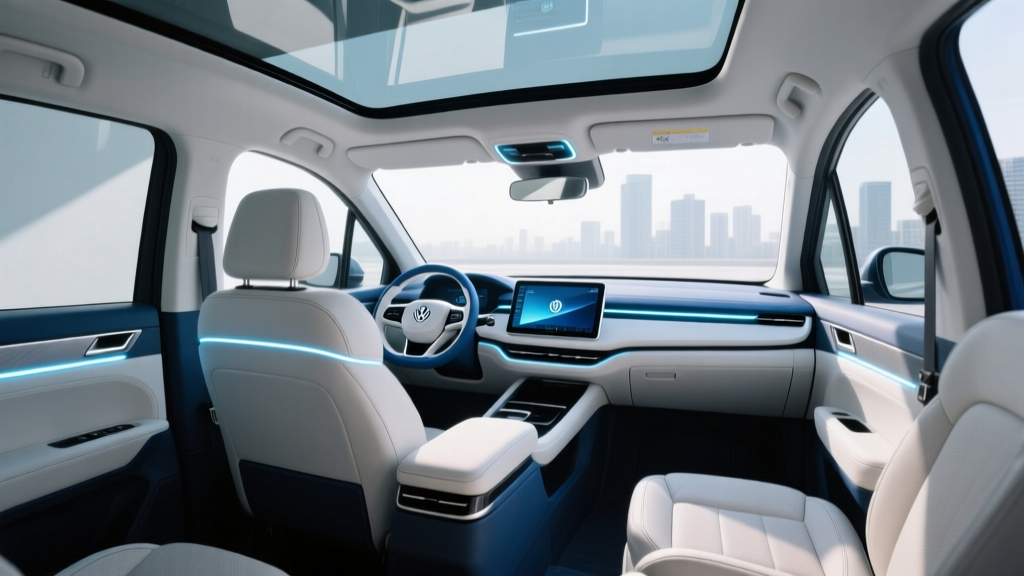
The phrase electric interior VW van draws buyers in for a reason: the ID. Buzz cabin is the main event. VW leaned heavily into retro-modern design with a flat floor, configurable seating (2-3-2 layout available on long-wheelbase models, 2-2-2 on the standard), ambient lighting strips, and a minimalist dashboard dominated by a 12.9-inch infotainment screen. Materials mix recycled fabrics with soft-touch surfaces, and the available panoramic glass roof floods the cabin with light.
But the interior experience only matters if the powertrain underneath supports your driving life. Here are the core specifications for the 2026 model year:
| Spec | RWD (Standard) | AWD (4Motion) |
|---|---|---|
| Battery (usable) | 91 kWh, NMC | 91 kWh, NMC |
| EPA Range | 234 miles | 231 miles |
| Motor Output | 282 hp / 406 lb-ft | 335 hp / 406 lb-ft |
| 0–60 mph | 7.9 sec | 5.9 sec |
| Peak DC Charge Rate | 170 kW | 170 kW |
| 10–80% DC Fast Charge | ~26 min | ~26 min |
| Level 2 (AC) Rate | 11 kW | 11 kW |
| MPGe (combined) | 87 MPGe | 84 MPGe |
| Cargo (behind 3rd row) | 18.4 cu ft | 18.4 cu ft |
| Towing Capacity | 2,500 lbs | 2,500 lbs |
Source: fueleconomy.gov and VW of America official specifications.
Real-World Range Reality: The EPA rates the RWD ID. Buzz at 234 miles. Expect roughly 195–210 miles on sustained 70+ mph highway driving, and as low as 165–180 miles in sub-freezing winter conditions without preconditioning. The 91 kWh battery and 2.8 mi/kWh efficiency mean you'll be planning charging stops on any trip over ~180 miles. Always precondition the battery via the vehicle's navigation system before DC fast charging to hit that 170 kW peak — without it, cold-soak can cut peak rates to under 80 kW.
Cost Breakdown: Purchase, Charging, and 5-Year Ownership
The ID. Buzz is not a budget vehicle. At $61,495 for the base Pro S trim (RWD), it competes with premium minivans and mid-size electric SUVs, not economy vans. Here's what ownership actually costs over five years and 75,000 miles, assuming 15,000 miles/year and a national-average electricity rate of $0.16/kWh.
| Cost Category | VW ID. Buzz (RWD) | Honda Odyssey (Gas Baseline) |
|---|---|---|
| Base MSRP | $61,495 | $41,000 |
| Estimated Federal Tax Credit | $0–$3,750* | $0 |
| Fuel / Electricity (75k mi) | $3,440 (electric) | $9,375 (gas @ $3.75/gal, 22 MPG) |
| Maintenance (5 yr) | ~$1,200 | ~$3,800 |
| Insurance (avg, 5 yr) | ~$11,500 | ~$8,500 |
| Estimated Depreciation (5 yr) | ~$24,600 (40%) | ~$16,400 (40%) |
| Total 5-Year Cost | ~$77,235 | ~$79,075 |
*The ID. Buzz's §30D tax credit eligibility is limited. As of 2026, battery-sourcing and critical-mineral requirements under IRS §30D rules restrict the full $7,500 credit for many VW EVs. Check current eligibility on irs.gov or consult a tax professional before purchase. Point-of-sale transfer is available if you qualify.
The ID. Buzz saves substantially on fuel and maintenance — no oil changes, no transmission fluid, and regenerative braking extends pad life. But higher insurance premiums (common for EVs due to repair costs and parts pricing) and steeper upfront depreciation partially offset those gains. The total cost of ownership is close to a gas minivan over five years, but the ID. Buzz buyer is paying a premium for the driving experience, cabin quality, and zero tailpipe emissions — not pure economics.
ID. Buzz vs. Gas Minivan vs. Electric SUV: Which Fits?
Buyers cross-shopping the ID. Buzz typically compare it against three categories: traditional gas minivans, three-row electric SUVs, and the Chrysler Pacifica Plug-In Hybrid. Here's how they stack up on the numbers that matter.
| Spec | VW ID. Buzz (RWD) | Kia EV9 (AWD LR) | Chrysler Pacifica PHEV | Honda Odyssey (Gas) |
|---|---|---|---|---|
| Base MSRP | $61,495 | $56,900 | $51,095 | $41,000 |
| EPA Range / MPG | 234 mi (87 MPGe) | 280 mi (89 MPGe) | 32 mi electric + 30 MPG gas | 22 MPG combined |
| Battery / Powertrain | 91 kWh NMC | 100 kWh NMC | 16 kWh + 3.6L V6 | 3.5L V6 |
| Seats | 6 or 7 | 6 or 7 | 7 | 7 or 8 |
| Cargo (behind 3rd row) | 18.4 cu ft | 20.2 cu ft | 32.3 cu ft | 38.6 cu ft |
| DC Fast Charge (10–80%) | ~26 min @ 170 kW | ~24 min @ 236 kW | N/A (Level 2 only, ~2 hr) | N/A (gas) |
| Towing | 2,500 lbs | 5,000 lbs | 3,600 lbs | 3,500 lbs |
The ID. Buzz trails the EV9 on range, charging speed, cargo space, and towing — but wins on interior character and ride comfort. Against the Pacifica PHEV, it offers zero-emission daily driving without the gas-engine fallback, but the Pacifica's 32-mile electric range plus unlimited gas range makes it a safer bet for families in charging deserts or those who regularly tow. The gas Odyssey remains the cargo and cost-of-entry champion, though it costs more to fuel and maintain over time.
Home Charging and Real-World Ownership Considerations
Owning the ID. Buzz — or any EV — hinges on your charging situation. Here's what first-time EV buyers need to map out before signing a purchase agreement:
Level 2 Home Charging: The Daily Backbone
The ID. Buzz accepts up to 11 kW on Level 2 AC. With a 48-amp home wallbox on a 240V/60A circuit, you'll add roughly 28–30 miles of range per hour of charging. A full 10–100% charge takes about 9 hours — perfect for overnight replenishment. If your home has a standard 240V dryer-style outlet (NEMA 14-50), a portable cord like the Emporia or ChargePoint Home Flex can deliver 9.6 kW (~25 mi/hr), covering most daily needs.
Home charging installation typically runs $800–$2,500 depending on panel capacity, conduit length, and local permit requirements. If your electrical panel is at or near capacity (common in older homes with 100A service), a panel upgrade to 200A can add $2,000–$4,000. Always get a quote from a licensed electrician before committing to the vehicle.
DC Fast Charging on Road Trips
The ID. Buzz uses the CCS1 connector natively (NACS adapter available through VW for Tesla Supercharger access). At a 170+ kW Electrify America or EVgo station, the charge curve peaks around 170 kW from roughly 10–30% SoC, then tapers progressively: ~120 kW at 50%, ~80 kW at 70%, and ~40 kW above 85%. That 10–80% time of ~26 minutes assumes battery preconditioning is active — navigational routing to a charger triggers this automatically.
On a 400-mile road trip, plan two charging stops of 25–30 minutes each. That's 50–60 minutes of added travel time versus a single 10-minute gas fill-up. For families accustomed to rest-stop breaks every two hours anyway, the impact is manageable. For time-sensitive drives, it's a real trade-off.
Climate and Driving Pattern Realities
Cold-weather range loss is physical, not a defect. At 20°F, the ID. Buzz's NMC battery loses roughly 20–30% of its usable capacity without cabin preconditioning. Using the heat pump (standard on the ID. Buzz) reduces this penalty to approximately 15–20%. If your daily commute is under 80 miles round-trip and you can charge at home, cold-weather range loss is an inconvenience but not a dealbreaker. If you live in the upper Midwest or Northeast and regularly drive 150+ miles in winter, factor in the reduced buffer.
Common Misconceptions About the ID. Buzz
| Myth | Fact |
|---|---|
| "It gets 234 miles, so I can drive 234 miles." | EPA is a lab estimate. Highway driving at 75 mph yields ~195–210 miles. Cold weather cuts this further to ~165–180 miles without preconditioning. |
| "I'll save $7,500 on taxes automatically." | The §30D credit requires meeting battery-sourcing and critical-mineral thresholds, plus MSRP and buyer income caps. The ID. Buzz may qualify for a partial credit or none at all depending on the current IRS determination. Always verify at irs.gov. |
| "It charges at 170 kW, so every session is fast." | 170 kW is a peak rate, sustained only in a narrow SoC window (roughly 10–30%). Average session power is closer to 100–110 kW over a 10–80% charge. |
| "The battery will need replacement in 5 years." | VW covers the battery for 8 years / 100,000 miles against degradation below 70% capacity. NMC batteries in liquid-cooled packs typically retain 85–90% SoH at 100,000 miles based on industry fleet data. |
| "It fits as much as a minivan." | At 18.4 cu ft behind the third row, the ID. Buzz holds significantly less cargo than the Honda Odyssey (38.6 cu ft) or Pacifica (32.3 cu ft). Fold the third row for ~75 cu ft, which is competitive but still trails minivan maximums. |
Decision Framework: Is the ID. Buzz Right for You?
Choose the VW ID. Buzz if:
- You want a distinctive, design-forward three-row EV and value cabin ambiance over maximum cargo volume.
- Your daily driving is under 150 miles and you have reliable Level 2 home charging.
- You take road trips 2–4 times per year and can tolerate 25-minute DC fast-charging stops.
- You live in a moderate climate or can precondition in cold weather.
- You're comfortable paying a $61,000+ premium for character and comfort.
Choose the Kia EV9 instead if:
- You need more range (280 mi), faster charging (236 kW peak), and greater towing capacity (5,000 lbs).
- Cargo flexibility and third-row utility are top priorities.
- You want a lower starting price with similar seating configurations.
Choose the Chrysler Pacifica PHEV if:
- You lack reliable home charging or live in a charging desert.
- You regularly tow over 2,500 lbs or need maximum cargo space behind the third row.
- You want electric-only school-run commuting (32 mi) without range-anxiety on long trips.
Stick with a gas minivan if:
- Upfront budget is under $45,000 and total cost of ownership is your sole metric.
- You frequently drive 400+ miles in a single day in cold or remote regions.
Battery Longevity, Warranty, and What Happens After Year 5
VW covers the ID. Buzz high-voltage battery for 8 years or 100,000 miles, guaranteeing it retains at least 70% of original capacity. If degradation drops below that threshold within the warranty period, VW will repair or replace modules to bring it above 70%.
Out-of-warranty battery replacement for a 91 kWh NMC pack is estimated at $12,000–$18,000 at current pricing — a significant sum, but one that most owners will never face. NMC chemistry in thermally managed packs has shown degradation curves that flatten after the first 20,000–30,000 miles, with typical capacity retention of 88–92% at 100,000 miles according to fleet data from Recurrent Auto.
To maximize battery State of Health (SoH), VW recommends:
- Setting a daily charge limit of 80% for routine use (100% only before long trips).
- Using DC fast charging sparingly — it's fine for road trips, but daily Level 2 is gentler on the cells.
- Preconditioning the battery before fast charging in cold weather.
- Avoiding prolonged storage at 100% or below 10% SoC.
Frequently Asked Questions
Does the VW ID. Buzz qualify for the $7,500 federal EV tax credit?
As of 2026, the ID. Buzz's §30D eligibility is limited. The federal credit depends on battery-component and critical-mineral sourcing thresholds that change annually, plus buyer income caps ($150K single / $300K joint) and the $80,000 MSRP cap for SUVs/vans. The ID. Buzz may qualify for a partial credit or none at all. Verify current status on irs.gov or ask your dealer for the IRS listing confirmation before purchase.
Can I charge the ID. Buzz at Tesla Superchargers?
Yes, with a VW-approved NACS adapter. The ID. Buzz ships with a CCS1 port, but VW has made a NACS adapter available for Supercharger network access. Charging speeds on Superchargers will be capped at the vehicle's 170 kW peak, and you'll need to use the Tesla app or in-car routing for session initiation at non-Magic-Dock stalls.
What's the real-world highway range at 75 mph?
Expect approximately 195–210 miles at sustained highway speeds in moderate temperatures (60–80°F). In cold weather (below 32°F), that drops to roughly 165–180 miles. The ID. Buzz's 87 MPGe combined rating and 2.8 mi/kWh efficiency reflect its boxy aerodynamics — it's less efficient on the highway than a sleeker SUV like the EV9.
How long does a full home charge take?
On an 11 kW Level 2 wallbox, a 10–100% charge takes roughly 9 hours. On a standard 120V household outlet (Level 1 at ~1.4 kW), a full charge takes over 60 hours — making Level 1 impractical as a primary charging method for a 91 kWh battery.
Is the ID. Buzz self-driving?
No. The ID. Buzz comes equipped with VW's IQ.DRIVE suite, which is an SAE Level 2 driver-assistance system. It provides adaptive cruise control, lane-centering, and emergency braking, but the driver must remain fully engaged with hands on the wheel and eyes on the road at all times. It is not autonomous.
How does insurance cost compare to a gas minivan?
EV insurance premiums run 15–25% higher than comparable gas vehicles on average, driven by higher repair costs, specialized parts, and battery-replacement risk. Expect annual premiums of $2,100–$2,500 for the ID. Buzz versus $1,600–$1,900 for a gas minivan, depending on your driving record, location, and coverage level. Shop quotes from EV-friendly insurers like Geico, Progressive, and Lemonade before purchase.
Sources consulted: EPA fueleconomy.gov, IRS §30D EV Tax Credit, VW of America ID. Buzz specifications.