Quick Answer: Is the VW ID. Buzz Interior Worth It?
The Volkswagen ID. Buzz delivers a genuinely spacious electric interior built around a 91 kWh usable battery (NMC chemistry), three-row seating for up to seven, and a maximum cargo volume of 163.5 cubic feet behind the front row. The EPA-estimated range is 234 miles for the rear-wheel-drive model and 231 miles for the 4Motion AWD variant. Pricing starts at approximately $59,995 for the Pro S trim. The cabin blends retro-minivan charm with modern EV packaging — a flat floor, open center console, and a 12.9-inch infotainment display running VW's ID. Software 4.0. For families needing a three-row electric hauler with usable third-row space and DC fast charging up to 200 kW (10–80% in roughly 26 minutes), the ID. Buzz is currently the only dedicated electric minivan on the US market.
Inside the VW ID. Buzz Electric Interior: Dimensions, Seating & Layout
Volkswagen built the ID. Buzz on the MEB platform, which positions the battery pack low in the chassis and frees up interior volume that a conventional minivan powertrain cannot match. The result is a flat floor from the dashboard to the rear cargo area — no transmission tunnel, no hump, just open space.
Seating Configuration
The US-market ID. Buzz comes standard with three rows. The second row features a 60/40 split-folding bench that slides fore and aft on rails, giving you flexibility between passenger legroom and cargo space. The third row is a 50/50 split that folds flat into the floor — a genuine advantage over competitors that require you to physically remove heavy seats.
- Front row: Heated and ventilated power-adjustable seats (Pro S Plus), heated standard on Pro S. The center console is an open "bridge" design with storage underneath.
- Second row: Sliding bench with USB-C ports, ISOFIX child-seat anchors, and fold-down armrests. Legroom is generous — roughly 38.5 inches.
- Third row: Usable for adults on short trips. Headroom and shoulder room are adequate, though legroom tightens if the second row is slid all the way back.
Cargo Volume Breakdown
| Configuration | Cargo Volume (cu ft) |
|---|---|
| Behind third row | 18.6 |
| Third row folded | 75.5 |
| Second and third rows folded | 163.5 |
That 18.6 cubic feet behind the third row is competitive with the Chrysler Pacifica Hybrid (approximately 32 cu ft with seats slid forward, but that's a PHEV with a smaller battery penalty) and meaningfully more than many three-row SUVs. With both rear rows folded, the 163.5 cubic feet of flat-load space rivals full-size cargo vans.
Tech & Displays
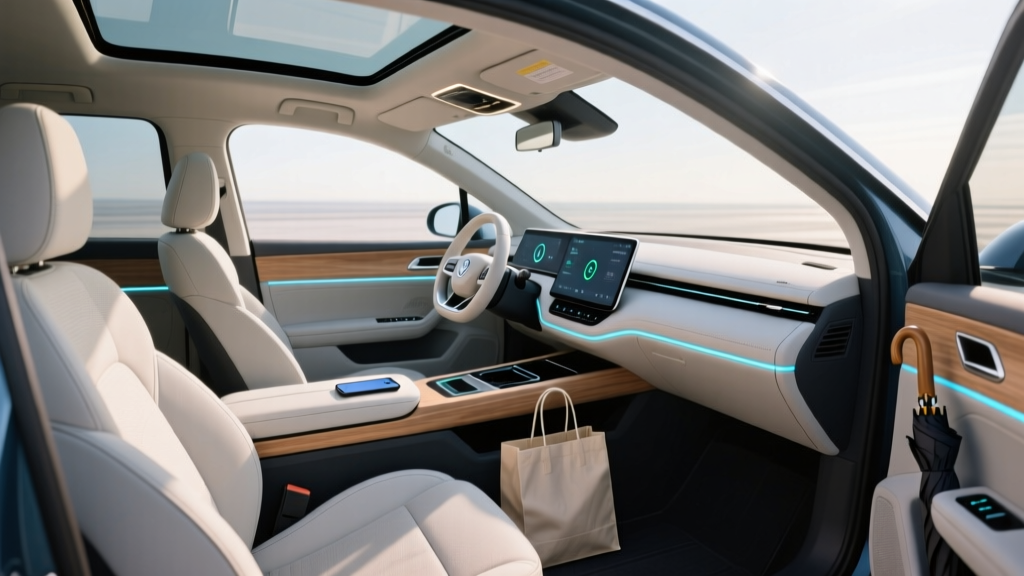
The driver faces a compact 5.3-inch digital instrument cluster (the "ID. Cockpit") mounted on the steering column — similar to the ID.4. The centerpiece is a 12.9-inch touchscreen running ID. Software 4.0, which VW significantly overhauled after criticism of earlier ID. software. Wireless Apple CarPlay and Android Auto are standard, along with a wireless phone charging pad. Voice control responds to natural-language prompts ("Hey ID., I'm cold" adjusts climate).
Range, Battery & Charging: What the Electric Interior Means for Daily Use
The ID. Buzz's electric interior is only as practical as the powertrain supporting it. Here are the hard numbers for the 2025–2026 model year.
| Spec | Pro S (RWD) | Pro S Plus 4Motion (AWD) |
|---|---|---|
| Usable battery | 91 kWh (NMC) | 91 kWh (NMC) |
| EPA range | 234 miles | 231 miles |
| Motor output | 282 hp / 413 lb-ft | 335 hp / 472 lb-ft |
| 0–60 mph | ~7.9 sec | ~6.5 sec |
| Peak DC charge rate | 200 kW | 200 kW |
| 10–80% DC fast charge | ~26 min | ~26 min |
| Level 2 (AC) charge rate | 11 kW | 11 kW |
| Level 2 full charge time | ~9 hours | ~9 hours |
| MPGe (combined) | 87 MPGe | 85 MPGe |
Real-World Range Expectations
EPA sticker: 234 miles (RWD) / 231 miles (AWD)
Highway driving (70–75 mph): Expect roughly 195–210 miles. The ID. Buzz's boxy shape creates more aerodynamic drag than a sleek SUV, which hurts efficiency at sustained highway speeds.
Cold weather (below 30°F): Plan for 165–185 miles. The heat pump (standard on US models) helps, but the large cabin volume requires significant energy to heat.
Mixed suburban/city: 215–230 miles is realistic, aided by regenerative braking in stop-and-go traffic.
The 200 kW peak DC fast-charging rate is competitive but not class-leading. The charge curve tapers noticeably above 80% SoC — a full 10–100% session will take closer to 45 minutes. For road trips, plan your stops around the 10–80% window where charging is fastest. The ID. Buzz uses the CCS1 connector; VW has committed to transitioning to NACS (Tesla-style) on future models, but current production retains CCS1. A NACS adapter for Supercharger access is expected but confirm availability with your dealer.
Cost Breakdown: ID. Buzz vs. Gas Minivan vs. PHEV Minivan
The ID. Buzz occupies a unique niche — it's the only all-electric minivan in the US. Its closest competitors are the Chrysler Pacifica Hybrid (PHEV) and the Honda Odyssey or Toyota Sienna (gas/hybrid). Let's compare real ownership costs over five years and 75,000 miles.
| Cost Category | VW ID. Buzz Pro S | Chrysler Pacifica Hybrid (PHEV) | Toyota Sienna (HEV) |
|---|---|---|---|
| Base MSRP | $59,995 | $47,995 | $39,995 |
| Federal tax credit (§30D) | Up to $7,500* | $0 (PHEV battery <7 kWh for full credit; verify current eligibility) | $0 |
| Effective purchase price | ~$52,495 | ~$47,995 | ~$39,995 |
| Fuel/energy (75k mi) | ~$4,800 (electricity at $0.14/kWh) | ~$7,200 (gas + electric mix) | ~$8,100 (gas at $3.50/gal, 36 MPG) |
| Maintenance (5 yr) | ~$1,200 | ~$3,500 | ~$2,800 |
| Estimated insurance (5 yr) | ~$12,500 | ~$10,000 | ~$9,500 |
| 5-year operating total | ~$18,500 | ~$20,700 | ~$20,400 |
*Federal §30D tax credit eligibility depends on buyer income caps, MSRP limits (vans/SUVs: $80,000), battery component sourcing, and point-of-sale transfer rules. Verify current eligibility at IRS.gov and with a tax professional. The ID. Buzz qualifies as an SUV/van for the higher MSRP cap.
The ID. Buzz costs more upfront but saves roughly $2,000–$3,000 in fuel and maintenance over five years compared to gas and hybrid minivans. The break-even point versus a Sienna Hybrid arrives around year 6–7 depending on your electricity rate and driving volume. If your electricity costs are low (under $0.12/kWh) or you have solar, the savings widen considerably.
Home Charging Setup: What You Need Before Delivery Day
The ID. Buzz's 91 kWh battery demands a proper Level 2 home charging setup to be practical. Level 1 (120V) charging adds roughly 3–4 miles per hour — a full charge would take over 25 hours. That's not viable for daily use.
Level 2 Installation Cost Breakdown
| Component | Estimated Cost |
|---|---|
| Level 2 charger (40–48A, hardwired) | $400–$700 |
| Electrical panel upgrade (if needed: 100A → 200A) | $1,500–$3,000 |
| Wiring & conduit run (50 ft typical) | $600–$1,500 |
| Electrician labor (licensed) | $800–$2,000 |
| Permit & inspection | $100–$300 |
| Total (no panel upgrade) | $1,900–$4,500 |
| Total (with panel upgrade) | $3,400–$7,500 |
At the ID. Buzz's 11 kW AC charge rate, a 48-amp Level 2 circuit adds approximately 30–33 miles of range per hour. An overnight charge (8 hours) restores roughly 240+ miles — effectively a full battery. Have a licensed electrician assess your panel capacity before ordering. The 91 kWh battery draws significant current, and older homes with 100-amp service will almost certainly need an upgrade.
If you lack home charging access — apartment living, street parking, or a landlord unwilling to install — the ID. Buzz becomes significantly less practical. Public DC fast charging works for road trips but is not a sustainable daily strategy: it's more expensive ($0.35–$0.50/kWh at networks like Electrify America), slower than home charging, and adds wear from frequent high-power sessions.
Common Misconceptions About the Electric VW Bus Interior
| Myth | Fact |
|---|---|
| "The ID. Buzz has 300+ miles of range." | The EPA-rated range is 234 miles (RWD). European WLTP figures are higher (~260 mi / 419 km) but not comparable to US EPA testing. Real-world highway range is closer to 200 miles. |
| "It charges as fast as a Tesla or Hyundai Ioniq 5." | The ID. Buzz peaks at 200 kW — respectable, but below the 250+ kW rates of the Ioniq 5, Kia EV9, or Tesla Model X. 10–80% takes ~26 minutes versus ~18 minutes for the fastest competitors. |
| "The third row is just for kids." | The third row fits adults up to about 5'10" comfortably for trips under an hour. It's genuinely usable — not a penalty seat. |
| "I'll get the full $7,500 federal tax credit." | §30D credit eligibility depends on your modified adjusted gross income (single: $150k cap, joint: $300k), battery critical-mineral sourcing, and the $80,000 MSRP cap for SUVs/vans. The credit can now be transferred to the dealer at point of sale, reducing your purchase price directly. Verify at IRS.gov. |
| "The electric interior means no maintenance." | You still need tire rotations (EVs wear tires faster due to weight and torque), cabin air filter replacement, brake fluid checks, and wiper/coolant service. Savings come from eliminating oil changes, transmission fluid, and exhaust system repairs. |
Battery Longevity & Warranty: What to Expect Over 10+ Years
The ID. Buzz uses an NMC (nickel manganese cobalt) lithium-ion battery. VW provides a 8-year / 100,000-mile battery warranty guaranteeing a minimum of 70% state of health (SoH). If capacity drops below 70% within that window, VW will repair or replace the pack.
NMC chemistry offers higher energy density than LFP (lithium iron phosphate), which is why VW chose it for the ID. Buzz's large 91 kWh pack — LFP would add too much weight for the target range. The trade-off is slightly faster long-term degradation compared to LFP, though modern thermal management systems have narrowed this gap significantly.
Maximizing battery life:
- Set daily charge limit to 80% (the ID. Buzz software allows this). Only charge to 100% before road trips.
- Avoid frequent DC fast charging when Level 2 is available.
- Use the vehicle's preconditioning feature before fast charging — it warms the battery to optimal temperature, improving charge speed and reducing stress.
- In extreme heat, park in shade or a garage when possible. Battery thermal management works harder (and consumes energy) in high ambient temperatures.
Real-world degradation data from VW MEB-platform vehicles (ID.4, ID.3 in Europe) suggests approximately 5–8% capacity loss over the first 100,000 miles with reasonable charging habits. At that rate, a 234-mile ID. Buzz would retain roughly 215–222 miles of range at 100,000 miles — still highly usable.
Decision Framework: Is the ID. Buzz Right for You?
Choose the VW ID. Buzz if:
- You need three rows of seating with a usable third row and want zero tailpipe emissions.
- You have access to home Level 2 charging (or can install it).
- Your daily driving is under 150 miles round-trip, with occasional road trips where 200 kW DC fast charging is acceptable.
- You value a flat-load cargo floor with 163+ cubic feet of space for gear, bikes, or furniture.
- You qualify for the §30D federal tax credit, bringing the effective price closer to $52,500.
Look elsewhere if:
- You regularly drive more than 200 miles between charging stops — the Kia EV9 (304-mile range, ~$54,900) or Tesla Model X (348-mile range, ~$79,990) offer more buffer.
- You cannot install home charging. A Toyota Sienna Hybrid (36 MPG combined, ~$40,000) is far more practical without home charging access.
- You need towing capacity above 2,500 lbs (the ID. Buzz is not rated for heavy towing).
- Budget is the primary constraint — the Pacifica Hybrid or Sienna Hybrid cost $12,000–$20,000 less upfront and have no range limitations.
Ownership Considerations: Climate, Driving Patterns & Practical Realities
Cold-Weather Performance
The ID. Buzz's heat pump is standard equipment in the US — a significant advantage. Heat pumps are 2–3x more efficient than resistive heaters for cabin warming, preserving more battery for driving. Still, expect 20–30% range reduction in sub-freezing temperatures. A pre-conditioned garage start mitigates this substantially: the vehicle uses grid power (not battery) to warm the cabin and battery before you unplug.
Insurance Costs
EV insurance premiums typically run 15–25% higher than comparable gas vehicles due to higher repair costs (specialized body panels, battery replacement risk, limited collision-repair networks). Budget approximately $2,400–$2,800 annually depending on your state, driving record, and coverage level. Shop quotes from insurers with EV-specific programs (Progressive, State Farm, and Tesla Insurance where available).
Driving Dynamics
The ID. Buzz is not a performance vehicle, and it doesn't pretend to be. The RWD model's 282 hp delivers adequate acceleration for merging and passing, but the 5,300+ lb curb weight is noticeable in corners. Ride quality is comfortable and well-damped — VW tuned the suspension for compliance over sportiness. The turning radius is surprisingly tight for a vehicle this size, making parking-lot navigation manageable. According to NHTSA and IIHS, check for the latest crash-test ratings as they become available for the 2025–2026 model year.
Public Charging Network Compatibility
The ID. Buzz charges natively via CCS1 at Electrify America, EVgo, ChargePoint, and most non-Tesla DC fast-charging networks. For Tesla Supercharger access, VW has indicated NACS adapter compatibility — verify with your dealer at purchase, as adapter programs and network agreements evolve. The ID. Buzz's navigation system supports route planning with automatic charge-stop suggestions, factoring in battery temperature and elevation changes.
Frequently Asked Questions
Does the VW ID. Buzz qualify for the $7,500 federal EV tax credit?
The ID. Buzz qualifies under the §30D credit rules as a van/SUV (MSRP cap: $80,000). However, your personal eligibility depends on income limits ($150,000 single / $300,000 joint MAGI) and the battery's critical-mineral and component sourcing, which the IRS updates periodically. The credit can be transferred to the dealer at point of sale as an immediate price reduction. Always verify current eligibility at IRS.gov and consult a tax professional.
How does the ID. Buzz electric interior cargo space compare to a gas minivan?
With all rear seats folded, the ID. Buzz offers 163.5 cubic feet — comparable to the Chrysler Pacifica (140.5 cu ft) and Honda Odyssey (144.9 cu ft). Behind the third row, the ID. Buzz provides 18.6 cu ft, which is less than the Pacifica (32 cu ft with Stow 'n Go). The trade-off: the ID. Buzz's floor is completely flat with no stowage wells (those are occupied by the battery), but you gain the advantage of a lower load floor and no gas tank intrusions.
Can I tow with the ID. Buzz?
The US-spec ID. Buzz has a maximum towing rating of approximately 2,500 lbs (braked). That's enough for a small utility trailer or a pair of dirt bikes but not a camper or boat. If towing is a priority, the Rivian R1S or Kia EV9 (both rated for 5,000+ lbs) are better choices, though neither is a minivan.
What is the real-world charging cost per mile?
At the US average residential electricity rate of approximately $0.16/kWh and the ID. Buzz's efficiency of roughly 2.9 miles/kWh (87 MPGe), you'll spend about $0.055 per mile on electricity. A comparable gas minivan at 22 MPG combined and $3.50/gallon costs about $0.159 per mile. That's roughly $104 less per 1,000 miles driven in the ID. Buzz. Source: fueleconomy.gov.
Is the ID. Buzz's infotainment software reliable?
VW's ID. Software 4.0, which the US-market ID. Buzz ships with, is a major improvement over the laggy, buggy ID. Software 3.x that plagued early ID.4 models. Response times are faster, the interface is more intuitive, and over-the-air updates are more stable. It's not class-leading (Tesla and Hyundai/Kia still set the bar), but it's functional and no longer a dealbreaker.
How does the ID. Buzz handle in snow and ice?
The 4Motion AWD variant adds a front motor for a combined 335 hp and significantly improved traction in low-grip conditions. Combined with the low center of gravity from the floor-mounted battery pack, the AWD ID. Buzz is confident in snow. Winter tires are still recommended for sustained sub-freezing climates — the stock all-season tires are adequate for occasional snow but not optimized for ice.