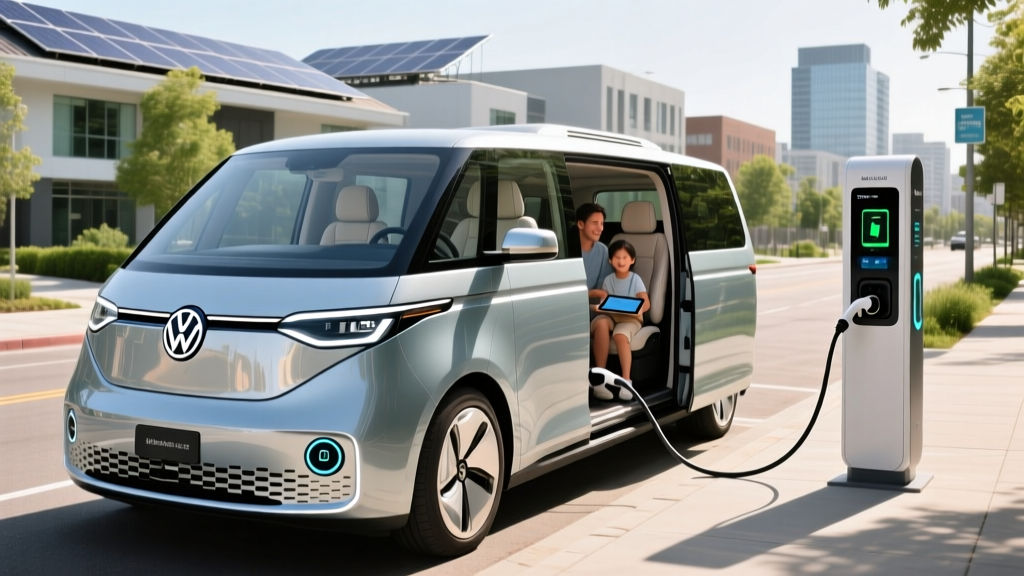
The Volkswagen ID Buzz arrived in the U.S. for the 2025 model year as the first electric minivan on the market, wrapping three rows of seating in a retro-styled shell that turns heads at every school drop-off. For 2026, the ID Buzz carries forward with minor software refinements and a stabilized price structure after its debut year. But nostalgia only carries a vehicle so far — buyers spending north of $60,000 need to know how this electric bus actually performs as a daily family hauler. We've spent time with the ID Buzz in real-world conditions to answer the questions that matter: What's the honest range? How fast does it actually charge? And does the math work after incentives?
Quick Verdict: Who Should Buy the VW ID Buzz
Choose the ID Buzz if: You need a 3-row family vehicle with strong cargo versatility, you charge primarily at home, your daily commute is under 150 miles round-trip, and you value distinctive design over maximum range-per-dollar.
Look elsewhere if: You regularly road-trip more than 200 miles between stops, you need all-wheel drive for snowy climates, or you're trying to maximize federal tax credit savings on a minivan purchase.
The ID Buzz occupies a unique niche: it's the only electric minivan you can buy in the U.S. as of 2026. That exclusivity is both its greatest asset and its greatest vulnerability. If you want three rows, a flat load floor, and a battery-electric powertrain, your alternative is a plug-in hybrid minivan (the Chrysler Pacifica Hybrid) or a three-row SUV like the Kia EV9. The ID Buzz trades some range and charging speed for a car-like driving position, exceptional interior flexibility, and a design that genuinely delights.
Range, Battery, and Real-World Efficiency
The 2026 VW ID Buzz is powered by a 91 kWh (gross) lithium-ion battery pack — specifically an NMC (nickel manganese cobalt) chemistry — of which approximately 86 kWh is usable. This pack sits in the floor between the axles, contributing to a low center of gravity that helps the tall-bodied van feel planted through corners.
| Spec | Value |
|---|---|
| EPA Range (RWD) | 234 miles |
| EPA Range (4Motion AWD) | 231 miles |
| Battery (gross / usable) | 91 kWh / ~86 kWh |
| Battery Chemistry | NMC |
| Drivetrain | RWD (single motor) or AWD (dual motor) |
| Horsepower | 282 hp (RWD) / 335 hp (AWD) |
| Torque | 406 lb-ft (RWD) / 509 lb-ft (AWD) |
| 0–60 mph | 7.9 sec (RWD) / 6.4 sec (AWD) |
| Max DC Fast Charge | 170 kW (peak) |
| 10–80% DC Charge Time | ~26 minutes |
| Level 2 AC Charge Rate | 11 kW |
| EPA Efficiency (combined) | 87 MPGe / 39 kWh/100 mi |
| Towing Capacity | Not rated (no tow package) |
| Base MSRP (Pro S) | $59,995 |
| Battery Warranty | 8 years / 100,000 miles |
Real-World Range Reality Check
EPA sticker: 234 miles (RWD), 231 miles (AWD)
Expect in practice: Around 200–215 miles on mixed highway driving at 70 mph in moderate temperatures. In cold weather (below 35°F), plan for 165–185 miles due to cabin heating demands and increased battery resistance. In city driving with frequent regenerative braking opportunities, you can stretch closer to the EPA figure — we saw 225 miles on a suburban loop at 35–45 mph.
The honest take: The ID Buzz's boxy shape creates substantial aerodynamic drag at highway speeds. This is the single biggest range killer on road trips. If your typical highway stretch exceeds 180 miles between charging stops, you'll want to plan conservatively, especially in winter or with a full load of passengers and cargo.
The ID Buzz's efficiency of 87 MPGe combined (39 kWh per 100 miles, per EPA data) is respectable for a vehicle of this size and weight — it's roughly comparable to a Kia EV9 Land AWD. But it's notably less efficient than a lower-slung EV sedan or crossover, which is the trade-off for minivan interior volume.
Charging Speed: DC Fast and Home Level 2
Charging performance is where the ID Buzz is competent but not class-leading. The 170 kW peak DC fast-charge rate means you'll add roughly 140 miles of range in about 20 minutes at a compatible 350 kW station — adequate for road trips but slower than competitors like the Hyundai Ioniq 9 or the Kia EV9, which peak above 230 kW.
| Charging Level | Power | Time | Range Added |
|---|---|---|---|
| Level 1 (120V standard outlet) | ~1.4 kW | ~61 hours (0–100%) | ~3 miles/hour |
| Level 2 (240V, 48A home charger) | 11 kW | ~8.5 hours (0–100%) | ~26 miles/hour |
| DC Fast Charge (peak) | 170 kW | ~26 min (10–80%) | ~140 miles in 20 min |
Understanding the charge curve: The ID Buzz hits its 170 kW peak between approximately 10% and 30% state of charge (SoC). From 30% to 60%, it sustains roughly 130–150 kW. Above 80% SoC, charging tapers significantly to protect battery longevity — going from 80% to 100% on DC can take nearly as long as the 10–80% session. For road trips, plan your stops around 10–80% charges to minimize time at the station.
Home charging setup: The 11 kW onboard AC charger is a practical choice. On a 48-amp Level 2 home circuit (which requires a 60-amp breaker), you'll fully recharge overnight in about 8.5 hours. This is perfectly adequate for daily use — plug in when you get home, wake up to a full battery. If your home panel is only 100 amps, an electrician may recommend a panel upgrade to 200 amps before installing a 48-amp EV circuit, which can add $1,500–$3,000 to your installation cost.
The ID Buzz uses the CCS1 connector standard for DC fast charging in the U.S. for 2026. Volkswagen has committed to adopting the NACS (Tesla-style) connector on future models, and VW owners can access Tesla Superchargers using a VW-approved CCS-to-NACS adapter, expanding the public charging network significantly.
Performance and Driving Dynamics
The rear-wheel-drive ID Buzz sends 282 horsepower and 406 lb-ft of torque to the rear wheels through a single-speed reduction gear. The 0–60 mph time of 7.9 seconds is unremarkable by EV standards but perfectly adequate for a family vehicle — merging onto highways and passing slower traffic is never a concern thanks to instant electric torque.
The available 4Motion all-wheel-drive variant adds a front motor for a combined 335 hp and 509 lb-ft, dropping the 0–60 time to 6.4 seconds. More importantly for minivan buyers, the AWD system provides better traction in rain and light snow. However, the AWD system in the ID Buzz is an on-demand setup — the front motor only engages when slip is detected or when the system anticipates traction needs. It is not a substitute for dedicated winter tires in severe snow conditions.
Driving dynamics are surprisingly composed for a vehicle with minivan proportions. The low-mounted battery keeps the center of gravity down, body roll is well-controlled, and the steering is light but reasonably precise. The ride quality is comfortable over most surfaces, though large impacts can produce some vertical motion given the tall body. Wind noise is noticeable at highway speeds — a consequence of the upright windshield and flat roofline — but it's no worse than a conventional minivan.
Regenerative braking offers adjustable levels through the steering-wheel paddle shifters, from aggressive one-pedal-like deceleration to a coasting mode. The ID Buzz doesn't quite achieve full one-pedal driving to a standstill in its strongest regen setting — you'll still need the brake pedal for the final stop — but it recovers energy effectively in stop-and-go traffic.
Interior Space, Cargo, and Technology
The ID Buzz's interior is where this vehicle makes its strongest case. The flat floor (no transmission tunnel) and short overhangs create a remarkably airy cabin with excellent outward visibility — the large windshield and side windows make it feel more like a European transit van than a traditional American minivan.
Passenger space:
- Front row: 41.3 inches headroom, 41.5 inches legroom — generous and commanding driving position
- Second row: 39.8 inches headroom, 37.6 inches legroom — comfortable for adults on long trips; seats slide fore/aft
- Third row: 38.3 inches headroom, 34.6 inches legroom — best suited for children or shorter adults; tighter than a Chrysler Pacifica's third row
Cargo volume:
- Behind third row: 18.8 cu ft (enough for a couple of carry-on bags and groceries)
- Behind second row (third row folded): 75.5 cu ft
- Behind front seats (second and third rows folded): 131.0 cu ft — a flat, van-like load floor that's genuinely useful for large items
The second-row seats fold flat rather than stowing into the floor (as Chrysler's Stow 'n Go does), and they don't offer the removable-seat flexibility of a traditional minivan. This is a real trade-off: if you frequently reconfigure your minivan for cargo vs. passengers, the ID Buzz requires more effort than a Pacifica or Sienna.
Infotainment and tech: The ID Buzz runs Volkswagen's latest ID. Software 4.0 on a 12.9-inch central touchscreen. The system is a meaningful improvement over earlier ID.4 software, with faster response times, a more intuitive menu structure, and wireless Apple CarPlay and Android Auto. However, VW still relies heavily on touch-capacitive controls for climate and volume — there are no physical knobs for these functions, which can frustrate drivers who prefer tactile feedback while driving.
The digital instrument cluster is mounted on the steering column (similar to the ID.4), which keeps the dash clean but requires glancing down rather than looking through the wheel. A head-up display is available on higher trims.
Driver assistance: The ID Buzz comes with VW's IQ.DRIVE suite, which includes:
- Adaptive cruise control with stop-and-go
- Lane centering assist (Travel Assist)
- Automatic emergency braking with pedestrian detection
- Blind-spot monitoring with rear cross-traffic alert
- Park assist with surround-view camera
Automation level: IQ.DRIVE Travel Assist is an SAE Level 2 driver-assistance system. It can manage steering, acceleration, and braking under certain conditions, but the driver must remain fully engaged — hands on the wheel, eyes on the road, ready to take over at any moment. This is not autonomous or self-driving capability.
Pricing, Trims, and Federal Tax Credit Eligibility
The 2026 VW ID Buzz is offered in three trims, all built on the long-wheelbase platform:
| Trim | Drivetrain | MSRP | §30D Credit Eligible? | Effective Price (if eligible) |
|---|---|---|---|---|
| Pro S | RWD | $59,995 | No (MSRP cap exceeded) | $59,995 |
| Pro S Plus | RWD | $63,495 | No (MSRP cap exceeded) | $63,495 |
| Pro S Plus | AWD (4Motion) | $67,995 | No (MSRP cap exceeded) | $67,995 |
The tax credit situation requires careful attention. Under IRS §30D rules, the federal clean vehicle credit of up to $7,500 has an MSRP cap for vans, SUVs, and pickups of $80,000. The ID Buzz is classified as a van, which means it technically falls under the $80,000 MSRP cap — and all trims are below that threshold. However, the credit also requires that the vehicle meet critical minerals and battery component sourcing requirements, which have tightened significantly since 2024. As of 2026, vehicles with battery components manufactured by a "foreign entity of concern" (FEOC) are disqualified. The ID Buzz's battery supply chain has not consistently met these sourcing thresholds, and buyers should verify current eligibility on fueleconomy.gov before assuming credit qualification.
Additionally, the §30D credit has buyer income caps: adjusted gross income must not exceed $150,000 (single filer), $225,000 (head of household), or $300,000 (married filing jointly). The credit can be transferred to the dealer at point of sale as an upfront discount, or claimed on your federal tax return. Consult a tax professional and check IRS.gov clean vehicle credits for your specific eligibility.
State and local incentives may still apply regardless of federal credit status. Several states offer rebates of $1,000–$5,000 for new EV purchases, and some utilities offer off-peak charging rebates or discounted Level 2 charger installations. Check your state's energy office and local utility for current programs.
Ownership Costs, Warranty, and Long-Term Value
Volkswagen backs the ID Buzz with a competitive warranty package:
- Battery warranty: 8 years / 100,000 miles (guarantees minimum 70% capacity retention)
- Powertrain warranty: 8 years / 100,000 miles
- Bumper-to-bumper: 4 years / 50,000 miles
- Corrosion perforation: 7 years / 100,000 miles
The 70% capacity retention guarantee means that if your battery drops below 70% of its original capacity within the warranty period, VW will repair or replace it at no cost. Based on NMC degradation data from similar VW MEB-platform vehicles (like the ID.4), most owners can expect roughly 8–12% capacity loss over the first 100,000 miles under normal use patterns — well within the warranty threshold.
Cost to charge vs. fuel: At the U.S. average electricity rate of $0.16/kWh, fully charging the ID Buzz's 86 kWh usable battery costs about $13.76 at home, delivering roughly 234 miles of range — that's approximately $0.059 per mile. A comparable gas minivan averaging 22 mpg at $3.40/gallon costs about $0.155 per mile. Over 15,000 miles annually, home charging saves roughly $1,440 per year compared to gasoline.
Insurance: EV insurance premiums tend to run 15–25% higher than equivalent gas vehicles due to higher repair costs and battery replacement risk. Expect annual premiums in the $2,200–$3,000 range depending on your location, driving record, and coverage level.
Depreciation: Early data on the ID Buzz is limited given its 2025 U.S. debut, but EVs in the $60,000+ range have generally experienced steeper first-year depreciation than mainstream gas vehicles. If you plan to keep the ID Buzz for 5+ years, depreciation matters less; if you trade in frequently, factor this into your cost calculation.
Pros and Cons
Pros
- Only all-electric minivan available in the U.S. — no direct competitor
- Exceptional interior versatility with flat load floor and 131 cu ft max cargo
- Comfortable ride, composed handling, and surprisingly tight turning radius
- Strong standard safety and driver-assist features
- Retro design generates genuine positive attention and conversation
- Overnight home charging fully replenishes the battery in ~8.5 hours
- Generous front-row and second-row passenger space
Cons
- 234-mile EPA range is modest for a $60K+ family vehicle — limits road-trip flexibility
- 170 kW peak DC charging is slower than key competitors (Kia EV9: 236 kW)
- Third row is tight for adults; less legroom than Chrysler Pacifica or Toyota Sienna
- Federal §30D tax credit eligibility is uncertain due to battery sourcing rules
- No towing capability — not rated for trailer use
- Touch-capacitive climate and volume controls lack physical feedback
- Highway wind noise is noticeable at 70+ mph
- Starting price near $60K is steep for a minivan with this range
How the ID Buzz Compares to Alternatives
With no direct electric minivan rival, the ID Buzz competes against adjacent vehicle categories:
- Kia EV9 (3-row electric SUV): Starts around $54,900, offers up to 304 miles of range (Long Range RWD), 236 kW DC fast charging, and a more conventional SUV form factor. The EV9 has less cargo volume behind the third row but better range and charging speed. If range and road-trip capability are priorities, the EV9 is the stronger EV choice.
- Chrysler Pacifica Hybrid (PHEV minivan): Starts around $50,000, delivers 32 miles of electric-only range plus 30 mpg combined on gas. Total range exceeds 500 miles. If you need unlimited range flexibility and a proven third-row minivan, the Pacifica Hybrid is the pragmatic choice — but it's not a full EV.
- Toyota Sienna (HEV minivan): Hybrid-only with 36 mpg combined and no electric-only range. The most fuel-efficient gas/hybrid minivan, starting around $38,000. Best for buyers who want max range and lowest upfront cost without EV charging infrastructure.
The ID Buzz wins on pure interior volume, design distinctiveness, and the zero-tailpipe-emission experience. It loses on range-per-dollar and charging speed. Your decision hinges on whether the minivan form factor and cargo flexibility matter more than having 300+ miles of range.
Frequently Asked Questions
What is the real-world range of the VW ID Buzz?
The EPA rates the rear-wheel-drive ID Buzz at 234 miles. In real-world mixed highway driving at 70 mph, expect 200–215 miles. In cold weather below 35°F, plan for 165–185 miles. City driving with regenerative braking can stretch closer to the EPA figure.
How fast does the ID Buzz charge at home and on the road?
At home on a Level 2 (240V, 48A) charger, the ID Buzz adds about 26 miles of range per hour, fully recharging in approximately 8.5 hours. On DC fast chargers, it peaks at 170 kW and charges from 10% to 80% in about 26 minutes — adding roughly 140 miles in a 20-minute stop.
Does the VW ID Buzz qualify for the federal EV tax credit?
Eligibility is uncertain for 2026. The ID Buzz falls under the $80,000 MSRP cap for vans, but the §30D credit also requires compliance with critical-mineral and battery-component sourcing rules, which the ID Buzz has not consistently met. Buyer income caps also apply. Verify current status on fueleconomy.gov and consult a tax professional before relying on the credit in your purchase decision.
Is the VW ID Buzz worth buying over a Kia EV9 or Pacifica Hybrid?
If you specifically need minivan cargo flexibility (flat load floor, 131 cu ft max) and want a fully electric powertrain, the ID Buzz is your only option. If you're flexible on body style, the Kia EV9 offers more range and faster charging in an SUV package. If road-trip range is your top priority, the Pacifica Hybrid's 500+ mile total range is hard to beat.
Can the ID Buzz tow a trailer?
No. The ID Buzz is not rated for towing in the U.S. market. If you need to tow a small trailer, camper, or boat, you'll need to look at the Kia EV9 (rated up to 5,000 lbs with tow package) or a conventional minivan/SUV.
What is the battery warranty on the ID Buzz?
Volkswagen covers the ID Buzz battery for 8 years or 100,000 miles, whichever comes first, guaranteeing at least 70% of original capacity retention. The powertrain carries the same 8-year/100,000-mile coverage.
How does the ID Buzz handle in snow?
The available 4Motion AWD system provides improved traction in rain and light snow compared to the RWD model. However, the ID Buzz's low ground clearance (approximately 6.8 inches) and standard all-season tires limit its capability in deep snow. Dedicated winter tires significantly improve cold-weather performance.