Quick Answer: The VW ID. Buzz Electric Bus Interior & Ownership Snapshot
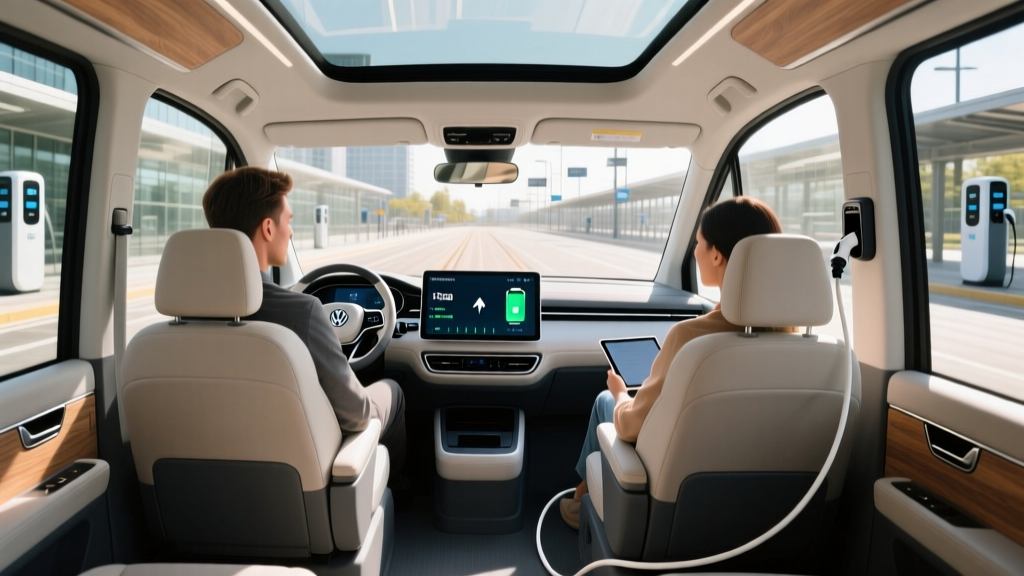
The 2026 Volkswagen ID. Buzz is a three-row, retro-styled electric minivan built on VW's MEB platform. Its electric VW bus interior features seating for up to seven, a flat floor thanks to the underbody battery pack, a 12.9-inch infotainment screen, and configurable second-row captain's chairs or a bench. The usable battery holds 91 kWh (NMC chemistry), delivering an EPA-estimated 234 miles of range (RWD) or 231 miles (AWD 4MOTION). DC fast charging peaks at 175 kW, reaching 10–80% in approximately 26 minutes. Starting MSRP is $59,995 (Pro S RWD), placing it above the §30D federal tax credit MSRP cap for vans ($80,000 applies to SUVs/trucks/vans, so it qualifies on price), though buyer income limits and battery-sourcing rules still apply.
Inside the Electric VW Bus Interior: Space, Seating & Tech
The ID. Buzz interior is where VW leans hardest into the Microbus heritage while packaging modern EV practicality. Because the battery sits beneath the floor, the cabin achieves a genuinely flat load surface and generous headroom — a packaging advantage no front-engine minivan can match.
Seating Configuration
The standard U.S. layout is a 2-3-2 configuration (seven seats). Second-row captain's chairs are available on higher trims, reducing capacity to six but improving third-row access. The second row slides fore and aft on rails, allowing you to prioritize legroom or cargo space. Third-row seats fold flat into the floor, expanding cargo volume from 18.8 cu ft (all rows up) to 75.5 cu ft (second and third rows folded).
Dashboard & Technology
Up front, a 5.3-inch digital instrument cluster sits behind the steering wheel, supplemented by a 12.9-inch central touchscreen running VW's ID. Software 4.x. Wireless Apple CarPlay and Android Auto are standard. A head-up display with augmented-reality navigation is available on Pro S Plus and 1st Edition trims. USB-C ports (up to eight across three rows) and a 15W wireless phone charger keep devices powered.
Materials & Build Quality
VW uses recycled materials throughout the cabin — seat fabrics made from recycled PET bottles, and a leatherette-wrapped steering wheel. Fit and finish are solid for the price point, though some hard plastics appear on lower door panels and the third-row surround. The flat floor and tall greenhouse give the cabin an airy, van-like feel that's distinct from the more carlike Chrysler Pacifica or Toyota Sienna.
| Spec | ID. Buzz Pro S (RWD) | ID. Buzz Pro S Plus (AWD) |
|---|---|---|
| Seating Capacity | 7 (or 6 w/ captain's chairs) | 7 (or 6 w/ captain's chairs) |
| Cargo (all rows up) | 18.8 cu ft | 18.8 cu ft |
| Cargo (2nd + 3rd folded) | 75.5 cu ft | 75.5 cu ft |
| Infotainment Screen | 12.9 in | 12.9 in |
| USB-C Ports | Up to 8 | Up to 8 |
| Panoramic Roof | Optional | Standard |
Range, Battery & Charging: What the Numbers Actually Mean
The ID. Buzz uses a 91 kWh usable NMC (nickel manganese cobalt) lithium-ion battery pack. Here's how that translates to real driving.
Range Reality Check
EPA estimate: 234 miles (RWD) / 231 miles (AWD 4MOTION)
Real-world expectation: Expect approximately 195–215 miles on sustained highway driving at 70–75 mph, and 170–190 miles in cold weather (below 32°F) due to cabin heating demands and increased battery resistance. The ID. Buzz's boxy shape creates more aerodynamic drag than sleeker EVs, which hurts highway efficiency disproportionately.
Charging Speeds
DC fast charging peaks at 175 kW on a CCS-equipped charger (VW has not adopted NACS for the 2026 model year in the U.S., though a transition is expected for 2027+). At peak rate, a 10–80% charge takes roughly 26 minutes. However, the charge curve tapers significantly above 80%, so a full 10–100% session takes closer to 45 minutes. Level 2 AC charging maxes at 11 kW (48A), fully replenishing the pack in about 9 hours — practical for overnight home charging.
| Charging Level | Power | Time / Rate | Connector |
|---|---|---|---|
| Level 1 (120V) | ~1.4 kW | ~3–4 mi/hr | J1772 |
| Level 2 (240V, 48A) | 11 kW | ~9 hours (0–100%) | J1772 |
| DC Fast Charge | 175 kW peak | ~26 min (10–80%) | CCS1 |
Source: fueleconomy.gov — 2025 VW ID. Buzz (2026 figures carried over with no powertrain changes announced)
ID. Buzz vs. Gas Minivans: Cost & Practicality Compared
The ID. Buzz competes in the minivan segment against the Toyota Sienna (hybrid), Chrysler Pacifica (PHEV available), Honda Odyssey, and Kia Carnival. Here's how it stacks up on the metrics that matter to families.
| Metric | VW ID. Buzz (RWD) | Toyota Sienna (HEV) | Chrysler Pacifica (Gas) |
|---|---|---|---|
| Base MSRP | $59,995 | $39,485 | $40,990 |
| EPA Range / MPG | 234 mi / 87 MPGe | 520 mi / 36 MPG combined | 450 mi / 22 MPG combined |
| Fuel/Energy Cost per Mile | ~$0.045 (home charging) | ~$0.095 | ~$0.155 |
| Cargo (all rows up) | 18.8 cu ft | 33.5 cu ft | 32.3 cu ft |
| AWD Available | Yes (4MOTION) | Yes | Yes |
| Estimated 5-Yr Fuel Savings vs. Pacifica | ~$5,200 | ~$2,800 | Baseline |
Energy costs based on U.S. average electricity rate of $0.16/kWh and gasoline at $3.30/gallon. Actual savings vary by region and driving patterns. Source: fueleconomy.gov
Where the ID. Buzz Wins
- Lowest per-mile energy cost when charging at home — roughly one-third the cost of gasoline
- Flat floor and tall cabin create a uniquely spacious feel and easy walk-through between rows
- Instant torque (282 hp RWD / 335 hp AWD) makes merging and city driving effortless
- Minimal scheduled maintenance — no oil changes, no transmission fluid, regenerative braking extends pad life
Where the ID. Buzz Falls Short
- Range is the segment's lowest — 234 miles is adequate for daily use but requires planning for road trips exceeding 200 miles one-way
- Cargo behind the third row is small — 18.8 cu ft trails the Sienna's 33.5 cu ft significantly
- Upfront cost premium of ~$20,000 over a gas minivan takes years of fuel savings to offset
- CCS charging network reliability still lags behind Tesla's Supercharger network in many regions
Real Ownership Costs: 5-Year Breakdown
Purchase price is only part of the equation. Here's a realistic 5-year/75,000-mile ownership cost comparison assuming 15,000 miles driven annually.
| Cost Category | VW ID. Buzz (RWD) | Chrysler Pacifica (Gas) |
|---|---|---|
| Purchase Price (MSRP) | $59,995 | $40,990 |
| Federal Tax Credit (§30D) | Up to $7,500 (see eligibility) | $0 |
| Home Charger Install (Level 2) | $1,200–$2,500 | $0 |
| Energy/Fuel (5 years, 75k mi) | ~$3,400 | ~$11,625 |
| Maintenance (5 years) | ~$1,500 | ~$3,800 |
| Insurance (5-year avg.) | ~$10,500 | ~$8,250 |
| Estimated Depreciation | ~$24,000 | ~$18,500 |
| Total 5-Year Cost | ~$52,095–$54,795 | ~$83,165 |
Key takeaway: After accounting for fuel and maintenance savings, the ID. Buzz's total 5-year cost can undercut the Pacifica — but only if you secure the tax credit and charge primarily at home. Public DC fast charging at $0.35–$0.50/kWh erodes the energy-cost advantage substantially.
Tax Credit Eligibility (§30D)
The ID. Buzz qualifies under the $80,000 MSRP cap for vans/SUVs/trucks. However, full §30D credit eligibility depends on:
- Buyer income caps: AGI ≤ $300,000 (joint), $225,000 (head of household), $150,000 (single)
- Battery sourcing requirements: Critical minerals and battery component thresholds that phase up annually — verify current-year compliance on IRS.gov
- Point-of-sale transfer: You can transfer the credit to the dealer at purchase to reduce your out-of-pocket cost immediately
Always verify eligibility with a tax professional before purchase. Rules are subject to legislative change.
Common Misconceptions About the ID. Buzz
| Myth | Fact |
|---|---|
| "234 miles of range is enough for any road trip" | Highway driving at 75 mph yields ~195–215 real-world miles. In winter, expect 170–190. Plan charging stops for trips over 180 miles one-way. |
| "It charges as fast as a Tesla" | The ID. Buzz peaks at 175 kW. A Model Y on a V4 Supercharger sustains ~250 kW. Expect 26 min (10–80%) vs. ~15 min for Tesla. |
| "No maintenance means no costs" | Tires wear faster on heavy EVs (the ID. Buzz weighs ~6,000 lbs). Budget for tire replacement every 25,000–35,000 miles at ~$800–$1,200 per set. |
| "I can charge anywhere" | CCS chargers are widespread in metro areas but sparse in rural corridors. Check AFDC station locator for your routes before committing. |
| "The tax credit is guaranteed $7,500" | Battery-sourcing rules eliminate or halve the credit for some model years. Verify VIN-level eligibility on IRS.gov or through the dealer at point of sale. |
Decision Framework: Is the ID. Buzz Right for You?
Choose the VW ID. Buzz If:
- You have reliable home charging (Level 2, 240V/48A) and drive under 200 miles most days
- You value cabin experience — the tall, flat-floor interior and retro styling offer something no other minivan delivers
- You qualify for the §30D tax credit, bringing the effective price closer to $52,500
- Your daily driving is city/suburban, where regenerative braking maximizes efficiency and range
- You want low running costs and plan to keep the vehicle 5+ years to recoup the purchase premium
Look Elsewhere (Sienna, Pacifica, Carnival) If:
- You regularly drive 300+ miles between stops and don't want to plan around DC charging
- You need maximum cargo space behind the third row — the Sienna's 33.5 cu ft nearly doubles the ID. Buzz's 18.8 cu ft
- You lack home charging access and would rely entirely on public infrastructure
- Your budget is under $45,000 — the ID. Buzz's premium is substantial before any incentives
- You frequently tow — the ID. Buzz's 3,500-lb tow rating is adequate for small trailers but trails the Pacifica's capability
What First-Time EV Buyers Should Know About the ID. Buzz
If this is your first EV, the ID. Buzz requires some lifestyle adjustments that gas minivan owners never think about:
Home Charging Is Essential
Budget $1,200–$2,500 for a Level 2 home charger installation (48A hardwired unit on a dedicated 60A circuit). If your electrical panel is at capacity, a panel upgrade adds $1,500–$3,000. Without home charging, owning the ID. Buzz becomes significantly less convenient and more expensive.
Cold Weather Cuts Range
The ID. Buzz uses a resistive PTC heater rather than a heat pump (standard on some competitors). In sub-freezing temperatures, expect 20–30% range reduction. Preconditioning the battery while plugged in helps mitigate this — schedule departure times in the VW app to warm the pack before driving.
Charging Curve Awareness
The 175 kW peak rate only holds between approximately 10–40% state of charge. From 40–80%, the rate tapers to 100–120 kW, and above 80% it drops below 50 kW. For road trips, plan to charge from 10–80% and move on rather than waiting for a full charge — the last 20% takes disproportionately long.
Insurance Costs More
EV insurance premiums average 15–25% higher than equivalent gas vehicles due to higher repair costs and battery replacement risk. Get quotes from multiple carriers before purchasing. Some insurers (Geico, Progressive, USAA) offer EV-specific discounts.
Frequently Asked Questions
Does the 2026 VW ID. Buzz qualify for the $7,500 federal tax credit?
It may. The ID. Buzz's MSRP falls under the $80,000 van/SUV/truck cap. However, eligibility depends on your adjusted gross income, the battery's critical-mineral and component sourcing for the specific model year, and commercial vs. personal use. Check the IRS clean vehicle credit page and confirm with your dealer at point of sale.
What is the real-world highway range of the ID. Buzz?
On a flat interstate at 70–75 mph in moderate temperatures (60–80°F), expect approximately 195–215 miles before reaching 10% state of charge. In cold weather or mountainous terrain, plan for 170–190 miles.
Can the ID. Buzz use Tesla Superchargers?
Not natively for the 2026 model year. The ID. Buzz uses the CCS1 connector. VW is expected to adopt NACS (the Tesla connector) for future model years, and a CCS-to-NACS adapter may become available, but as of early 2026, you'll rely on Electrify America, EVgo, ChargePoint, and other CCS networks.
How does ID. Buzz cargo space compare to a Toyota Sienna?
Behind the third row, the ID. Buzz offers 18.8 cu ft vs. the Sienna's 33.5 cu ft — a significant gap for groceries and luggage. With all rear seats folded, the ID. Buzz provides 75.5 cu ft vs. the Sienna's 101.0 cu ft. The ID. Buzz's taller roof helps with vertical items, but overall volume favors the Sienna.
What is the battery warranty on the ID. Buzz?
Volkswagen provides an 8-year / 100,000-mile high-voltage battery warranty, guaranteeing minimum 70% capacity retention. The basic vehicle warranty is 4 years / 50,000 miles. Battery replacement out of warranty is estimated at $15,000–$22,000, though most packs outlast the vehicle's useful life based on current degradation data.
Is the ID. Buzz self-driving?
No. The ID. Buzz comes equipped with VW's IQ.DRIVE suite, which includes adaptive cruise control, lane-keeping assist, and automatic emergency braking. This is an SAE Level 2 driver-assistance system — you must remain fully engaged with hands on the wheel and eyes on the road at all times.