Quick Verdict: What Does the VW ID. Buzz Actually Cost?
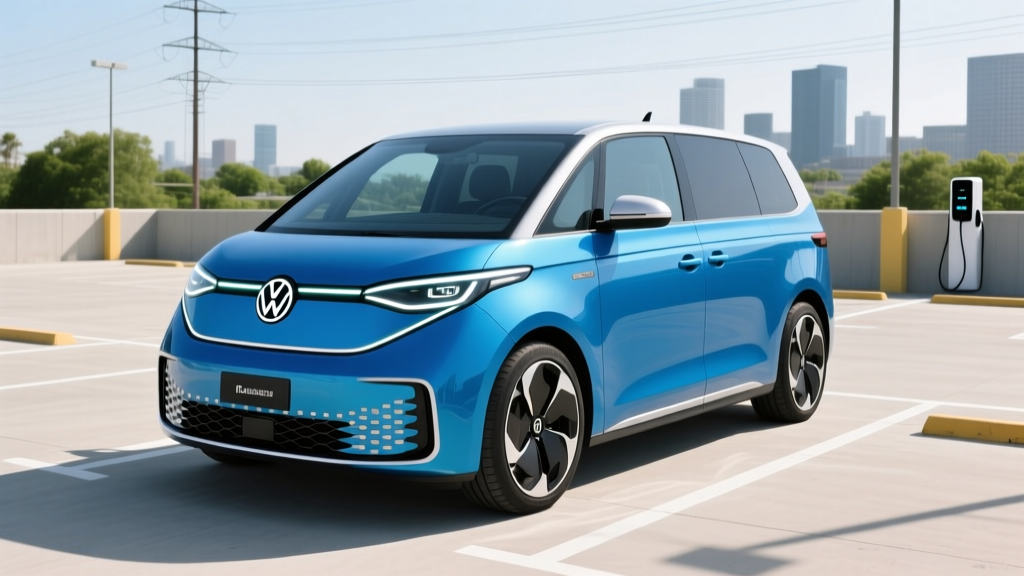
The 2026 Volkswagen ID. Buzz arrives in the U.S. as a three-row, retro-styled electric van with genuine practicality and a premium price tag. Starting at $59,995 before destination, the ID. Buzz undercuts its most direct rival—the Chrysler Pacifica Hybrid in plug-in form—on electric-only commuting but overshoots mainstream minivan pricing by a wide margin. After factoring in the federal tax credit (currently unavailable for the ID. Buzz due to battery-sourcing rules), the out-of-pocket cost lands squarely in luxury-SUV territory.
For buyers who need three rows, a usable frunk, and an all-electric drivetrain, the ID. Buzz occupies a segment of one. But the math requires scrutiny. Below, we break down every cost variable, from trim-level pricing to home-charging installation, real-world range, and five-year ownership economics.
2026 VW ID. Buzz Pricing by Trim
| Trim | Drivetrain | Base MSRP | Destination | Total Before Incentives | §30D Federal Credit | Effective Price |
|---|---|---|---|---|---|---|
| Pro S (RWD) | Rear-Wheel Drive | $59,995 | $1,395 | $61,390 | $0 (sourcing) | $61,390 |
| Pro S Plus (RWD) | Rear-Wheel Drive | $64,995 | $1,395 | $66,390 | $0 (sourcing) | $66,390 |
| 1st Edition (AWD) | Dual-Motor AWD | $69,995 | $1,395 | $71,390 | $0 (sourcing) | $71,390 |
The ID. Buzz currently does not qualify for the $7,500 federal §30D tax credit. While the van is assembled in Hannover, Germany, and its MSRP falls well under the $80,000 cap for vans/SUVs, its battery cells do not meet the critical-minerals and battery-component sourcing requirements set by the IRS. Buyers should check the IRS qualified-vehicle list before purchase, as sourcing rules can shift with supply-chain updates.
State incentives may partially offset the gap. California's CVRP, for example, has offered rebates up to $7,000 for income-qualified buyers, and states like Colorado and New York maintain their own EV rebate programs. Always verify current state-level eligibility through your local energy or DMV office.
Range, Efficiency, and Real-World Expectations
EPA Range (AWD): 231 miles
Real-World Highway: ~195–210 miles at 70 mph
Real-World Cold Weather (30°F): ~170–190 miles
City / Mixed Commuting: ~220–240 miles
The ID. Buzz posts an EPA-estimated 234 miles of range for the rear-wheel-drive Pro S and Pro S Plus trims, dropping to 231 miles with the dual-motor AWD 1st Edition. The van's boxy aerodynamics—a drag coefficient around 0.29 Cd—work against it at highway speeds, where efficiency falls to roughly 2.8–3.0 kWh/mile.
In mixed suburban and city driving, where regenerative braking recovers more energy, owners can expect to meet or slightly exceed the EPA figure. Highway-only trips at 70+ mph will yield closer to 200 miles. Cold-weather testing in sub-freezing temperatures typically shaves 15–25% off the sticker range, landing around 170–190 miles without preconditioning.
The ID. Buzz's efficiency rating sits at approximately 88 MPGe combined (RWD), translating to about 38 kWh per 100 miles. That's competitive with the Rivian R1S and slightly behind the Tesla Model X, which benefits from a lower drag profile.
Battery Chemistry and Capacity
VW equips the U.S.-market ID. Buzz with a 91 kWh usable (NMC lithium-ion) battery pack, positioned in the floor for a low center of gravity. The NMC (nickel-manganese-cobalt) chemistry prioritizes energy density over cycle life compared to LFP alternatives, giving the van its 234-mile range within a manageable pack weight.
| Specification | Detail |
|---|---|
| Usable Capacity | 91 kWh |
| Gross Capacity | ~95 kWh |
| Chemistry | NMC (Nickel-Manganese-Cobalt) |
| Thermal Management | Active liquid cooling + heat pump |
| Buffer (top/bottom) | ~4 kWh reserved |
The included heat pump is a significant advantage for cold-climate buyers—it reduces cabin-heating energy draw by roughly 30–40% compared to resistive heaters, preserving range in winter. VW's battery warranty covers 8 years or 100,000 miles against degradation below 70% state of health (SoH).
Charging Speed: DC Fast Charge and Home Level 2
| Level | Max Power | Rate / Time | Notes |
|---|---|---|---|
| Level 1 (120V) | 1.4 kW | ~4 miles/hour | Emergency only; full charge in 65+ hours |
| Level 2 (240V, 48A) | 11 kW | ~30 miles/hour | Full charge in ~8.5 hours; ideal overnight |
| DC Fast Charge | 170 kW peak | 10–80% in ~26 minutes | Tapers above 80%; sustained ~100 kW avg |
The ID. Buzz charges at a peak of 170 kW on DC fast chargers, which is respectable but not class-leading. The 10–80% session takes approximately 26 minutes under optimal conditions (battery preconditioned, ambient temperature 60–80°F). The charge curve tapers notably above 80% SoC to protect the NMC cells—plan for 40+ minutes if you need a full charge at a public station.
At home, the onboard 11 kW AC charger delivers about 30 miles of range per hour on a 240V/48A Level 2 circuit. Most owners will plug in overnight and wake to a full battery. A typical Level 2 home installation (40–48A hardwired charger, 50–60A breaker) costs between $800 and $2,500 depending on panel proximity and local permit fees. If your electrical panel is at capacity, a 200-amp service upgrade can add $1,500–$3,000.
The ID. Buzz uses the CCS1 connector for DC fast charging in North America. VW has not yet confirmed NACS adoption for the ID. Buzz, meaning Tesla Supercharger access requires an adapter (if available) or reliance on Electrify America, EVgo, and other CCS networks.
Performance and Drivetrain
| Trim | Motor | Horsepower | Torque | 0–60 mph | Top Speed |
|---|---|---|---|---|---|
| Pro S / Pro S Plus | Single Rear Motor | 282 hp | 406 lb-ft | 7.9 sec | 90 mph (governed) |
| 1st Edition | Dual Motor AWD | 330 hp | 509 lb-ft | 6.5 sec (est.) | 99 mph (governed) |
The rear-wheel-drive ID. Buzz delivers 282 horsepower and 406 lb-ft of instant torque, adequate for highway merging and city driving but not sporty. The 0–60 mph time of 7.9 seconds feels relaxed in a vehicle this size. The AWD 1st Edition adds a front motor for 330 combined horsepower and a noticeably quicker 6.5-second sprint, along with better traction in rain and snow.
Regenerative braking offers multiple levels via steering-wheel paddles, but VW does not offer true one-pedal driving with a full stop hold. The brake blending is smooth, though drivers accustomed to Tesla or Hyundai's aggressive regen may find the ID. Buzz's default coasting behavior surprisingly neutral.
Cargo, Passenger Space, and Interior Practicality
| Measurement | Specification |
|---|---|
| Seating Capacity | 7 passengers (3 rows) |
| Front Headroom | 41.3 inches |
| Second-Row Legroom | 39.6 inches |
| Third-Row Legroom | 33.5 inches |
| Cargo (behind 3rd row) | 18.5 cu ft |
| Cargo (3rd row folded) | 52.0 cu ft |
| Cargo (all rear rows folded) | ~95 cu ft |
| Frunk (front trunk) | ~2.0 cu ft (cable storage) |
The ID. Buzz offers genuine three-row usability, with the second row providing generous legroom on sliding benches. The third row suits children or shorter adults on trips under an hour. Behind the third row, 18.5 cubic feet of cargo space handles a week of groceries or a few carry-on bags—less than a Pacifica or Sienna but adequate for daily use.
The flat floor (thanks to the skateboard platform) enables easy walk-through between front seats, and the available power-sliding doors are a family essential. However, the third row does not fold into a floor well like competing minivans; instead, the seats fold flat onto the cargo floor, creating a raised load surface.
Tax Credit Eligibility: §30D Rules Explained
As of 2026, the VW ID. Buzz does not qualify for the $7,500 federal clean-vehicle credit under IRS §30D. The reasons:
- Battery sourcing: The ID. Buzz's battery cells and critical minerals do not meet the required percentages for North American or FTA-partner sourcing.
- Assembly: Final assembly occurs in Hannover, Germany, not North America (a separate §30D requirement).
However, buyers should monitor VW's supply-chain announcements. Automakers periodically requalify vehicles as they shift battery suppliers. Before purchasing, verify the ID. Buzz's status on the IRS qualified vehicles list or ask your dealer for the current IRS eligibility confirmation.
If the ID. Buzz does not qualify for the new-vehicle credit, consider whether your state offers a point-of-sale rebate, utility-company EV incentive, or HOV-lane access (which carries measurable commute-time value in states like California, Virginia, and Maryland).
Ownership Costs: Five-Year Projection
| Category | Estimated Cost |
|---|---|
| Purchase Price (after destination) | $61,390 |
| Federal Tax Credit | $0 |
| Home Level 2 Charger Install | $1,200–$2,000 |
| Electricity (15,000 mi/yr × 5 yrs, $0.14/kWh avg) | $3,420 |
| Insurance (avg. $2,100/yr) | $10,500 |
| Maintenance (tires, cabin filter, fluid top-offs) | $1,800 |
| Estimated Depreciation (50% over 5 yrs) | -$30,695 |
| Net 5-Year Cost | ~$47,615–$48,415 |
The ID. Buzz's operating costs are low—roughly $0.045 per mile on average U.S. electricity rates, compared to $0.12–$0.15 per mile for a gas minivan at 22 MPG combined and $3.50/gallon. Maintenance is minimal: no oil changes, no transmission fluid, and brake pads last well past 80,000 miles thanks to regenerative braking.
Insurance premiums run 15–25% higher than comparable gas minivans, reflecting EV repair costs and parts pricing. Depreciation remains a wildcard; VW's EV resale values have trailed Tesla and Hyundai historically, though the ID. Buzz's novelty and segment uniqueness may provide some support.
Pros, Cons, and the Competition
- Unique retro design with genuine head-turning appeal
- Standard 91 kWh battery with heat pump
- Three-row seating with flat floor and walk-through
- DC fast charging to 170 kW (10–80% in ~26 min)
- Smooth, quiet ride quality on the MEB platform
- Power-sliding doors available for family use
- No federal tax credit eligibility (as of 2026)
- Range drops to ~195 mi highway; ~170 mi in cold
- Third row tight for adults; no stow-in-floor seating
- CCS1 only—no native NACS/Tesla Supercharger access
- Infotainment software lag reported in early builds
- Base price of ~$61K is steep for a minivan
Key competitors: The ID. Buzz competes loosely with the Chrysler Pacifica Hybrid (PHEV, 32 miles electric-only, ~$50K, qualifies for $7,500 credit), the Kia Carnival Hybrid (HEV, no plug, ~$42K), and the Tesla Model X (335-mile range, ~$80K+). For pure electric three-row family hauling, the ID. Buzz is currently the only dedicated electric van on the U.S. market. If you can accept a plug-in hybrid, the Pacifica PHEV offers a lower effective price after credits and eliminates range anxiety on road trips.
Who Should Buy the VW ID. Buzz?
The ID. Buzz fits a specific buyer: a family or fleet operator who wants a fully electric three-row vehicle, values distinctive design, and can charge at home. It works best for suburban commuters with daily drives under 100 miles who can top up overnight and use DC fast charging for occasional road trips.
It is less ideal for buyers in extreme cold climates without garage parking, road-trip-heavy families who need 300+ miles of range, or budget-conscious shoppers who need every available tax credit to make the math work. If towing matters, note that the ID. Buzz is rated for only 2,500 pounds—far below the Rivian R1S or even the Pacifica's 3,600-pound capacity.
Frequently Asked Questions
What is the real-world range of the VW ID. Buzz?
EPA-estimated at 234 miles (RWD) and 231 miles (AWD). Expect 195–210 miles on the highway, 170–190 miles in freezing weather, and up to 240 miles in city driving with regenerative braking.
How fast does the ID. Buzz charge at home and on the road?
At home on a 240V/48A Level 2 charger, it adds about 30 miles of range per hour (11 kW), fully charging overnight in ~8.5 hours. On DC fast chargers, it peaks at 170 kW, reaching 10–80% in approximately 26 minutes.
Does the VW ID. Buzz qualify for the $7,500 federal EV tax credit?
No. As of 2026, the ID. Buzz does not meet the IRS §30D battery-sourcing and North American final-assembly requirements. State rebates and utility incentives may still apply—check local programs.
How much does it cost to own the ID. Buzz over five years?
Approximately $47,000–$49,000 over five years including purchase price, home charger installation, electricity, insurance, maintenance, and estimated depreciation. Fuel savings versus a gas minivan total roughly $6,000–$8,000 over the same period.
Is the ID. Buzz worth buying over a Pacifica Hybrid or Tesla Model X?
If you want a fully electric van with three rows and distinctive design, the ID. Buzz is a segment of one. If budget and tax credits are priorities, the Pacifica PHEV offers 32 miles of electric commuting at a lower effective price. If range and Supercharger access matter most, the Model X wins—though at a $20K+ premium.
What connector does the ID. Buzz use?
The U.S.-market ID. Buzz uses the CCS1 connector for DC fast charging and the J1772 connector for Level 2 AC charging. It does not natively support NACS (Tesla's connector), limiting Supercharger access unless an approved adapter becomes available.
What is the battery warranty?
VW covers the ID. Buzz battery for 8 years or 100,000 miles against degradation below 70% of original capacity. The powertrain (motors, power electronics) carries the same 8-year/100,000-mile coverage. The vehicle limited warranty is 4 years/50,000 miles.