The Volkswagen ID. Buzz arrives in the U.S. market carrying decades of Microbus nostalgia wrapped around a modern 91-kWh battery pack and dual-motor all-wheel drive. Beyond the retro styling, buyers want hard numbers: real-world range, charging speed, interior space, and whether the available color palette justifies the premium price tag. This review covers the 2026 VW ID. Buzz colors alongside the performance, charging, and ownership data that actually matter once the initial design thrill fades.
2026 VW ID. Buzz Colors and Exterior Design
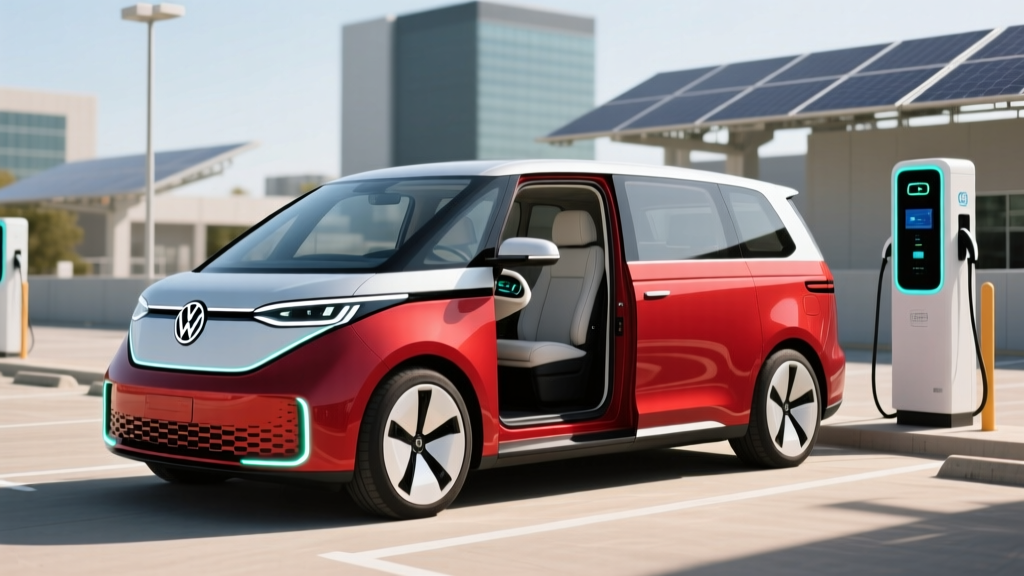
Volkswagen offers the ID. Buzz in a curated selection of single-tone and two-tone paint options for the U.S. market. The two-tone configurations pair a white upper body with a colored lower section, directly referencing the classic T1 Microbus aesthetic. Available colors for 2026 include:
- Candy White (single-tone, standard)
- Deep Black Pearl (single-tone)
- Metro Silver Metallic (single-tone)
- Cherry Red Metallic (single-tone)
- Candy White / Cherry Red (two-tone)
- Candy White / Cabana Green (two-tone)
- Candy White / Mahi Green (two-tone)
- Candy White / Metro Silver (two-tone)
Two-tone paint adds approximately $995 to the MSRP depending on trim. The two-tone options are exclusive to the 1st Edition and Pro S Plus trims, while single-tone colors are available across the lineup. All finishes use a clear-coat process designed to withstand automated car washes, though the white upper body on two-tone models shows road grime faster than darker single-tone options.
Range, Battery, and Real-World Efficiency
The U.S.-spec ID. Buzz is built on Volkswagen's MEB platform and ships exclusively with the long-wheelbase configuration and a 91 kWh (gross) / 86 kWh (usable) lithium-ion battery pack using NMC (nickel manganese cobalt) chemistry. Unlike some competitors that have shifted to LFP for cost savings, VW retained NMC for its higher energy density, which is critical given the Buzz's boxy aerodynamic profile and 5,000+ lb curb weight.
| Specification | Value |
|---|---|
| Battery Gross / Usable | 91 kWh / 86 kWh |
| Chemistry | NMC (Nickel Manganese Cobalt) |
| EPA Range (AWD Pro S) | 234 miles |
| EPA Range (RWD Pro S) | 231 miles |
| Combined MPGe | 87 MPGe |
| Efficiency | 39 kWh/100 mi |
| Thermal Management | Liquid-cooled with heat pump (standard) |
Charging Speed: DC Fast and Home Level 2
The ID. Buzz supports DC fast charging via the CCS1 connector at a peak rate of 170 kW. On a compatible 350 kW station (such as Electrify America's latest hardware), the Buzz can charge from 10% to 80% in approximately 26 minutes under ideal thermal conditions. However, the charging curve tapers noticeably above 80%, as is typical for NMC packs — a 10-90% session stretches closer to 40 minutes.
| Charging Level | Power | Speed | Connector |
|---|---|---|---|
| Level 1 (120V household) | 1.4 kW | ~4 miles per hour | J1772 |
| Level 2 (240V home) | 11 kW (max onboard) | ~30 miles per hour | J1772 |
| DC Fast Charge | 170 kW peak | 10-80% in ~26 min | CCS1 |
Home charging on a 48-amp Level 2 station delivers the full 11 kW the onboard charger can accept, replenishing the 86 kWh usable battery from empty in roughly 8 hours. This means overnight charging easily covers daily driving needs for most owners. A key consideration: the ID. Buzz does not come with a NACS (Tesla-style) charge port. VW has not announced a factory NACS option for the 2026 model year, meaning Supercharger access requires a CCS-to-NACS adapter, and compatibility with Tesla's V3/V4 stalls varies. For public DC charging, Electrify America remains VW's primary partner, and 30 kWh of complimentary charging is included with purchase.
Preconditioning the battery before a DC fast charge session is critical. Using the navigation system to route to a charger automatically warms the pack, enabling the 170 kW peak rate. Without preconditioning — especially in cold weather — peak charge rates may initially be limited to 50-80 kW until the battery reaches optimal temperature.
Performance and Drivetrain
The U.S. ID. Buzz is offered in both rear-wheel drive (single motor) and 4Motion all-wheel drive (dual motor) configurations. The AWD variant is the volume seller and the only drivetrain available on the 1st Edition launch trim.
| Specification | RWD | AWD (4Motion) |
|---|---|---|
| Powertrain | Single rear motor | Dual motor (front + rear) |
| Horsepower | 282 hp | 335 hp |
| Torque | 413 lb-ft | 413 lb-ft |
| 0-60 mph | ~7.9 sec | ~5.7 sec |
| Top Speed | 99 mph (electronically limited) | 99 mph |
| Towing Capacity | Not rated | Not rated |
The AWD model's 5.7-second 0-60 time is genuinely quick for a three-row minivan weighing over 5,000 lbs. Power delivery is linear and immediate, as expected from a dual-motor EV, and the low center of gravity from the floor-mounted battery keeps body roll surprisingly controlled in corners. That said, this is a family hauler, not a performance vehicle — the steering is light and numb, and the suspension prioritizes ride comfort over sporty feedback. The 99 mph top speed limiter may frustrate some drivers on unrestricted roads, but it's a pragmatic choice for efficiency and tire longevity on a heavy van.
Interior Space, Cargo, and Technology
The ID. Buzz's long-wheelbase U.S. version rides on a 127.5-inch wheelbase and stretches 192.4 inches overall, making it slightly shorter than a Chrysler Pacifica but significantly taller. The vertical packaging pays dividends in interior volume.
| Dimension | Measurement |
|---|---|
| Seating Capacity | 7 passengers (2+3+2 configuration) |
| Front Headroom | 41.3 inches |
| Second-Row Legroom | 39.6 inches |
| Third-Row Legroom | 30.1 inches |
| Cargo (behind 3rd row) | 18.4 cu ft |
| Cargo (3rd row folded) | 75.5 cu ft |
| Cargo (all rear seats folded) | 124.3 cu ft |
The third row accommodates adults for short trips but is best suited for children on longer drives, with 30.1 inches of legroom falling short of what a Pacifica or Sienna offers. Cargo space behind the third row (18.4 cu ft) is tight for a week's worth of groceries for a family of five, but the power-folding third row opens up a massive 75.5 cu ft cargo area. The second-row bench slides fore and aft, allowing flexibility between passenger legroom and cargo capacity.
Technology centers on a 12.9-inch infotainment touchscreen running VW's ID. Software 4.0, which is a significant improvement over the laggy, frustrating ID.4 early-generation system. Wireless Apple CarPlay and Android Auto are standard. The digital cockpit uses a 5.3-inch driver display, which is small by modern standards but functional. The available head-up display with augmented-reality navigation is a strong addition for road trips.
Driver assistance features include Travel Assist (adaptive cruise control with lane centering), which operates as a SAE Level 2 system. The driver must keep hands on the wheel and remain fully engaged — this is not autonomous driving. The system performs competently on highways but requires regular steering input to avoid disengagement warnings. Park Assist Plus with memory parking is a standout feature for a vehicle this size, allowing the Buzz to memorize and repeat parking maneuvers in tight garages.
Pricing, Trims, and Federal Tax Credit Eligibility
The 2026 VW ID. Buzz is positioned as a premium electric minivan, and its pricing reflects that ambition. Three trims are available:
| Trim | Drivetrain | Base MSRP | As-Tested (with options) |
|---|---|---|---|
| Pro S | RWD | $59,995 | ~$63,500 |
| Pro S Plus | AWD | $64,995 | ~$69,800 |
| 1st Edition | AWD | $69,995 | ~$71,500 |
Destination charges add $1,395. Two-tone paint, as noted, adds ~$995. The 1st Edition includes exclusive badging, a panoramic fixed glass roof, and a premium Harman Kardon audio system, but its content largely overlaps with a well-optioned Pro S Plus.
Warranty and Long-Term Ownership
Volkswagen backs the ID. Buzz with a competitive warranty package:
- Basic Vehicle Warranty: 4 years / 50,000 miles
- Battery & Powertrain Warranty: 8 years / 100,000 miles
- Battery Capacity Guarantee: ≥70% state of health (SoH) over the 8-year/100,000-mile period
- Roadside Assistance: 4 years / 50,000 miles
- Complimentary Electrify America Charging: 30 kWh included (approximately 3-4 DC fast charge sessions)
The 70% SoH battery guarantee is standard across the industry and means that if the usable capacity drops below approximately 60 kWh within 8 years or 100,000 miles, VW will repair or replace the pack. Real-world data from European ID. Buzz owners (the van launched in Europe in 2022) shows minimal degradation in the first 30,000 miles, typically around 3-5%, though long-term U.S. data is still limited. The NMC chemistry is well-proven in VW's ID.4 and ID.5 models, which share the MEB platform.
How It Stacks Up Against Competitors
The ID. Buzz doesn't have a direct electric minivan rival in the U.S., which is both its greatest advantage and its challenge. Here's how it compares to the vehicles buyers actually cross-shop:
| Metric | VW ID. Buzz AWD | Kia EV9 (3-row SUV) | Chrysler Pacifica PHEV |
|---|---|---|---|
| EPA Range | 234 mi | 279 mi (LR RWD) | 32 mi (EV) + 520 mi (gas) |
| Starting MSRP | $59,995 | $54,900 | $49,995 |
| Federal Tax Credit | Not eligible | Up to $7,500 | Not eligible (PHEV rules differ) |
| Third-Row Space | 30.1 in legroom | 29.1 in legroom | 35.2 in legroom |
| DC Fast Charge | 170 kW / 26 min (10-80%) | 210 kW / 20 min (10-80%) | N/A (PHEV) |
| Seating | 7 passengers | 6 or 7 passengers | 7 passengers |
The Kia EV9 undercuts the Buzz on price and range, qualifies for the federal credit, and charges faster — but it's an SUV, not a minivan, so the sliding doors and low step-in height are absent. The Chrysler Pacifica PHEV offers vastly more third-row space and the safety net of a gas engine, though it sacrifices the EV driving experience and requires regular oil changes. The ID. Buzz wins on character, interior flexibility, and the practicality of minivan-format electric driving — but it costs more and goes less far per charge than the EV9.
Pros
- Iconic retro design with genuine road presence
- Sliding doors and minivan practicality in EV form
- Strong AWD acceleration (5.7 sec 0-60)
- Heat pump standard (better cold-weather efficiency)
- Power-folding third row with 124 cu ft max cargo
- Improved ID. Software 4.0 infotainment
Cons
- No federal tax credit eligibility (foreign assembly)
- 234-mile EPA range is modest for the price
- Highway range drops significantly due to boxy aero
- No NACS charge port (CCS1 only)
- Third-row legroom trails Pacifica and Sienna
- Premium pricing starting near $60,000
Who Should Buy the VW ID. Buzz?
The ID. Buzz is best suited for families and individuals who prioritize minivan-format practicality (sliding doors, low load floor, upright seating position) and want a fully electric vehicle with distinctive styling. It works well for suburban commuters with home charging access who drive fewer than 180 miles round-trip daily. The AWD system adds confidence in snow-belt states, and the 335 hp output makes highway merging effortless.
It's a tougher recommendation for frequent road-trippers who regularly exceed 200 miles between stops, as the combination of modest range and 170 kW charging (slower than the EV9's 210 kW or the Hyundai Ioniq 5's 240 kW) means longer stops. Buyers who need maximum third-row comfort should test-fit their family in the back before committing, and anyone counting on the $7,500 federal credit should budget without it.
Frequently Asked Questions
What is the real-world range of the VW ID. Buzz?
The EPA rates the AWD ID. Buzz at 234 miles. In real-world highway driving at 70 mph, expect 200-215 miles. Cold weather (below freezing) reduces this to approximately 170-185 miles. City driving with regenerative braking can approach or match the EPA estimate.
How fast does the ID. Buzz charge?
On a DC fast charger, the ID. Buzz peaks at 170 kW and charges from 10% to 80% in about 26 minutes with preconditioning. At home on a Level 2 (240V, 48A) charger, it accepts up to 11 kW, adding roughly 30 miles of range per hour and fully recharging overnight in about 8 hours.
Does the VW ID. Buzz qualify for the federal EV tax credit?
No. The ID. Buzz is assembled in Hanover, Germany, and does not meet the North American final assembly requirement under IRS §30D. It is not eligible for the $7,500 federal new-vehicle tax credit. Always verify current rules at irs.gov and check for applicable state incentives.
What colors are available for the 2026 VW ID. Buzz?
Single-tone options include Candy White, Deep Black Pearl, Metro Silver Metallic, and Cherry Red Metallic. Two-tone options (white upper with colored lower body) include Cherry Red, Cabana Green, Mahi Green, and Metro Silver. Two-tone paint is available on Pro S Plus and 1st Edition trims only.
Is the ID. Buzz worth buying over the Kia EV9?
It depends on your priorities. The EV9 offers longer range (279 mi), faster charging (210 kW), a lower starting price ($54,900), and federal tax credit eligibility. The ID. Buzz wins on minivan practicality (sliding doors, lower step-in height, more upright seating), retro styling, and standard AWD availability. If you need a true minivan in EV form, the Buzz has no direct rival. If a 3-row SUV works, the EV9 is the more pragmatic financial choice.
Does the ID. Buzz have a NACS (Tesla) charge port?
No. The 2026 ID. Buzz uses a CCS1 charge port. Volkswagen has not announced a factory NACS option for this model year. Supercharger access may be possible with a third-party CCS-to-NACS adapter, but compatibility is not guaranteed across all Tesla stall versions.