Quick Verdict: The Electric Microbus Returns With Modern Substance
The 2026 Volkswagen ID. Buzz channels retro nostalgia into a practical three-row electric van. Beyond the heritage styling and two-tone paint schemes that dominate search interest around VW ID. Buzz color options, this is a serious family hauler with 234 miles of EPA-estimated range (RWD), available 4MOTION all-wheel drive, and DC fast charging that peaks at 170 kW. Starting at $59,995 before incentives, it competes directly with the Chrysler Pacifica Hybrid, Kia EV9, and Tesla Model X in the electrified three-row space — though none of those match its cargo versatility or head-turning design.
Real-World Range Reality Check
EPA Estimate: 234 miles (RWD Pro S) | 231 miles (AWD Pro S Plus)
Expect in practice: ~200–215 miles on highway road trips at 70+ mph; ~175–190 miles in freezing winter conditions with cabin heat running. The ID. Buzz's boxy aerodynamics (drag coefficient ~0.29) penalize highway efficiency more than sleeker SUVs. City driving with regenerative braking recovers more energy, often yielding 240+ miles in stop-and-go commuting.
Full Spec Sheet: 2026 VW ID. Buzz at a Glance
| Specification | RWD Pro S | AWD Pro S Plus |
|---|---|---|
| EPA Range | 234 miles | 231 miles |
| Battery (usable) | 86 kWh (NMC) | 86 kWh (NMC) |
| Drivetrain | Rear-wheel drive | Dual-motor AWD |
| Horsepower | 282 hp | 335 hp |
| 0–60 mph | 7.9 sec | 5.9 sec |
| Max DC Fast Charge | 170 kW | 170 kW |
| 10–80% DC Time | ~26 min | ~26 min |
| Level 2 Home Charge | 11 kW (~30 mi/hr) | 11 kW (~30 mi/hr) |
| MPGe (combined) | 87 MPGe | 85 MPGe |
| Efficiency | 39 kWh/100 mi | 40 kWh/100 mi |
| Cargo (behind 3rd row) | 18.4 cu ft | 18.4 cu ft |
| Cargo (max, seats folded) | 163.0 cu ft | 163.0 cu ft |
| Base MSRP | $59,995 | $69,995 |
| Battery Warranty | 8 yr / 100,000 mi | 8 yr / 100,000 mi |
Sources: EPA fueleconomy.gov, Volkswagen USA
VW ID. Buzz Color Options: Every Exterior and Two-Tone Combination
The ID. Buzz's visual identity is inseparable from its color palette. VW offers the 2026 model in a mix of solid and heritage-inspired two-tone configurations that reference the original Type 2 microbus. Here is the complete color menu for the US market:
Solid Exterior Colors
- Candy White — Classic, no-cost standard on Pro S
- Deep Black Pearl — Metallic, available across all trims
- Metro Silver Metallic — Subtle, premium appearance
- Pomelo Yellow — Bold, heritage-adjacent warm tone
- Starlight Blue Metallic — Deep, ocean-inspired hue
- Salsa Red — Vibrant, available on select trims
Two-Tone Heritage Combinations (Pro S Plus / 1st Edition)
Two-tone paint pairs a white or silver upper body with a colored lower section — a direct callback to the split-window buses of the 1960s. These are premium options typically adding $1,500–$2,500 depending on trim:
- Candy White / Pomelo Yellow — The most iconic retro pairing
- Candy White / Starlight Blue — Coastal, vintage feel
- Candy White / Salsa Red — High-contrast, sporty
- Metro Silver / Deep Black Pearl — Understated, modern luxury
- Candy White / Cabana Green — Earthy, nature-oriented (limited availability)
Buyer tip: Two-tone configurations are most widely available on the Pro S Plus and 1st Edition trims. The base Pro S is more limited — typically Candy White, Deep Black, or Metro Silver as single-tone. Order early if a specific two-tone is your priority; dealer allocations of heritage colors are often constrained.
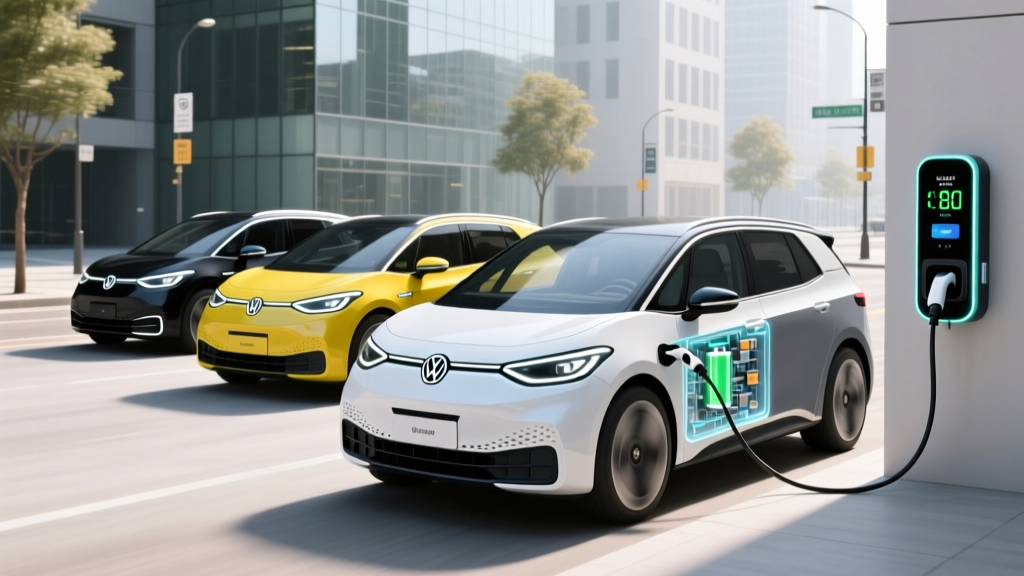
Charging Speed: DC Fast Charging and Home Level 2
| Charging Level | Power / Rate | Speed / Time |
|---|---|---|
| Level 1 (120V household) | ~1.4 kW | ~4 miles per hour |
| Level 2 (240V home) | 11 kW (48A) | ~30 miles per hour; 0–100% in ~9 hours |
| DC Fast Charge (peak) | 170 kW | 10–80% in ~26 minutes |
| DC Fast Charge (sustained avg) | ~120 kW (10–80%) | ~130 miles added in 15 min |
Understanding the Charge Curve
The ID. Buzz peaks at 170 kW only when the battery is preconditioned and between roughly 10–30% state of charge. Above 50%, the rate tapers to ~100 kW, and above 80% it drops sharply to ~40–50 kW to protect the NMC cells. This is standard behavior for lithium-ion packs, but it means a 10–90% session takes closer to 40 minutes, not 26. For road trips, plan stops at 10–80% to maximize time efficiency.
Home charging reality: The onboard 11 kW AC charger is competitive. On a 48-amp Level 2 home station (like a ChargePoint Home Flex or Emporia Level 2), expect a full overnight charge in about 9 hours. Most owners who plug in nightly will never need to use DC fast charging except on road trips.
Pricing, Trims, and Federal Tax Credit Eligibility
| Trim | Base MSRP | Est. As-Tested* | §30D Credit Eligible? |
|---|---|---|---|
| Pro S (RWD) | $59,995 | $62,500 | Potential — see rules below |
| Pro S (AWD) | $64,995 | $67,500 | Potential — see rules below |
| Pro S Plus (RWD) | $64,995 | $70,000 | Potential — see rules below |
| Pro S Plus (AWD) | $69,995 | $75,500 | Potential — see rules below |
| 1st Edition (AWD) | $74,995 | $76,000 | Potential — see rules below |
*As-tested includes destination charge (~$1,395) and common options like two-tone paint and floor mats.
Does the ID. Buzz Qualify for the $7,500 Federal EV Tax Credit?
Under IRS §30D rules for 2026, the ID. Buzz must satisfy multiple requirements — and the van/vehicle classification matters:
- MSRP Cap: Vans, SUVs, and pickups qualify up to $80,000 MSRP. The ID. Buzz is classified as a van, so all trims clear this cap.
- Buyer Income Cap: AGI must not exceed $300,000 (married filing jointly), $225,000 (head of household), or $150,000 (single).
- Battery Sourcing: A percentage of critical minerals and battery components must be sourced from the US or FTA-trade partners. VW has been working to localize supply chains, but eligibility can shift model year to model year. Verify current status on fueleconomy.gov before purchasing.
- Point-of-Sale Transfer: If eligible, the credit can be transferred to the dealer at purchase, reducing the out-of-pocket price by up to $7,500 immediately — no waiting for tax filing.
Bottom line: Always confirm the specific VIN's credit eligibility with the dealer and cross-reference the IRS clean vehicle credit list. Sourcing requirements evolve, and a model eligible in January may not be in June.
Interior, Cargo, and Passenger Space
The ID. Buzz's boxy proportions translate directly into usable interior volume that few three-row EVs can match:
- Headroom (front): 41.5 inches — genuinely van-like, easy entry without ducking
- Legroom (2nd row): 38.8 inches — comfortable for adults on long trips
- Legroom (3rd row): 35.2 inches — adequate for children and teens, tight for adults over 6 feet
- Cargo behind 3rd row: 18.4 cu ft — fits 3–4 carry-on bags or a week of groceries
- Cargo (2nd row folded): 75.5 cu ft
- Cargo (all rear seats folded): 163.0 cu ft — enough for sheet goods, camping gear, or a bicycle without removing wheels
The second-row seats slide and recline. The third row folds flat but does not tumble-fold into the floor like some minivans. For maximum cargo, VW offers removable rear seat configurations on certain trims.
Infotainment and Standout Tech
- 12.9-inch touchscreen with VW's ID. Software 4.0 — improved responsiveness over earlier ID.4 versions
- Wireless Apple CarPlay and Android Auto
- Travel Assist (SAE Level 2): Adaptive cruise + lane centering on highways — driver must remain engaged with hands on wheel
- Park Assist Plus with memory parking: learns repeated parking maneuvers (home garage, office spot)
- Heat pump: Standard on all trims — preserves range in cold weather by efficiently heating the cabin without draining the traction battery as quickly as resistive heaters
- Power sliding doors with kick-to-open on Pro S Plus and above
Notable Drawbacks
- No front trunk (frunk): The rear-mounted motor and packaging leave no under-hood storage
- Touch-sensitive steering wheel controls: Prone to accidental inputs; physical buttons would be preferable
- Rear visibility: Thick D-pillars and the high-mounted third row create blind spots; the digital rearview mirror option helps
- No towing rating published for the US market as of early 2026 — if you need to tow, look at the Rivian R1S or Kia EV9
Who Should Buy the 2026 VW ID. Buzz?
Choose the ID. Buzz if:
- You need three rows of seating with genuinely usable adult space in the second row
- You want maximum cargo versatility (163 cu ft) without stepping up to a full-size SUV
- You value distinctive design and heritage styling that stands out in a sea of generic crossovers
- Your daily commute is under 150 miles round-trip with home Level 2 charging available
- You want a minivan alternative that doesn't look or feel like a traditional minivan
Look elsewhere if:
- You regularly tow — the ID. Buzz has no US towing rating
- You need 300+ miles of range for frequent long road trips (consider the Rivian R1S or Tesla Model X)
- You want the lowest possible price — the Kia EV9 starts ~$5,000 less and offers similar passenger space
- You live in a region with sparse DC fast charging infrastructure and frequently drive 200+ miles between charges
How It Compares: ID. Buzz vs. Key Rivals
| Spec | VW ID. Buzz (RWD) | Kia EV9 (LR RWD) | Tesla Model X (LR) | Chrysler Pacifica Hybrid |
|---|---|---|---|---|
| Powertrain | BEV | BEV | BEV | PHEV |
| EPA Range | 234 mi | 304 mi | 335 mi | 32 mi (EV) + 520 mi total |
| Starting MSRP | $59,995 | $54,900 | $79,990 | $51,095 |
| Max Cargo | 163 cu ft | 81.7 cu ft | 88.1 cu ft | 140.5 cu ft |
| 0–60 mph | 7.9 sec | 8.2 sec | 3.8 sec | 7.1 sec |
| §30D Credit | Potential | Eligible (some trims) | Eligible | $7,500 (PHEV rules) |
The ID. Buzz trades range for cargo volume and character. If max range is your priority, the EV9 or Model X wins. If cargo capacity and design personality matter most, the Buzz has no direct equal.
Pros
- Class-leading cargo volume (163 cu ft max)
- Distinctive retro design with meaningful two-tone color options
- Spacious, airy cabin with excellent headroom
- Competitive 170 kW DC fast charging
- Standard heat pump for cold-weather efficiency
- 8-year / 100,000-mile battery warranty
Cons
- 234-mile EPA range trails rivals like the EV9 (304 mi)
- No US towing rating
- Touch-sensitive controls frustrate some drivers
- No frunk for additional storage
- Starting price above $60K before options
- Third row is tight for tall adults
Frequently Asked Questions
What is the real-world range of the 2026 VW ID. Buzz?
The EPA rates the RWD ID. Buzz at 234 miles and the AWD at 231 miles. In real-world highway driving at 70–75 mph, expect roughly 200–215 miles before needing a charge. In freezing temperatures (below 32°F) with the cabin heater active, range can drop to 175–190 miles. The standard heat pump mitigates some of this loss compared to resistive heating systems.
How fast does the ID. Buzz charge at home and on the road?
On a 240V Level 2 home charger (48 amps / 11 kW), the ID. Buzz adds about 30 miles of range per hour, fully charging overnight in roughly 9 hours. On DC fast chargers, it peaks at 170 kW, reaching 10–80% in approximately 26 minutes under ideal conditions (preconditioned battery, moderate temperatures). Above 80%, charging slows significantly — plan to charge to 80% and go for best road-trip efficiency.
How much does the VW ID. Buzz cost after the federal tax credit?
If you qualify for the full $7,500 §30D credit (income under limits, battery sourcing confirmed for your VIN), the base RWD Pro S drops from $59,995 to an effective $52,495. However, credit eligibility depends on current IRS sourcing rules, which can change. The point-of-sale transfer option lets you apply the credit at the dealership rather than waiting for tax season. Always verify with your dealer and check fueleconomy.gov for the latest eligible vehicle list.
Is the VW ID. Buzz worth buying over the Kia EV9 or Tesla Model X?
It depends on your priorities. The EV9 offers 70 more miles of EPA range and a lower starting price, making it more practical for road trips. The Model X delivers far more range (335 mi) and performance (3.8 sec 0–60) but costs $20,000+ more. The ID. Buzz wins on cargo volume (163 cu ft vs. 81–88 cu ft for rivals), distinctive design, and minivan-like usability. If character and cargo space matter more than maximum range, the Buzz is a compelling choice.
What battery chemistry does the ID. Buzz use, and how long will it last?
The ID. Buzz uses an NMC (nickel manganese cobalt) lithium-ion battery with 86 kWh of usable capacity. NMC offers higher energy density than LFP (lithium iron phosphate), which helps the Buzz achieve its range in a relatively compact pack. VW warranties the battery for 8 years or 100,000 miles, guaranteeing it will retain at least 70% of original capacity during that period. Based on data from the ID.4 (which shares the MEB platform), owners typically see 5–8% degradation over the first 50,000 miles, with the rate slowing significantly afterward.
Can I get the ID. Buzz in a two-tone color with any trim?
Two-tone heritage color combinations (like the iconic Candy White over Pomelo Yellow) are primarily available on the Pro S Plus and 1st Edition trims. The base Pro S is generally limited to solid colors. Two-tone paint typically adds $1,500–$2,500 to the MSRP. Because heritage colors are popular and allocations can be limited, discuss availability with your dealer early in the ordering process.
Does the ID. Buzz have self-driving capability?
No. The ID. Buzz features VW's Travel Assist, which is an SAE Level 2 driver-assistance system combining adaptive cruise control and lane centering. It can manage speed and steering on highways, but the driver must remain fully engaged with hands on the wheel and eyes on the road at all times. This is not autonomous driving — it is a convenience and safety aid. No consumer vehicle sold in the US today offers true self-driving (Level 4) capability; that remains limited to geofenced robotaxi services like Waymo.