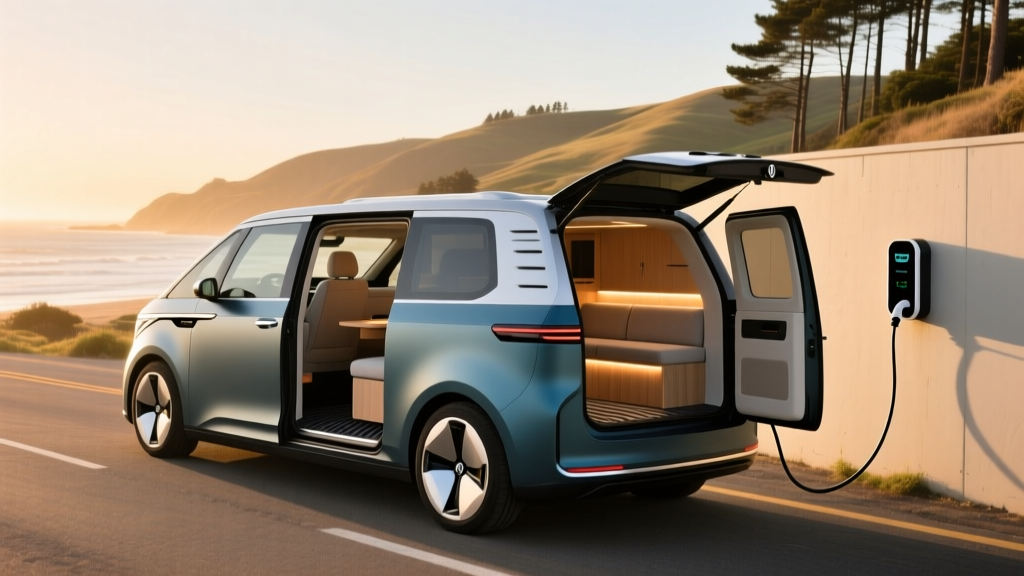
The Volkswagen ID. Buzz has been turning heads since its retro-styled concept debut, and now the production version is finally reaching U.S. driveways. For buyers searching for a VW ID. Buzz camper van, the reality is both exciting and complicated: Volkswagen is selling the ID. Buzz in the United States as a three-row passenger van and a two-row cargo variant, but the factory-built California camper version that Europeans enjoy remains unavailable stateside. That means U.S. buyers eyeing a VW ID. Buzz camper van are either waiting for Volkswagen of America to greenlight the California model, exploring third-party conversion kits, or rethinking what an electric van can do on a weekend trip. Below, we break down everything you need to know about the ID. Buzz platform — range, charging, pricing, tax credits, and whether it can realistically serve as a camper.
Quick Verdict: What the ID. Buzz Is (and Isn't) in the U.S.
The 2025–2026 VW ID. Buzz sold in the United States rides on a long-wheelbase platform with a 91-kWh gross (approximately 86-kWh usable) lithium-ion battery using NMC (nickel-manganese-cobalt) chemistry. It is not the shorter-wheelbase European model, and the factory California pop-top camper variant is not currently on the U.S. menu. What you can buy is a seven-passenger electric minivan with available 4MOTION all-wheel drive, a spacious flat-load floor, and enough interior volume that several aftermarket upfitters have begun offering camper-conversion packages. If you're researching a VW ID. Buzz camper van for U.S. roads, you're really researching the ID. Buzz platform's suitability as a camper base — and that depends heavily on range, charging, and interior space.
Range and Efficiency: EPA Sticker vs. Real-World Miles
| Spec | RWD (Pro S) | AWD (Pro S Plus / 4MOTION) |
|---|---|---|
| EPA Range | ~234 miles | ~231 miles |
| Battery (gross / usable) | 91 kWh / ~86 kWh (NMC) | |
| Efficiency (EPA) | ~87 MPGe | ~85 MPGe |
| Energy Consumption | ~39 kWh/100 mi | ~40 kWh/100 mi |
| Drivetrain | Rear-wheel drive, 282 hp | Dual-motor AWD, 335 hp |
| 0–60 mph | ~7.9 sec | ~5.7 sec |
| Max DC Fast Charge | 175 kW (CCS) | |
| 10–80% DC Charge Time | ~26 minutes | |
| Level 2 Home Charge Rate | 11 kW (~26 mi/hr) | |
| Cargo (behind 3rd row) | ~37 cu ft | |
| Cargo (all seats folded) | ~138 cu ft | |
| Battery Warranty | 8 years / 100,000 miles | |
The EPA rates the U.S. ID. Buzz at approximately 231–234 miles depending on drivetrain. In real-world mixed driving, expect closer to 190–210 miles on the highway at 70–75 mph, where this tall, boxy van's aerodynamic drag takes a heavy toll. In cold weather (below 32°F), plan for a 15–25% reduction, putting effective range in the 160–185 mile window. City driving with regenerative braking recovers more energy and can push range slightly above the EPA figure. If you're building this into a VW ID. Buzz camper van, plan your road-trip legs around 150–170 miles between DC fast-charger stops to keep a comfortable buffer.
The ID. Buzz's efficiency — roughly 39–40 kWh per 100 miles — is unremarkable by passenger-EV standards. Compare it to a Tesla Model Y at ~28 kWh/100 mi or a Hyundai Ioniq 5 at ~30 kWh/100 mi. The penalty is physics: the Buzz is a tall, flat-fronted van optimized for interior volume, not slipstream aerodynamics. For a camper conversion that adds roof weight, a pop-top, or gear, efficiency will drop further.
Charging Speed: DC Fast Charging and Home Setup
The ID. Buzz charges via CCS1 (the Combined Charging System standard still used by VW in North America, even as the industry migrates to NACS). Volkswagen quotes a peak DC fast-charge rate of 175 kW, which is competitive but not class-leading. Here's what that means in practice:
- 10–80% in ~26 minutes at a capable 175+ kW station (Electrify America, EVgo, or similar).
- The charge curve tapers significantly above 80%. An 80–100% top-off can add another 20+ minutes — plan accordingly on road trips.
- Preconditioning is available via the infotainment system's navigation: set a DC charger as your destination and the thermal management system warms the battery for faster charging on arrival.
| Level | Power | Approx. Miles Added per Hour |
|---|---|---|
| Level 1 (120V household) | ~1.4 kW | ~4 mi/hr |
| Level 2 (240V home, 48A) | ~11 kW | ~26 mi/hr (full charge ~8 hr) |
| DC Fast Charge | Up to 175 kW | 10–80% in ~26 min |
For a VW ID. Buzz camper van use case, home Level 2 charging is essential. A full overnight charge on Level 2 gives you a topped-off battery every morning — critical when you're using the van for weekend getaways. Expect to spend $800–$2,000 on a quality Level 2 home charger installation (equipment plus licensed electrician), depending on whether your electrical panel needs a 60-amp circuit upgrade. Consult a licensed electrician for your specific setup.
Pricing, Trims, and Federal Tax Credit Eligibility
The U.S.-spec ID. Buzz launched for the 2025 model year. Pricing by trim (MSRP, excluding destination):
| Trim | Drivetrain | Base MSRP | Federal §30D Credit Eligibility |
|---|---|---|---|
| Pro S | RWD | ~$59,995 | See eligibility notes below |
| Pro S Plus | RWD or AWD | ~$63,495 | See eligibility notes below |
| 1st Edition | AWD | ~$65,495 | See eligibility notes below |
At these price points, the ID. Buzz clears the MSRP cap for the IRS §30D federal EV tax credit ($80,000 for vans/SUVs/pickups). However, eligibility for the full $7,500 credit depends on several factors that change frequently:
- Buyer income caps: Modified adjusted gross income (MAGI) must not exceed $150,000 (single), $225,000 (head of household), or $300,000 (joint filers).
- Battery sourcing: Increasing percentages of critical minerals and battery components must be sourced from the U.S. or free-trade-agreement countries. VW's supply chain compliance varies by model year — verify on the IRS qualified vehicles list before purchase.
- Point-of-sale transfer: As of 2024, you can transfer the credit to the dealer at purchase, reducing your out-of-pocket cost immediately rather than waiting for tax filing.
- Assembled in North America? The ID. Buzz for the U.S. market is assembled in Hannover, Germany. This has been a barrier to §30D eligibility for some model years. Always check the current IRS qualified vehicles list on fueleconomy.gov for the latest determination.
Important: Tax credit rules are subject to legislative and regulatory change. Consult a tax professional and verify eligibility on irs.gov before relying on the credit in your purchase decision.
Camper Van Practicality: Interior Space and Conversion Potential
This is where the VW ID. Buzz camper van concept gets interesting — and where U.S. buyers face a gap. The European-market ID. Buzz California comes with a factory pop-top roof, a compact kitchen module, and a fold-flat bed system designed specifically for camping. Volkswagen of America has not confirmed the California variant for U.S. sale as of early 2026.
What the U.S. long-wheelbase ID. Buzz does offer:
- ~138 cubic feet of cargo volume with all rear seats folded — a flat, rectangular load area ideal for aftermarket bed platforms.
- ~60+ inches of interior height (floor to ceiling), enough for most adults to sit upright on a mattress platform.
- Flat floor with no transmission tunnel, thanks to the dedicated MEB EV platform.
- V2L (vehicle-to-load) capability in some markets, allowing the high-voltage battery to power external devices — a significant advantage for camper use (running a small fridge, lights, or laptop charging without a separate generator).
Aftermarket companies like Peace Vans and Lightship have signaled interest in ID. Buzz camper conversions for the U.S. market. A basic bed-platform-and-storage kit can run $3,000–$8,000; a full kitchenette and pop-top conversion can exceed $20,000. Factor that on top of the van's MSRP.
Performance, Tech, and Driver Assistance
The ID. Buzz is not a performance vehicle, but the AWD variant's 5.7-second 0–60 time is genuinely brisk for a seven-seat van. The RWD model's 282 hp is adequate for highway merging and mountain grades. Ride quality is car-like thanks to the MEB platform's low center of gravity and independent rear suspension.
On the tech front:
- 12.9-inch infotainment touchscreen with wireless Apple CarPlay and Android Auto.
- IQ.DRIVE suite: adaptive cruise control, lane-centering assist, automated emergency braking, and Travel Assist (hands-on-wheel lane-centering at highway speeds).
- Park Assist Plus with memory parking — useful for slotting the wide van into tight campsite spots.
- USB-C ports (up to 8 available), heated and ventilated front seats, and a panoramic glass roof on upper trims.
VW's IQ.DRIVE and Travel Assist are SAE Level 2 driver-assistance systems. They provide steering and speed support, but you must remain fully engaged — hands on the wheel, eyes on the road. This is not self-driving. Volkswagen does not currently offer a hands-free system comparable to GM's Super Cruise or Ford's BlueCruise on the ID. Buzz.
Biggest Pros and Cons
- Massive, flat-load interior ideal for camper conversions (~138 cu ft)
- Class-leading ride comfort and refinement for a van
- AWD available — rare for an electric van in this segment
- Retro styling generates genuine enthusiasm everywhere
- 175-kW DC charging is practical for road trips
- 8-year/100,000-mile battery warranty
- Range limited to ~234 mi EPA; real-world highway/cold is 160–210 mi
- Factory California camper variant not sold in the U.S.
- Efficiency is poor (~39 kWh/100 mi) vs. crossovers/sedans
- CCS1 connector as NACS adoption accelerates (adapters needed for Tesla Superchargers)
- Starting near $60K before conversion costs — expensive camper platform
- §30D tax credit eligibility uncertain due to German assembly
Competitors: Is the ID. Buzz Worth It vs. Alternatives?
If your goal is an electric camper van, the ID. Buzz competes less with other EVs and more with the concept itself. Here's how the landscape shapes up:
- Chrysler Pacifica Hybrid (PHEV): Not a BEV, but offers 32 miles of electric-only range, available Stow 'n Go seating for flat-load camper builds, and a starting price ~$20K lower. Better for budget-conscious camper builds that need gas-engine range for remote areas.
- Ford E-Transit (commercial): Full-size electric van with more cargo volume (~246 cu ft, low-roof) but only ~126 miles of EPA range. Better suited for commercial fleets than weekend camper life.
- Used Tesla Model X or Rivian R1S: Neither is a van, but both offer more range, faster charging, and better efficiency for road-trip camping with a rooftop tent or small trailer.
- Winnebago e-RV (concept/limited): Built on the Ford E-Transit chassis; extremely limited availability and range.
The ID. Buzz's advantage is its combination of passenger comfort, car-like driving dynamics, and a flat-load interior that invites conversion. Its disadvantage is range and the absence of a factory camper option in the U.S.
Who the VW ID. Buzz Camper Van Suits Best
- You want a daily-driver minivan that doubles as a weekend camper (not a dedicated RV).
- You have reliable home Level 2 charging and your typical trips stay within 150-mile legs between DC chargers.
- You value ride comfort, quiet refinement, and passenger space over maximum range.
- You're willing to invest in an aftermarket conversion and accept the current limitations of the U.S. model.
- You need 300+ miles of range for remote boondocking without charger access.
- You want a turnkey factory camper with pop-top, kitchen, and bed — wait for VW to confirm the California variant or explore non-electric camper vans.
- The $60K+ MSRP plus conversion costs exceed your budget for a camper platform.
Frequently Asked Questions
What is the real-world range of the VW ID. Buzz?
The EPA rates the U.S.-spec ID. Buzz at approximately 231–234 miles. Real-world highway driving at 70–75 mph typically yields 190–210 miles. In cold weather below freezing, expect 160–185 miles. For camper van road-trip planning, budget 150–170 miles between fast-charger stops.
How fast does the ID. Buzz charge at home and on the road?
On a DC fast charger, it peaks at 175 kW and reaches 10–80% in approximately 26 minutes. On a Level 2 home charger (11 kW), a full charge takes about 8 hours, adding roughly 26 miles of range per hour. Level 1 (120V) trickle charging adds only ~4 miles per hour — impractical for regular use.
Does the VW ID. Buzz qualify for the $7,500 federal EV tax credit?
Eligibility under IRS §30D is uncertain and varies by model year. The ID. Buzz is assembled in Germany, and battery-sourcing requirements may disqualify it from the full credit. Check the current qualified-vehicle list on fueleconomy.gov and consult a tax professional before purchase. Buyer income caps ($150K single / $300K joint) also apply.
Can I buy the VW ID. Buzz California camper van in the United States?
Not currently. The factory California camper variant (pop-top roof, built-in kitchen, fold-flat bed) is sold in Europe but has not been confirmed for the U.S. market. U.S. buyers can purchase the standard ID. Buzz and pursue aftermarket camper conversions from third-party upfitters.
What's the biggest drawback of using the ID. Buzz as a camper?
Range and efficiency. At ~39 kWh/100 mi and 234 miles EPA, the Buzz requires more frequent charging stops than a crossover or sedan — especially when loaded with camping gear that further reduces efficiency. In remote areas with sparse DC charging infrastructure, this is a genuine limitation.
How does the ID. Buzz handle cold weather?
The ID. Buzz uses a liquid-cooled and heated battery thermal management system, which helps preserve charging speed and range in cold conditions. Expect 15–25% range loss below freezing. Using the seat heaters and steering-wheel heater instead of cranking cabin heat can recover some of that loss. The heat pump (standard on U.S. models) improves cold-weather cabin efficiency.
Sources: EPA range and efficiency data via fueleconomy.gov; Volkswagen of America official specifications at vw.com; IRS §30D tax credit rules at irs.gov.