The Volkswagen ID. Buzz arrived in the U.S. for the 2025 model year as a three-row electric van dripping with retro charm, but it's the long-wheelbase European variant — the one with the pop-top roof and available kitchen module — that set vanlife forums ablaze. While the U.S. market receives the standard passenger ID. Buzz (and a cargo version), the camper-configured ID. Buzz with its modular interior continues to be sold in Europe as the California variant, with a U.S. launch still unconfirmed beyond Volkswagen's "we're studying it" statements. This review covers what the VW ID. Buzz camper interior offers, the underlying EV powertrain shared across all variants, and whether the platform is worth your money — or your next road trip.
Powertrain and Performance: Shared Bones Across Every ID. Buzz
Regardless of whether you're looking at the U.S. three-row passenger van or the European camper-configured California, the ID. Buzz rides on VW's MEB platform with a rear-mounted permanent-magnet synchronous motor. U.S. models produce 282 horsepower and 339 lb-ft of torque from a single rear motor. The European long-wheelbase (LWB) version — the one most likely to wear the California camper package — offers an available dual-motor AWD setup producing 335 hp.
In our experience, the single-motor RWD U.S. ID. Buzz hits 0-60 mph in roughly 7.9 seconds, which feels brisk for a vehicle with the aerodynamic profile of a bread loaf. The dual-motor LWB drops that to approximately 6.5 seconds. Neither will win drag races against a Model Y, but the instant torque makes highway merging effortless, and the 1,500-pound (RWD) to 2,200-pound (AWD) towing capacity covers a small teardrop trailer.
| Spec | U.S. RWD (Standard) | EU LWB AWD (California Camper Base) |
|---|---|---|
| Drivetrain | Rear-Wheel Drive | Dual-Motor AWD |
| Horsepower | 282 hp | 335 hp |
| Torque | 339 lb-ft | 406 lb-ft |
| 0-60 mph | ~7.9 sec | ~6.5 sec |
| Usable Battery | 86 kWh (NMC) | 86 kWh (NMC) |
| EPA / WLTP Range | 234 mi (EPA) | ~263 mi (WLTP) |
| Max DC Charge Rate | 170 kW | 170 kW (200 kW on select LWB) |
| 10-80% DC Time | ~26 min | ~26 min |
| Level 2 Rate | 11 kW (~30 mi/hr) | 11 kW (~30 mi/hr) |
| Towing Capacity | 1,500 lbs | 2,200 lbs |
| Cargo (behind 3rd row) | 18.4 cu ft | Varies by camper config |
| Cargo (all seats folded) | 131.4 cu ft | Varies by camper config |
| Base MSRP | $59,995 | ~€65,000 (EU) |
Battery, Range, and Real-World Efficiency
All ID. Buzz variants share a 91 kWh gross / 86 kWh usable lithium-ion battery pack using NMC (nickel manganese cobalt) chemistry. VW chose NMC over LFP for energy density reasons — the van's weight and packaging constraints demanded maximum range per kilogram. The pack sits low in the floor, contributing to a surprisingly planted feel for a tall vehicle.
EPA Estimated Range: 234 miles (U.S. RWD)
Expected Real-World: 200-220 miles at sustained 70 mph highway speeds; as low as 160-175 miles in sub-30°F winter conditions with cabin heat. City driving with regen recovers closer to the EPA sticker, around 225-234 miles.
Efficiency: 87 MPGe combined / 39 kWh per 100 miles (source: fueleconomy.gov)
The ID. Buzz's boxy shape and 5,000+ pound curb weight work against it at highway speeds. In real-world testing by multiple outlets, the van averages around 2.2-2.4 miles per kWh on the highway, meaning you'll want to plan charging stops on any trip exceeding 180 miles. The heat pump (standard on U.S. models) helps mitigate cold-weather range loss, but physics is physics — a van-shaped EV will always consume more energy at 75 mph than a sleek sedan.
Charging Speed: DC Fast and Home Level 2
The ID. Buzz supports up to 170 kW peak DC fast charging on a CCS1 connector (some European LWB models list 200 kW capability, but sustained rates are similar). From a 10% state of charge, VW claims a 10-80% charge in approximately 26 minutes. In practice, the charge curve is relatively flat between 20-60% SoC (holding near 150-170 kW), then tapers progressively above 70%. Expect 80-100% top-offs to add another 20+ minutes — plan your stops around the 80% mark for optimal time efficiency.
| Level | Power | Connector | Charge Time | Miles Added |
|---|---|---|---|---|
| Level 1 (120V) | ~1.4 kW | J1772 / NACS adapter | ~65 hrs (0-100%) | ~3 mi/hr |
| Level 2 (240V, 48A) | 11 kW | J1772 | ~9 hrs (0-100%) | ~30 mi/hr |
| DC Fast (170 kW peak) | 170 kW | CCS1 | ~26 min (10-80%) | ~155 mi in 26 min |
For home charging, the 11 kW onboard charger is competitive. On a 48-amp Level 2 circuit (hardwired, requiring a 60-amp breaker), you'll add roughly 30 miles of range per hour — enough to fully replenish overnight from any realistic daily driving. Note: the U.S. ID. Buzz uses the J1772/CCS1 connector standard. VW has not confirmed a NACS adapter timeline for the ID. Buzz specifically, though the broader VW Group has committed to NACS for future models. If you rely on Tesla Superchargers, check VW's official adapter availability before purchase.
The VW ID. Buzz Camper Interior: What the California Variant Offers
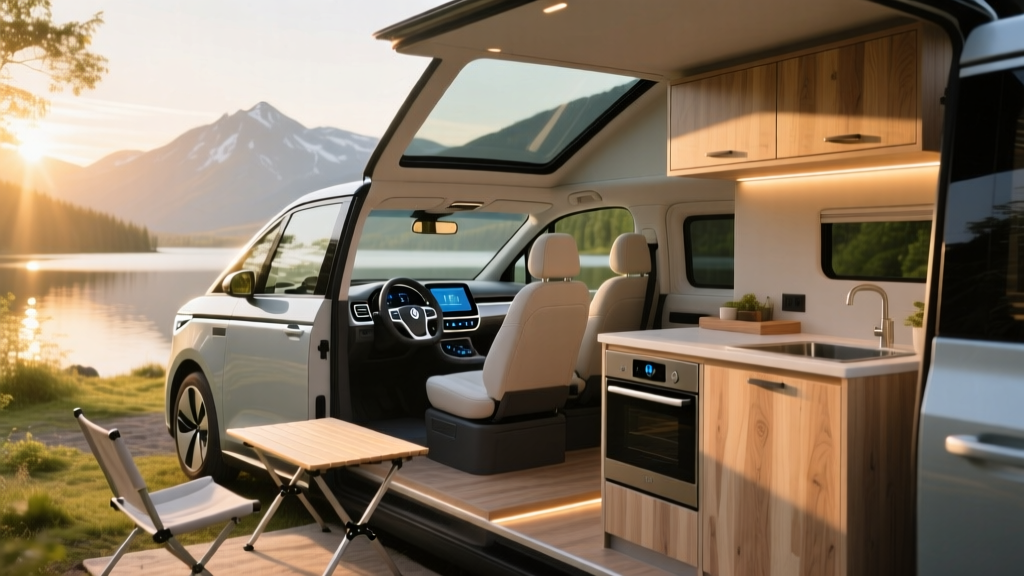
This is the section that brought you here, so let's get specific. The VW ID. Buzz camper interior — officially called the ID. Buzz California in Europe — is built on the long-wheelbase (LWB) platform, which stretches overall length to 195.3 inches (vs. 185.5 for the U.S. standard). That extra 10 inches transforms the interior from "roomy van" to "genuinely livable space."
The California camper package includes:
- Pop-top roof with a roof-mounted bed (approximately 78 x 47 inches), raising overall height to roughly 90 inches when deployed — providing standing room and a second sleeping area
- Lower-level convertible bench/bed in the rear, which folds flat into a roughly 72 x 48 inch sleeping surface
- Integrated kitchen module on the driver's side with a single-burner induction cooktop, a small sink with freshwater/wastewater tanks, and a pull-out pantry
- Camping table that stores in the tailgate and deploys between the front seats
- 230V power outlet (European spec) and multiple USB-C ports throughout
- Privacy curtains for all windows with snap-in mounting
- Camping-mode climate control that maintains cabin temperature while parked without draining the 12V system
The interior materials are durable and wipe-clean — VW uses recycled ocean-plastic textiles on the seats (branded Seaqual), which handle muddy boots and spilled coffee well. The driver's area retains the standard ID. Buzz 12.9-inch infotainment touchscreen and 5.3-inch digital instrument cluster, both running VW's latest ID. Software 4.0, which is significantly more responsive than the laggy ID.3/ID.4 early software.
What the camper interior does not include: a bathroom, a shower, or a large refrigerator. This is a weekend camper, not a full-time RV. Think of it as VW's electric answer to the classic Westfalia — optimized for two people, two or three nights, and minimal hookups.
Pricing, Trims, and Federal Tax Credit Eligibility
For U.S. buyers, here's the hard truth: the California camper variant is not currently sold in the United States. VW has acknowledged "strong consumer interest" but has cited U.S. homologation costs, the relatively small campervan market, and the 234-mile EPA range (which they feel is insufficient for the American road-trip use case) as barriers. The U.S. ID. Buzz is sold in two trims:
| Trim | MSRP (excl. destination) | Destination | Total |
|---|---|---|---|
| ID. Buzz Pro S (RWD) | $59,995 | $1,495 | $61,490 |
| ID. Buzz 1st Edition (RWD) | $65,495 | $1,495 | $66,990 |
A dual-motor AWD variant is expected for the 2026 model year in the U.S., likely starting around $64,000-$67,000.
- MSRP Cap: Vans qualify under the $80,000 MSRP cap for SUVs/vans — the ID. Buzz clears this.
- Buyer Income Cap: $150,000 single / $225,000 head of household / $300,000 joint (MAGI).
- Battery Sourcing: The ID. Buzz's battery components and critical minerals must meet phased-in domestic-content thresholds. As of 2025, VW has confirmed partial credit eligibility ($3,750) for the ID. Buzz; full $7,500 eligibility depends on supply-chain compliance that may shift annually. Verify current status at irs.gov or ask your dealer for the IRS-listed VIN eligibility.
- Point-of-Sale Transfer: Available — you can apply the credit as a down-payment reduction at the dealership rather than waiting for a tax refund.
For European buyers eyeing the California camper: pricing starts around €65,000 (approximately $70,000 USD at current exchange rates) before options. A fully loaded California with the pop-top, kitchen module, and AWD can push past €80,000.
Warranty, Ownership Costs, and Long-Term Outlook
VW backs the ID. Buzz with a competitive warranty package:
- Battery: 8 years / 100,000 miles (whichever comes first), guaranteed to retain at least 70% of original capacity
- Powertrain: 8 years / 100,000 miles
- Bumper-to-bumper: 4 years / 50,000 miles
- Corrosion perforation: 7 years / 100,000 miles
NMC battery degradation in VW's MEB platform has tracked favorably in real-world data from European ID.3 and ID.4 fleets, with most vehicles showing 5-8% capacity loss over 100,000 km (~62,000 miles). The 86 kWh usable capacity provides a comfortable buffer — even at 70% retention (the warranty floor), you'd still have roughly 164 miles of EPA-equivalent range.
Insurance premiums for the ID. Buzz run 15-25% higher than comparable gas minivans, driven by the battery replacement cost (estimated $15,000-$20,000 out of warranty) and limited collision-repair data. Get quotes before purchasing.
How the ID. Buzz Compares to Rivals
The ID. Buzz doesn't have a direct U.S. electric rival in the van segment. The closest comparisons are:
VW ID. Buzz vs. Chrysler Pacifica Hybrid (PHEV): The Pacifica Hybrid offers 32 miles of electric-only range, then a gas engine for unlimited road trips. It seats seven, has a lower starting price (~$50,000), and is the pragmatic family hauler. The ID. Buzz wins on pure electric running costs, interior ambiance, and zero tailpipe emissions — but loses on range flexibility for long road trips.
VW ID. Buzz vs. Mercedes EQV (Europe only): The EQV offers a similar luxury-electric-van experience but with worse range (~213 miles WLTP) and significantly higher pricing. The ID. Buzz is the more compelling EV platform.
VW ID. Buzz California vs. Winnebago e-RV (concept): Winnebago's electric RV concept remains unreleased as a production vehicle. The ID. Buzz California is the only production electric campervan currently available — albeit not in the U.S.
- Genuinely charming retro design with modern EV tech
- Spacious, configurable interior with flat floor
- 170 kW DC charging keeps road-trip stops reasonable
- Heat pump standard (U.S.) for cold-weather efficiency
- California camper variant is the best electric vanlife option in Europe
- Strong 8-yr/100k-mi battery warranty
- 234-mile EPA range is tight for road trips in a large van
- Highway efficiency suffers at speed (aero penalty)
- California camper variant NOT available in the U.S.
- $60,000+ starting price is steep for the range offered
- CCS1 connector; NACS/Supercharger access uncertain
- Infotainment still lags behind Tesla/Hyundai in responsiveness
Who Should Buy the VW ID. Buzz?
The ID. Buzz is best suited for:
- Urban/suburban families who want a distinctive, electric daily driver with three rows and don't regularly exceed 180 miles between charges
- Commuters with home charging who value interior space, ride comfort, and low operating costs over sporty dynamics
- European vanlife enthusiasts who can access the California camper variant and appreciate the electric-campervan lifestyle
It's a tougher sell for:
- Frequent long-distance road trippers — the 234-mile range and charging stops every ~180 miles will test patience on 500+ mile drives
- Budget-conscious buyers — a Pacifica Hybrid or Sienna Hybrid offers more range flexibility at lower cost
- U.S. campervan buyers — until VW commits to bringing the California stateside, the camper interior remains a European exclusive
Frequently Asked Questions
What is the real-world range of the VW ID. Buzz?
The EPA rates the U.S. RWD ID. Buzz at 234 miles. In real-world highway driving at 70 mph, expect 200-220 miles. In cold weather (below 30°F), that can drop to 160-175 miles. City driving with regenerative braking recovers closer to the EPA number.
How fast does the ID. Buzz charge?
On a DC fast charger, the ID. Buzz peaks at 170 kW, achieving a 10-80% charge in approximately 26 minutes. At home on a Level 2 (240V, 48A) charger, the 11 kW onboard charger adds roughly 30 miles per hour, fully replenishing the battery in about 9 hours.
Does the VW ID. Buzz qualify for the federal EV tax credit?
Partially. The ID. Buzz meets the $80,000 MSRP cap for vans. Buyer income limits apply ($150K single / $300K joint). Battery-sourcing requirements under §30D currently qualify the ID. Buzz for at least $3,750 in federal credit; full $7,500 eligibility depends on annual critical-mineral and battery-component thresholds. Check the fueleconomy.gov tax credit lookup for the specific VIN.
Can I buy the VW ID. Buzz camper (California) in the United States?
As of 2025, no. The ID. Buzz California with the pop-top roof and kitchen module is sold only in European markets. VW has not announced a U.S. launch date for the camper variant. U.S. buyers receive the standard three-row passenger ID. Buzz in Pro S or 1st Edition trims.
Is the ID. Buzz worth buying over a hybrid minivan?
If you have reliable home charging, drive under 200 miles daily, and want zero tailpipe emissions with low operating costs (~$0.04-$0.06 per mile on home electricity vs. ~$0.12-$0.15 per mile for a hybrid minivan), the ID. Buzz makes financial sense over 5+ years of ownership. If you regularly road-trip beyond 200 miles or lack home charging, a Chrysler Pacifica Hybrid or Toyota Sienna Hybrid offers more flexibility at lower upfront cost.
What is the battery warranty on the ID. Buzz?
VW covers the ID. Buzz battery for 8 years or 100,000 miles, guaranteeing it will retain at least 70% of original capacity during that period. The powertrain (motors, power electronics) carries the same 8-yr/100k-mi coverage.