The VW ID. Buzz Arrives in America — But Is the Camper Interior Coming?
The Volkswagen ID. Buzz has finally crossed the Atlantic, landing in U.S. showrooms for the 2025 model year in a long-wheelbase, three-row configuration. For EV buyers drawn to retro styling and practical van utility, it's the most distinctive electric vehicle on the market. But the version generating the most search interest — the one with the van VW ID Buzz camper interior — tells a more complicated story for North American buyers.
Europe received the shorter-wheelbase ID. Buzz with a factory California camper conversion (pop-top roof, fold-flat bed, integrated kitchenette). That variant remains unavailable in the United States as of early 2026. What U.S. buyers can purchase is the three-row ID. Buzz LWB, a 195-inch-long electric minivan with a flexible interior that, with aftermarket modifications, can serve as a capable camper platform. Let's break down exactly what you're getting — and what you're not.
Specs at a Glance: 2025 VW ID. Buzz LWB
| Specification | 2025 VW ID. Buzz LWB (RWD) | 2025 VW ID. Buzz LWB (AWD) |
|---|---|---|
| EPA Range | 234 miles | 231 miles |
| Battery (Usable) | 91 kWh (NMC) | 91 kWh (NMC) |
| Horsepower | 282 hp | 335 hp (combined) |
| 0–60 mph | ~7.9 sec | ~5.9 sec |
| Drivetrain | Rear-wheel drive | Dual-motor AWD |
| Max DC Fast Charge | 170 kW | 170 kW |
| 10–80% DCFC Time | ~26 minutes | ~26 minutes |
| Level 2 Charge Rate | 11 kW (AC) | 11 kW (AC) |
| MPGe (Combined) | 87 MPGe | 84 MPGe |
| Efficiency | 39 kWh/100 mi | 40 kWh/100 mi |
| Cargo (Behind 3rd Row) | 18.4 cu ft | 18.4 cu ft |
| Cargo (All Rows Folded) | ~120 cu ft | ~120 cu ft |
| Base MSRP | $59,995 | $69,995 |
| Battery Warranty | 8 yr / 100,000 mi | 8 yr / 100,000 mi |
Real-World Range: What to Actually Expect
EPA Sticker: 234 miles (RWD) / 231 miles (AWD)
Real-World Highway (70 mph, mild weather): ~195–210 miles
Cold-Weather Highway (30°F or below): ~160–180 miles
City / Stop-and-Go: ~230–245 miles (regen-heavy driving helps)
The ID. Buzz's boxy, upright shape works against it at highway speeds. Aerodynamic drag is the single biggest range killer for EVs above 65 mph, and the Buzz's flat windshield and squared-off rear end create substantial turbulence. In EPA testing, the combined cycle yields 87 MPGe for RWD — respectable for a 5,800-pound van, but lower than a Tesla Model Y Long Range (117 MPGe combined) or Hyundai Ioniq 5 (114 MPGe).
For camper-conversion buyers planning road trips, plan conservatively. In moderate temperatures on mixed highway driving, expect to use roughly 350–380 Wh/mile. That means a practical highway range of about 200 miles before the low-battery warnings start appearing around 10% State of Charge. In winter, the ID. Buzz does include a heat pump (standard on U.S. models), which mitigates cabin-heating energy draw — but battery chemistry itself loses efficiency in cold. Expect a 20–30% range reduction below freezing.
Charging Speed: DC Fast and Home Level 2
| Charging Method | Power | Miles Added per Hour | Time (10–80%) |
|---|---|---|---|
| Level 1 (120V household) | ~1.4 kW | ~3–4 mi/hr | ~65+ hours |
| Level 2 (240V home, 48A) | 11 kW | ~28–30 mi/hr | ~9 hours (0–100%) |
| DC Fast (170 kW peak) | 170 kW max | ~137 mi in 10 min (peak) | ~26 minutes |
| DC Fast (50 kW station) | 50 kW | ~120 mi/hr | ~55 minutes |
The ID. Buzz charges at a peak rate of 170 kW on a DC fast charger — adequate but not class-leading. Competitors like the Hyundai Ioniq 5 and Kia EV9 accept 235–240 kW and 236 kW respectively on 800V architectures, shaving 8–10 minutes off a 10–80% session.
Here's what the charging curve actually looks like: the ID. Buzz sustains close to 170 kW between roughly 10% and 35% SoC, then begins a gradual taper. Between 50% and 80%, expect sustained rates of 80–110 kW. This is typical of 400V NMC architectures and means your last 30 percentage points take noticeably longer than the first 30.
For home charging, the 11 kW onboard AC charger is a strong point. On a dedicated 48-amp Level 2 circuit (NEMA 14-50 or hardwired), you'll add roughly 30 miles of range per hour — meaning a full overnight charge from 10% to 100% takes about 9 hours. Most owners will wake up to a full battery every morning, which is the entire point of home charging. Budget $800–$1,500 for a quality Level 2 home charger installation, potentially more if your electrical panel needs a 200-amp upgrade.
The Camper Interior Situation: U.S. vs. Europe
This is the section that matters most for anyone specifically searching for the VW ID Buzz camper interior. Here's the reality:
In Europe: VW offers the ID. Buzz California — a factory camper conversion built in partnership with Brabus-style upfitter Westfalia. It includes a pop-up roof with a sleeping area, a fold-down rear bed, a compact kitchen module with a single-burner induction cooktop, integrated water tank, and auxiliary battery for off-grid camping. This is a compelling, purpose-built electric camper van.
In the United States: VW has not announced the California camper variant for the North American market as of 2026. The U.S. receives only the long-wheelbase, three-row passenger configuration. VW America executives have acknowledged "strong interest" in a camper version but cite different regulatory requirements, the larger U.S. vehicle dimensions, and market prioritization as reasons for the delay.
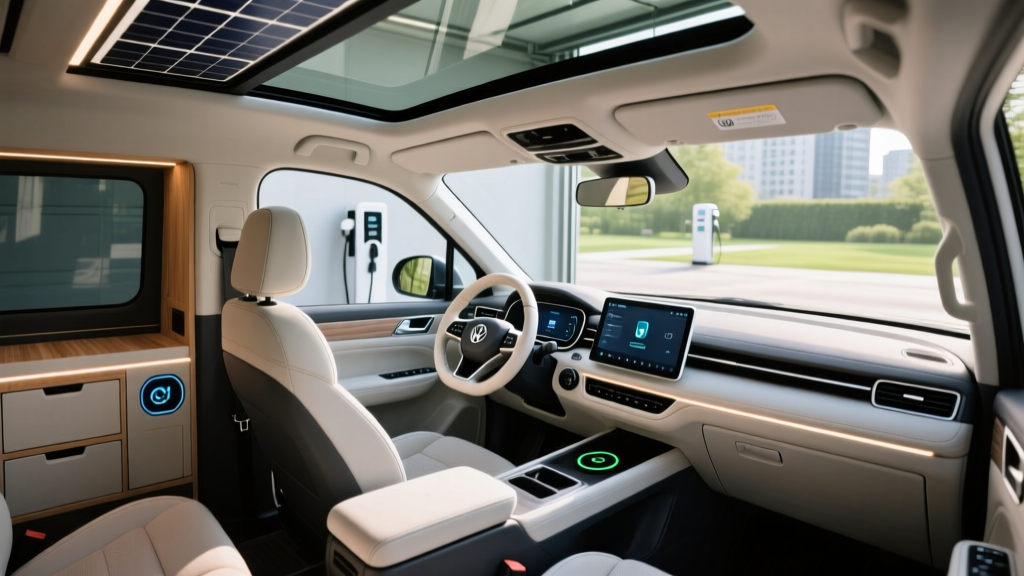
What you can do with the U.S. ID. Buzz LWB is pursue an aftermarket camper conversion. The van's flat floor, generous interior height (~55 inches from floor to ceiling in the cargo area with seats folded), and 91 kWh battery make it a viable platform. Companies like Peace Vans, Colorado Camperman, and independent upfitters have begun offering ID. Buzz conversion packages that include:
- Fold-flat sleeping platforms (accommodating two adults)
- Removable galley boxes with 12V compressor fridges and portable cooktops
- Roof-rack-mounted solar panels (200–400W) to trickle-charge the 12V accessory system
- Window insulation panels and privacy curtains
- Portable cassette toilets and collapsible water containers
The ID. Buzz's 91 kWh battery is a camper-conversion advantage. While VW does not currently offer Vehicle-to-Load (V2L) functionality on U.S. models (a significant omission compared to Hyundai/Kia), aftermarket inverters can tap the 12V system for low-power accessories. For high-power needs (induction cooktops, space heaters), you'd need an external portable power station — the Buzz itself won't power them directly.
Interior Space, Tech, and Daily Livability
With all three rows in use, cargo space behind the third row is just 18.4 cubic feet — enough for a few grocery bags or two small suitcases, but tight for a family road trip with luggage. Fold the third row (which splits 60/40 and slides forward), and you open up roughly 75 cubic feet. Fold everything flat and you approach 120 cubic feet — a genuinely cavernous space ideal for a camper bed platform or hauling gear.
Second-row seats slide, recline, and fold flat but do not tumble or remove easily — a drawback for those wanting a completely empty cargo bay. The floor is flat from the front footwells to the rear hatch, which is excellent for camper builds.
Up front, the ID. Buzz uses VW's ID. 4-derived infotainment system: a 12.9-inch touchscreen running ID. Software 4.0 (improved significantly over the laggy 3.x generation). Wireless Apple CarPlay and Android Auto are standard. A 5.3-inch digital instrument cluster sits behind the steering wheel. The center console is modular and removable — a clever touch that opens up a walk-through between front seats.
Driver assistance includes VW's IQ.DRIVE suite: adaptive cruise control, lane-keeping assist, automatic emergency braking, and Travel Assist (a combined lane-centering + ACC system operating up to 95 mph). This is a competent Level 2 SAE system — it requires constant driver supervision and is not autonomous driving.
Pricing, Tax Credits, and Total Cost
| Trim | MSRP | Federal §30D Credit | Effective Price |
|---|---|---|---|
| ID. Buzz Pro S (RWD) | $59,995 | $0 (see below) | $59,995 |
| ID. Buzz 1st Edition (RWD) | $65,495 | $0 | $65,495 |
| ID. Buzz Pro S Plus AWD | $69,995 | $0 | $69,995 |
Federal tax credit status: The VW ID. Buzz does not currently qualify for the $7,500 federal EV tax credit under IRS §30D. The reasons are twofold:
- MSRP cap: Under §30D rules, vans must have an MSRP at or below $80,000. The ID. Buzz clears this threshold.
- Battery sourcing: The ID. Buzz's NMC battery cells are manufactured outside the United States and do not currently meet the critical-minerals and battery-component sourcing requirements that phase in annually under the Inflation Reduction Act. As of the 2025 tax year, the battery-component requirement effectively excludes most vehicles with non-North-American battery production.
Buyer income limits also apply (§30D caps at $300,000 joint / $150,000 single filer for new vehicles), but the sourcing disqualification is the primary barrier. Always verify current eligibility on IRS.gov before purchasing, as VW's supply chain evolves and rules can shift.
Some states offer their own EV rebates (California, Colorado, New York, and others) that may apply regardless of federal credit status. Check your state's energy or DMV website for specifics.
How It Compares: ID. Buzz vs. Key Alternatives
The ID. Buzz occupies a unique niche, but if you're cross-shopping an electric van or camper-capable EV, consider these alternatives:
- Kia EV9 (3-row SUV, $54,900+): More range (304 mi EPA), faster 236 kW charging, available for the $7,500 federal credit (select trims), but it's an SUV — not a van, and far less camper-friendly interior volume.
- Chrysler Pacifica PHEV (minivan, $50,000+): 32 miles of electric-only range, then a gas engine for unlimited road-trip range. Not a BEV, but practical for camper-curious families who need range flexibility. No DC fast charging.
- Mercedes EQV / eSprinter (not widely available U.S.): Larger, more expensive, fleet-oriented. Not a consumer product in the U.S. market.
- Used Tesla Model X or Rivian R1S: Neither is a van, but both offer more range and charging speed. The R1S in particular has strong overlanding/camping aftermarket support.
The ID. Buzz wins on character, interior flexibility, and the specific use case of a daily-driver that moonlights as a weekend camper. It loses on range, charging speed, and tax-credit eligibility versus mainstream EV SUVs.
Pros, Cons, and Who Should Buy
Pros
- Flat, cavernous interior ideal for aftermarket camper builds
- Distinctive retro design with modern EV powertrain
- Strong 11 kW Level 2 home charging (full overnight charge)
- Standard heat pump for cold-weather efficiency
- Spacious third row that actually fits adults
- IQ.DRIVE suite is a competent Level 2 assist
- 8-year/100,000-mile battery warranty
Cons
- 234-mile EPA range is short for road-trip camper use
- 170 kW peak DC charging is slow vs. 800V competitors
- No federal §30D tax credit eligibility currently
- Factory camper (California) variant not sold in the U.S.
- No Vehicle-to-Load (V2L) feature for powering camper accessories
- Third-row seats don't tumble or remove easily
- $60,000+ starting price with no credit offset
- Highway efficiency drops sharply above 70 mph
Who the ID. Buzz Is For
Buy the ID. Buzz if: You want a unique, stylish EV that serves as a daily family hauler and weekend camper platform. You have reliable home Level 2 charging. Your road trips are under 200 miles between stops, or you're patient with DC fast-charging breaks. You value interior space and flat-floor flexibility over outright range.
Look elsewhere if: You need 300+ miles of range for long road trips. You want the fastest possible DC charging. You need the federal tax credit to make the math work. You want a factory-built camper van with a pop-top roof — the U.S. ID. Buzz doesn't offer one.
Frequently Asked Questions
What is the real-world range of the VW ID. Buzz?
The EPA rates the RWD ID. Buzz at 234 miles and the AWD at 231 miles. In real-world highway driving at 70 mph in mild weather, expect 195–210 miles. In cold weather (below 30°F), plan for 160–180 miles. City driving with regenerative braking can push range closer to or slightly above the EPA figure.
How fast does the ID. Buzz charge at home and on the road?
On a DC fast charger, the ID. Buzz peaks at 170 kW and charges from 10–80% in about 26 minutes. At home on a 240V Level 2 charger (48 amps), it charges at 11 kW, adding roughly 30 miles of range per hour — a full charge overnight in about 9 hours. On a standard 120V household outlet (Level 1), expect just 3–4 miles per hour — usable only for overnight top-ups, not primary charging.
Does the VW ID. Buzz qualify for the federal EV tax credit?
As of 2025–2026, the VW ID. Buzz does not qualify for the $7,500 federal §30D tax credit. While its MSRP is under the $80,000 van cap, its battery components and critical minerals do not meet the IRA's North American sourcing requirements. Always verify current rules at IRS.gov, as eligibility can change with supply-chain updates.
Is there a factory VW ID. Buzz camper van available in the U.S.?
No. The ID. Buzz California — VW's factory camper variant with a pop-top roof, fold-flat bed, and integrated kitchenette — is sold only in Europe. VW has not announced a U.S. release date. American buyers must pursue aftermarket camper conversions, which the ID. Buzz's flat floor and generous interior volume support well.
Is the ID. Buzz worth buying vs. competitors?
It depends on your priorities. For a camper-capable electric vehicle with unmatched character and interior flexibility, the ID. Buzz has no direct U.S. rival. However, if range, charging speed, and tax-credit savings are your top concerns, the Kia EV9 (304 mi range, 236 kW charging, $7,500 credit on qualifying trims) is a more practical three-row EV — just not a van. For true camper-van utility with unlimited range, a Chrysler Pacifica PHEV remains a compelling, if less electrified, alternative.
What is the battery warranty on the ID. Buzz?
Volkswagen covers the ID. Buzz's 91 kWh NMC battery pack for 8 years or 100,000 miles, whichever comes first. The warranty guarantees that the battery will retain at least 70% of its original capacity during that period. VW's broader vehicle warranty is 4 years / 50,000 miles bumper-to-bumper.