Can the VW ID. Buzz Actually Work as an Electric Camper?
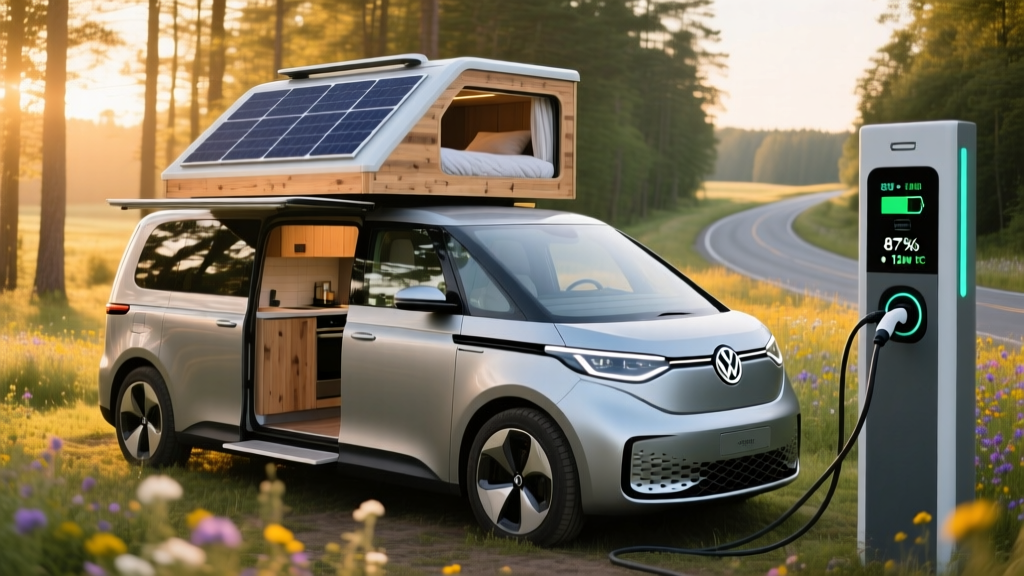
The Volkswagen ID. Buzz arrived in the U.S. for the 2025 model year as a three-row electric van dripping with retro nostalgia. But beneath the two-tone paint and microbus vibes sits a 91 kWh battery, a flat load floor, and enough interior volume to make the vanlife community take notice. The search for a viable VW ID. Buzz camper conversion is already underway — and for good reason. This is one of the only modern electric vehicles with the standing height, cargo footprint, and electrical architecture to support a legitimate DIY or professionally outfitted camper build.
But converting any EV into a camper introduces unique challenges: Will the range hold up with added weight? Can you charge fast enough on remote road trips? Does the battery warranty survive a conversion? We've analyzed the ID. Buzz's specifications, real-world efficiency data, and conversion feasibility to give you the full picture before you pull the trigger on a build.
| Spec | Value |
|---|---|
| EPA Estimated Range | 234 miles (Std trim) / 231 miles (AWD Pro S) |
| Battery Capacity (Usable) | 91 kWh (NMC lithium-ion) |
| Max DC Fast Charge Rate | 170 kW (peak) |
| 10–80% DC Fast Charge Time | ~26 minutes (VW est.) |
| Level 2 Home Charging Rate | 11 kW (48A) — ~28 mi/hr |
| Drivetrain | RWD (single motor) or AWD (dual motor) |
| Horsepower | 282 hp (RWD) / 335 hp (AWD) |
| 0–60 mph | ~7.9 sec (RWD) / ~6.5 sec (AWD) |
| EPA Efficiency | 87 MPGe combined (RWD) |
| Cargo Volume (behind 3rd row) | 18.4 cu ft |
| Cargo Volume (2nd/3rd folded) | ~130 cu ft (est.) |
| Wheelbase | 131.5 in (LWB) |
| Battery/Powertrain Warranty | 8 years / 100,000 miles |
| Base MSRP | $59,995 (Std) / $63,495 (Pro S) |
Range and Efficiency: The Camper Conversion Reality Check
The EPA rates the rear-wheel-drive ID. Buzz at 234 miles on a full charge, with the dual-motor AWD Pro S dropping slightly to 231 miles. Those numbers come from Volkswagen's U.S.-spec long-wheelbase model equipped with the 91 kWh usable NMC (nickel manganese cobalt) battery pack. For context, fueleconomy.gov lists the combined efficiency at 87 MPGe for the RWD variant, translating to roughly 38–40 kWh per 100 miles of mixed driving.
Real-World Range Expectations (Camper-Converted):
- EPA Sticker: 234 miles (RWD, stock)
- Highway (70 mph, stock): ~195–210 miles
- Camper conversion (+500–800 lbs): Expect a 10–18% reduction — ~165–190 miles usable in mixed driving
- Cold weather (below 32°F): Subtract another 20–30% — plan for 120–150 miles in winter conditions with a loaded build
A camper conversion adds weight (insulation, bed platform, water tanks, cabinetry) and often increases aerodynamic drag if you mount roof boxes or solar panels. Budget your route planning around 160 miles of comfortable range to avoid pushing the pack below 10% SoC in unfamiliar territory.
The ID. Buzz already carries a heavy curb weight of roughly 5,800 pounds in AWD trim. Adding a typical camper conversion — bed frame, mattress, portable kitchen, 5-gallon water jugs, insulation, and personal gear — can push total vehicle weight past 6,500 pounds. That weight penalty hits efficiency harder in stop-and-go city driving and on steep grades than it does on flat highway cruising, but the aerodynamic penalty of roof-mounted gear is what really stings at interstate speeds.
Charging Speed and Infrastructure for Vanlife Routes
Charging is the make-or-break factor for any EV camper, and the ID. Buzz's 170 kW peak DC fast-charge capability is adequate but not class-leading. Here's the full breakdown:
| Level | Power | Speed | Notes |
|---|---|---|---|
| Level 1 (120V outlet) | ~1.4 kW | ~3–4 mi/hr | Emergency/trickle only — ~60+ hrs for full charge |
| Level 2 (240V, 48A) | 11 kW | ~28 mi/hr | Full charge in ~9.5 hrs; ideal for overnight at campsite or home |
| DC Fast Charge | 170 kW (peak) | 10–80% in ~26 min | Peak rate sustained only to ~30% SoC; tapers significantly above 70% |
The charge curve matters enormously for road-tripping campers. The ID. Buzz's 170 kW peak only holds through roughly the 10–30% state-of-charge window. From 30–70%, expect sustained rates closer to 110–130 kW. Above 80%, the rate drops sharply to protect the NMC cells — often below 50 kW. This means the common road-trip strategy of charging from 10% to 80% takes about 26 minutes, but if you need a full 100% for a remote leg with no chargers ahead, budget 45–55 minutes total at the station.
For camper use, the Level 2 rate of 11 kW is genuinely useful. Many RV parks and campgrounds now offer 240V/50A outlets (NEMA 14-50), which can deliver up to 11.5 kW — close to the van's onboard charger maximum. Plug in overnight at a campground and wake up to a full battery. The ID. Buzz uses the CCS1 connector for DC fast charging and J1772 for Level 2. If you're traveling routes with Tesla Superchargers, you'll need a NACS-to-CCS adapter (Volkswagen has confirmed NACS compatibility via adapter for U.S. models).
Performance and Drivetrain: Which Configuration Suits a Camper Build?
The U.S. ID. Buzz comes in two drivetrain configurations, and the choice matters for a camper conversion:
RWD (Single Motor, 282 hp): The rear-axle-mounted APP550 permanent-magnet motor delivers 282 horsepower and 406 lb-ft of torque. The 0–60 mph time of roughly 7.9 seconds is leisurely but perfectly adequate for a loaded van. The RWD model gets the best EPA range at 234 miles and costs $3,500 less than the AWD. If your camper routes stay mostly on paved roads in moderate climates, this is the efficiency-maximizing choice.
AWD (Dual Motor, 335 hp): Adding a front induction motor brings total output to 335 hp and drops the 0–60 time to about 6.5 seconds. More importantly for camper use, the AWD system provides traction on forest service roads, snowy mountain passes, and wet campground gravel. The range penalty is minimal (3 miles EPA), but the cost premium and slightly reduced payload capacity from the front motor's weight are worth considering.
Neither configuration offers a tow rating in the U.S. market — Volkswagen has not published a towing capacity for the American ID. Buzz, which limits camper builds that rely on teardrop trailers. Your camping gear goes inside, not behind.
Interior Volume and Camper Conversion Feasibility
The U.S. long-wheelbase ID. Buzz measures 131.5 inches between the axles with an overall length of about 195 inches. Interior cargo length with the second and third rows folded and removed is approximately 80 inches — enough for a full-length bed platform without cutting diagonals. Interior height from floor to ceiling is roughly 53 inches at the center, which doesn't provide standing room for most adults but is competitive with other camper-van platforms like the Mercedes Metris (now discontinued) and the Ford Transit Connect.
Key conversion advantages:
- Flat load floor: The battery sits beneath the floor, creating a completely flat surface from the rear hatch to the back of the front seats — ideal for bed platforms and cabinetry.
- 12V and high-voltage access: The ID. Buzz's 12V auxiliary system can power LED lighting, USB charging, and a 12V fridge. Some converters tap the high-voltage system via an inverter for AC appliances, though this requires professional installation and may affect warranty coverage.
- Climate preconditioning: The heat pump (standard on U.S. models) allows you to preheat or precool the cabin while plugged in — a major comfort advantage at campsites with shore power.
- Rear hatch design: The liftgate opens upward to create a natural awning, and the low load-in height makes loading heavy gear manageable.
The main spatial drawback: the ID. Buzz is narrower than a Ford Transit or Ram ProMaster, limiting crosswise sleeping for taller occupants. A longitudinal bed layout (head-to-toe along the driver's side) works best for anyone over 5'10".
Pricing, Trims, and Federal Tax Credit Eligibility
The 2025 VW ID. Buzz starts at $59,995 for the Standard trim (RWD) and climbs to $63,495 for the Pro S with AWD. A fully loaded 1st Edition model — the only trim available at initial U.S. launch — carries an MSRP of approximately $69,995 before destination charges.
| Trim | MSRP | Est. After §30D Credit* | Notes |
|---|---|---|---|
| Std (RWD) | $59,995 | ~$52,495 | Requires buyer + vehicle eligibility |
| Pro S (RWD) | $61,495 | ~$53,995 | Within MSRP cap |
| Pro S (AWD) | $63,495 | ~$55,995 | Within MSRP cap |
| 1st Edition (AWD) | $69,995 | ~$62,495 | Exceeds $80,000 van cap? No — van cap is $80,000 |
*Assumes full $7,500 credit. Eligibility is NOT guaranteed — see requirements below.
The ID. Buzz is classified as a van/minivan under IRS §30D rules, which sets the MSRP cap at $80,000 — meaning all current trims fall within the price limit. However, qualifying for the full $7,500 federal tax credit depends on several factors that change frequently:
- Buyer income caps: Modified AGI must not exceed $150,000 (single), $225,000 (head of household), or $300,000 (joint). Source: IRS §30D guidelines.
- Battery component sourcing: The battery must meet escalating domestic-content and critical-mineral requirements. Volkswagen manufactures the ID. Buzz in Hanover, Germany, and the battery cell sourcing may not meet all U.S. content thresholds for the full credit in every model year. Check the latest fueleconomy.gov credit listings before purchasing.
- Point-of-sale transfer: As of 2024, qualifying buyers can transfer the credit to the dealer at purchase, reducing the out-of-pocket price immediately rather than waiting for a tax refund.
Given the ID. Buzz's German manufacturing origin, buyers should verify current credit eligibility with their dealer and a tax professional before assuming the $7,500 reduction. The partial credit ($3,750) may apply if the vehicle meets critical-mineral requirements but not battery-component requirements.
Warranty Coverage and Conversion Considerations
Volkswagen provides an 8-year/100,000-mile warranty on the high-voltage battery pack, guaranteeing it will retain at least 70% of its original capacity during that period. The limited vehicle warranty covers 4 years/50,000 miles, and the powertrain (motors, reduction gear) is covered for 8 years/100,000 miles.
The critical question for converters: Does a camper build void the warranty? The Magnuson-Moss Warranty Act protects consumers — VW cannot void your battery or powertrain warranty simply because you installed a bed platform, insulation, or cabinetry. However, if you tap into the high-voltage system for an inverter or modify the 12V electrical architecture in a way that causes a failure, Volkswagen can deny coverage for that specific damage. Keep all electrical modifications on the 12V side, use a standalone auxiliary battery for camper loads, and document your build meticulously.
NMC battery degradation for VW's MEB platform has tracked well in European fleet data, with most ID.3 and ID.4 packs showing 5–8% capacity loss over the first 60,000 miles. Expect similar behavior in the ID. Buzz — meaning roughly 215 miles of usable range (stock) after 5 years of moderate use. A camper-converted van driven 15,000 miles per year should retain approximately 180–190 miles of real-world range at the 5-year mark.
Pros, Cons, and the Verdict
Pros
- Flat load floor with ~130 cu ft of cargo space — excellent camper platform
- 91 kWh battery provides legitimate 160+ mile range even with conversion weight
- 11 kW Level 2 charging works well at RV parks and campgrounds overnight
- Heat pump standard — efficient cabin heating in cold weather without massive range penalty
- Retro styling turns heads at every campsite (subjective, but real)
- Strong 8-yr/100,000-mi battery warranty provides long-term peace of mind
Cons
- 170 kW peak DC charge rate trails rivals like the Hyundai Ioniq 5 (240 kW) and Tesla Model Y (250 kW)
- No published towing capacity in the U.S. — limits trailer-based camper setups
- Interior height (~53 in) doesn't allow standing — not a true "stand-up" camper van
- German-built battery sourcing may limit or eliminate §30D tax credit eligibility
- $60,000+ starting price is steep before conversion costs ($5,000–$15,000 typical)
- CCS1 charging network reliability remains inconsistent in rural areas
The verdict: The VW ID. Buzz is the most compelling electric camper conversion platform available in the U.S. market today — not because it's perfect, but because nothing else combines this much interior volume, a large battery, and a flat floor in a passenger-vehicle package. If your camping style involves weekend trips to established campgrounds with charging access, national forest roads within 150 miles of home, or boondocking with solar supplementation, the ID. Buzz camper conversion is genuinely viable. If you need 300+ miles of range for remote desert routes or standing-height interior space, you'll want to look at a used Mercedes Sprinter or wait for larger electric van platforms to reach the U.S.
Frequently Asked Questions
What is the real-world range of a VW ID. Buzz after a camper conversion?
Expect approximately 165–190 miles of usable range in mild weather with a typical 500–800 lb conversion. In cold weather (below freezing), plan for 120–150 miles. The EPA sticker of 234 miles applies to the stock, unmodified van under mixed-driving conditions.
How fast does the ID. Buzz charge on a road trip?
At a DC fast charger rated 170 kW or higher, the ID. Buzz charges from 10–80% in approximately 26 minutes. The peak 170 kW rate only sustains through the early portion of the curve; expect 110–130 kW through the mid-range and significant tapering above 80%. On Level 2 at a campground (240V/50A), a full overnight charge takes about 9.5 hours.
How much does a VW ID. Buzz camper conversion cost in total?
The vehicle itself starts at $59,995. A DIY camper conversion (bed platform, insulation, basic cabinetry, 12V lighting, portable stove) typically runs $5,000–$10,000 in materials. Professional conversions from shops like Peace Vans or Colorado Camper Van range from $15,000 to $40,000+ depending on complexity. Total all-in cost for a professionally converted ID. Buzz camper: $75,000–$110,000.
Does the VW ID. Buzz qualify for the $7,500 federal EV tax credit?
It may, but eligibility is not guaranteed. The ID. Buzz is assembled in Germany, and its battery cell sourcing must meet IRS critical-mineral and domestic-content thresholds that tighten each year. Check the current listing on fueleconomy.gov and consult a tax professional. The van qualifies under the $80,000 MSRP cap for vans/SUVs, and buyer income limits apply.
Can I install solar panels on an ID. Buzz camper conversion?
Yes, but with constraints. The roof can support flexible solar panels (100–200W typical) connected to a standalone auxiliary battery — not the main traction battery. This auxiliary system can run LED lights, a 12V fridge, and device charging. Don't expect rooftop solar to meaningfully extend driving range; its purpose is powering camper amenities off-grid.
Is the ID. Buzz better for camper conversion than a Tesla Model Y or Rivian R1S?
For pure interior volume and flat-floor camper practicality, the ID. Buzz wins decisively — its 80-inch cargo length and van-style body are purpose-built for sleeping platforms. The Model Y offers better range (320+ mi) and faster charging (250 kW) but a cramped, sloped interior. The Rivian R1S provides off-road capability and a larger battery option but less usable interior height and a higher starting price. Choose the ID. Buzz if interior livability is your top priority.