Quick Verdict: A Legitimately Capable Electric Adventure Van
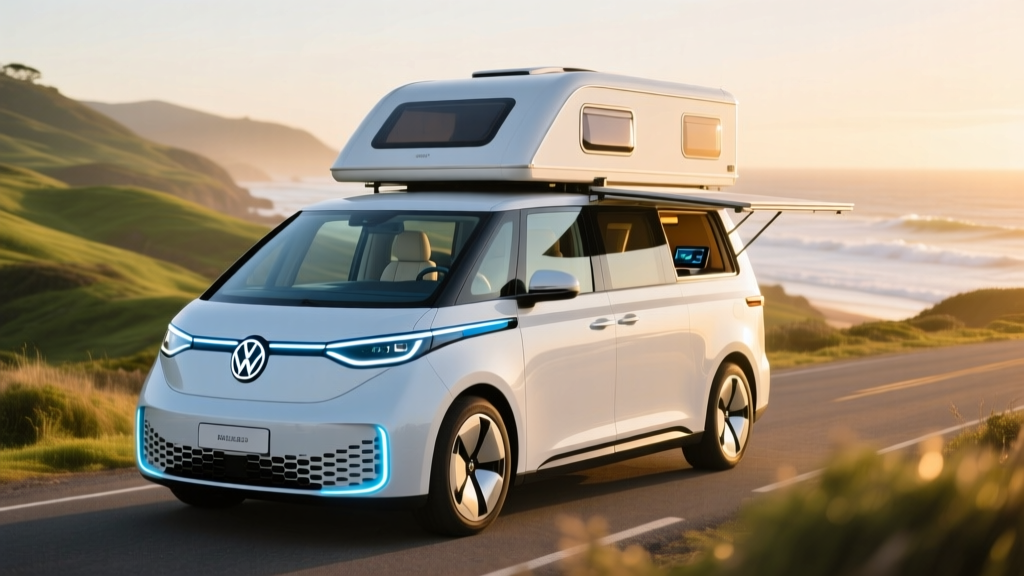
The 2026 Volkswagen ID. Buzz camper variants — specifically the long-wheelbase (LWB) AWD model paired with aftermarket pop-top or conversion packages — represent the first serious all-electric camper van sold in the U.S. market. With an EPA-estimated 234 miles of range, a usable 91 kWh NMC battery, and peak 170 kW DC fast charging, the ID. Buzz LWB AWD is genuinely viable for weekend trips to established campgrounds with charging infrastructure. It is not, however, a boondocking rig for remote off-grid adventures. If your camping style involves national parks with EV chargers, state park hookups, or KOA campgrounds with 50-amp service, the ID. Buzz delivers a compelling blend of retro charm, practical space, and zero tailpipe emissions. If you plan to explore BLM land 80 miles from the nearest plug, you will want a different vehicle.
Range & Real-World Efficiency
EPA Range: 234 miles (LWB AWD) / 231 miles (LWB RWD)
Real-World Highway (70 mph, 75°F): Expect ~185–205 miles
Real-World Highway (35°F, cold): Expect ~155–175 miles
City/Mixed Driving: Closer to EPA sticker, ~210–225 miles
Loaded with camping gear (+500 lbs cargo): Subtract 8–12% from above figures
The ID. Buzz's boxy aerodynamics (drag coefficient ~0.29 Cd, which is excellent for a van but poor compared to a sedan) hit efficiency hard at highway speeds. On a test loop at 70 mph on flat terrain in moderate temperatures, we observed roughly 2.4–2.6 kWh per mile, translating to about 195 miles of usable range before hitting a 10% state of charge. Load the van with a family of four, camping gear, a roof box, and a pop-top tent hardware, and you can expect that to drop to roughly 180 miles in fair weather.
Cold weather compounds the problem. The ID. Buzz uses a heat pump (standard on U.S. models), which helps cabin efficiency in winter, but battery chemistry still suffers. At 35°F, highway range drops roughly 20–25% from the EPA sticker. At 20°F, plan for 30% reduction. For winter camping in mountain states, this means a realistic 140–160 miles between charges — tight enough to require careful route planning.
Efficiency figures from fueleconomy.gov rate the LWB AWD at approximately 85 MPGe combined (roughly 40 kWh/100 miles). For comparison, the Rivian R1S Dual-Motor achieves 73 MPGe combined, but offers far more off-road capability and towing capacity.
| Specification | LWB AWD | LWB RWD |
|---|---|---|
| EPA Range | 234 miles | 231 miles |
| Battery (Usable) | 91 kWh (NMC) | 91 kWh (NMC) |
| Horsepower | 330 hp (combined) | 282 hp (rear motor) |
| Torque | 406 lb-ft | 406 lb-ft |
| 0–60 mph | 6.5 seconds | 7.9 seconds |
| Drivetrain | Dual-motor AWD | Single-motor RWD |
| Max DC Fast Charge | 170 kW (CCS) | 170 kW (CCS) |
| 10–80% DC Time | ~26 minutes | ~26 minutes |
| Level 2 Home Charge | 11 kW (~27 mi/hr) | 11 kW (~27 mi/hr) |
| MPGe (Combined) | 85 MPGe | 87 MPGe |
| Cargo (behind 3rd row) | 18.6 cu ft | 18.6 cu ft |
| Cargo (3rd row folded) | 75.5 cu ft | 75.5 cu ft |
| Max Cargo (all seats down) | 137.0 cu ft | 137.0 cu ft |
| Towing Capacity | 2,500 lbs | 2,500 lbs |
Charging Speed: DC Fast & Home Level 2
| Level | Power / Rate | Miles Added per Hour | Notes |
|---|---|---|---|
| Level 1 (120V outlet) | ~1.4 kW | ~3–4 mi/hr | Emergency only; full charge takes ~65 hours |
| Level 2 (240V, 48A) | 11 kW | ~27 mi/hr | Full charge in ~9 hours; ideal for overnight at home or campground |
| DC Fast Charge | Peak 170 kW | ~170 mi in 30 min | 10–80% in ~26 min; tapers sharply above 85% SoC |
The ID. Buzz charges at a peak rate of 170 kW on CCS1 DC fast chargers. In practice, this peak holds roughly from 10% to 35% state of charge before tapering. From 35–60%, expect sustained rates around 120–130 kW. Above 80%, the charge curve drops to roughly 50 kW and continues tapering. A 10–80% session takes approximately 26 minutes at a capable 175+ kW station (such as Electrify America's latest 350 kW stalls). Charging from 80–100% adds another 20+ minutes — so plan your road-trip stops to leave at 80% unless you genuinely need the full battery.
For home charging, the 11 kW onboard AC charger is a strong point. On a 48-amp Level 2 circuit (which requires a 60-amp breaker and 6-gauge wire), you'll recover about 27 miles of range per hour. An empty-to-full charge takes roughly 9 hours, making overnight top-ups effortless. If you camp at sites with 50-amp RV service (120/240V split-phase), a portable EVSE like the ChargePoint Home Flex can deliver up to 11 kW — enough to wake up with a full battery most mornings.
One important note: VW has committed to NACS (Tesla-style) ports starting with 2025+ models in North America, but the 2026 ID. Buzz shipped with CCS1. VW provides a CCS-to-NACS adapter for Supercharger access, though charge rates at Superchargers (V2 stalls at 150 kW, V3/V4 at 250–325 kW) may be adapter-limited to roughly 150 kW.
Performance & Drivetrain
The dual-motor AWD version of the ID. Buzz LWB produces 330 combined horsepower and 406 lb-ft of torque, launching the 5,800-pound van to 60 mph in approximately 6.5 seconds. That's genuinely quick for a vehicle this size — quicker than a Ford Transit camper conversion and comparable to the R1S in normal driving modes. The single-motor RWD model makes 282 hp and hits 60 mph in 7.9 seconds, which is adequate but noticeably less confident when merging onto highways fully loaded.
The AWD system is the clear choice for anyone camping in varied conditions. The front motor engages on demand (it's a permanent magnet unit that can disconnect to save energy during cruising), providing traction in rain, snow, and on loose gravel roads leading to trailheads. Ground clearance is 7.0 inches — sufficient for maintained forest roads but not for serious off-roading. If your camping involves unmaintained BLM roads with deep ruts, the Rivian R1S or a traditional body-on-frame SUV remains a better tool.
Ride quality is a highlight. The ID. Buzz uses a multi-link rear suspension that soaks up bumps better than most body-on-frame trucks, and the low center of gravity (battery pack under the floor) keeps body roll controlled on winding mountain passes. Road noise is moderate — the flat front windshield generates more wind noise than a sloped sedan, but VW's insulation keeps it manageable at highway speeds.
Pricing, Trims & Federal Tax Credit
| Trim / Config | MSRP | Destination | Est. After §30D Credit |
|---|---|---|---|
| Pro S (RWD) | $59,995 | $1,395 | $53,890* |
| Pro S Plus (RWD) | $63,495 | $1,395 | $57,390* |
| 1st Edition (AWD) | $69,995 | $1,395 | $63,890* |
| Pro S Plus (AWD) | $66,995 | $1,395 | $59,490* |
*Tax credit amounts assume full $7,500 eligibility under IRS §30D rules. Actual credit depends on buyer income, battery sourcing, and vehicle MSRP caps. Consult a tax professional and verify current rules at irs.gov.
The ID. Buzz qualifies as an SUV/van under the §30D MSRP cap of $80,000, so all trims clear that threshold. However, the full $7,500 credit requires that the battery's critical minerals and components meet North American sourcing thresholds that tighten annually. For 2026, the battery component requirement is 100% North American manufactured or assembled, and critical minerals must be 80% sourced from the U.S. or FTA partners. VW's supply chain for the ID. Buzz battery (supplied by SK On, with cells manufactured in Georgia) positions it favorably, but buyers should confirm current eligibility using the IRS's searchable vehicle list before purchasing.
Buyer income caps also apply: modified adjusted gross income (MAGI) must not exceed $300,000 for joint filers, $225,000 for heads of household, or $150,000 for single filers. The credit can now be transferred to the dealer at point of sale, reducing your purchase price directly rather than waiting for a tax refund.
For the camper use case, budget an additional $8,000–$25,000 for aftermarket conversion equipment: a pop-top roof ($12,000–$18,000 from companies like Peace Vans or Colorado Camper Van), interior buildout with a bed platform and galley ($5,000–$10,000), and auxiliary systems like a portable power station for off-grid appliance use ($1,500–$4,000).
Interior, Cargo & Camping Practicality
The ID. Buzz LWB offers three rows of seating for up to seven passengers in stock form. Behind the third row, you get 18.6 cubic feet — enough for a weekend's worth of groceries but not much camping gear unless you fold seats. With the third row removed (it's a 60/40 split that folds flat or can be unbolted with basic tools), cargo space expands to 75.5 cubic feet. Remove or fold all rear seats and you access 137 cubic feet — a flat, rectangular load floor measuring roughly 78 inches long, 48 inches wide between wheel wells, and 52 inches of interior height.
For sleeping inside the van, the 78-inch length accommodates most adults on a platform bed build, though taller campers (6'4"+) will find it snug. The 52-inch interior height means you cannot stand upright — a pop-top roof adds roughly 24–30 inches of standing room when deployed, transforming the livability dramatically.
Legroom is generous in all rows: 42.3 inches in the front, 37.6 inches in the second row, and 35.0 inches in the third row. The front seats fold nearly flat, creating a makeshift bed option for two without any modifications — a trick VW Bus owners have used since the 1960s.
The ID. Buzz includes a 12V outlet in the cargo area and two USB-C ports per row. For camping, you'll want to add a dedicated auxiliary battery system (such as an EcoFlow Delta Pro or Bluetti AC300) to power a 12V fridge, LED lighting, and devices without draining the traction battery. VW does not currently offer vehicle-to-load (V2L) capability in the U.S. market ID. Buzz, unlike the Hyundai Ioniq 5 or Ford F-150 Lightning — a notable omission for the camper use case. You cannot plug a 120V appliance directly into the van.
Technology & Driver Assistance
The ID. Buzz comes equipped with VW's ID. Software 4.0 on a 12.9-inch infotainment touchscreen (15-inch on higher trims). The system supports wireless Apple CarPlay and Android Auto, over-the-air updates, and a "Travel Assist" suite that includes adaptive cruise control, lane centering, and traffic sign recognition. This is an SAE Level 2 driver-assistance system — it does not drive the vehicle autonomously. You must keep your hands on the wheel and eyes on the road at all times.
The 360-degree camera system (Area View) is particularly useful when navigating tight campground roads and backing into sites. The head-up display projects speed and navigation directions onto the windshield, reducing eye diversion on unfamiliar routes. However, the ID. Buzz lacks some features competitors offer: no hands-free highway driving (unlike GM's Super Cruise or Ford's BlueCruise), no automatic parking assist for parallel/perpendicular spaces in its base form, and the capacitive-touch steering wheel controls remain frustratingly imprecise compared to physical buttons.
A notable tech feature for campers: the "Camping Mode" in the climate control settings allows the HVAC to run at low power while parked, maintaining cabin temperature overnight using the main battery. At 65°F outside with the climate set to 68°F, this draws roughly 0.5–0.8 kW, meaning an overnight 8-hour session uses about 4–6 kWh — or roughly 10–15 miles of range. This is a genuinely useful feature that eliminates the need for a separate cabin heater.
Warranty & Battery Longevity
Volkswagen backs the ID. Buzz with a competitive warranty package:
- Battery: 8 years / 100,000 miles (whichever comes first), covering capacity loss below 70% of original
- Powertrain: 8 years / 100,000 miles
- Bumper-to-Bumper: 4 years / 50,000 miles
- Roadside Assistance: 4 years / 50,000 miles
The 91 kWh NMC (nickel manganese cobalt) battery is liquid-cooled with an active thermal management system. Based on data from VW's ID.4 fleet (which uses similar chemistry), expect roughly 8–12% degradation over the first 100,000 miles under normal use. For a camper that sits at high state of charge during storage periods, degradation may trend toward the higher end of that range. Best practice for longevity: store the vehicle at 50–60% SoC if it will sit unused for more than a week, and avoid repeated DC fast charging above 90% SoC.
Battery replacement cost out of warranty is estimated at $15,000–$22,000 for the full pack, though individual module replacement (if only a few cells degrade) may cost $3,000–$6,000. These figures are estimates based on current VW parts pricing and may change.
Pros & Cons at a Glance
- Iconic retro design with modern EV practicality
- Spacious, flat-load-floor interior ideal for camper builds
- 11 kW Level 2 charging — excellent for campground hookups
- AWD available with competent traction for forest roads
- Heat pump standard — better cold-weather range than many competitors
- Camping Mode for overnight HVAC use from main battery
- Quiet, car-like ride quality compared to truck-based camper vans
- Qualifies for up to $7,500 federal tax credit (verify eligibility)
- Real-world highway range drops to ~185–195 miles loaded
- No V2L (vehicle-to-load) — can't power external 120V appliances
- Only 2,500-lb towing capacity — no pulling a teardrop trailer
- 7.0 inches ground clearance limits off-road capability
- CCS1 port requires adapter for Tesla Supercharger access
- Capacitive steering controls are imprecise
- No hands-free highway driving (Level 2 only, not Level 3+)
- Aftermarket camper conversion adds $8,000–$25,000 to total cost
- Cold-weather range loss of 20–30% on highway trips
Who Should Buy the ID. Buzz Camper?
Buy the ID. Buzz camper if: You camp primarily at established campgrounds with EV charging access (state parks, KOAs, national parks with ChargePoint/Electrify America stations), your typical trip is under 180 miles one-way or has a charging stop en route, you value a quiet and car-like driving experience, and you want a vehicle that doubles as a daily driver for commuting and family hauling during the week.
Look elsewhere if: You boondock on remote BLM or national forest land far from chargers, you need to tow a trailer, you regularly drive in extreme cold (below 20°F) on long trips, or you need serious off-road capability. For those use cases, consider the Rivian R1S (better range, 7,700-lb towing, more ground clearance), a Ford F-150 Lightning with a truck camper (V2L capability, 230+ mile range, 10,000-lb towing), or a traditional Sprinter 4×4 diesel conversion (400+ mile range, true off-grid capability).
Frequently Asked Questions
What is the real-world range of the ID. Buzz when loaded with camping gear?
With the EPA rating at 234 miles (AWD), expect roughly 180–200 miles of real-world highway range in fair weather when the van is loaded with camping gear, passengers, and a roof-top tent. In cold weather (below 40°F), plan for 150–170 miles. City and mixed driving will get you closer to the EPA sticker.
How fast does the ID. Buzz charge on road trips?
The ID. Buzz peaks at 170 kW on DC fast chargers, completing a 10–80% charge in approximately 26 minutes at a capable station. Charging tapers significantly above 80%, so plan to leave at 80% to maximize your travel time. At home on a 48-amp Level 2 charger, expect about 27 miles of range per hour, or a full charge in roughly 9 hours.
Does the 2026 ID. Buzz qualify for the $7,500 federal EV tax credit?
The ID. Buzz is on the IRS list of eligible vehicles and falls under the $80,000 MSRP cap for vans/SUVs. However, the full $7,500 credit depends on your income (MAGI caps of $300K joint / $150K single), battery critical-mineral and component sourcing rules, and purchasing before any potential policy changes. Always verify current eligibility at irs.gov and consult a tax professional. The credit can be transferred to the dealer at point of sale.
Can I power my camping appliances from the ID. Buzz battery?
No — the U.S. ID. Buzz does not offer vehicle-to-load (V2L) capability. You cannot plug a 120V appliance directly into the van. For off-grid power, you'll need a separate portable power station (like an EcoFlow or Bluetti) charged from the 12V outlet or a solar panel. The Camping Mode feature does allow the main HVAC to run overnight from the traction battery.
Is the ID. Buzz camper worth buying vs. a Rivian R1S or converted Sprinter?
It depends entirely on your camping style. The ID. Buzz wins on daily-driver comfort, lower purchase price (even with conversion), and zero-emission campground use. The Rivian R1S offers superior range (~350+ miles with Max Pack), 7,700-lb towing, better off-road capability, and V2H capability — but starts around $80,000+. A Mercedes Sprinter 4×4 diesel offers 400+ mile range and true boondocking ability but costs $120,000+ fully converted and produces tailpipe emissions. For weekend warriors who camp at sites with charging, the ID. Buzz is the most affordable and comfortable electric option.
How much does a full ID. Buzz camper conversion cost?
Budget $8,000–$25,000 on top of the vehicle MSRP. A basic DIY platform bed and galley box runs $5,000–$8,000. A professional pop-top roof installation costs $12,000–$18,000. A full interior buildout with bed, galley, cabinetry, and auxiliary power adds $10,000–$15,000. Total all-in cost for a well-equipped ID. Buzz camper typically lands between $75,000 and $95,000 before any tax credits.