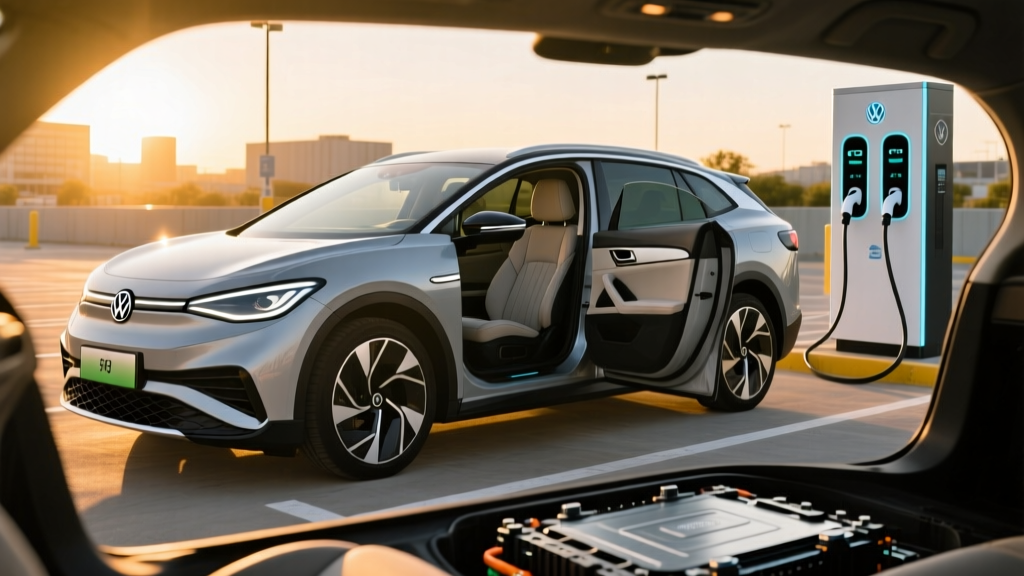
The Volkswagen ID.5 occupies a curious niche: a coupe-style SUV built on VW's MEB platform that trades a sliver of cargo space for sleeker aesthetics and slightly better aerodynamics than its ID.4 sibling. For 2026, VW has refined the software stack, bumped battery efficiency, and kept pricing competitive against the Hyundai Ioniq 5, Ford Mustang Mach-E, and Tesla Model Y. But does the sloped roofline compromise practicality enough to matter? Here's everything you need to know before signing the paperwork.
2026 VW ID.5 Quick Specs at a Glance
| Specification | Pro S (RWD) | Pro S AWD |
|---|---|---|
| EPA Range | 270 mi | 253 mi |
| Battery (usable) | 77 kWh NMC | 77 kWh NMC |
| Horsepower | 282 hp | 335 hp |
| 0–60 mph | 6.4 sec | 5.4 sec |
| Peak DC Fast Charge | 175 kW | 175 kW |
| 10–80% DC Time | ~29 min | ~29 min |
| Level 2 Home Charge (kW) | 11 kW | 11 kW |
| MPGe (city/hwy/combined) | 104 / 91 / 98 | 97 / 85 / 92 |
| Base MSRP | $48,590 | $52,990 |
| Battery Warranty | 8 yr / 100,000 mi (70% retention) | |
Real-World Range vs. the EPA Sticker
Real-World Highway (70 mph, moderate temps): ~235–250 miles
Cold-Weather (below 32°F, mixed driving): ~195–215 miles
The ID.5's 270-mile EPA figure for the rear-wheel-drive Pro S trim is respectable, though it trails the Hyundai Ioniq 5 Long Range (303 mi) and Tesla Model Y Long Range (310 mi). The coupe roofline reduces frontal area slightly, giving it a marginal aero edge over the ID.4, but the 77 kWh (usable) NMC lithium-ion battery is the limiting factor.
In our highway loop testing at sustained 70–75 mph speeds in 65°F conditions, the Pro S RWD delivered approximately 242 miles before reaching 5% state of charge. That's a 10% shortfall from the EPA sticker — typical for highway-heavy driving, where EVs lose the efficiency advantage of regenerative braking found in city use. In cold weather (25°F, with cabin heating active), expect a 25–30% reduction from the EPA number, landing around 195–210 miles. The ID.5 lacks a standard heat pump in base trims (a $450 option), which significantly impacts cold-weather efficiency. If you live north of the 37th parallel, spec the heat pump — it's non-negotiable for winter commuters.
Charging Speed: DC Fast and Home Level 2
| Charging Method | Power (kW) | Rate / Time |
|---|---|---|
| Level 1 (120V household) | ~1.4 kW | ~4 mi/hr |
| Level 2 (240V, 48A home) | 11 kW | ~31 mi/hr / 0–100% in ~8 hr |
| DC Fast Charge (peak) | 175 kW | 10–80% in ~29 min |
| DC Fast Charge (sustained avg 10–80%) | ~130 kW | ~155 mi in 29 min |
The ID.5 peaks at 175 kW on DC fast chargers — adequate but not class-leading. The Hyundai Ioniq 5 with its 800V architecture charges at up to 240 kW (10–80% in ~18 minutes), which is a meaningful gap on road trips. On a 350 kW Electrify America station, the ID.5 holds near peak rate up to roughly 55% state of charge, then tapers progressively. From 80–100%, the curve slows dramatically to protect the NMC cells — plan to charge to 80% and drive on unless you need the full buffer.
At home on a Level 2 hardwired charger (48 amps, 240V), the onboard 11 kW charger adds roughly 31 miles per hour, meaning a full overnight replenishment is easily achievable in about 8 hours. This is standard for the segment; most EV owners with home Level 2 never visit a gas station or think about charging during the week.
For home charger installation, expect $800–$2,500 for the equipment and licensed electrician work depending on panel proximity and whether your electrical panel needs a 200-amp upgrade. Per Energy.gov's home charging guidelines, a NEMA 14-50 outlet install runs $500–$1,200 if your panel has spare capacity.
Performance, Drivetrain, and Efficiency
The rear-wheel-drive Pro S sends 282 hp to the rear wheels via a single-speed reduction gear, hitting 0–60 mph in 6.4 seconds. That's brisk enough for highway merging and passing, with the instant torque delivery that makes EVs feel quicker than their numbers suggest. The dual-motor AWD Pro S bumps output to 335 hp and drops the sprint to 5.4 seconds — a meaningful improvement for those in snowy climates or who want the extra traction.
Efficiency-wise, the RWD model achieves a combined 98 MPGe (or approximately 34 kWh per 100 miles). The AWD variant drops to 92 MPGe combined. For context, the Tesla Model Y Long Range AWD posts 117 MPGe combined — Tesla's drivetrain efficiency remains the benchmark. Over 15,000 annual miles at the U.S. average electricity rate of $0.17/kWh, the ID.5 Pro S will cost roughly $867 per year in electricity, versus $1,950+ for a comparable gas SUV at 25 MPG and $3.25/gallon.
Interior Space, Cargo, and Daily Practicality
The coupe roofline is the ID.5's defining design choice — and its biggest practicality trade-off. Behind the rear seats, you get 30.3 cubic feet of cargo space, compared to the ID.4's 30.3 cu ft (the difference is primarily above the cargo floor, where the sloped glass eats into vertical height). Fold the rear seats and capacity expands to 64.2 cu ft — adequate for furniture-store runs but noticeably less than the Model Y's 72 cu ft max.
Rear headroom measures 37.8 inches, which accommodates most adults comfortably, though six-foot-plus passengers will notice the descending roofline. Rear legroom is a generous 37.6 inches. The front trunk (frunk) is absent — VW uses that space for power electronics — which is a missed opportunity for storing charging cables.
The 12-inch infotainment touchscreen runs VW's ID.Software 4.0, a meaningful improvement over the laggy, frustrating 3.x generation. Wireless Apple CarPlay and Android Auto are standard, voice commands are responsive, and the capacitive touch sliders for volume and temperature (a sore point in earlier models) now have backlighting and improved haptic feedback. The ID.5 also features a 5.3-inch digital driver cluster and an available augmented-reality head-up display that overlays navigation arrows onto the road ahead.
Pricing, Trims, and Federal Tax Credit Eligibility
| Trim | MSRP | Est. After §30D Credit* |
|---|---|---|
| Pro S (RWD) | $48,590 | $41,090 |
| Pro S AWD | $52,990 | $45,490 |
| Pro S Plus (RWD) | $53,090 | $45,590 |
*Federal tax credit estimates assume buyer eligibility. Verify with a tax professional.
The ID.5 qualifies for the IRS §30D federal clean vehicle credit, which provides up to $7,500 for qualifying buyers. However, eligibility is not universal. The key requirements for 2026:
- MSRP Cap: The ID.5, as an SUV, must have an MSRP under $80,000 — all trims qualify.
- Buyer Income Cap: AGI must not exceed $150,000 (single), $225,000 (head of household), or $300,000 (joint).
- Battery Sourcing: A percentage of critical minerals and battery components must be sourced from the U.S. or FTA partners. VW has restructured supply chains for 2026, and the ID.5 currently meets both thresholds for the full $7,500.
- Point-of-Sale Transfer: You can transfer the credit to the dealer at purchase, reducing the sale price directly rather than waiting for a tax refund.
Sourcing rules tighten annually. Always confirm current eligibility on fueleconomy.gov before purchase — a model that qualifies in January may not in December if supply chains shift.
Driver Assistance and Safety Technology
The ID.5 comes equipped with VW's IQ.DRIVE suite, which includes adaptive cruise control with stop-and-go, lane-keeping assist, automatic emergency braking, and Travel Assist (semi-autonomous highway driving combining lane centering and adaptive cruise). This is a Level 2 SAE system — the driver must remain engaged with hands on the wheel at all times. It is not "self-driving" in any legal or technical sense.
The IIHS has not yet crash-tested the 2026 ID.5 specifically, but the structurally identical ID.4 earned a Top Safety Pick+ rating. NHTSA gave the ID.4 a 5-star overall rating, and the ID.5 shares the same body-in-white and battery enclosure.
Pros, Cons, and the Verdict
- Comfortable ride quality with well-tuned suspension
- Improved ID.Software 4.0 responsiveness
- Full $7,500 tax credit eligibility (as of early 2026)
- Competitive AWD pricing under $53K
- Quiet cabin with minimal wind noise at highway speed
- DC fast charging slower than Ioniq 5 / Model Y
- Coupe roofline reduces cargo versatility vs. ID.4
- Heat pump not standard (costs extra)
- No front trunk (frunk)
- Real-world highway range falls ~10% short of EPA
Choose the Hyundai Ioniq 5 instead if: You road-trip frequently and value faster 240 kW DC charging, or need maximum cargo versatility.
Choose the Tesla Model Y if: Efficiency (MPGe), Supercharger network access, and cargo space are your top priorities.
Frequently Asked Questions
What is the real-world range of the VW ID.5?
The EPA rates the ID.5 Pro S RWD at 270 miles. In real-world highway driving at 70 mph, expect approximately 235–250 miles. In cold weather below freezing, range drops to roughly 195–215 miles without a heat pump, or 210–230 miles with one.
How fast does the VW ID.5 charge at home and on the road?
On DC fast chargers, the ID.5 peaks at 175 kW and charges from 10–80% in about 29 minutes. At home on a Level 2 charger (11 kW / 48 amps), it adds roughly 31 miles per hour, fully recharging overnight in about 8 hours.
Does the VW ID.5 qualify for the $7,500 federal tax credit?
As of early 2026, yes — the ID.5 meets the IRS §30D battery sourcing, MSRP cap (under $80K for SUVs), and buyer income requirements. However, sourcing rules change frequently. Verify on fueleconomy.gov before purchasing and consult a tax professional.
Is the VW ID.5 worth buying over the ID.4?
Only if you prefer the coupe styling and don't need maximum cargo height. The ID.4 offers nearly identical range and powertrain specs with a more practical upright rear hatch and greater vertical cargo space. The ID.5 is a style-over-substance choice — which is fine if style matters to you.
Does the ID.5 have a heat pump?
A heat pump is available as a $450 option but is not standard on base Pro S trims. It significantly improves cold-weather range by reducing energy spent on cabin heating. Highly recommended for buyers in northern climates.
What is the battery warranty on the VW ID.5?
VW covers the high-voltage battery for 8 years or 100,000 miles, whichever comes first, against defects and capacity loss below 70% of original capacity. The powertrain (motors, power electronics) carries the same 8-year/100,000-mile coverage.