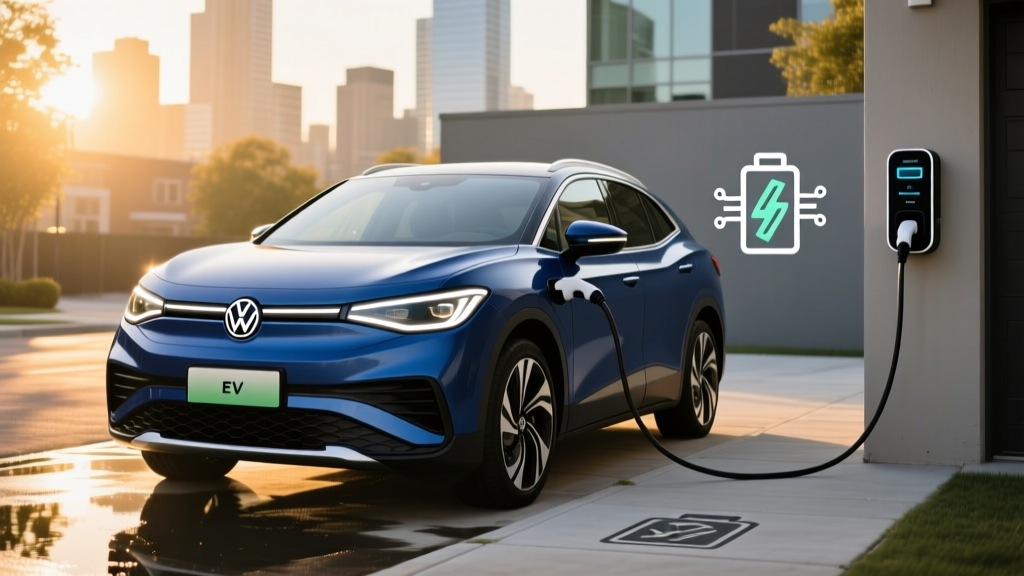
The Volkswagen ID.4 occupies a specific niche in the electric-vehicle market: a mainstream, no-drama compact electric crossover aimed at buyers who want EV efficiency without the learning curve. For 2026, VW has continued refining the formula with incremental software and interior updates, though the core hardware — the MEB platform, 82 kWh battery pack, and available dual-motor AWD — remains largely unchanged since its significant 2024 refresh. This VW ID.4 review breaks down every number that matters to an actual buyer: real-world range versus the EPA sticker, charging-curve behavior at public DC stations, true cost after the federal tax credit, and where it lands against the Hyundai Ioniq 5, Ford Mustang Mach-E, and Tesla Model Y.
Specs at a Glance: 2026 Volkswagen ID.4
| Specification | Pro S (RWD) | AWD Pro |
|---|---|---|
| EPA Range | 291 miles | 263 miles |
| Battery (Usable/Total) | 77 kWh usable / 82 kWh total | 77 kWh usable / 82 kWh total |
| Battery Chemistry | NMC (Nickel Manganese Cobalt) | NMC |
| Horsepower | 282 hp | 335 hp (combined) |
| 0–60 mph | 7.3 sec | 5.4 sec |
| Drivetrain | Rear-Wheel Drive | Dual-Motor AWD |
| Max DC Fast Charge | 170 kW peak | 170 kW peak |
| 10–80% DC Charge Time | ~30 minutes | ~30 minutes |
| Level 2 Home Charging | 11 kW (≈37 mi/hr) | 11 kW (≈37 mi/hr) |
| MPGe (City/Hwy/Combined) | 104 / 93 / 99 | 97 / 87 / 92 |
| Base MSRP (incl. destination) | $40,735 | $44,735 |
| Battery/Powertrain Warranty | 8 years / 100,000 miles | |
Source: fueleconomy.gov, Volkswagen of America
Range in the Real World: What the EPA Number Doesn't Tell You
EPA Sticker: 291 miles (RWD Pro S) / 263 miles (AWD Pro)
Real-World Expectation: Plan for 240–265 miles on a mixed highway trip in moderate weather (65–75°F). In sustained 75 mph highway driving, expect roughly 235–250 miles before needing a charge stop. In cold weather (below 30°F), range can drop 20–30%, yielding as little as 185–210 miles for the RWD variant.
The ID.4's NMC lithium-ion pack holds 82 kWh total, with 77 kWh usable — the remaining 5 kWh acts as a buffer to protect long-term battery health. The RWD Pro S achieves 99 MPGe combined (roughly 34 kWh/100 mi), which is competent but trails the Hyundai Ioniq 5 Long Range (114 MPGe combined) and the Tesla Model Y Long Range (122 MPGe combined). The AWD variant sacrifices some efficiency for the traction and 5.4-second 0–60 sprint.
One practical note: the ID.4's heat pump — now standard across most trims — helps mitigate cold-weather range loss compared to EVs without one, but physics still wins. If your daily commute is under 60 miles round-trip, the ID.4's real-world range is a non-issue even in January in the upper Midwest. If you regularly drive 200+ miles one-way in winter, you'll need to plan at least one DC fast-charge stop.
Charging Speed: DC Fast, Level 2, and the Curve Reality
| Charge Level | Power / Voltage | Speed (miles added) | Full Charge Time |
|---|---|---|---|
| Level 1 (120V household) | ~1.4 kW | ~4 miles per hour | ~55 hours (empty to full) |
| Level 2 (240V home/public) | 11 kW (48A) | ~37 miles per hour | ~7.5 hours (empty to full) |
| DC Fast Charge | 170 kW peak (CCS/NACS*) | ~70% in 30 min | 10–80% in ~30 min |
*2026 ID.4 models ship with CCS1; NACS adapter available for Tesla Supercharger access.
The 170 kW peak DC charge rate is the ID.4's most debated spec. It trails the Hyundai Ioniq 5's 235 kW and the Tesla Model Y's ~250 kW peak. Here's what that means in practice: at a 350 kW Electrify America or EVgo station, the ID.4 will hold close to 170 kW from roughly 10% to 30% State of Charge, then taper progressively — dropping to around 100 kW by 50% and further to 50–60 kW above 70%. The 10–80% charge takes approximately 30 minutes, which is acceptable for a highway rest stop but noticeably slower than the Ioniq 5's ~18-minute 10–80% session.
At home on a Level 2 charger (a 48-amp hardwired unit on a 60-amp circuit), the ID.4 accepts up to 11 kW. That's roughly 37 miles of range added per hour of charging, or a full overnight replenishment from near-empty in about 7.5 hours. Most owners who plug in nightly at home will never see a low State of Charge.
Preconditioning tip: The ID.4 allows you to set a departure time in the infotainment system, which warms the battery to optimal charging temperature. Use this before heading to a DC fast charger in cold weather — a preconditioned battery can accept 20–40% more power in the first 10 minutes of charging versus a cold-soaked pack.
Pricing, Trims, and the Federal Tax Credit
| Trim | Drivetrain | MSRP (incl. dest.) | Est. Price After Credit* |
|---|---|---|---|
| Standard Range S | RWD | $39,735 | ~$32,235 |
| Pro S | RWD | $40,735 | ~$33,235 |
| Pro S Plus | RWD | $45,735 | ~$38,235 |
| AWD Pro | AWD | $44,735 | ~$37,235 |
| AWD Pro S Plus | AWD | $49,735 | ~$42,235 |
*Assumes full $7,500 §30D federal tax credit eligibility. Actual credit varies.
All 2026 ID.4 trims fall under the $80,000 MSRP cap for SUVs under IRS §30D rules, so price is not a disqualifier. However, eligibility for the full $7,500 credit depends on two additional factors:
- Buyer income caps: Modified adjusted gross income (MAGI) must not exceed $150,000 (single), $225,000 (head of household), or $300,000 (joint filers).
- Battery component and critical mineral sourcing: The credit splits into two $3,750 halves — one for battery components manufactured or assembled in North America, and one for critical minerals sourced from the U.S. or a free-trade-agreement country. VW has been working to qualify the ID.4's battery supply chain, but the exact credit amount (full $7,500, partial $3,750, or $0) can shift as sourcing requirements tighten annually. Verify current-year eligibility at fueleconomy.gov before purchasing.
- Point-of-sale transfer: As of 2024, buyers can transfer the credit to the dealer at purchase, reducing the out-of-pocket price immediately rather than waiting to claim it on a tax return. Confirm your dealer is registered for POS transfers.
Consult a tax professional for your specific situation — the rules are detailed and change year to year.
Driving, Performance, and Everyday Usability
The RWD ID.4 produces 282 hp from its rear-mounted permanent-magnet synchronous motor. The 0–60 mph time of 7.3 seconds won't thrill anyone coming from a Tesla Model Y Performance (3.5 sec), but it's adequate for highway merging and passing. The dual-motor AWD variant bumps output to 335 hp and cuts the sprint to 5.4 seconds — quick enough for most buyers and genuinely useful in snow-belt states.
Where the ID.4 earns its keep is ride comfort and cabin isolation. VW tuned the suspension for compliance over sportiness: it absorbs highway expansion joints and broken pavement with a maturity that the firmer-riding Ioniq 5 and Model Y don't quite match. Steering is light and precise, if devoid of feedback. Regenerative braking offers multiple levels (selectable via steering-wheel paddles), though the ID.4 does not offer true one-pedal driving to a complete stop in all conditions — a notable omission versus competitors.
Cargo and Passenger Space
The ID.4 provides 30.3 cubic feet of cargo space behind the second row and 64.2 cubic feet with the rear seats folded — competitive with the RAV4 and CR-V it often cross-shops against. Rear legroom measures 37.6 inches, enough for adults on longer trips. There is no front trunk (frunk); VW uses that space for power electronics. A hands-free power liftgate is standard on Pro S and above.
Technology, Driver Assistance, and Software
The 2026 ID.4 runs VW's ID. Software 4.0 on a 12.9-inch center touchscreen. The system is a marked improvement over the laggy, frustrating ID. Software 2.x that plagued early 2021–2022 models. Response times are quicker, the navigation routing is more reliable, and wireless Apple CarPlay and Android Auto are standard across all trims.
The IQ.DRIVE suite (VW's branding for its SAE Level 2 driver-assistance system) includes:
- Adaptive cruise control with stop-and-go
- Lane centering assist (Travel Assist)
- Automatic emergency braking with pedestrian detection
- Blind-spot monitoring and rear cross-traffic alert
Important: IQ.DRIVE is an SAE Level 2 driver-assistance system. The driver must remain fully engaged — hands on or near the wheel, eyes on the road — at all times. This is not autonomous driving. It reduces fatigue on highway commutes but does not replace the driver.
Compared to Ford's BlueCruise (which allows hands-off driving on pre-mapped divided highways) or GM's Super Cruise, VW's Travel Assist is more conservative: it requires steering-wheel contact and does not support hands-free operation. It works well in its intended lane, but buyers seeking the most advanced hands-free highway assist in this segment should look to Ford or GM.
How the ID.4 Stacks Up Against Key Competitors
| Spec | VW ID.4 Pro S (RWD) | Hyundai Ioniq 5 SEL (LR RWD) | Tesla Model Y (LR AWD) | Ford Mach-E (ER RWD) |
|---|---|---|---|---|
| EPA Range | 291 mi | 303 mi | 320 mi | 320 mi |
| Battery (usable kWh) | 77 kWh | 77.4 kWh | ~75 kWh | 88 kWh |
| Peak DC Charge | 170 kW | 235 kW | ~250 kW | 150 kW |
| 10–80% DC Time | ~30 min | ~18 min | ~22 min | ~36 min |
| 0–60 mph | 7.3 sec | 7.0 sec | 4.8 sec | 6.1 sec |
| MPGe (combined) | 99 | 114 | 122 | 101 |
| Base MSRP | $40,735 | $46,650 | $44,990 | $42,995 |
| Cargo (rear up/folded) | 30.3 / 64.2 cu ft | 27.2 / 59.3 cu ft | 30.2 / 72.1 cu ft | 29.7 / 59.7 cu ft |
Key takeaways from the comparison:
- The ID.4 is the most affordable of the four at base MSRP, and when the full $7,500 credit applies, its effective price undercuts every competitor here.
- It is the slowest to DC fast-charge among the group. If you take frequent road trips, the Ioniq 5's 18-minute 10–80% session is a meaningful advantage.
- The Model Y wins on efficiency, range, and performance, but carries a higher price and no federal credit eligibility for most configurations in 2026.
- The ID.4 offers the most compliant ride quality — a subjective but important differentiator for comfort-oriented buyers.
Who Should Buy the ID.4 — and Who Shouldn't
Choose the VW ID.4 if:
- You want the most affordable entry point into a mainstream electric SUV after tax credits
- Your daily driving is under 80 miles and you can charge at home overnight
- You prioritize ride comfort and cabin quietness over sporty handling
- You want a conventional SUV driving experience with minimal learning curve
- You live in a region with reliable Electrify America coverage (VW's affiliated network)
Look elsewhere if:
- You take frequent 300+ mile road trips and want the fastest DC charging (consider Ioniq 5 or Model Y)
- You want hands-free highway driving assist (consider Ford Mach-E with BlueCruise)
- Maximum range and efficiency are your top priorities (Tesla Model Y or Ioniq 5 lead here)
- You need a front trunk (frunk) for charging cable storage or extra cargo
Pros and Cons
Pros
- Lowest effective price in segment after §30D credit
- Comfortable, quiet ride — best in class for daily commuting
- Spacious rear seat and competitive cargo volume
- Heat pump standard — helps cold-weather range
- Significantly improved infotainment software vs. early model years
- 8-year/100,000-mile battery warranty
Cons
- 170 kW peak DC charging is slower than most rivals
- No true one-pedal driving to a full stop
- No front trunk (frunk)
- IQ.DRIVE is capable but less advanced than BlueCruise or Super Cruise
- AWD variant's 263-mile range may feel tight for road trips
- Tax credit amount depends on evolving battery-sourcing rules
Frequently Asked Questions
What is the real-world range of the 2026 VW ID.4?
The EPA rates the RWD Pro S at 291 miles and the AWD Pro at 263 miles. In real-world mixed driving at moderate temperatures, expect 240–265 miles (RWD) and 215–240 miles (AWD). Sustained 75 mph highway driving and cold weather below 30°F will reduce these figures by 10–30%.
How fast does the ID.4 charge at home and on the road?
At home on a Level 2 (240V, 48A) charger, the ID.4 adds roughly 37 miles of range per hour, reaching a full charge in about 7.5 hours. On a DC fast charger, it peaks at 170 kW and charges from 10–80% in approximately 30 minutes — slower than the Ioniq 5 (~18 min) and Model Y (~22 min).
Does the 2026 VW ID.4 qualify for the federal EV tax credit?
The ID.4's MSRP falls under the $80,000 SUV cap for the §30D credit. Whether you receive the full $7,500, a partial $3,750, or $0 depends on your income (MAGI caps apply) and the battery's critical-mineral and component sourcing, which changes annually. Verify current eligibility at fueleconomy.gov and consult a tax professional.
Is the VW ID.4 worth buying over the Tesla Model Y or Hyundai Ioniq 5?
The ID.4 is worth buying if your priority is value — it's the most affordable option after tax credits and offers the most comfortable ride. If fast-charging speed, maximum range, or cutting-edge driver-assist features matter more, the Ioniq 5 or Model Y may be a better fit. Cross-shop all three with a test drive.
What is the battery warranty on the VW ID.4?
Volkswagen covers the ID.4's high-voltage battery for 8 years or 100,000 miles (whichever comes first), warranting it against capacity loss below 70% of its original usable capacity. The general vehicle warranty is 4 years / 50,000 miles.
Can the ID.4 use Tesla Superchargers?
The 2026 ID.4 ships with a CCS1 charge port. VW offers a NACS adapter that enables access to Tesla's Supercharger network (V3 and V4 stalls with a CCS adapter cable). Confirm adapter availability and compatibility with your dealer at purchase.