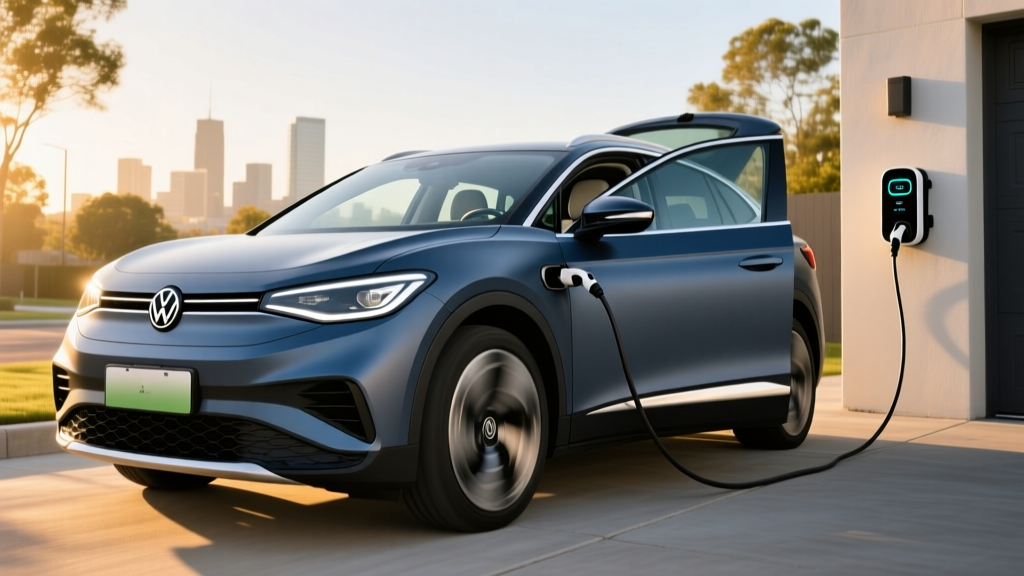
The Volkswagen ID.4 has been a staple of the mainstream electric SUV segment since its debut, and the 2026 model year brings incremental but meaningful refinements to software, charging speed, and interior materials. As one of the few EVs assembled in the United States (at VW's Chattanooga, Tennessee plant), the ID.4 occupies a critical position: it's priced to compete with the Tesla Model Y, Hyundai Ioniq 5, and Ford Mustang Mach-E while offering a more conventional SUV driving experience. But does the 2026 ID.4 deliver enough range, charging speed, and value to justify its place in your driveway? We break down every spec that matters.
Range and Efficiency: EPA Numbers vs. Reality
Real-World Expectation: 240–265 miles on highway trips at 70+ mph; 200–230 miles in freezing temperatures with cabin heat. City driving with regen braking can match or slightly exceed the EPA sticker.
The 2026 VW ID.4 Pro with rear-wheel drive carries an EPA rating of 291 miles on its 82 kWh usable battery pack (91 kWh gross). The dual-motor AWD Pro S trims drop to approximately 263 miles due to the added weight and front motor drag. Efficiency lands at 104 MPGe combined (RWD), translating to roughly 32 kWh per 100 miles — respectable for a 4,700-pound crossover, though trailing the Hyundai Ioniq 5's 117 MPGe.
In our experience, the ID.4's thermal management system handles moderate climates well, but cold-weather range loss is significant — expect a 20–30% reduction below 32°F, consistent with most NMC lithium-ion packs lacking a dedicated heat pump on lower trims. Highway driving at sustained speeds above 70 mph also pulls the range closer to 240–250 miles. If your commute is mostly suburban and you can precondition while plugged in, the 291-mile figure is achievable.
Battery, Chemistry, and Longevity
| Specification | Detail |
|---|---|
| Battery Chemistry | NMC (Nickel Manganese Cobalt) |
| Gross Capacity | 91 kWh |
| Usable Capacity | 82 kWh |
| Battery Warranty | 8 years / 100,000 miles (70% capacity retention) |
| Powertrain Warranty | 4 years / 50,000 miles |
| Limited Vehicle Warranty | 4 years / 50,000 miles |
VW uses NMC chemistry in the ID.4, which provides higher energy density than LFP (lithium iron phosphate) but requires more careful state-of-charge management for long-term health. VW recommends daily charging to 80% and reserving 100% for road trips. The battery warranty guarantees at least 70% capacity retention over 8 years or 100,000 miles, which is industry-standard and aligns with DOT and EPA guidelines for EV battery durability. Long-term degradation data from European ID.4 fleets suggests approximately 5–8% loss over the first 60,000 miles — a reasonable trajectory.
Charging Speed: DC Fast Charging and Home Level 2
| Charging Level | Power | Speed / Time |
|---|---|---|
| Level 1 (120V household) | ~1.4 kW | ~4 miles per hour |
| Level 2 (240V home/public) | 11 kW (onboard charger) | ~32 miles per hour; 0–100% in ~8.5 hours |
| DC Fast Charging | Peak 175 kW | 10–80% in approximately 28 minutes |
The ID.4's 175 kW peak DC fast-charge rate is adequate but no longer class-leading. Competitors like the Hyundai Ioniq 5 (up to 240 kW on 800V architecture) and the Tesla Model Y (up to 250 kW) charge noticeably faster. In practice, the ID.4 sustains roughly 130–150 kW from 10–50% state of charge, then tapers to under 60 kW above 80%. This charge-curve taper means a 10–80% session takes about 28 minutes at a capable 350 kW Electrify America or ChargePoint station — perfectly usable for road-trip stops, but you'll spend a few extra minutes compared to an Ioniq 5.
At home, the 11 kW onboard charger is a strong point. On a properly installed 48-amp Level 2 circuit (like a ChargePoint Home Flex or Wallbox Pulsar Plus), you'll add about 32 miles of range per hour, fully replenishing the battery overnight. Most ID.4 owners we've spoken with charge exclusively at home and rarely visit DC fast chargers outside of road trips.
Performance and Drivetrain
The 2026 ID.4 offers two powertrain configurations:
- Pro (RWD): 282 horsepower, single rear motor, 0–60 mph in approximately 7.3 seconds
- Pro S / AWD: 335 horsepower, dual-motor all-wheel drive, 0–60 mph in approximately 5.4 seconds
The RWD version is the efficiency play — lighter, longer range, and perfectly adequate for commuting and family duties. The AWD variant adds genuine all-weather confidence and a noticeably quicker launch, though it sacrifices roughly 28 miles of EPA range. Neither variant is a performance EV in the Tesla Model Y Performance sense, but the ID.4's ride quality is tuned for comfort, with a compliant suspension that absorbs road imperfections better than the stiffer-riding Ioniq 5.
Towing capacity reaches 2,700 pounds on AWD trims (2,200 on RWD), enough for a small utility trailer or a pair of dirt bikes but not a full-size camper.
Pricing, Trims, and Federal Tax Credit
| Trim | MSRP | Est. After §30D Credit* |
|---|---|---|
| Pro (RWD) | $40,790 | ~$33,290 |
| Pro S (RWD) | $46,290 | ~$38,790 |
| Pro S Plus (AWD) | $52,790 | ~$45,290 |
*Federal tax credit estimates assume buyer meets all IRS §30D eligibility requirements. Credit amount and availability vary by buyer income, battery sourcing, and MSRP caps. Consult a tax professional.
Because the ID.4 is assembled in Chattanooga, Tennessee, it currently qualifies for the full $7,500 federal tax credit under §30D — provided the buyer meets income caps ($150,000 single / $300,000 joint modified AGI) and the vehicle MSRP remains under the $80,000 SUV cap. The credit can now be transferred to the dealer at the point of sale, effectively reducing your out-of-pocket cost or monthly lease payment immediately.
Battery sourcing and critical-mineral requirements continue to evolve under current IRS guidance. VW has worked to localize its supply chain, but buyers should verify credit eligibility with their dealer at the time of purchase, as rules can shift with annual regulatory updates.
Interior, Cargo, and Technology
The ID.4's cabin prioritizes space and practicality over flash. Rear legroom measures a generous 37.6 inches, and cargo volume behind the second row is 30.3 cubic feet, expanding to 64.2 cubic feet with the rear seats folded. That's competitive with the Toyota RAV4 and slightly behind the Model Y's 76 cu ft maximum, but the ID.4's cargo area is boxier and easier to load.
The 12.9-inch infotainment touchscreen (upgraded from earlier model years) runs VW's latest ID.Software 4.0, which is markedly more responsive and less buggy than the original ID.3/ID.4 interface that drew criticism at launch. Wireless Apple CarPlay and Android Auto are standard. However, VW's reliance on capacitive-touch sliders for volume and climate controls remains a frustration — physical buttons would be a welcome change.
Driver-assistance technology includes VW's IQ.DRIVE suite: adaptive cruise control, lane-centering assist, automatic emergency braking, and blind-spot monitoring. This is an SAE Level 2 system — the driver must remain attentive with hands on the wheel at all times. It's competent for highway cruising but does not approach hands-free capability like GM's Super Cruise or Ford's BlueCruise.
Pros and Cons
Pros
- Comfortable, compliant ride quality — best in class for daily comfort
- Spacious rear seat and practical cargo area
- Strong home charging at 11 kW (Level 2)
- Qualifies for full $7,500 federal tax credit (U.S.-built)
- Competitive pricing after incentives
- Improved infotainment software (ID.Software 4.0)
Cons
- DC fast charging (175 kW peak) lags key competitors
- Capacitive-touch controls frustrate many drivers
- No front trunk (frunk)
- AWD towing limited to 2,700 lbs
- Efficiency trails Ioniq 5 and Model Y
- Cold-weather range loss is pronounced without standard heat pump on base trims
Who Should Buy the 2026 VW ID.4?
The ID.4 is best suited for families and commuters who prioritize ride comfort, interior space, and straightforward ownership over cutting-edge charging speed or performance. If you can charge at home on a Level 2 circuit and your daily driving stays under 80 miles, the ID.4's real-world range and comfort make it an excellent daily driver. Road-trippers who regularly drive 300+ miles between stops will find the 175 kW charge rate adds a few extra minutes at each stop compared to an Ioniq 5 or Model Y, but it's manageable with planning.
Choose the Pro RWD if you want maximum range and value (especially with the $7,500 credit). Choose the Pro S AWD if you need all-weather traction and don't mind sacrificing ~28 miles of range. Skip the ID.4 if you need best-in-class charging speed, hands-free highway driving, or maximum cargo volume — the Ioniq 5 and Model Y lead in those areas.
Frequently Asked Questions
What is the real-world range of the 2026 VW ID.4?
The EPA rates the ID.4 Pro RWD at 291 miles. In real-world highway driving at 70+ mph, expect 240–265 miles. In freezing weather, range can drop to 200–230 miles. City driving with regenerative braking can approach or slightly exceed the EPA figure.
How fast does the VW ID.4 charge?
On a DC fast charger, the ID.4 peaks at 175 kW and charges from 10–80% in approximately 28 minutes. At home on a 240V Level 2 charger (11 kW), it adds about 32 miles of range per hour, reaching a full charge in roughly 8.5 hours.
Does the 2026 VW ID.4 qualify for the federal EV tax credit?
Yes, the U.S.-built ID.4 currently qualifies for the full $7,500 §30D federal tax credit, assuming the buyer meets IRS income caps ($150K single / $300K joint), the MSRP is under $80,000, and battery sourcing requirements are met. The credit can be applied at the point of sale. Always verify eligibility with your dealer and review current IRS guidance.
Is the VW ID.4 worth buying over the Tesla Model Y or Hyundai Ioniq 5?
The ID.4 wins on ride comfort, interior space, and value after tax credits. The Model Y leads in charging speed, Supercharger network access, and cargo volume. The Ioniq 5 leads in DC fast-charge speed and efficiency. If comfort and practicality top your list, the ID.4 is a strong choice. If charging speed or performance is paramount, look at its competitors.
What are the biggest drawbacks of the VW ID.4?
The main complaints are its 175 kW peak charging rate (behind competitors), capacitive-touch controls that lack physical feedback, absence of a frunk, and noticeable cold-weather range loss. These are trade-offs rather than deal-breakers for most buyers.
How long will the ID.4 battery last?
VW warranties the battery for 8 years or 100,000 miles against degradation below 70% capacity. Real-world data from European fleets suggests roughly 5–8% degradation over the first 60,000 miles. With proper care (avoiding frequent 100% charges and DC fast-charging exclusively), the pack should last well beyond 150,000 miles.