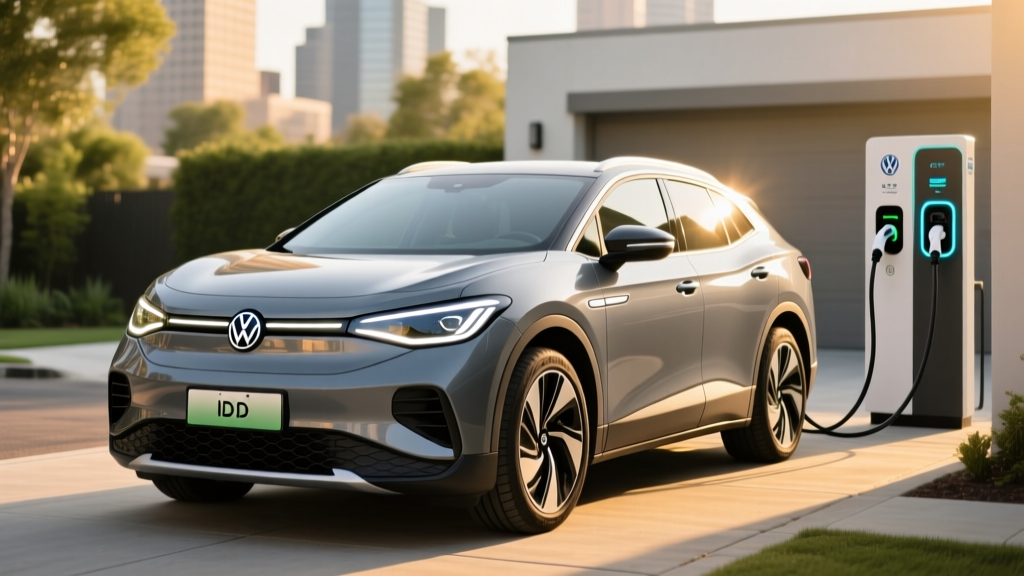
The Volkswagen ID.4 has carved out a specific niche in the compact electric SUV segment: it isn't the flashiest, the fastest, or the longest-range option, but it consistently undercuts key rivals on price while delivering a comfortable, practical daily driver. For buyers researching the VW ID.4 MSRP and weighing it against the Tesla Model Y, Hyundai Ioniq 5, or Ford Mustang Mach-E, the value equation hinges on a few critical data points — real-world range, charging speed, and whether the federal tax credit applies to your specific situation.
We've spent time with the ID.4 across multiple model years and trim levels. Below is a complete spec-driven profile of the 2026 Volkswagen ID.4, covering everything from battery chemistry to cargo dimensions, with the honest numbers you need to make a purchase decision.
2026 VW ID.4 MSRP and Trim Pricing
Volkswagen has kept the ID.4 lineup relatively streamlined. The 2026 model year continues with Standard Range and Pro (extended-range) battery options, available in rear-wheel drive (RWD) and all-wheel drive (AWD) configurations. Here's the current pricing structure before any incentives or destination charges:
| Trim | Drivetrain | Battery | MSRP |
|---|---|---|---|
| Standard Range S | RWD | 62 kWh (usable) | $39,730 |
| Pro S | RWD | 82 kWh (usable) | $43,730 |
| Pro S Plus | RWD | 82 kWh (usable) | $47,230 |
| AWD Pro S | AWD (dual-motor) | 82 kWh (usable) | $47,730 |
| AWD Pro S Plus | AWD (dual-motor) | 82 kWh (usable) | $51,230 |
Destination charge: approximately $1,350 additional. Prices reflect base MSRP before dealer markups, accessories, or applicable incentives.
Estimated Price After Federal Tax Credit (§30D)
If you qualify for the full IRS §30D clean vehicle credit, the effective price drops significantly. However, eligibility depends on three factors: your modified adjusted gross income (MAGI), the vehicle's MSRP cap (SUVs capped at $80,000 — the ID.4 clears this easily), and battery component/critical mineral sourcing requirements that tighten each year.
| Trim | MSRP | Est. Credit* | Effective Price |
|---|---|---|---|
| Standard Range S | $39,730 | Up to $7,500 | ~$32,230 |
| Pro S RWD | $43,730 | Up to $7,500 | ~$36,230 |
| AWD Pro S | $47,730 | Up to $7,500 | ~$40,230 |
*Credit amount varies based on battery sourcing compliance and buyer income limits ($150K single / $300K joint for 2026). Point-of-sale transfer is available at participating dealers. Always verify current eligibility with your tax professional and the DOE/IRS sourcing database.
EPA Range and Real-World Efficiency
The ID.4's range depends heavily on which battery and drivetrain you choose. The Pro (82 kWh usable) RWD model delivers the longest legs, while the AWD variants sacrifice roughly 15-20 miles for the added traction.
| Trim | EPA Range | MPGe (City/Hwy/Combined) | kWh/100 mi |
|---|---|---|---|
| Standard Range S (RWD) | 206 mi | 115 / 98 / 107 | 31 |
| Pro S (RWD) | 291 mi | 115 / 100 / 108 | 31 |
| Pro S Plus (RWD) | 291 mi | 115 / 100 / 108 | 31 |
| AWD Pro S | 270 mi | 108 / 94 / 102 | 33 |
| AWD Pro S Plus | 263 mi | 105 / 91 / 99 | 34 |
Data sourced from fueleconomy.gov.
Real-World Range: What to Actually Expect
EPA sticker: 291 miles (Pro S RWD). In practice, plan for less:
- Mixed city/suburban driving (65-75°F): 270-285 miles is achievable thanks to regenerative braking in stop-and-go traffic.
- Sustained highway (70-75 mph): Expect 240-260 miles. Aerodynamic drag at speed reduces efficiency by roughly 10-15%.
- Cold weather (below 32°F): Range drops 20-30% without preconditioning. A 291-mile EPA rating can fall to 200-220 miles in freezing conditions, especially on short trips where the cabin heater runs frequently.
- With heat pump (available on AWD trims): Cold-weather losses moderate to roughly 15-20% — a worthwhile option for northern-climate buyers.
The ID.4 uses a liquid-cooled NMC (nickel manganese cobalt) lithium-ion battery pack. NMC chemistry offers strong energy density, which is how VW fits 82 kWh of usable capacity into a relatively compact underfloor layout. The trade-off versus LFP (lithium iron phosphate) is slightly more sensitivity to sustained 100% SoC storage — VW recommends charging to 80% for daily use and 100% only before long trips.
Charging Speed: DC Fast and Home Level 2
Charging performance is where the ID.4 shows both strengths and compromises relative to its segment. The Pro (82 kWh) models support up to 175 kW peak DC fast charging on CCS-equipped vehicles, though Volkswagen has been gradually transitioning to the NACS connector for Supercharger access. Here's what the numbers look like in practice:
| Charging Method | Power | Rate / Time |
|---|---|---|
| Level 1 (120V household) | ~1.4 kW | ~3-4 miles per hour |
| Level 2 (240V, 48A home charger) | 11.5 kW | ~33 miles per hour; 0-100% in ~8.5 hours |
| DC Fast Charge (CCS/NACS) | Peak 175 kW | 10-80% in ~28 minutes (Pro 82 kWh) |
| DC Fast Charge (Standard Range) | Peak 140 kW | 10-80% in ~25 minutes |
Charging curve reality check: The 175 kW peak rate is not sustained across the entire session. The ID.4 holds strong charging speeds from roughly 10-50% SoC, then begins a gradual taper. From 50-80%, expect average speeds closer to 100-120 kW. Above 80%, charging slows dramatically to protect battery health — this is normal for NMC chemistry, but it means a 10-90% session takes considerably longer than the 10-80% figure suggests. Plan your road-trip stops around the 10-80% window for optimal time efficiency.
On a home Level 2 setup (the most common daily charging scenario), the ID.4's 11.5 kW onboard charger is competitive. A full overnight charge from 20% to 100% takes roughly 7-8 hours, which is more than adequate for most commuters. Note that you'll need a 60A circuit to deliver the full 48A/11.5 kW — a standard 40A circuit limits you to about 9.6 kW.
Performance and Drivetrain
The ID.4 is tuned for comfort over sportiness, which is an intentional choice that suits its family-SUV positioning. Still, the instant torque from the electric motors makes it feel quicker in daily driving than its 0-60 times might suggest.
| Configuration | Horsepower | Torque (lb-ft) | 0-60 mph |
|---|---|---|---|
| RWD (single rear motor) | 201 hp | 229 | 7.7 sec |
| AWD (dual motor) | 295 hp | 339 | 5.4 sec |
The RWD model's 201 hp is adequate for commuting and highway merging but won't win any stoplight races. The AWD variant's 295 hp and 5.4-second 0-60 time provide confident passing power and genuine all-weather capability. Both configurations feature a single-speed reduction gear — no traditional transmission to service.
Regenerative braking in the ID.4 is adjustable via steering-wheel paddles (on equipped trims) or through the drive-mode selector. It does not offer true one-pedal driving to a complete stop in all modes, which some EV drivers accustomed to stronger regen (like the Nissan Leaf or Tesla's hold mode) may notice. The B-mode provides stronger regen but still creeps at very low speeds.
Interior Space, Cargo, and Practicality
The ID.4's MEB platform places the battery under the floor, yielding a flat load floor and surprisingly generous interior volume for its exterior footprint. This is where VW's packaging engineering pays dividends.
| Dimension | Measurement |
|---|---|
| Front headroom | 41.1 in |
| Front legroom | 41.1 in |
| Rear headroom | 38.4 in |
| Rear legroom | 37.6 in |
| Cargo volume (behind 2nd row) | 30.3 cu ft |
| Cargo volume (2nd row folded) | 64.2 cu ft |
| Frunk (front trunk) | None — houses HVAC components |
The 30.3 cu ft behind the rear seats is competitive with the Hyundai Ioniq 5 (27.2 cu ft) and slightly less than the Tesla Model Y (30.2 cu ft behind the second row, though the Model Y offers additional sub-trunk and frunk space). The ID.4's lack of a frunk is a missed opportunity — that space is occupied by the cabin HVAC system and power electronics.
Rear-seat comfort is a genuine strength. The 37.6 inches of rear legroom accommodates adults comfortably on longer trips, and the flat floor (no transmission tunnel) makes the middle seat more usable than in many ICE crossovers. ISOFIX/LATCH anchors are standard for child seats.
Technology, Driver Assistance, and Drawbacks
The 2026 ID.4 features VW's latest ID. Software 4.0 infotainment system on a 12.9-inch center touchscreen (upgraded from earlier 12-inch units). The system supports wireless Apple CarPlay and Android Auto, over-the-air updates, and improved voice recognition. A 5.3-inch digital driver display sits behind the steering wheel.
IQ.DRIVE suite is standard across all trims and includes:
- Adaptive cruise control with stop-and-go
- Lane-keeping assist and lane-centering
- Automatic emergency braking with pedestrian detection
- Blind-spot monitoring with rear cross-traffic alert
- Travel Assist (combined lane-centering + adaptive cruise for highway use)
SAE Level 2 — Not Self-Driving: VW's Travel Assist and IQ.DRIVE are Level 2 driver-assistance systems per SAE classification. The driver must remain fully engaged, hands on or near the wheel, and eyes on the road at all times. These systems assist with steering and speed but do not replace the driver. They are not equivalent to Level 4 autonomous services like Waymo.
Notable drawbacks:
- Infotainment learning curve: VW's capacitive touch sliders for volume and climate have drawn consistent criticism for being less intuitive than physical controls. The 2026 software update improves responsiveness but doesn't fully resolve the issue.
- No frunk: Competitors like the Ioniq 5, Mach-E, and Model Y all offer front-trunk storage.
- Rear drum brakes: The ID.4 uses rear drum brakes to reduce rolling resistance and cost. While adequate for an EV (regen handles most braking), some buyers perceive this as a cost-cutting measure unbecoming of a $40K+ vehicle.
- Charging speed ceiling: At 175 kW peak, the ID.4 charges noticeably slower than the Ioniq 5 (up to 350 kW on 800V architecture) or the Tesla Model Y (up to 250 kW on V3 Superchargers).
Battery Warranty and Long-Term Ownership
Volkswagen backs the ID.4's high-voltage battery with an 8-year / 100,000-mile warranty (whichever comes first), guaranteeing a minimum of 70% state-of-health (SoH) capacity retention. If the battery degrades below 70% within the warranty period, VW will repair or replace it at no cost.
The powertrain (electric motors, reduction gear, power electronics) carries the same 8-year/100,000-mile coverage. The basic vehicle limited warranty is 4 years / 50,000 miles.
NMC battery longevity in the ID.4 has tracked well in early fleet data. Owners who keep daily charging at 80% SoC and avoid frequent DC fast charging in extreme heat should expect well over 150,000 miles before meaningful degradation. VW's liquid-cooling thermal management system is effective at maintaining battery temperature, which is the primary factor in long-term cell health.
Pros
- Competitive MSRP — undercuts Model Y and Ioniq 5 at base trim
- Comfortable ride quality and quiet cabin at highway speeds
- Spacious rear seat and flat floor for passengers
- Standard IQ.DRIVE safety suite on all trims
- Strong federal tax credit potential (up to $7,500)
- 8-year/100,000-mile battery warranty with 70% SoH guarantee
Cons
- 175 kW peak DC charge rate trails key competitors
- No front trunk (frunk)
- Capacitive touch controls remain frustrating
- Real-world highway range ~240-260 mi (Pro RWD) — plan conservatively
- Rear drum brakes feel like a cost compromise
- Cold-weather range loss significant without heat pump
Who Should Buy the 2026 VW ID.4?
Choose the ID.4 if:
- You want a comfortable, practical compact EV SUV and prioritize a lower purchase price over maximum range or charging speed.
- Your daily commute is under 60 miles round-trip, and you have reliable home Level 2 charging.
- You live in a moderate climate (or opt for the AWD heat pump package) and don't frequently road-trip in deep winter.
- You value a quiet, composed ride over sporty handling dynamics.
Look elsewhere if:
- You need 300+ miles of real-world highway range (consider the Model Y Long Range or Ioniq 5 with extended battery).
- Fastest-possible DC charging is a priority for frequent road trips (the Ioniq 5's 800V architecture charges nearly twice as fast).
- You need a frunk for gear storage or tow heavy loads (the ID.4's 2,700-lb max tow rating is modest).
Frequently Asked Questions
What is the real-world range of the VW ID.4?
The EPA rates the Pro S RWD at 291 miles, but real-world highway driving at 70-75 mph yields approximately 240-260 miles. In freezing temperatures, expect 200-220 miles without preconditioning. City driving with regenerative braking can approach or slightly exceed the EPA estimate in mild weather.
How fast does the ID.4 charge at home and on DC fast chargers?
On a 240V Level 2 home charger (48A), the ID.4 adds roughly 33 miles of range per hour and fully charges overnight in about 8.5 hours. On DC fast chargers, the 82 kWh Pro models peak at 175 kW, reaching 10-80% in approximately 28 minutes. Expect longer times above 80% due to charging-curve taper.
How much does the VW ID.4 cost after the federal tax credit?
If you qualify for the full $7,500 §30D credit, the Standard Range S drops to approximately $32,230 and the Pro S RWD to roughly $36,230. Eligibility requires meeting IRS income caps ($150K single / $300K joint), and the vehicle must comply with battery sourcing requirements. The credit can be transferred at the point of sale at participating dealerships as an instant discount.
Is the VW ID.4 worth buying vs. the Tesla Model Y or Hyundai Ioniq 5?
The ID.4 wins on base price and ride comfort. The Model Y offers more range, faster Supercharger access, and a frunk but at a higher MSRP and with a firmer ride. The Ioniq 5 charges dramatically faster (350 kW capable on 800V) and has distinctive styling, but its cargo space is slightly smaller and its MSRP runs higher for comparable trims. For budget-conscious buyers who charge primarily at home, the ID.4's value proposition is strong.
Does the 2026 VW ID.4 qualify for the $7,500 federal EV tax credit?
The ID.4 qualifies as an eligible vehicle under §30D, and its MSRP is well under the $80,000 SUV cap. However, the credit amount you receive (up to $7,500) depends on battery component and critical mineral sourcing compliance — which changes annually — and your personal income. Check the DOE's eligible vehicle list and consult a tax professional before relying on the credit in your purchase math.
What is the ID.4's towing capacity?
The ID.4 is rated to tow up to 2,700 pounds when properly equipped with a factory tow hitch (available on AWD trims). This covers small utility trailers or a pair of jet skis but is insufficient for most boat or camper trailers. RWD models are rated at 2,200 pounds.