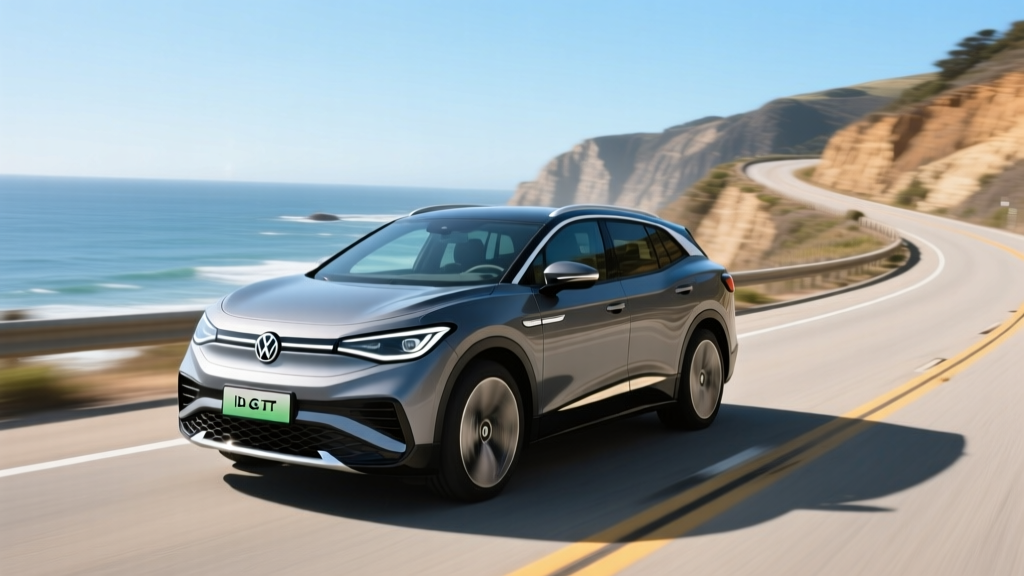
The Volkswagen ID.4 GTX sits at the top of VW's electric compact SUV lineup, pairing dual-motor all-wheel drive with a sport-tuned suspension and a 335-horsepower powertrain. For 2026, the GTX badge continues to represent VW's performance-oriented EV trim — but with a base MSRP approaching $50,000, the question isn't just whether it's quick. It's whether the GTX's added power and traction justify its range and price trade-offs versus the standard rear-wheel-drive ID.4 and rivals like the Tesla Model Y, Hyundai Ioniq 5, and Ford Mustang Mach-E.
After examining EPA data, charging behavior, ownership costs, and real-world driving variables, here's everything you need to know before putting down a deposit.
Range, Battery, and Real-World Efficiency
The 2026 ID.4 GTX uses an 82 kWh usable lithium-ion battery pack (NMC chemistry — nickel manganese cobalt). This is the same pack found across the ID.4 lineup, but the GTX's dual-motor AWD system and stickier tires reduce efficiency compared to the RWD Pro models.
| Spec | Value |
|---|---|
| Battery (usable) | 82 kWh, NMC |
| EPA Range | 263 miles |
| EPA Efficiency | 97 MPGe combined (35 kWh/100 mi) |
| Drivetrain | Dual-motor AWD |
EPA Sticker: 263 miles
Highway driving (70-75 mph): Expect ~220–235 miles. The boxy SUV shape and AWD drivetrain penalty show up at sustained highway speeds.
City/mixed driving: Closer to 250–260 miles, where regenerative braking recovers energy.
Cold weather (below 32°F): Plan for 180–210 miles. NMC chemistry loses 15–25% capacity in freezing temps without consistent preconditioning. The ID.4's heat pump (standard on GTX trims) helps mitigate cabin energy draw, but battery chemistry physics still apply.
Bottom line: A 263-mile EPA rating is adequate for commuting and moderate road trips, but if you regularly drive 300+ miles between charges, the GTX will require at least one DC fast-charge stop.
Compared to the RWD ID.4 Pro S (291 miles EPA), the GTX sacrifices roughly 28 miles of rated range for the privilege of all-wheel drive and an extra 85 horsepower. Whether that trade-off works depends on your climate and driving habits.
Charging Speed: DC Fast, Level 2, and the Curve Reality
Charging speed remains one of the ID.4 platform's relative weak points versus competitors. Here's what the numbers actually look like across charging levels.
| Level | Max Rate | Speed / Time |
|---|---|---|
| Level 1 (120V) | 1.4 kW | ~4 miles per hour |
| Level 2 (240V, home/public) | 11 kW (onboard charger) | ~32 miles per hour; 0–100% in ~8.5 hours |
| DC Fast Charge (CCS) | 175 kW peak | 10–80% in ~30 minutes |
The 175 kW peak DC rate is the headline figure, but the charge curve matters more than peak. The ID.4 GTX holds close to its peak rate from roughly 10% to 30% state of charge, then steps down to ~120 kW through 50%, and progressively tapers above 70%. This is why VW quotes 10–80% at approximately 30 minutes — that's realistic on a functioning 175+ kW CCS station.
For context, the Hyundai Ioniq 5 peaks at 240 kW and hits 10–80% in roughly 18 minutes. The Tesla Model Y on V3 Superchargers does 10–80% in about 25 minutes. The ID.4 GTX is noticeably slower on long road trips where multiple DC stops add up.
On the positive side, the 11 kW onboard Level 2 charger is competitive. A home Level 2 station (like a ChargePoint Home Flex or Wallbox Pulsar Plus on a 48-amp circuit) will fully replenish the 82 kWh pack overnight — roughly 8.5 hours from empty. Most owners will wake up to a full battery every morning without ever visiting a public charger.
Connector note: The ID.4 GTX uses the CCS1 connector for DC fast charging. VW has confirmed a transition to NACS (Tesla's connector standard) for future models, but the 2026 ID.4 retains CCS1. Tesla Supercharger access is available via an included adapter for VW models, though charge speeds are limited to the vehicle's 175 kW cap and adapter overhead.
Performance: 335 HP and What the GTX Badge Actually Delivers
| Spec | Value |
|---|---|
| Horsepower | 335 hp (combined) |
| Torque | 402 lb-ft |
| 0–60 mph | 5.4 seconds |
| Top Speed | 112 mph (electronically limited) |
| Drivetrain | Dual-motor AWD |
| Towing Capacity | 2,700 lbs (with factory hitch) |
The GTX's dual-motor setup pairs a 201-hp rear motor with a 107-hp front motor. The combined 335 hp and instant electric torque deliver a 5.4-second 0–60 mph time — quick for a 4,700-lb compact SUV, if not class-leading. The Tesla Model Y Long Range AWD hits 60 in 4.8 seconds; the Ford Mustang Mach-E Premium AWD does it in 5.1 seconds.
Where the GTX distinguishes itself is ride quality. VW's sport-tuned adaptive dampers (standard on GTX) provide a firm but controlled ride that handles twisty back roads with more composure than most electric crossovers. The steering is heavier than the standard ID.4, and the lowered suspension (0.6 inches) reduces body roll. It's not a sports car, but it's the most engaging version of the ID.4 VW offers.
The AWD system is fully variable — the front motor disengages during light-load cruising to improve efficiency, engaging within milliseconds when traction demand increases. In snow and rain testing, the GTX provides confident grip, making it a strong choice for four-season climates where RWD-only EVs can feel nervous.
Interior, Cargo, and Daily Practicality
The ID.4 GTX's cabin is spacious and functional, though VW's touch-sensitive controls and infotainment software remain a sore point for many owners.
| Measurement | Value |
|---|---|
| Cargo (behind 2nd row) | 30.3 cu ft |
| Cargo (seats folded) | 64.2 cu ft |
| Rear Legroom | 37.6 inches |
| Front Legroom | 41.1 inches |
| Frunk (front trunk) | None |
| Seating | 5 passengers |
The 30.3 cubic feet of cargo space is competitive with the segment — slightly less than the Model Y's 34 cu ft but comparable to the Ioniq 5's 27.2 cu ft. Rear seats fold nearly flat, opening up 64.2 cu ft for larger hauls.
The GTX trim adds sport seats with integrated headrests, a heated steering wheel, ventilated front seats, and GTX-specific interior stitching. The panoramic fixed glass roof is standard and makes the cabin feel airy, though it lacks a shade — a real issue in summer parking lots.
Tech and infotainment: The 12.9-inch touchscreen runs VW's latest ID.Software 4.0, which has improved responsiveness over earlier versions. Wireless Apple CarPlay and Android Auto are standard. However, the capacitive touch sliders for volume and climate remain frustrating — they're unlit at night and lack haptic feedback. The head-up display with augmented-reality navigation is a highlight, projecting turn arrows directly onto the windshield in your line of sight.
Driver assistance: The ID.4 GTX includes VW's IQ.DRIVE suite as standard: adaptive cruise control with stop-and-go, lane centering, automatic emergency braking, blind-spot monitoring, and rear cross-traffic alert. This is an SAE Level 2 driver-assist system — it does not drive the car for you. The driver must maintain hands-on-wheel awareness at all times. Travel Assist (VW's combined lane-centering + adaptive cruise) works well on highways but can be overly conservative with lane changes and occasionally phantom-brakes on curves.
Pricing, Trims, and Federal Tax Credit Eligibility
| Trim | MSRP (incl. destination) |
|---|---|
| ID.4 GTX (base AWD) | $49,795 |
| ID.4 GTX w/ Gradient Package | $51,395 |
The GTX is the most expensive ID.4 variant. The Gradient Package adds 20-inch wheels, a black roof, and silver roof rails. Options are limited — VW packages most features into the trim level rather than offering extensive à la carte choices.
As of 2026, the VW ID.4 GTX qualifies for up to $3,750 of the federal tax credit (not the full $7,500). Here's why, per IRS §30D guidelines:
- MSRP cap: SUVs must be under $80,000. The GTX passes. ✓
- Buyer income cap: MAGI ≤ $150,000 (single) / $300,000 (joint). Varies by filer. ✓ (if eligible)
- Battery sourcing — critical minerals ($3,750): The ID.4's battery pack does not fully meet the critical-minerals sourcing threshold for 2026. ✗
- Battery sourcing — component assembly ($3,750): Battery components meet North American assembly requirements. ✓
After the partial credit, the effective price starts around $46,045. That puts the GTX in direct competition with a well-equipped Tesla Model Y Long Range (~$47,000 after credit), a Hyundai Ioniq 5 SEL AWD (~$49,000 after credit), and a Ford Mustang Mach-E Premium AWD (~$47,500 after credit).
Warranty and Ownership Costs
| Coverage | Term |
|---|---|
| Limited Vehicle Warranty | 4 years / 50,000 miles |
| Battery & Powertrain | 8 years / 100,000 miles |
| Battery Capacity Guarantee | ≥70% retention over 8 yr / 100,000 mi |
| Roadside Assistance | 4 years / 50,000 miles |
| Complimentary DC Charging | 3 years unlimited on Electrify America |
VW's 8-year/100,000-mile battery warranty with a 70% capacity retention floor is industry-standard, matching most competitors. The 3 years of unlimited Electrify America DC fast charging is a genuine value-add — at an average of $0.48/kWh on EA's network, this could save $1,500–$2,500 over three years for a driver who road-trips regularly.
EV insurance premiums for the ID.4 GTX run 10–20% higher than a comparable gas Tiguan, according to industry averages. Budget roughly $1,800–$2,400 annually depending on your state and driving record.
Maintenance costs are low: no oil changes, no transmission fluid. Expect cabin air filter replacement ($50–$80 annually), brake fluid checks every 2 years, and tire rotation every 7,500 miles. EV tires wear faster due to instant torque and higher vehicle weight — budget for a set of four tires (~$800–$1,200) every 30,000–40,000 miles.
Pros, Cons, and the Competition
- Confident AWD with 335 hp — strong in snow and rain
- Comfortable, well-damped ride quality
- Spacious rear seat and usable cargo area
- 3 years free Electrify America charging
- Augmented-reality head-up display
- Heat pump standard (cold-weather efficiency)
- 175 kW peak DC charging — slower than rivals
- Only $3,750 of the $7,500 federal credit
- Capacitive touch controls are frustrating
- No front trunk (frunk)
- Range drops significantly in cold weather
- Infotainment still lags competitors in responsiveness
Key competitors compared:
- Tesla Model Y LR AWD: 310 mi range, faster charging, Supercharger network, but firmer ride and no Apple CarPlay.
- Hyundai Ioniq 5 SEL AWD: 290 mi range, 240 kW DC charging (10–80% in ~18 min), 800V architecture. Faster charging is the Ioniq 5's biggest advantage.
- Ford Mustang Mach-E Premium AWD: 290 mi range, engaging handling, BlueCruise hands-off highway driving. Less rear cargo space.
Who Should Buy the VW ID.4 GTX?
- Four-season commuters who need AWD traction in snow and rain but want EV running costs
- Families prioritizing ride comfort and rear-seat space over maximum range
- Electrify America corridor dwellers — VW's free 3-year EA charging is most valuable where EA stations are dense and reliable
- Buyers who prefer traditional dealership service over Tesla's mobile-ranger model
- You regularly road-trip 400+ miles and need the fastest DC charging (Ioniq 5 or Model Y)
- You need the full $7,500 federal credit to make the math work
- You prioritize cutting-edge infotainment and over-the-air features (Tesla)
- You tow more than 2,700 lbs (consider the Rivian R1S or F-150 Lightning)
Frequently Asked Questions
What is the real-world range of the VW ID.4 GTX?
The EPA rates the 2026 ID.4 GTX at 263 miles. In real-world highway driving at 70–75 mph, expect 220–235 miles. In freezing winter conditions, range can drop to 180–210 miles despite the standard heat pump. City driving with regenerative braking gets closest to the EPA number.
How fast does the ID.4 GTX charge?
On a DC fast charger, the GTX peaks at 175 kW and charges from 10–80% in approximately 30 minutes. At home on a Level 2 (240V) charger, the 11 kW onboard charger adds about 32 miles per hour, fully charging the 82 kWh battery in roughly 8.5 hours. Level 1 (120V) trickle charging adds about 4 miles per hour.
Does the VW ID.4 GTX qualify for the federal EV tax credit?
Yes, but only partially. Under 2026 IRS §30D rules, the ID.4 GTX qualifies for $3,750 of the maximum $7,500 credit (it meets battery component requirements but not the full critical-minerals sourcing threshold). Buyer income must be under $150,000 single / $300,000 joint, and the MSRP is well under the $80,000 SUV cap. The credit can be applied at point of sale through a registered dealer.
How much does the ID.4 GTX cost after incentives?
The base MSRP is $49,795. After the $3,750 federal credit, the effective price is approximately $46,045. State incentives vary — check your local DMV or energy office for additional rebates. Some states offer $1,000–$4,000 in additional EV incentives that stack with the federal credit.
Is the ID.4 GTX worth buying over the Tesla Model Y?
It depends on priorities. The Model Y offers more range (310 mi), faster Supercharger access, and more cargo space. The ID.4 GTX counters with a more comfortable ride, better build quality, a traditional dealership experience, and 3 years of free Electrify America charging. If charging speed and range are paramount, the Model Y wins. If ride quality and dealer support matter more, the GTX has a strong case.
What's the battery replacement cost for the ID.4 GTX?
Out-of-warranty battery replacement for the ID.4 platform currently runs $12,000–$18,000 based on VW service estimates. However, VW's 8-year/100,000-mile battery warranty covers replacement if capacity drops below 70%. Most NMC packs in liquid-cooled systems like the ID.4's show 10–15% degradation over 100,000 miles — well within the warranty threshold.
Does the ID.4 GTX have a frunk?
No. The ID.4 platform does not include a front trunk. All cargo space is in the rear — 30.3 cu ft behind the second row, expanding to 64.2 cu ft with seats folded.