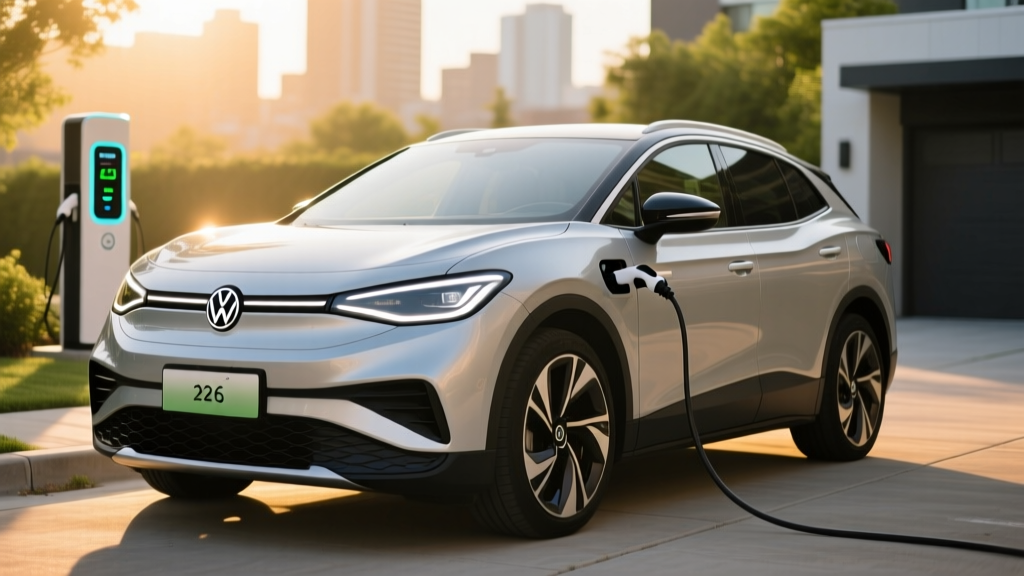
The Volkswagen ID.4 has been the German automaker's mainstream electric answer to the compact crossover segment since its U.S. debut, and the 2026 model year continues its evolution with incremental software refinements, improved infotainment responsiveness, and a matured MEB platform. For buyers searching for a practical VW ID.4 electric SUV that balances daily usability, family space, and access to a growing charging ecosystem, this is one of the few European-engineered EVs built right in the U.S. — at Volkswagen's Chattanooga, Tennessee factory.
But how does it actually perform when you strip away the marketing? I've spent time analyzing its EPA numbers, charging curves, real-world efficiency, and ownership economics to give you the data that matters before you sign a purchase agreement.
Range, Efficiency, and the Real-World Reality
The 2026 VW ID.4 is offered with two battery configurations and two drivetrain layouts, which significantly affect how far you'll go on a charge. Here's how the EPA rates each variant:
| Trim / Drivetrain | Battery (Usable kWh) | EPA Range | MPGe (City/Hwy/Combined) | kWh/100 mi |
|---|---|---|---|---|
| Standard Range S (RWD) | 62 kWh (NMC) | 223 mi | 115 / 98 / 107 | 33 |
| Pro / Pro S (RWD) | 82 kWh (NMC) | 291 mi | 115 / 99 / 107 | 33 |
| Pro / Pro S (AWD) | 82 kWh (NMC) | 263 mi | 104 / 90 / 97 | 36 |
The ID.4's NMC (nickel-manganese-cobalt) lithium-ion battery chemistry prioritizes energy density — that's how VW fits 82 usable kWh into a compact crossover footprint. The trade-off versus LFP chemistry is that NMC degrades slightly faster over time if you routinely charge to 100% or let it sit at extreme states of charge. VW's battery management system includes a top-end buffer to help protect longevity, but for daily driving, setting your charge limit to 80% is the smart move.
Charging Speed: DC Fast, Level 2, and What to Expect
Charging speed is often the make-or-break factor for EV buyers, and the ID.4 delivers solid but not class-leading DC fast-charging performance. Here's the full breakdown:
| Charging Level | Power (kW) | Speed / Time | Connector |
|---|---|---|---|
| Level 1 (120V household) | ~1.4 kW | ~3-4 mi/hr | NACS (J1772 adapter included) |
| Level 2 (240V home/public) | 11 kW (48A) | ~25-30 mi/hr; full charge in ~9 hr | NACS (J1772 adapter included) |
| DC Fast Charge (peak) | 170 kW (82 kWh battery) | 10-80% in ~30 min | NACS |
| DC Fast Charge (Std Range) | 135 kW | 10-80% in ~28 min | NACS |
Starting with the 2025 model year, VW transitioned the ID.4 to the NACS (North American Charging Standard) port — the Tesla-designed connector now adopted industry-wide. This means native access to Tesla Superchargers (over 25,000 stalls in North America as of early 2026) without an adapter, which dramatically expands the ID.4's road-trip practicality. For Electrify America, ChargePoint, and other CCS-based networks, VW includes a CCS adapter in the vehicle.
Charging curve reality check: The 170 kW peak rate applies only in a narrow state-of-charge window, roughly 5-25% SoC with a preconditioned battery. From 25-60%, expect a sustained rate closer to 120-130 kW. Above 80%, charging slows dramatically to protect battery health — from 80-100% can take nearly as long as 10-80%. On a road trip, the practical move is to charge to 80% and get back on the road rather than wait for a trickle top-off.
For home charging, the 11 kW onboard charger is one of the ID.4's strengths. If you have a 48-amp Level 2 wallbox on a 60-amp circuit, you'll recover a full battery overnight in about 9 hours. This is faster than some competitors limited to 7.2 or 9.6 kW onboard chargers.
Performance and Drivetrain
The ID.4 isn't positioned as a performance EV — it's a comfort-oriented family hauler — but the numbers are respectable for the segment:
| Variant | Motor Config | Horsepower | Torque (lb-ft) | 0-60 mph | Drivetrain |
|---|---|---|---|---|---|
| Standard Range / Pro RWD | Single rear motor | 201 hp | 229 | 7.7 sec | RWD |
| Pro / Pro S AWD | Dual motor (front + rear) | 295 hp | 339 | 5.4 sec | AWD |
The rear-wheel-drive layout gives the ID.4 a tight 31.5-foot turning circle — excellent for urban parking. The AWD variant adds a front induction motor for all-weather traction and a meaningful power bump, though it costs you about 28 miles of EPA range.
Regenerative braking in the ID.4 is adjustable via steering-wheel paddles (D, D1, D2, D3 levels) or the B-mode for stronger regen. It doesn't quite achieve true one-pedal driving at the lightest regen setting, but B-mode gets close in stop-and-go traffic. The brake pedal feel is one of the better executions among EVs — firm and predictable, without the vague mushiness that plagues some competitors blending regen and friction braking.
Pricing, Trims, and Federal Tax Credit Eligibility
The 2026 VW ID.4 lineup spans five trims, with pricing that positions it squarely in the mainstream compact electric crossover segment:
| Trim | Drivetrain | MSRP (incl. destination) | Est. Price After §30D Credit |
|---|---|---|---|
| Standard Range S | RWD | $43,990 | $36,490* |
| Pro | RWD | $47,490 | $39,990* |
| Pro S | RWD | $51,490 | $43,990* |
| Pro S Plus | AWD | $56,490 | $48,990* |
| Pro S Plus (fully loaded) | AWD w/ Gradient Pkg | ~$58,990 | ~$51,490* |
*Estimated price assumes full $7,500 federal tax credit eligibility. Actual credit depends on individual tax liability and compliance with all §30D requirements.
- MSRP cap: SUVs must be ≤ $80,000 — all ID.4 trims qualify ✅
- Buyer income cap: AGI ≤ $150,000 (single), $225,000 (head of household), $300,000 (joint) — verify against your tax situation
- Battery sourcing: Critical minerals and battery component requirements phase in annually under the Inflation Reduction Act. The ID.4's Tennessee assembly helps with North American content, but mineral sourcing rules are complex and change yearly. Confirm current-year eligibility at IRS.gov
- Point-of-sale transfer: As of 2024+, you can transfer the credit to the dealer for an immediate price reduction at purchase — you don't have to wait until tax filing
- Tax liability: The credit is now transferable, so it's not limited by your personal tax liability in the same way — but consult a tax professional for your specific case
Interior Space, Cargo, and Daily Practicality
The ID.4's MEB platform — designed from the ground up as electric — gives it a flat floor and a wheelbase that maximizes interior volume relative to its exterior footprint. Here's what you're working with:
| Measurement | Specification |
|---|---|
| Cargo (behind rear seats) | 30.3 cu ft |
| Cargo (rear seats folded) | 64.2 cu ft |
| Front legroom | 41.1 in |
| Rear legroom | 37.6 in |
| Front headroom | 41.1 in (w/o panoramic roof) |
| Towing capacity (AWD, w/ factory hitch) | 2,700 lbs |
| Frunk (front trunk) | None — small storage cubby only |
The lack of a true frunk is a missed opportunity — competitors like the Hyundai Ioniq 5 and Ford Mustang Mach-E offer meaningful front-trunk storage. The ID.4 instead has a small lidded compartment under the hood that fits a charging cable and a few essentials, but not a grocery bag.
Interior materials are a mixed bag. The Pro S and above trims get heated leatherette seats, a panoramic fixed glass roof, and ambient lighting that elevate the cabin feel. Lower trims use more hard plastics on the door panels and lower dash than you'd expect at this price point. The seats themselves are comfortable for long drives, with adequate bolstering and a driving position that feels more car-like than SUV-like — a VW hallmark.
Tech, Infotainment, and Driver Assistance
The ID.4 runs VW's latest ID. Software 4.x on a 12.9-inch center touchscreen (upgraded from the original 10- and 12-inch units). The 2025-2026 software revisions addressed many of the early ID.4's most-criticized pain points: sluggish response times, confusing menu structures, and capacitive-touch steering wheel controls that triggered accidentally.
What's improved:
- Faster screen response and more intuitive menu hierarchy
- Backlit capacitive sliders for volume and climate (finally — the unlit sliders on 2021-2023 models were a legitimate safety complaint)
- Wireless Apple CarPlay and Android Auto
- Over-the-air (OTA) update capability for ongoing improvements
- Wireless phone charging pad (Pro S and above)
Driver assistance (SAE Level 2): The ID.4 comes standard with VW's IQ.DRIVE suite, which includes:
- Travel Assist (adaptive cruise + lane centering) — functional on highways but requires hands on the wheel
- Front Assist (automatic emergency braking with pedestrian detection)
- Lane Assist (lane-keeping)
- Blind-spot monitoring with rear cross-traffic alert
- Park Assist Plus (semi-automated parking)
Warranty Coverage
Volkswagen provides competitive warranty coverage for the ID.4, anchored by an industry-standard battery warranty:
| Coverage | Term |
|---|---|
| Basic vehicle (bumper-to-bumper) | 4 years / 50,000 miles |
| Battery & drive unit | 8 years / 100,000 miles |
| Battery capacity retention guarantee | ≥70% of original capacity over 8 yr / 100,000 mi |
| Roadside assistance | 4 years / 50,000 miles |
| Corrosion perforation | 12 years / unlimited miles |
The 70% capacity retention threshold over 8 years is consistent with most mainstream EV makers. Real-world data from early 2021-2022 ID.4 owners suggests degradation is tracking well — most reporting 3-6% loss over the first 30,000-50,000 miles, which projects favorably against VW's guarantee. According to data compiled by fueleconomy.gov, modern NMC batteries with active thermal management typically retain 85-90% capacity at the 100,000-mile mark under normal use patterns.
Pros, Cons, and the Verdict
Pros
- U.S.-built (Chattanooga, TN) — supports domestic manufacturing and helps with §30D eligibility
- NACS port with native Tesla Supercharger access
- Competitive 291-mile EPA range (RWD Pro)
- 11 kW Level 2 onboard charger — faster home charging than many rivals
- Comfortable ride quality and tight turning radius
- Spacious rear seat and cargo area for the segment
- 3 years of complimentary Electrify America charging (30-min sessions, on select trims)
Cons
- DC fast charging peaks at 170 kW — slower than Hyundai/Kia's 800V architecture (~240 kW)
- No meaningful frunk storage
- AWD variant loses 28 miles of range
- Interior plastics on lower trims don't match the price
- Infotainment, while improved, still trails Tesla and Hyundai in UX fluidity
- No front trunk (frunk) limits practical storage for charging cables
- 2,700-lb towing capacity is modest vs. some competitors
How the ID.4 Stacks Up Against Key Competitors
The compact electric SUV segment is crowded. Here's how the ID.4 compares on the metrics that matter most:
| Spec | VW ID.4 Pro S (RWD) | Hyundai Ioniq 5 SEL (RWD LR) | Tesla Model Y (LR RWD) | Ford Mustang Mach-E (ER RWD) |
|---|---|---|---|---|
| EPA Range | 291 mi | 303 mi | 320 mi | 320 mi |
| Battery (usable kWh) | 82 kWh (NMC) | 77.4 kWh (NMC) | ~75 kWh (NMC) | 88 kWh (NMC) |
| Peak DC Charge | 170 kW | 238 kW (800V) | 250 kW | 150 kW |
| 10-80% DC Time | ~30 min | ~18 min | ~22 min | ~38 min |
| Starting MSRP | ~$51,490 (Pro S) | ~$50,000 | ~$46,630 | ~$48,995 |
| Cargo (rear seats up) | 30.3 cu ft | 27.2 cu ft | 30.2 cu ft | 29.7 cu ft |
The ID.4 doesn't win any single spec category outright. The Ioniq 5 charges significantly faster thanks to its 800-volt architecture. The Model Y goes farther per charge and has a more responsive infotainment system. The Mach-E offers a sportier drive. But the ID.4's strength is that it's competitive across the board while offering a driving character, build quality, and dealer network that appeal to buyers transitioning from a conventional VW, Toyota, or Honda.
Who Should Buy the VW ID.4?
- You want a practical family EV with strong cargo space and a comfortable ride
- Home Level 2 charging is your primary refueling method (the 11 kW onboard charger shines here)
- You value a traditional dealer service experience over a direct-to-consumer model
- You want Tesla Supercharger access via NACS without buying a Tesla
- You prioritize a tight turning radius and car-like driving dynamics in an SUV package
- Fastest possible DC charging is your top priority → Hyundai Ioniq 5 / Kia EV6
- Maximum range per dollar matters most → Tesla Model Y Long Range
- You need serious towing capacity → Ford F-150 Lightning or Rivian R1S
- You want a frunk for gear storage → Hyundai Ioniq 5
Frequently Asked Questions
What is the real-world range of the VW ID.4?
The EPA rates the RWD Pro at 291 miles, but in real-world highway driving at 70-75 mph, expect roughly 245-260 miles. In cold weather below freezing, that can drop to 190-210 miles. City driving with regenerative braking can actually exceed the EPA estimate slightly, as the stop-and-go cycle recovers energy.
How fast does the ID.4 charge at home and on the road?
At home on a 240V Level 2 charger (48 amps), the ID.4 charges at 11 kW — adding about 25-30 miles of range per hour, or a full charge in roughly 9 hours. On DC fast chargers, the 82 kWh battery peaks at 170 kW, reaching 10-80% in approximately 30 minutes under optimal conditions with a preconditioned battery.
Does the 2026 VW ID.4 qualify for the $7,500 federal tax credit?
The ID.4 qualifies on MSRP (all trims are under the $80,000 SUV cap) and is assembled in Tennessee. However, full §30D credit eligibility depends on your income, the battery's critical mineral and component sourcing (which shifts yearly under IRA rules), and your tax situation. The credit can now be transferred at the point of sale for an instant price reduction. Always confirm current eligibility at IRS.gov and consult a tax professional.
Is the VW ID.4 worth buying over the Tesla Model Y or Hyundai Ioniq 5?
It depends on your priorities. The ID.4 offers a more conventional dealership experience, a comfortable ride, and competitive range — but it charges slower than the Ioniq 5 and doesn't match the Model Y's range or software ecosystem. If you value build quality, U.S. assembly, and a non-Tesla brand with Supercharger access, the ID.4 is a strong pick. If maximum range or fastest charging tops your list, look at the competitors.
What is the battery warranty on the ID.4?
VW covers the high-voltage battery and drive unit for 8 years or 100,000 miles, whichever comes first. The battery is guaranteed to retain at least 70% of its original usable capacity during that period. If degradation exceeds that threshold, VW will repair or replace the battery to bring it back within spec.
Can the ID.4 tow?
Yes, but modestly. AWD models equipped with the factory towing package can tow up to 2,700 pounds — enough for a small utility trailer, a pair of jet skis, or a light camper. RWD models are rated lower. Towing significantly reduces range (expect a 30-50% reduction depending on trailer weight and aerodynamics), so plan accordingly.