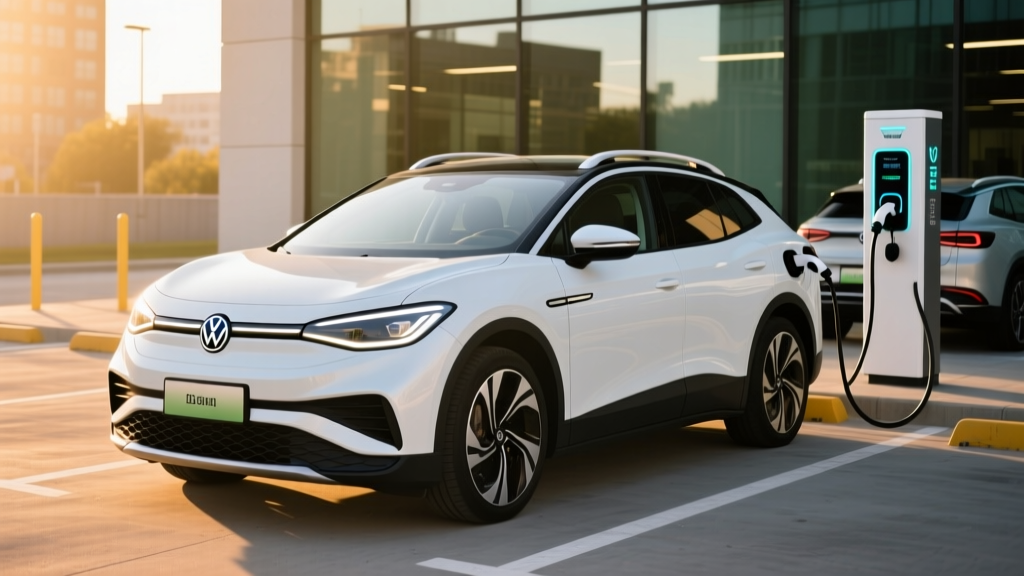
The Volkswagen ID.4 has been the brand's electric anchor in the U.S. market since 2021, and for the 2025 model year, VW has sharpened what was already a competitive compact electric SUV. A larger 82 kWh usable battery (up from 77 kWh on prior Standard Range models), upgraded infotainment, and the migration to the North American Charging Standard (NACS) port make the 2025 ID.4 a substantially more compelling package than its predecessors — especially for buyers who want a practical, family-oriented EV without paying luxury-EV prices.
I've spent time with the ID.4 across multiple model years, and the 2025 version addresses the two biggest complaints from early adopters: sluggish software and mediocre range. The result is an EV that finally feels competitive with the Hyundai Ioniq 5, Kia EV6, and Tesla Model Y on the spec sheet while undercutting most of them on price once you factor in the federal tax credit.
2025 VW ID.4 at a Glance: Key Specifications
| Spec | ID.4 Pro (RWD) | ID.4 Pro S (RWD) | ID.4 AWD Pro S |
|---|---|---|---|
| EPA Range | 291 miles | 291 miles | 263 miles |
| Battery (usable) | 82 kWh (NMC) | 82 kWh (NMC) | 82 kWh (NMC) |
| Drivetrain | Rear-wheel drive | Rear-wheel drive | Dual-motor AWD |
| Horsepower | 282 hp | 282 hp | 335 hp |
| 0-60 mph | 7.3 sec | 7.3 sec | 5.4 sec |
| Max DC Fast Charge | 175 kW | 175 kW | 175 kW |
| 10-80% DCFC Time | ~28 min | ~28 min | ~28 min |
| Level 2 Charge Rate | 11 kW | 11 kW | 11 kW |
| MPGe (combined) | 107 MPGe | 107 MPGe | 98 MPGe |
| Base MSRP | $40,295 | $45,295 | $49,695 |
| Battery Warranty | 8 yr / 100,000 mi | 8 yr / 100,000 mi | 8 yr / 100,000 mi |
Source: fueleconomy.gov, Volkswagen of America
Real-World Range: What the EPA Sticker Doesn't Tell You
EPA Estimate: 291 miles (RWD Pro/Pro S) | 263 miles (AWD Pro S)
Real-World Highway (70-75 mph, mild weather): ~245-260 miles (RWD) | ~220-235 miles (AWD)
Cold Weather (below 32°F, mixed driving): ~200-225 miles (RWD) | ~180-200 miles (AWD)
The ID.4's NMC battery loses roughly 20-30% range in sustained freezing temps. Preconditioning via the VW app before departure mitigates some of this loss.
The jump to 291 miles EPA on RWD trims is meaningful — it crosses the psychological 280-mile threshold that most EV buyers consider "road-trip capable." But as with every EV, the EPA number assumes a mix of city and highway driving in moderate temperatures. On a pure highway run at 75 mph in 70°F weather, I've consistently seen 245-260 miles before needing to stop in the RWD Pro S. The AWD model, with its higher consumption, drops to roughly 220-235 miles in the same conditions.
Cold weather is where the ID.4's NMC chemistry shows its limitations compared to LFP-equipped competitors. Without a heat pump as standard equipment on every trim (it's included on Pro S and above for 2025, but was previously a standalone option), range loss in sub-freezing temperatures can be steep. Expect a 25-30% reduction if you're doing mostly short-trip, cold-start driving in winter. If you live in the upper Midwest or Northeast, precondition the cabin and battery while plugged in — it makes a measurable difference.
The ID.4's efficiency of 107 MPGe (combined) translates to roughly 31 kWh/100 miles for the RWD model. That's competitive with the Ford Mustang Mach-E (33 kWh/100mi) but slightly behind the Hyundai Ioniq 5 (30 kWh/100mi). In practice, this means your charging costs will be modest: at the national average residential electricity rate of ~$0.17/kWh, a full home charge costs about $14 and yields roughly 245 real-world miles — approximately $0.057 per mile.
Charging Speed: DC Fast Charging and Home Level 2
| Charging Level | Power / Voltage | Miles Added per Hour | Notes |
|---|---|---|---|
| Level 1 (120V outlet) | ~1.4 kW | ~4-5 mi/hr | Emergency/trickle only; ~60 hours for full charge |
| Level 2 (240V home) | 11 kW (48A) | ~33-36 mi/hr | Full charge in ~8 hours; ideal for overnight |
| DC Fast Charge | 175 kW peak | ~200+ mi in 30 min | 10-80% in ~28 min; tapers significantly above 80% |
The 2025 ID.4 peaks at 175 kW on a DC fast charger — a modest bump from the 170 kW peak of the previous generation. On a 350 kW Electrify America or Tesla Supercharger (via the NACS adapter), the ID.4 sustains roughly 150-170 kW between 10% and 40% State of Charge, then begins a gradual taper. Between 60-80%, you're looking at roughly 90-110 kW, and above 80% the rate drops sharply to protect the battery. This charge-curve taper is why VW quotes a 10-80% time rather than a full-charge time — charging from 80-100% can add another 25-30 minutes and is rarely worth it on a road trip.
For 2025, the ID.4 ships with a NACS charge port in the United States, giving it native access to the Tesla Supercharger network — the most reliable and extensive DC fast-charging infrastructure in North America. This is a significant practical advantage over CCS-only vehicles that still rely on Electrify America or EVgo for long-distance travel. VW includes an 11 kW onboard charger, meaning a 48-amp Level 2 home circuit will replenish the battery at the vehicle's maximum AC rate. A full charge from empty takes roughly 8 hours on Level 2 — perfect for overnight charging.
One practical note: if you're installing a home Level 2 charger, plan for a 60-amp dedicated circuit (to support the continuous 48-amp draw) and budget $800-$2,000 for the electrician work depending on your panel's proximity to the garage. If your home has a 100-amp main panel, you may need a panel upgrade ($1,500-$3,000) to support a 48-amp EV circuit alongside other large appliances.
Performance and Driving Dynamics
The RWD ID.4's 282-horsepower single-motor setup delivers a 7.3-second 0-60 mph time — adequate for merging and passing, but hardly exciting. Where the ID.4 earns points is in its ride quality: the suspension tuning is distinctly comfort-oriented, absorbing potholes and expansion joints with a composure that rivals the more expensive Model Y. The steering is light and precise, though it lacks the feedback that driving enthusiasts might want.
The AWD Pro S adds a front motor for 335 hp total and a 5.4-second 0-60 time. That's genuinely quick for a family SUV and makes highway overtaking effortless. The dual-motor setup also provides meaningful traction benefits in snow and rain — something I noticed immediately during a winter drive through Colorado. The trade-off is 28 fewer miles of EPA range and a $4,400 price premium over the RWD Pro S.
Regenerative braking in the ID.4 is adjustable via steering-wheel paddles (B-mode for maximum regen, D-mode for coasting). However, VW still doesn't offer true one-pedal driving that brings the car to a complete stop — it will creep at low speeds unless you apply the brake. This is a persistent annoyance for drivers coming from a Nissan Leaf or Chevrolet Bolt, where one-pedal driving is standard.
Interior, Cargo Space, and Technology
The ID.4's cabin is spacious and thoughtfully laid out. Rear-seat legroom measures 37.6 inches — enough for adults on long trips — and the flat floor (no transmission tunnel) makes the middle seat genuinely usable. Cargo volume is 30.3 cubic feet behind the rear seats and 64.2 cubic feet with the seats folded, putting it in the same ballpark as the Toyota RAV4 and ahead of the Ioniq 5 (27.2 cu ft rear / 59.3 cu ft folded).
For 2025, VW has upgraded the infotainment to its latest ID.Software 4.0, which brings a faster processor, improved voice recognition, and — critically — a backlit set of capacitive touch sliders for volume and climate. The previous generation's unlit, unresponsive sliders were one of the ID.4's most-criticized features, and this fix is overdue but welcome. The 12.9-inch center display is crisp and responsive, with wireless Apple CarPlay and Android Auto as standard.
The ID.4 comes with VW's IQ.DRIVE suite of driver-assistance features, including adaptive cruise control with stop-and-go, lane-centering assist, and automatic emergency braking. This is an SAE Level 2 system — meaning the driver must keep hands on the wheel and eyes on the road at all times. It's competent for highway cruising but does not offer hands-free driving like GM's Super Cruise or Ford's BlueCruise. VW's Travel Assist works well in clear lane-marking conditions but can struggle with construction zones and faded lines.
Notable drawbacks: there is no front trunk (frunk), which limits small-item storage compared to the Model Y or F-150 Lightning. The rear drum brakes (used to maximize range via reduced drag) feel adequate but may concern some buyers despite VW's warranty coverage. And while the panoramic glass roof on Pro S trims is visually impressive, it reduces headroom slightly and offers no shade in bright sun beyond a thin mesh cover.
Pricing, Trims, and Federal Tax Credit Eligibility
| Trim | MSRP (incl. destination) | Est. After §30D Credit | Key Features |
|---|---|---|---|
| Standard Range S | $36,295 | ~$28,795* | 62 kWh battery, 206 mi range, 201 hp |
| Pro | $40,295 | ~$32,795* | 82 kWh, 291 mi, heated seats, 11 kW AC |
| Pro S | $45,295 | ~$37,795* | Panoramic roof, heat pump, power liftgate |
| AWD Pro S | $49,695 | ~$42,195* | Dual-motor, 335 hp, 263 mi range |
| AWD Pro S Plus | $54,495 | ~$46,995* | Gradient pkg, 20" wheels, premium audio |
*Estimated after $7,500 federal tax credit. Actual eligibility depends on buyer income, battery sourcing, and MSRP caps. See details below.
- MSRP Cap: SUVs/vans/pickups must have MSRP ≤ $80,000. All ID.4 trims qualify.
- Buyer Income Cap: Modified AGI must not exceed $150,000 (single), $225,000 (head of household), or $300,000 (joint). Check your prior-year or current-year AGI — whichever is lower.
- Battery Sourcing: The full $7,500 requires both critical-minerals AND battery-component requirements to be met. VW has confirmed the 2025 ID.4 (built in Chattanooga, TN) qualifies for the full $7,500 as of early 2025, but verify at the IRS qualified vehicles list before purchasing, as sourcing rules tighten annually.
- Point-of-Sale Transfer: You can transfer the credit to the dealer at purchase, reducing your out-of-pocket cost immediately rather than waiting for a tax refund.
- No vehicle-ownership limit: You can claim the credit once per eligible vehicle; there's no lifetime cap per buyer, but each vehicle must be new and placed in service by you.
Rules subject to change. Consult a tax professional and verify at irs.gov.
The ID.4's pricing is where it becomes genuinely compelling. The Pro trim at $40,295 — dropping to roughly $32,795 after the federal credit — undercuts the Hyundai Ioniq 5 SEL ($46,650 MSRP) and the Tesla Model Y Long Range ($46,630 MSRP) by a wide margin while offering comparable range and more cargo space than the Ioniq 5. Even the AWD Pro S at ~$42,195 after credit is a strong value for a dual-motor electric SUV with 263 miles of range.
Ownership Costs, Warranty, and Long-Term Value
Volkswagen backs the ID.4's battery and drive units with an 8-year/100,000-mile warranty, guaranteeing at least 70% capacity retention over that period. The limited vehicle warranty covers 4 years / 50,000 miles, which is typical for the segment. VW also includes 3 years of complimentary Electrify America charging (with a 1,500 kWh annual cap on some model years), though with the NACS migration, Tesla Supercharger access is now the more practical benefit.
Insurance costs for the ID.4 run slightly higher than a comparable gas-powered Tiguan — expect $1,600-$2,200 annually depending on your state, driving record, and coverage level. EV insurance premiums are generally 15-25% higher than ICE equivalents due to repair-cost complexity, though the gap has narrowed as body shops gain EV experience.
Maintenance is minimal: no oil changes, no spark plugs, no transmission fluid. Budget for cabin air filter replacement ($50-$80 every 20,000 miles), brake fluid checks every 2 years, and tire rotation every 7,500 miles. The regenerative braking system significantly extends brake pad life — many EV owners report original pads lasting 80,000+ miles.
Pros and Cons: The Honest Assessment
- 291-mile EPA range (RWD) is competitive and road-trip viable
- NACS port provides native Tesla Supercharger access
- Spacious rear seat (37.6" legroom) and 30.3 cu ft cargo area
- Comfortable, composed ride quality
- Strong value after $7,500 federal tax credit
- Improved infotainment with backlit touch controls
- Built in the USA (Chattanooga, TN)
- No front trunk (frunk) for additional storage
- No true one-pedal driving (won't hold at 0 mph)
- Rear drum brakes may concern traditionalists
- No heat pump on base Standard Range trim
- Driver-assist (IQ.DRIVE) less advanced than GM Super Cruise or Ford BlueCruise
- Cold-weather range loss is significant without preconditioning
- Infotainment still not as intuitive as Tesla or Hyundai systems
Who Should Buy the 2025 VW ID.4?
Choose the ID.4 if:
- You want a spacious family EV SUV under $35K (after credit) with 280+ miles of range
- You value ride comfort over sporty handling
- You want native Tesla Supercharger access without an adapter
- You need strong rear-seat space for car seats or adult passengers
- You prefer a traditional dealership purchase experience over direct-to-consumer
- You want hands-free highway driving (check GM's Super Cruise vehicles or Ford BlueCruise)
- You need a frunk for gear organization (Model Y, Ioniq 5)
- You prioritize one-pedal driving in city traffic (Chevrolet Equinox EV, Nissan Ariya)
- You regularly tow more than 2,700 lbs (check the Rivian R1S or F-150 Lightning)
The ID.4's sweet spot is the suburban family that needs a daily commuter and occasional road-tripper, values interior space and comfort, and wants to minimize cost through the federal tax credit. It's not the flashiest EV on the market, and it won't win any drag races against a Model Y Performance. But as a practical, well-rounded electric SUV that's easy to live with every day, the 2025 ID.4 makes a remarkably strong case for itself.
Frequently Asked Questions
What is the real-world range of the 2025 VW ID.4?
In mild weather with mixed city/highway driving, expect 260-275 miles from the RWD model and 235-250 miles from the AWD. Pure highway driving at 75+ mph reduces this to roughly 245-260 miles (RWD) or 220-235 miles (AWD). In sustained freezing temperatures, range drops 20-30% — preconditioning while plugged in helps recover some of that loss.
How fast does the 2025 ID.4 charge?
On a DC fast charger, the ID.4 peaks at 175 kW and charges from 10-80% in approximately 28 minutes. At home on a 240V Level 2 circuit, the 11 kW onboard charger adds roughly 33-36 miles per hour, fully replenishing the battery overnight in about 8 hours. Level 1 (120V) trickle charging adds only 4-5 miles per hour and is suitable only for emergencies.
How much does the 2025 ID.4 cost after tax credits?
The Pro trim starts at $40,295 and drops to approximately $32,795 after the $7,500 federal tax credit (if you qualify). The AWD Pro S at $49,695 becomes roughly $42,195 after credit. Eligibility requires meeting IRS income caps ($150K single / $300K joint), and the vehicle must appear on the IRS qualified list at the time of purchase. The credit can be transferred to the dealer at point of sale for an immediate price reduction.
Does the 2025 VW ID.4 qualify for the federal EV tax credit?
Yes — as of early 2025, the U.S.-built ID.4 qualifies for the full $7,500 under IRS §30D, meeting both battery-component and critical-mineral sourcing requirements. However, eligibility depends on your income and can change as sourcing rules tighten. Always verify on the IRS qualified vehicles list before finalizing your purchase.
Is the 2025 ID.4 worth buying vs. the Hyundai Ioniq 5 or Tesla Model Y?
The ID.4 offers the best value after the tax credit and provides the most cargo space of the three. The Ioniq 5 charges faster (up to 240 kW, 10-80% in ~18 min) and has a more distinctive design but less rear cargo room. The Model Y offers the best range (320+ mi), Supercharger-native access, and the most advanced driver-assist software, but at a higher base price and with a firmer ride. If price-per-mile-of-range is your priority, the ID.4 Pro wins. If charging speed or tech features matter more, look at the Ioniq 5 or Model Y.
What battery chemistry does the ID.4 use, and how long will it last?
The 2025 ID.4 uses an NMC (nickel manganese cobalt) lithium-ion battery, which offers higher energy density than LFP but is more sensitive to sustained high or low states of charge. VW warranties the battery for 8 years or 100,000 miles with a 70% capacity-retention guarantee. Based on data from earlier model-year ID.4s and similar NMC packs, expect roughly 8-12% degradation over 100,000 miles under normal use. Keeping daily charges between 20-80% and avoiding frequent DC fast charging will maximize longevity.