The VW ID.3 in America: What US Buyers Need to Know
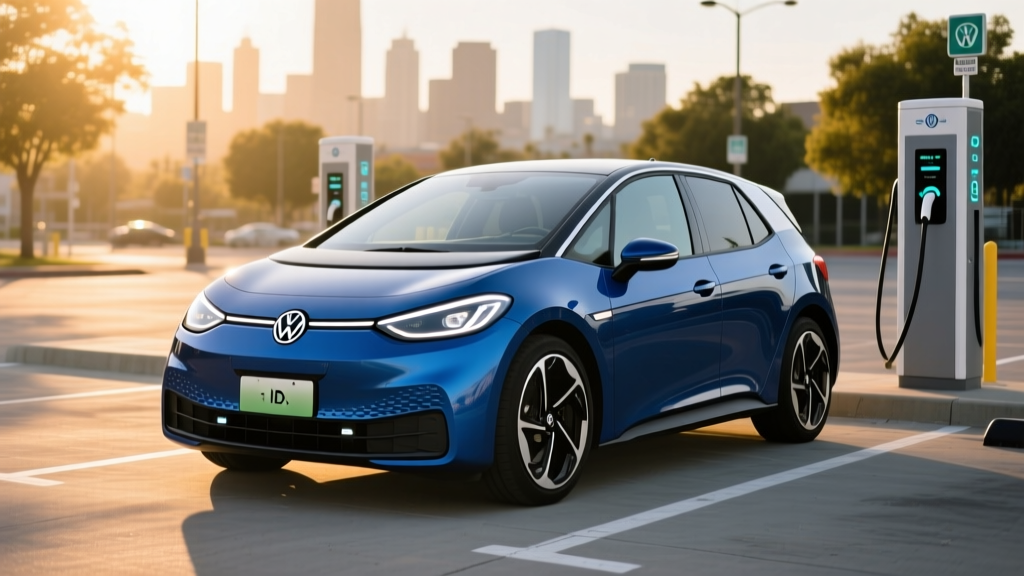
The Volkswagen ID.3 is one of Europe's best-selling electric hatchbacks — a practical, right-sized EV that slots below the ID.4 crossover in VW's MEB-platform lineup. But for American shoppers searching for the VW ID.3 USA availability, the answer in 2026 remains the same as it has been since the car's 2019 debut: Volkswagen does not sell the ID.3 in the United States, and there is no confirmed plan to bring it here.
This isn't a case of a model quietly skipping the American market. VW has been deliberate about which MEB-platform vehicles it imports, prioritizing crossovers and SUVs that match US buyer preferences. The ID.4 (compact SUV), ID.5 (coupe-SUV variant), and the upcoming ID.7 (sedan/wagon) are the vehicles VW has chosen for American showrooms. The ID.3, despite its European success, has consistently fallen outside VW's US product strategy.
Here's a comprehensive look at what the ID.3 offers overseas, why it hasn't crossed the Atlantic, what US buyers can get instead from VW, and whether the math could ever change.
VW ID.3 Specs: What European Buyers Get in 2026
For the 2026 model year, the European-market ID.3 is available with several battery and powertrain configurations. The latest facelifted version (introduced for 2024 and carried forward) brings improved interior materials, updated infotainment software (VW ID.Software 4.0), and a new GTX performance variant. Here's how the lineup breaks down:
| Specification | ID.3 Pro | ID.3 Pro S | ID.3 GTX |
|---|---|---|---|
| Battery (usable / gross) | 58 kWh / 62 kWh | 77 kWh / 82 kWh | 77 kWh / 82 kWh |
| Chemistry | NMC (Nickel Manganese Cobalt) | NMC | NMC |
| WLTP Range | ~263 mi (425 km) | ~348 mi (560 km) | ~335 mi (540 km) |
| Motor / Drivetrain | RWD / 201 hp | RWD / 201 hp | RWD / 282 hp |
| 0–62 mph (0–100 km/h) | ~7.3 sec | ~7.9 sec | ~5.9 sec |
| Max DC Fast Charge | 120 kW | 170 kW | 170 kW |
| 10–80% DC Charge Time | ~35 min | ~30 min | ~30 min |
| Level 2 AC Charge Rate | 11 kW (3-phase) | 11 kW (3-phase) | 11 kW (3-phase) |
| Base Price (Europe, approx.) | €36,000 (~$39,000) | €43,000 (~$46,500) | €47,000 (~$51,000) |
Key terminology note: European range figures use the WLTP testing cycle, which tends to produce more optimistic numbers than the US EPA cycle. If the ID.3 Pro S were EPA-rated, we'd estimate roughly 290–310 miles based on typical WLTP-to-EPA conversion factors (roughly 10–15% lower). The base Pro model would likely land around 220–240 miles EPA.
If sold in the US, the ID.3 Pro S would likely carry an EPA range sticker of approximately 290–310 miles. In real-world highway driving at 70+ mph, expect 240–270 miles before needing a charge. In cold weather (below 30°F), range can drop an additional 20–30%, putting winter highway range closer to 190–220 miles. The smaller 58 kWh Pro model would see proportionally lower figures.
Why the VW ID.3 Isn't Sold in the USA
Volkswagen's decision to keep the ID.3 out of the American market comes down to several converging factors:
1. The American Hatchback Problem
US consumers have overwhelmingly shifted toward crossovers and SUVs. The hatchback segment — where the ID.3 competes against the Nissan Leaf, MG4 (in Europe), and BYD Dolphin — has shrunk to near-irrelevance in America. Even the Chevrolet Bolt EV, arguably the closest US-market analog, was discontinued in 2023 (though a next-generation Bolt is expected). VW's US product planning reflects this reality: crossovers sell, hatchbacks don't.
2. Regulatory and Homologation Costs
Bringing any vehicle to the US requires meeting Federal Motor Vehicle Safety Standards (FMVSS), which differ significantly from European ECE regulations. Differences in crash-test requirements, lighting standards, bumper regulations, and emissions (where applicable) mean substantial engineering investment. For a low-volume hatchback in a market that doesn't strongly want one, the business case is thin.
3. Production and Supply Chain Logistics
The ID.3 is built at VW's Zwickau plant in Germany and, more recently, at the Dresden Transparent Factory. Neither facility has been configured for US-spec production. VW's US-market EVs (the ID.4) are now built at the Chattanooga, Tennessee plant, which is optimized for larger vehicles. Retooling for a hatchback would require significant capital for uncertain returns.
4. The ID.4 Fills the Gap
For American buyers looking for a compact VW EV, the ID.4 serves as VW's answer. It's built domestically (avoiding import tariffs), qualifies for partial or full federal tax credits depending on battery sourcing, and offers the crossover body style Americans prefer. From VW's perspective, the ID.4 already addresses the compact EV segment in the US.
What US Buyers Get Instead: The VW ID.4
If you're a US-based shopper drawn to the ID.3's concept — a practical, reasonably priced VW electric vehicle — the ID.4 is the closest domestic option. Here's how the two compare on paper:
| Attribute | ID.3 Pro S (EU) | ID.4 Pro S (US, RWD) |
|---|---|---|
| Body Style | 5-door hatchback | 5-door compact SUV |
| Battery (usable) | 77 kWh (NMC) | 77 kWh (NMC) |
| EPA / WLTP Range | ~348 mi WLTP (~300 EPA est.) | 291 mi EPA |
| Horsepower | 201 hp (RWD) | 282 hp (RWD) |
| 0–60 mph | ~7.5 sec (est.) | ~7.0 sec |
| Max DC Charge | 170 kW | 175 kW |
| 10–80% DC Time | ~30 min | ~28 min |
| Cargo Volume | 13.6 cu ft (385 L) | 30.3 cu ft (behind rear seats) |
| US Base MSRP | Not sold in US | ~$44,000 |
| Federal Tax Credit (§30D) | N/A | Up to $7,500 (eligibility varies) |
The ID.4 offers substantially more cargo room (30.3 vs. 13.6 cu ft), more power in US spec, and domestic production that supports tax-credit eligibility. The trade-off is a higher starting price, larger exterior footprint, and slightly lower efficiency than the lighter, more aerodynamic hatchback would deliver.
Charging Speed and Infrastructure: What ID.3 Owners Experience in Europe
Understanding the ID.3's charging behavior helps US buyers evaluate whether a potential future import would meet their needs. Here's the full charging picture:
| Charging Level | Power / Rate | Time / Speed | Notes |
|---|---|---|---|
| Level 1 (120V household) | ~1.4 kW | ~3–4 miles per hour | Emergency/trickle only |
| Level 2 (240V home/public) | 11 kW (requires 3-phase) | ~7 hours (0–100%, 77 kWh) | US homes typically single-phase; expect 7.2 kW max |
| DC Fast Charge (Pro) | 120 kW peak | 10–80% in ~35 min | Peak rate sustained to ~50% SoC, then tapers |
| DC Fast Charge (Pro S / GTX) | 170 kW peak | 10–80% in ~30 min | Peak rate sustained to ~45% SoC, then tapers |
Charging curve reality: Like all EVs, the ID.3 doesn't sustain its peak charge rate throughout the session. The 170 kW peak on the Pro S holds roughly from 10% to 45% State of Charge, then tapers progressively. From 80% to 100%, charging slows dramatically to protect battery health — expect an additional 25–35 minutes if you need a full fill. For road trips, planning stops at 10–80% is the sweet spot for time efficiency.
US compatibility note: European ID.3 models use CCS2 connectors (the European DC fast-charging standard). If VW ever brought the ID.3 to America, it would need the CCS1 connector (current US standard) or the increasingly dominant NACS (North American Charging Standard). VW has announced plans to adopt NACS on future US-market EVs, so any hypothetical American ID.3 would likely feature a NACS port.
Battery Technology, Warranty, and Longevity
The ID.3 uses NMC (Nickel Manganese Cobalt) lithium-ion battery cells supplied primarily by LG Energy Solution and SK On. NMC offers high energy density — critical for fitting 77 usable kWh into a compact hatchback footprint — but it comes with different care requirements than LFP (Lithium Iron Phosphate) chemistry.
NMC vs. LFP — what it means for owners:
- NMC: Higher energy density, lighter weight, better cold-weather performance. VW recommends daily charging to 80% for battery longevity, with 100% reserved for trips. Typical degradation: ~5–8% over 100,000 miles based on European fleet data.
- LFP (not used in ID.3): Lower energy density but longer cycle life, can be charged to 100% daily without significant degradation. Used in some competitors like the base Tesla Model 3.
European warranty: VW provides an 8-year / 160,000 km (~100,000 mile) battery warranty guaranteeing minimum 70% State of Health (SoH). If the ID.3 were sold in the US, we'd expect the same 8-year/100,000-mile coverage VW offers on the ID.4, which aligns with the EPA's standard EV battery warranty benchmark.
Could VW Ever Bring the ID.3 to America?
While there's no announced plan, several scenarios could shift VW's calculus:
The case FOR a US ID.3:
- Growing demand for affordable EVs under $35,000 (the ID.3 Pro starts at ~€36,000 in Europe)
- Urban buyers in dense metros who don't need SUV cargo space
- The Bolt EV/EUV discontinuation leaving a gap in the affordable hatchback segment
- Potential production at a future VW North American plant to avoid import tariffs
The case AGAINST:
- Hatchback demand in the US continues to decline
- The ID.4 and upcoming ID.2/ID.1 (smaller, cheaper EVs VW has teased for Europe) may fill the affordable segment differently
- FMVSS homologation costs for a low-volume model
- VW's US EV strategy is focused on crossovers, SUVs, and the ID.7 sedan
Our assessment: a US-market ID.3 remains unlikely before 2028 at the earliest. VW is more likely to introduce a small, affordable crossover (potentially badbed as an "ID.2" or "ID.Crozz" variant) than to import the hatchback.
Best US Alternatives to the VW ID.3
If you're drawn to the ID.3's combination of practicality, efficiency, and VW engineering, here are the closest EVs currently available in America:
✅ Choose the VW ID.4 if...
- You want VW's MEB platform and driving dynamics
- You need crossover cargo space (30.3 cu ft)
- You want domestic production and potential §30D tax credit eligibility
- You can accommodate the ~$44,000 starting price
✅ Choose the Hyundai Kona Electric if...
- You want a compact EV hatchback/crossover closer to the ID.3's size
- You want 261 miles EPA range at a ~$33,000 starting price
- You prefer a more affordable entry point with strong warranty coverage
- You want widely available CCS fast charging
✅ Choose the Tesla Model 3 if...
- You want the best efficiency and charging speed in the segment
- Supercharger network access is a priority
- You prefer a sedan form factor with 341+ miles of range (Long Range)
- You value over-the-air updates and software refinement
✅ Choose the Chevrolet Equinox EV if...
- You want 300+ miles of range near $35,000
- You prefer an American brand with broad dealer support
- NACS charging (Supercharger access) matters to you
- You want a compact SUV with modern infotainment
Frequently Asked Questions: VW ID.3 in the USA
Can I import a VW ID.3 to the United States?
Not legally for road use. The ID.3 doesn't meet US FMVSS safety standards, and importing a non-compliant vehicle for personal use requires it to be at least 25 years old under current NHTSA import regulations. Grey-market imports with aftermarket modifications are technically possible but prohibitively expensive and may not be insurable or registrable in most states.
Will the VW ID.3 ever be sold in the US?
As of 2026, Volkswagen has not announced any plans to sell the ID.3 in the United States. VW's US EV roadmap focuses on the ID.4 (currently on sale), the ID.7 sedan (expected), and potentially smaller, more affordable crossovers in the future. A hatchback remains unlikely given US market preferences.
What's the closest VW EV I can buy in America?
The VW ID.4 is VW's only EV currently sold in the US. It starts around $44,000, offers up to 291 miles of EPA range (Pro S RWD), and is built in Chattanooga, Tennessee. It's larger and more expensive than the ID.3 but shares the same MEB platform DNA.
Does the VW ID.3 use NACS or CCS charging?
European ID.3 models use the CCS2 connector standard. If VW ever sold the ID.3 in the US, it would likely feature NACS (Tesla's North American Charging Standard), which VW has committed to adopting for future US-market EVs. This would grant access to Tesla's Supercharger network.
How does the ID.3 compare to the Tesla Model 3?
The ID.3 is a hatchback; the Model 3 is a sedan — different form factors. On range and efficiency, the Model 3 Long Range (341 mi EPA) significantly outperforms the ID.3 Pro S (~300 mi EPA estimate). The Model 3 also charges faster (up to 250 kW on V3 Superchargers) and has access to the Supercharger network. The ID.3 offers a more upright seating position and European-tuned ride quality, but these advantages are moot for US buyers who can't purchase one.
What is the real-world range of the VW ID.3?
European WLTP testing rates the ID.3 Pro S at 348 miles (560 km). Real-world testing by European outlets typically shows 260–300 miles in mixed driving, dropping to 200–240 miles at sustained highway speeds or in cold weather. If EPA-rated, we'd estimate the sticker would read approximately 290–310 miles.
Does a VW compact EV qualify for the federal tax credit?
The ID.3 is not sold in the US and therefore cannot qualify. The VW ID.4's §30D tax credit eligibility varies by model year, battery sourcing, buyer income (capped at $150,000 single / $300,000 joint), and MSRP limits ($80,000 for SUVs). Check current IRS guidance before purchasing, as battery-sourcing rules change annually.