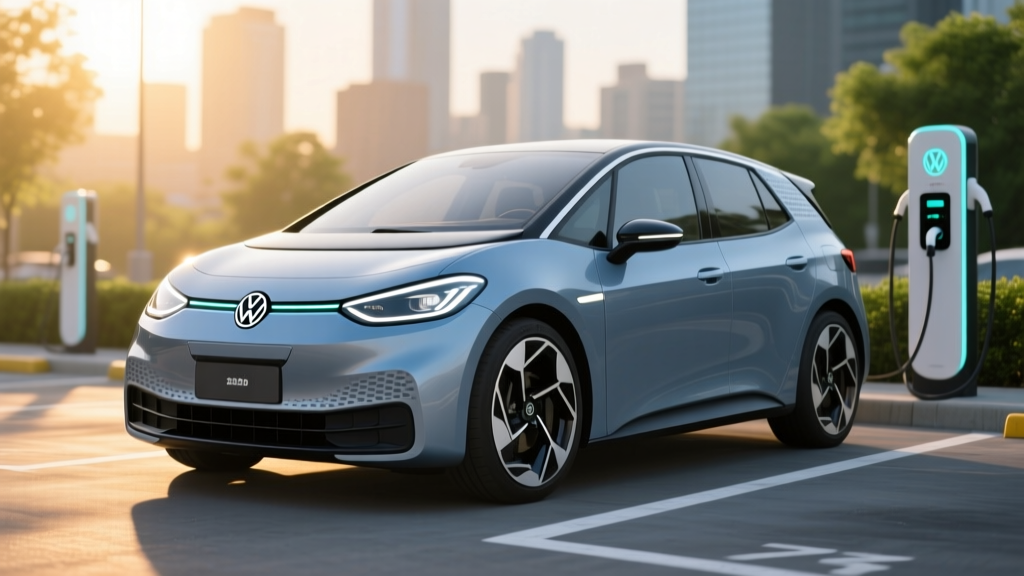
The Volkswagen ID.1 is the German automaker's most ambitious EV play yet: a sub-€25,000 (roughly $26,000–$28,000 USD, depending on exchange rates and import decisions) electric hatchback designed to bring battery-electric motoring to the mass market. First previewed as the ID.2all concept in 2023 and later joined by the ID.Every1 concept in early 2025, the production ID.1 is slated for a European launch in 2027, with a U.S. arrival still unconfirmed. This review covers every confirmed and estimated specification we have as of early 2026, along with the real-world ownership picture buyers should expect.
What Is the VW ID.1 and When Can You Buy It?
The VW ID.1 sits below the ID.3 and ID.4 in Volkswagen's electric lineup, occupying the B-segment hatchback space historically held by the Polo and Golf in Europe. It is built on a derivative of VW's MEB platform — likely a shortened, cost-optimized version — and is intended to compete directly with upcoming affordable EVs from BYD, Renault (the Renault 5 E-Tech), and Stellantis brands.
As of early 2026, the ID.1 remains an announced, unreleased model. Volkswagen has confirmed European production will begin at its Pamplona, Spain facility in 2027. No official U.S. launch date or commitment has been announced. American buyers hoping for a sub-$30,000 electric hatchback from VW should monitor Volkswagen's U.S. press channels, but should also evaluate currently available alternatives like the Chevrolet Bolt EV/EUV (if reintroduced for 2026) and the Nissan Leaf.
Battery, Range, and Efficiency: What We Know
Volkswagen has not published final battery specifications, but industry reporting and platform analysis point to the following estimates:
| Specification | Estimated / Targeted |
|---|---|
| Battery Chemistry | LFP (Lithium Iron Phosphate) — expected for base trim |
| Battery Capacity (Usable) | ~48–52 kWh (estimated) |
| WLTP Range | Up to 450 km (~280 miles) |
| EPA Range (U.S. Estimate) | 240–260 miles (if U.S.-spec) |
| Efficiency Target | ~3.8–4.2 mi/kWh (~115–125 MPGe combined) |
| Drivetrain | Front-wheel drive (single motor) |
| Horsepower | ~130–150 hp (estimated) |
| 0–60 mph | ~8.5–9.5 seconds (estimated) |
The shift to LFP chemistry for the ID.1's base battery is significant. LFP cells trade some energy density for lower cost, longer cycle life, and reduced reliance on cobalt and nickel. For daily commuting and moderate-range use cases, LFP is an excellent match — it tolerates frequent 100% charges better than NMC chemistry, which is a practical advantage for owners who want to wake up to a full battery every morning without accelerated degradation concerns.
Real-World Range Expectations
WLTP range figures are notoriously optimistic compared to EPA estimates and real-world driving. Based on comparable MEB-platform vehicles like the ID.3 and ID.4, we estimate:
- City driving (moderate climate): 250–270 miles achievable
- Highway driving (70 mph, 68°F): 200–220 miles
- Cold-weather highway (30°F): 170–190 miles (LFP chemistry can suffer 25–35% range loss in freezing temps without adequate battery preconditioning)
These figures assume VW equips the ID.1 with a heat pump — a feature that should be standard but has historically been an expensive option on some MEB vehicles. Buyers should verify this at launch.
Charging Speed: DC Fast and Home Level 2
Charging infrastructure compatibility will be critical for a mass-market EV. Here is what we anticipate based on MEB platform capabilities and VW's cost targets:
| Charging Level | Estimated Spec | Practical Result |
|---|---|---|
| Level 1 (120V household) | ~1.4 kW | ~4–5 miles per hour of charging |
| Level 2 (240V home, 32A) | ~7.2–11 kW | ~25–38 miles per hour; full charge in 5–7 hours |
| DC Fast Charge (peak) | ~80–100 kW (estimated) | 10–80% in approximately 30–35 minutes |
A peak DC rate of 80–100 kW is modest by 2026 standards — the Hyundai Ioniq 5 peaks at 240 kW on an 800V architecture — but it is typical for cost-optimized sub-$30,000 EVs. On a road trip, a 30-minute stop at a 150 kW Electrify America or Tesla Supercharger stall will add roughly 150–170 miles of range, which is workable for highway travel if you plan stops strategically.
One important caveat: LFP batteries typically exhibit a less aggressive charge curve taper than NMC cells, meaning the ID.1 may sustain closer to its peak kW rate through a wider state-of-charge window. This could partially offset the lower peak number in real-world charging sessions.
Interior, Cargo, and Technology
The ID.1 is a B-segment hatchback, so interior space will be tighter than the ID.4. Expect dimensions in the neighborhood of:
- Rear legroom: ~34–36 inches (adequate for adults on short trips, tight for long journeys)
- Cargo volume (behind rear seats): ~13–15 cu ft
- Cargo volume (rear seats folded): ~38–42 cu ft
Technology highlights are expected to include a 10- to 12-inch infotainment touchscreen running VW's next-generation ID.Software (likely version 4.x, addressing the lag and usability complaints of earlier MEB vehicles), wireless Apple CarPlay and Android Auto, and a digital instrument cluster. Driver-assistance features should include adaptive cruise control, lane-keeping assist, and automatic emergency braking — all SAE Level 0–1 features requiring full driver engagement.
Notable drawback to watch: Volkswagen's earlier ID. models were criticized for haptic-touch steering wheel controls and capacitive buttons that frustrated owners. Whether the ID.1 retains physical buttons for climate and volume — a frequent owner request — will be a key usability differentiator.
Pricing, Trims, and Federal Tax Credit Outlook
Volkswagen has targeted a European starting price below €25,000. U.S. pricing, if the ID.1 is launched stateside, would likely land in the $26,000–$32,000 MSRP range depending on trim, options, and tariff structures.
| Estimated U.S. Trim | Est. MSRP | After Potential §30D Credit |
|---|---|---|
| Base (S) | $26,000–$28,000 | $18,500–$20,500* |
| Mid (SE) | $29,000–$31,000 | $21,500–$23,500* |
| Premium (SEL) | $32,000–$34,000 | $24,500–$26,500* |
*Assumes full $7,500 federal tax credit eligibility. Actual credit depends on IRS §30D requirements including battery critical-mineral sourcing, buyer income caps ($150K single / $300K joint AGI), and MSRP caps ($55,000 for sedans/hatchbacks). Rules are subject to change — verify at irs.gov before purchasing. Point-of-sale transfer is available for eligible buyers, reducing the purchase price directly at the dealership.
Will the ID.1 Qualify for the $7,500 Federal Tax Credit?
This is the critical question for U.S. buyers, and the answer is uncertain. The ID.1 is manufactured in Spain (Pamplona plant), which means it is not assembled in North America — a requirement for the full §30D new-vehicle credit under current IRS rules. Unless Volkswagen shifts production or assembles U.S.-bound units domestically, the ID.1 would not qualify for the $7,500 new clean vehicle credit.
However, it could potentially qualify for the used EV credit (up to $4,000 or 30% of sale price, whichever is less) after its first resale, subject to the $25,000 used-vehicle price cap and buyer income limits. This is an important distinction for budget-conscious shoppers.
Who Should Wait for the VW ID.1 — and Who Shouldn't
- You want a European-brand compact EV with VW build quality and dealer support
- Your daily commute is under 80 miles round-trip and you have home charging
- You value LFP battery longevity and are comfortable charging to 100% daily
- You don't need the vehicle before late 2027 at the earliest
- You need a vehicle in 2026 — the ID.1 is not yet available anywhere
- You regularly drive 300+ mile highway trips and need fast DC charging
- You need maximum cargo space or rear-seat room for car seats
- Federal tax credit eligibility is a dealbreaker for your budget
How the VW ID.1 Stacks Up Against Competitors
If and when the ID.1 reaches U.S. shores, it will face a competitive affordable-EV segment:
- Chevrolet Bolt EV/EUV (2026 relaunch): Expected ~250-mile range, likely NMC, U.S.-built (tax credit eligible), ~$28,000 MSRP
- Nissan Leaf (next-gen): Possible CCS/NACS adoption, ~220-mile range, competitive pricing
- Hyundai Kona Electric: 261-mile EPA range, 100 kW DC charging, ~$33,000 MSRP
- Tesla Model 2 (announced): Speculative ~250-mile range, ~$25,000 target, unconfirmed timeline
The ID.1's differentiator would be Volkswagen's European driving dynamics, build quality, and the LFP battery's longevity. Its vulnerability is charging speed and North American production status affecting tax credit eligibility.
- Sub-$30,000 starting price (before incentives)
- LFP battery: long cycle life, daily 100% charging friendly
- Compact hatchback practicality for urban commuting
- VW dealer network and service infrastructure
- Expected heat pump for cold-weather efficiency
- Not available until 2027+ (Europe); U.S. launch unconfirmed
- Modest DC fast-charge speed (~80–100 kW peak)
- Spain-built: likely ineligible for §30D new-vehicle tax credit
- Tighter rear seat and cargo space vs. ID.4 or Kona Electric
- VW's software interface remains a question mark
Frequently Asked Questions
What is the real-world range of the VW ID.1?
Based on the 450 km WLTP target and comparable MEB-platform vehicles, expect an EPA estimate of 240–260 miles if U.S.-spec. Real-world highway driving yields approximately 200–220 miles in mild weather and 170–190 miles in freezing conditions. LFP chemistry's cold-weather performance is a known limitation without robust battery preconditioning.
How fast does the VW ID.1 charge?
Estimated peak DC fast-charge rate is 80–100 kW, delivering a 10–80% charge in approximately 30–35 minutes. Home Level 2 charging at 7.2–11 kW adds 25–38 miles per hour, fully recharging overnight in 5–7 hours.
How much does the VW ID.1 cost after tax credits?
Estimated U.S. MSRP is $26,000–$34,000 depending on trim. However, because the ID.1 is assembled in Spain, it likely does not qualify for the $7,500 federal §30D new-vehicle credit. The used EV credit (up to $4,000) may apply after first resale. Always verify current rules at irs.gov.
Is the VW ID.1 worth waiting for vs. buying a Bolt or Kona Electric now?
If you need a vehicle in 2026, no — the ID.1 is at least 18–24 months from U.S. availability and may never arrive. The Chevrolet Bolt (if relaunched) and Hyundai Kona Electric offer proven range, available tax credits, and immediate purchase. Wait only if you specifically want a VW-branded compact EV and can defer your purchase to 2027 or later.
Does the VW ID.1 have LFP or NMC battery chemistry?
Industry reporting strongly indicates the base ID.1 will use LFP (lithium iron phosphate) cells. LFP offers lower cost, longer cycle life, and cobalt-free sourcing, but with lower energy density and greater cold-weather range loss than NMC. This is a rational trade-off for an affordable commuter EV.
What warranty will the VW ID.1 carry?
Volkswagen's current EV warranty structure covers the battery pack for 8 years or 100,000 miles (whichever comes first) with a minimum 70% capacity retention guarantee. The vehicle limited warranty is typically 4 years/50,000 miles. These terms are expected to carry over to the ID.1, though final U.S. specifications will be confirmed at launch.