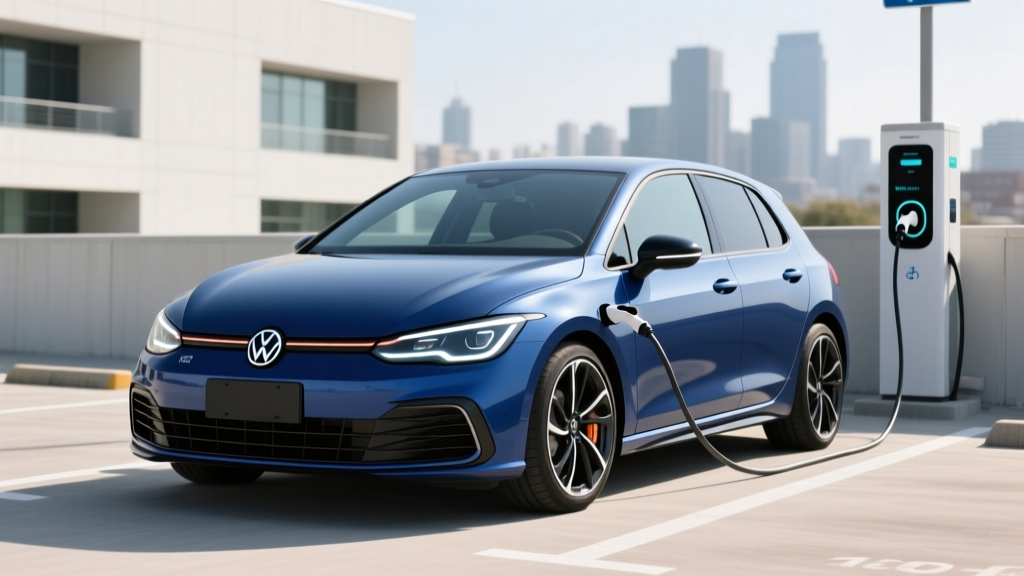
The Volkswagen Golf EV, marketed globally as the ID.3 and evolving into the ID.2all platform for North America, is Volkswagen's bid to bring affordable electric mobility to the compact hatchback segment. If you're researching the VW Golf EV for a potential purchase, here's what you need to know right now: the European-spec ID.3 delivers up to 263 miles of WLTP range (roughly 220–240 miles EPA-equivalent), uses a 58 kWh or 77 kWh NMC battery, supports up to 120 kW DC fast charging (10–80% in approximately 30 minutes), and starts around €35,000 in Europe. A North American variant has not been officially confirmed for the U.S. market as of early 2026, meaning U.S. buyers looking at VW's electric lineup should focus on the ID.4 crossover or wait for official announcements.
What Is the VW Golf EV? Platform, Battery, and Specs
The VW Golf EV nameplate refers to Volkswagen's electric compact hatchback lineage, which began with the e-Golf (produced 2014–2020) and transitioned to the dedicated MEB-platform ID.3 in 2020. The ID.3 was designed from the ground up as a battery-electric vehicle, unlike the e-Golf, which adapted the combustion Golf's architecture.
For 2025–2026, the ID.3 received a significant refresh with updated styling, improved interior materials, and software upgrades to VW's ID.Software 4.0. Volkswagen has also previewed the ID.2all concept, a smaller, more affordable electric hatchback expected to slot below the ID.3 in price and size — effectively becoming the spiritual successor to the electric Golf for global markets.
| Specification | Pro (Mid Battery) | Pro S (Large Battery) |
|---|---|---|
| Battery (usable) | 58 kWh (NMC) | 77 kWh (NMC) |
| WLTP Range | ~263 mi (424 km) | ~342 mi (550 km) |
| Est. EPA-Equiv. Range | ~215–230 mi | ~280–300 mi |
| Motor Power | 201 hp (150 kW) | 201 hp (150 kW) |
| 0–100 km/h (0–62 mph) | 7.3 sec | 7.9 sec |
| Max DC Charge Rate | 120 kW | 135 kW |
| 10–80% DC Fast Charge | ~30 min | ~30 min |
| Level 2 AC Charging | 11 kW (3-phase) | 11 kW (3-phase) |
| Base Price (Europe) | ~€36,000 | ~€42,000 |
Important distinction on range: WLTP (Worldwide Harmonised Light Vehicle Test Procedure) is the European testing standard and consistently produces higher range figures than the U.S. EPA cycle. As a rule of thumb, expect EPA-equivalent range to be roughly 15–20% lower than WLTP. Real-world highway driving at 70+ mph or in cold weather will further reduce range by 20–30%, a factor every EV buyer should internalize.
VW Golf EV vs. Gas Golf: Cost and Efficiency Compared
For buyers cross-shopping an electric hatchback against the traditional gas-powered Golf (still sold in many markets), the economics depend heavily on your driving patterns, electricity rates, and how long you plan to keep the vehicle.
| Category | ID.3 (Electric) | Golf 1.5 TSI (Gas) |
|---|---|---|
| Fuel/Energy Cost | ~$540/yr (home charging at $0.14/kWh, 3.5 mi/kWh) | ~$1,370/yr (32 MPG combined, $3.65/gal) |
| Annual Maintenance | ~$200 (cabin filter, tire rotation, fluid top-off) | ~$600 (oil changes, filters, brakes, spark plugs) |
| Annual Savings (EV) | ~$1,230/year in fuel + maintenance | |
| 5-Year Fuel+Maint. Total | ~$3,700 | ~$9,850 |
| Purchase Price Gap | EV costs ~$8,000–$12,000 more upfront (before incentives) | |
The math is clear: the EV saves significantly on operating costs, but the higher purchase price means a break-even point of roughly 5–7 years depending on your local electricity and fuel prices. If you drive more than 12,000 miles per year or have access to cheap off-peak electricity, the break-even arrives sooner. If you drive less than 8,000 miles annually, the gas Golf may remain cheaper on a total-cost basis over a typical ownership period.
Real-World Ownership: What First-Time EV Buyers Must Know
Owning a VW Golf EV (or any compact EV) involves practical considerations that go well beyond the spec sheet. Here are the factors that most directly affect daily satisfaction:
Home Charging Is Non-Negotiable for Most Owners
The single biggest predictor of EV satisfaction is reliable home charging. With a Level 2 home charger (7–11 kW), the ID.3's 58 kWh battery recharges fully overnight in roughly 6–8 hours. This means you start every morning with a "full tank" — a convenience gas cars can't match.
However, if you live in an apartment without charging access, or rely exclusively on street parking, EV ownership becomes significantly more challenging. Public DC fast charging costs 2–4× more per kWh than home charging (typically $0.30–$0.50/kWh vs. $0.10–$0.18/kWh at home), and repeated use accelerates battery wear slightly. Before buying any EV, confirm you can install a Level 2 charger at home or have reliable workplace charging.
Cold Weather Cuts Range — Plan for It
Lithium-ion batteries lose efficiency in cold temperatures, and cabin heating draws significant energy. In sub-freezing conditions (20–32°F), expect the ID.3 to lose 20–35% of its rated range. A 230-mile EPA-equivalent range drops to roughly 150–180 miles in winter highway driving. The ID.3 includes a heat pump (standard on most trims from 2024 onward), which mitigates this loss somewhat, but the physics of cold-weather EV operation can't be fully engineered away.
If you live in northern climates and regularly drive 100+ miles in winter, the larger 77 kWh battery is a practical necessity, not a luxury.
Charging Speed: The 120 kW Reality
The ID.3's peak DC fast-charge rate of 120–135 kW is adequate but not class-leading. Competitors like the Hyundai Ioniq 5 (peak 240 kW on 800V architecture) charge nearly twice as fast. At a 150+ kW Electrify America or Ionity station, the ID.3 will charge from 10–80% in roughly 30 minutes — acceptable for road-trip stops, but noticeably slower than the 18-minute benchmarks set by 800V vehicles.
Also understand the charging curve: the ID.3 hits peak charge rate only between roughly 10–40% state of charge. Above 60%, the rate tapers significantly, and above 80% it drops to under 30 kW. This is normal for NMC batteries but means the last 20% of a charge takes disproportionately long. On road trips, plan to charge to 80% and go — don't wait for 100%.
Common VW Golf EV Misconceptions — Fact-Checked
| Myth | Fact |
|---|---|
| "The battery will need replacing in 5 years." | VW warranties the ID.3 battery for 8 years / 100,000 miles (160,000 km) with a minimum 70% capacity retention guarantee. Real-world data from MEB-platform vehicles shows degradation of roughly 5–10% over the first 60,000 miles, with the curve flattening thereafter. Full battery replacement is rare and costs €10,000–€15,000 out of warranty. |
| "You can't take an EV on a road trip." | The ID.3's 230+ mile real-world range and 30-minute fast-charge stops make 400–500 mile trips practical with one stop. Navigation includes route planning with charging suggestions. It requires more planning than a gas car, but is routine for experienced EV owners. |
| "EVs are worse for the environment because of battery mining." | Lifecycle analyses by the ICCT and Transport & Environment consistently show that EVs produce 50–70% fewer lifecycle emissions than equivalent gas cars in Europe and the U.S., even accounting for battery manufacturing. The grid is also getting cleaner every year, improving the EV's advantage over time. |
| "The VW Golf EV is available in the U.S." | As of 2026, the ID.3 is not sold in the United States. VW's U.S. electric lineup centers on the ID.4 crossover. The ID.2all concept may eventually reach North America, but no timeline has been confirmed. |
| "Fast charging ruins the battery." | Occasional DC fast charging has minimal impact on battery health. VW's thermal management system actively cools the battery during fast charging. Studies show that vehicles charged primarily via DC fast charging lose roughly 1–3% more capacity over 100,000 miles compared to Level 2-only charging — a marginal difference. |
U.S. Buyers: What Are Your Alternatives?
Since the VW Golf EV / ID.3 isn't available stateside, here's how comparable electric hatchbacks stack up for U.S. buyers in 2026:
| Model | EPA Range | Battery | Max DC Charge | Base MSRP | §30D Credit Eligible? |
|---|---|---|---|---|---|
| Chevrolet Equinox EV | 319 mi | 85 kWh (NMC) | 150 kW | ~$33,600 | Yes (up to $7,500, subject to income/sourcing rules) |
| Hyundai Ioniq 5 | 303 mi | 77.4 kWh (NMC) | 240 kW (800V) | ~$42,600 | Partial (sourcing rules may reduce to $3,750) |
| Nissan Leaf (if still available) | 212 mi | 60 kWh (NMC) | 100 kW (CHAdeMO) | ~$29,000 | Unlikely (Japan-sourced battery) |
| VW ID.4 (closest VW option) | 275 mi | 82 kWh (NMC) | 175 kW | ~$39,700 | Yes (U.S.-built, subject to income/sourcing) |
Federal tax credit note: The IRS §30D clean vehicle credit offers up to $7,500, but eligibility depends on the buyer's modified adjusted gross income (AGI caps: $150K single / $300K joint), the vehicle's MSRP (must be under $55,000 for cars, $80,000 for SUVs/trucks), battery component and critical mineral sourcing requirements, and North American final assembly. Rules evolve annually — always verify current eligibility at irs.gov and fueleconomy.gov before purchasing. The credit can be transferred to the dealer at point of sale as an instant discount, per 2024+ rules.
Decision Framework: Is the VW Golf EV Right for You?
Choose the VW Golf EV (ID.3) if:
- You live in Europe or the UK where the ID.3 is sold and supported
- You want a practical compact hatchback with 220+ miles of real-world range
- You have home or workplace Level 2 charging access
- Your daily commute is under 80 miles round-trip (covering 95%+ of trips without public charging)
- You value VW's build quality, dealer network, and MEB platform maturity
- You plan to own the vehicle 5+ years to recoup the upfront price premium vs. gas
Look at alternatives if:
- You're a U.S. buyer — the ID.3 isn't available; consider the ID.4, Equinox EV, or Ioniq 5
- You lack home charging and your area has sparse public charging infrastructure
- You regularly drive 300+ miles in a single day — the ID.3's 120 kW charging and ~230-mile range require more stops than 800V competitors
- You live in a very cold climate and need maximum winter range — consider a larger-battery EV or a plug-in hybrid like the Toyota Prius Prime (44 mi electric + 500+ mi total range)
- You need towing capability — the ID.3 is not rated for towing in most markets
Frequently Asked Questions
Will VW ever sell the Golf EV / ID.3 in the United States?
Volkswagen has not announced U.S. sales for the ID.3. The company has focused its U.S. electric strategy on the ID.4 crossover (built in Chattanooga, Tennessee) and the upcoming ID.7 sedan. The ID.2all concept, previewed in 2023, could theoretically reach North America as a sub-$30,000 electric hatchback, but no production timeline has been confirmed. U.S. buyers wanting a VW EV should look at the ID.4 or monitor VW's annual product announcements.
How much does it cost to charge the VW Golf EV at home?
Charging the 58 kWh battery from 10% to 100% at home using a U.S. average electricity rate of ~$0.16/kWh costs approximately $8.40. Over a year of 12,000 miles (assuming 3.5 miles per kWh efficiency), annual home charging costs roughly $550–$650 — about one-third the cost of fueling an equivalent gas hatchback.
What is the real-world range of the VW ID.3 in winter?
In temperatures below 32°F (0°C), expect range to drop by 20–35% depending on driving speed, use of cabin heat, and terrain. A 58 kWh ID.3 rated at ~230 miles EPA-equivalent will deliver roughly 150–180 miles in mixed winter highway driving. Preconditioning the battery while plugged in and using seat/steering wheel heaters instead of cabin air heating can recover 10–15 miles of range.
Does the VW Golf EV qualify for any tax incentives?
In Europe, incentives vary by country — Germany's former Umweltbonus ended in 2023, but many European nations still offer purchase subsidies, reduced registration taxes, or company-car tax benefits. In the U.S., since the ID.3 is not sold, there is no applicable federal §30D credit. If VW introduces a U.S.-spec electric hatchback, credit eligibility would depend on final assembly location, battery sourcing, MSRP, and buyer income per IRS §30D rules.
How does the ID.3 compare to the old e-Golf?
The ID.3 is a generational leap over the e-Golf. The e-Golf had a 35.8 kWh battery, 125 miles of EPA range, and 50 kW DC fast charging. The ID.3 offers roughly double the range, 2.4× the fast-charge speed, a dedicated EV platform with more interior space, and over-the-air software updates. If you're upgrading from an e-Golf, the ID.3 will feel like a dramatically more capable vehicle.
What's the battery warranty on the VW ID.3?
Volkswagen provides an 8-year / 100,000-mile (160,000 km) battery warranty for the ID.3, guaranteeing a minimum of 70% state of health (capacity retention) over that period. If the battery degrades below 70% within the warranty window, VW will repair or replace modules to bring it above the threshold. This is consistent with industry standards from Hyundai, Kia, and Tesla.
Sources: Volkswagen AG official specifications (volkswagen-newsroom.com), European WLTP data, U.S. EPA fueleconomy.gov for comparison vehicles, IRS §30D Clean Vehicle Credit guidance. European-spec figures may differ from any future U.S.-spec model. All pricing and specifications reflect 2025–2026 model-year data available at time of publication.