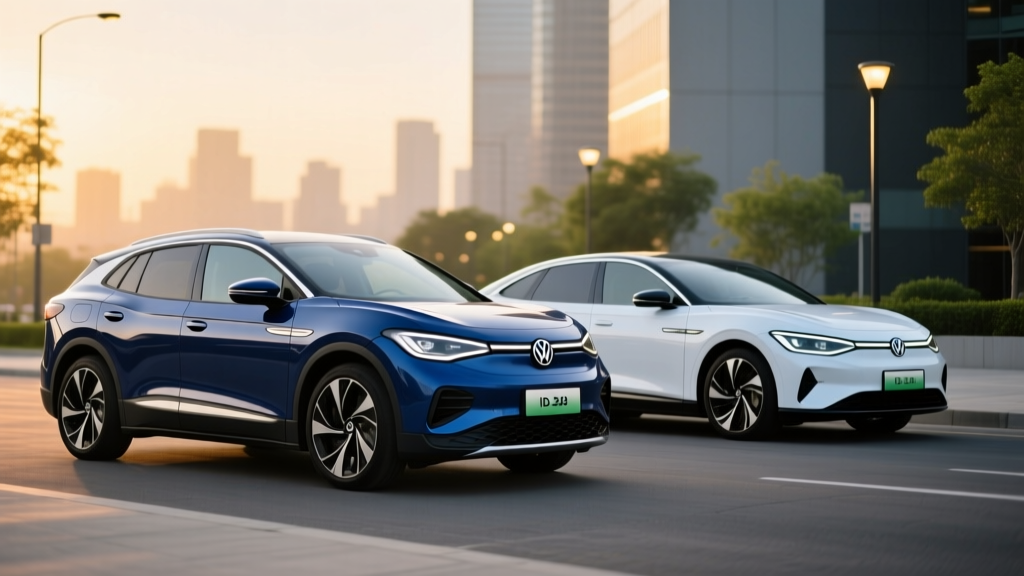
If you're researching VW electric vehicles in 2026, the practical answer comes down to two models currently on sale: the Volkswagen ID.4 compact SUV and the Volkswagen ID.7 midsize sedan. Both sit on VW's MEB platform, use NMC lithium-ion battery packs, and qualify for partial or full federal tax credits depending on your income, trim, and the prevailing IRS §30D battery-sourcing rules. The ID.4 starts near $39,000 and delivers an EPA-estimated 291 miles of range in its best configuration, while the ID.7 sedan pushes past 340 miles EPA at a higher price point. Below, we break down exact specs, real-world range expectations, charging realities, and five-year ownership costs so you can decide whether a VW EV fits your driving life — or whether a hybrid or competitor makes more sense.
Quick Verdict: Which VW EV Is Right for You?
Choose the ID.4 if you need cargo space (30.3 cu ft behind the rear seats), all-wheel drive, and a lower entry price. Choose the ID.7 if you prioritize highway range (340+ miles EPA), a quieter cabin, and sedan efficiency. Look elsewhere if you lack reliable home or workplace charging — VW's public-charging reliability mirrors the broader CCS network, which remains inconsistent in rural corridors.
2026 VW EV Lineup: Specs at a Glance
| Spec | 2026 ID.4 Pro S (RWD) | 2026 ID.4 AWD Pro S | 2026 ID.7 Pro S |
|---|---|---|---|
| Base MSRP | $39,735 | $43,735 | $52,735 |
| EPA Range | 291 mi | 263 mi | 342 mi |
| Battery (usable) | 82 kWh (NMC) | 82 kWh (NMC) | 82 kWh (NMC) |
| Motor Output | 282 hp | 335 hp | 282 hp |
| 0-60 mph | 7.7 sec | 5.4 sec | 6.5 sec |
| Peak DC Fast Charge | 175 kW | 175 kW | 200 kW |
| 10-80% DCFC Time | ~28 min | ~28 min | ~26 min |
| Level 2 (AC) Charge Rate | 11 kW | 11 kW | 11 kW |
| MPGe (combined) | 107 MPGe | 98 MPGe | 115 MPGe |
| Cargo Volume | 30.3 cu ft | 30.3 cu ft | 19.6 cu ft (trunk) |
| Battery Warranty | 8 yr / 100,000 mi | 8 yr / 100,000 mi | 8 yr / 100,000 mi |
Source: fueleconomy.gov and Volkswagen USA. MSRP excludes destination. Specs reflect 2026 model year.
Real-World Range: What the EPA Sticker Doesn't Tell You
ID.4 Pro S (RWD): EPA 291 Miles vs. Reality
Expect ~240-260 miles on a 75°F highway trip at 70-75 mph. In winter conditions (below 30°F), plan for ~190-220 miles before needing to charge. The ID.4's heat pump (standard on Pro S trims) mitigates cold-weather losses compared to older EVs, but battery chemistry still loses efficiency in the cold.
The ID.7 benefits from a more aerodynamic sedan profile (Cd ~0.23 vs the ID.4's ~0.28), which is why its real-world highway range holds closer to the EPA figure — expect roughly 290-310 miles at highway speeds in mild weather, and 240-270 miles in freezing temperatures.
For context, VW's NMC battery chemistry provides strong energy density but is more sensitive to sustained 100% charges and extreme temperatures than LFP (lithium iron phosphate) packs found in some competitors. VW recommends daily charging to 80% for battery longevity, using the vehicle's built-in charge-limit setting. Reserve 100% charges for road-trip departure mornings.
Charging Speed and Infrastructure: The Honest Picture
VW's 175-200 kW peak DC fast-charging rate is competitive but not class-leading. The Hyundai Ioniq 5 and Kia EV6, built on 800-volt architectures, peak at 240+ kW and complete a 10-80% charge in roughly 18 minutes — about 8-10 minutes faster than the ID.4 or ID.7.
Here's what that charge curve actually looks like at a 350 kW Electrify America station:
| Charging Level | Power (kW) | Miles Added per Hour | Typical Use Case |
|---|---|---|---|
| Level 1 (120V household) | ~1.4 kW | ~4 mi/hr | Overnight top-up, emergencies |
| Level 2 (240V home/public) | 11 kW | ~35 mi/hr | Daily home charging, full charge in ~8 hrs |
| DC Fast (peak) | 175-200 kW | ~600+ mi/hr (at peak) | Road trips; 10-80% in 26-28 min |
| DC Fast (tapered, 80-100%) | ~40-50 kW | ~130 mi/hr | Slows dramatically to protect battery |
Key insight: The published peak kW is not sustained. The ID.4 will pull close to 175 kW only between roughly 10-30% State of Charge, then taper progressively. This is normal for 400-volt NMC architectures but means a "28-minute" 10-80% claim assumes ideal battery preconditioning and a functioning high-power stall. In practice, add 3-5 minutes for real-world variance.
VW includes three years of complimentary Electrify America charging (with a kWh cap) on new ID.4 and ID.7 purchases. After that, expect to pay $0.35-$0.55/kWh at public DC fast chargers depending on your region.
Cost Breakdown: VW EV vs. Gas Equivalent Over 5 Years
Let's compare the ID.4 Pro S (RWD) against a comparably equipped Tiguan SEL gas SUV over 5 years and 75,000 miles. This is where the EV economics either work in your favor or don't.
| Cost Category (5 yr / 75k mi) | 2026 ID.4 Pro S | 2026 Tiguan SEL (Gas) |
|---|---|---|
| Purchase Price (MSRP) | $39,735 | $37,500 |
| Federal Tax Credit (§30D) | -$3,750 to -$7,500* | $0 |
| Effective Purchase Price | $32,235 - $35,985 | $37,500 |
| Fuel / Electricity | $3,100 (home L2) – $5,800 (public DCFC) | $7,900 ($3.40/gal, 26 MPG combined) |
| Maintenance | $1,200 | $3,400 |
| Insurance (avg) | $8,200 | $6,800 |
| Estimated Depreciation | $16,500 | $14,200 |
| Total 5-Year Cost | $61,235 - $65,685 | $69,800 |
* Federal tax credit eligibility depends on MSRP caps, buyer income limits, and battery critical-mineral sourcing rules under IRS §30D. Credit may be $3,750 (partial sourcing) or $7,500 (full sourcing) — verify current-year rules before purchase. Point-of-sale transfer is available at participating dealers.
The takeaway: If you charge primarily at home on Level 2 (roughly $0.12-$0.18/kWh national average), the ID.4 saves $4,000-$8,000 over five years compared to the Tiguan. If you rely entirely on public DC fast charging at $0.45+/kWh, those savings shrink to near-zero. Home charging access is the single largest variable in EV ownership economics.
Tax Credit Eligibility: What Actually Applies to VW EVs
§30D Federal Tax Credit Checklist (2026)
- MSRP Cap: SUVs (ID.4) must be under $80,000; sedans (ID.7) under $55,000. Both currently qualify at base trims.
- Buyer Income Cap: Modified AGI must not exceed $150,000 (single), $225,000 (head of household), or $300,000 (joint).
- Battery Sourcing: Credit splits into two halves — $3,750 for critical-mineral sourcing and $3,750 for battery-component manufacturing. VW's supply chain has been transitioning; check the fueleconomy.gov credit tracker for the exact trim's current eligibility before signing.
- Point-of-Sale Transfer: You can transfer the credit to the dealer at purchase, reducing your out-of-pocket cost immediately rather than waiting for tax filing.
- One Credit Per VIN: The vehicle must be new, purchased for personal use, and primarily used in the United States.
Warning: Battery-sourcing rules have tightened annually since 2024. A trim that qualified for the full $7,500 in a prior year may only qualify for $3,750 now. Always verify the specific VIN's eligibility on the IRS or fueleconomy.gov database before committing.
VW EV vs. Gas vs. Hybrid: Which Powertrain Fits Your Life?
| Factor | VW ID.4 (EV) | VW Tiguan (Gas) | Toyota RAV4 Hybrid |
|---|---|---|---|
| Upfront Cost | $$ | $$ | $$ |
| Fuel Cost per Mile | $0.04-$0.08 (home) / $0.12-$0.16 (public) | $0.13 (gas) | $0.09 (gas) |
| Home Charging Needed? | Strongly recommended | No | No |
| Road-Trip Convenience | Plan 25-min stops every ~240 mi | 5-min stops every ~380 mi | 5-min stops every ~470 mi |
| Cold-Weather Penalty | 20-30% range loss | ~5% fuel economy loss | ~5% fuel economy loss |
| Maintenance Burden | Low (no oil, fewer brakes) | High (oil, filters, belts, brakes) | Medium (oil + hybrid system) |
| Best For | Home-charging owners, daily commuters | Rural drivers, heavy tow needs | No-charging-access buyers wanting efficiency |
Common Misconceptions About VW Electric Vehicles
| Myth | Fact |
|---|---|
| "The ID.4 battery will need replacing in a few years." | VW warranties the battery for 8 years/100,000 miles against dropping below 70% capacity. Real-world NMC degradation data from similar MEB-platform vehicles shows roughly 8-12% capacity loss over 100,000 miles with normal charging habits. |
| "VW EVs can't use Tesla Superchargers." | VW has announced NACS adapter compatibility for the ID.4, expanding access to Tesla's Supercharger network. Confirm adapter availability and firmware requirements with your dealer at purchase. |
| "Electricity is just as expensive as gas." | At the U.S. average residential rate of ~$0.16/kWh, the ID.4 costs roughly $0.05/mile to fuel at home — about 60% less per mile than a 26 MPG gas SUV at $3.40/gallon. Public DC fast charging narrows the gap but remains cheaper in most markets. |
| "EVs are worse in the cold." | Range drops 20-30% in sub-freezing temps — a real limitation. But EVs start instantly in cold weather (no cranking), and preconditioning while plugged in warms the battery and cabin without draining range. |
| "The ID.4 is self-driving." | VW's IQ.DRIVE is a Level 2 driver-assist system (per SAE International). It provides lane-centering and adaptive cruise but requires the driver to remain fully engaged at all times. It is not autonomous. |
Home Charging Setup: What VW EV Buyers Need to Budget
Most ID.4 and ID.7 owners will do 80-90% of their charging at home on Level 2. Here's what a typical 240V/48A home charging installation costs:
| Component | Low Estimate | High Estimate |
|---|---|---|
| Level 2 Charger (hardwired, 48A) | $400 | $750 |
| Electrician Labor | $600 | $2,000 |
| Permit & Inspection | $100 | $400 |
| Panel Upgrade (if needed, 200A) | $0 (not needed) | $3,500 |
| Total Installation | $1,100 | $6,650 |
The wide range exists because older homes with 100A electrical panels may require a panel upgrade to support a 48A EV charger alongside existing loads. Have a licensed electrician assess your panel capacity before purchasing equipment. Many utility companies offer rebates of $250-$1,000 for Level 2 installations — check with your local provider.
VW recommends the Electrify America HomeStation or a ChargePoint Home Flex for ID.4 and ID.7 owners. Both support the 11 kW onboard charger rate, delivering a full 0-100% charge in roughly 8 hours overnight.
Decision Framework: Should You Buy a VW Electric Vehicle?
Buy the ID.4 If:
- You have home Level 2 charging (or can install it)
- Your daily commute is under 100 miles round-trip
- You want an EV SUV under $40,000 (before credits)
- You take road trips 2-4 times per year and can plan 25-min charging stops
- You qualify for at least $3,750 in federal tax credits
Buy the ID.7 If:
- You want 340+ miles of EPA range for frequent highway driving
- You prefer sedan efficiency and a quieter ride over SUV cargo space
- You're cross-shopping the Tesla Model 3, Hyundai Ioniq 6, or BMW i4
- Your budget accommodates a $52,000+ sedan
Consider a Hybrid Instead If:
- You have no access to home or workplace charging
- You regularly drive in extreme cold (below 10°F) with no garage
- You tow more than 2,700 lbs (ID.4 max towing)
- You live in a charging desert with sparse DC fast-charger coverage
- Your budget is strictly under $30,000
Frequently Asked Questions
What is the real-world range of the VW ID.4?
The EPA rates the 2026 ID.4 Pro S (RWD) at 291 miles. In real-world highway driving at 70-75 mph in moderate temperatures, expect roughly 240-260 miles. In sub-freezing winter conditions, plan for 190-220 miles. The AWD variant's EPA rating drops to 263 miles, with real-world highway range around 220-240 miles.
Does the VW ID.4 qualify for the $7,500 federal tax credit?
Eligibility varies by trim, model year, and current battery-sourcing rules under IRS §30D. The ID.4 may qualify for the full $7,500, a partial $3,750, or no credit depending on its critical-mineral and battery-component sourcing. Always verify on fueleconomy.gov before purchase. Income caps ($150K single / $300K joint) and the $80,000 SUV MSRP cap also apply.
How long does it take to charge a VW ID.4 at home?
On a Level 2 home charger (240V, 48A, 11 kW), a full 0-100% charge takes approximately 8 hours. Most owners plug in nightly and wake to a full battery. On a standard 120V outlet (Level 1), a full charge takes over 50 hours — only practical for emergency trickle charging or very low daily mileage.
Is the VW ID.4 reliable compared to gas cars?
EVs have fewer moving parts — no engine, transmission, exhaust, or oil system — which reduces mechanical failure points. VW's MEB platform has been in production since 2020, and early-model software issues have been largely addressed through over-the-air updates. The battery carries an 8-year/100,000-mile warranty against degradation below 70% capacity. Long-term reliability data is still building compared to decades of gas-car history.
Can I use Tesla Superchargers with a VW ID.4?
VW has committed to NACS (North American Charging Standard) adapter support for its ID. models. Availability of the adapter and required firmware updates should be confirmed with your dealer. Once enabled, this opens access to Tesla's Supercharger network — the most reliable and widespread DC fast-charging network in the U.S.
How does VW's driver-assist system compare to Tesla Autopilot?
VW's IQ.DRIVE is a Level 2 system offering adaptive cruise control, lane-centering, and semi-automated lane changes on select trims. It is comparable to Tesla's base Autopilot in capability but generally considered less assertive in highway merging scenarios. Neither system is self-driving — both require continuous driver attention and hands on or near the wheel.
Prices, tax credit eligibility, and specifications reflect the 2026 model year and current IRS §30D rules as of publication. Always confirm final pricing, credit eligibility, and vehicle availability with your local Volkswagen dealer and a tax professional. Real-world range and charging times vary based on temperature, driving style, terrain, and charger condition.