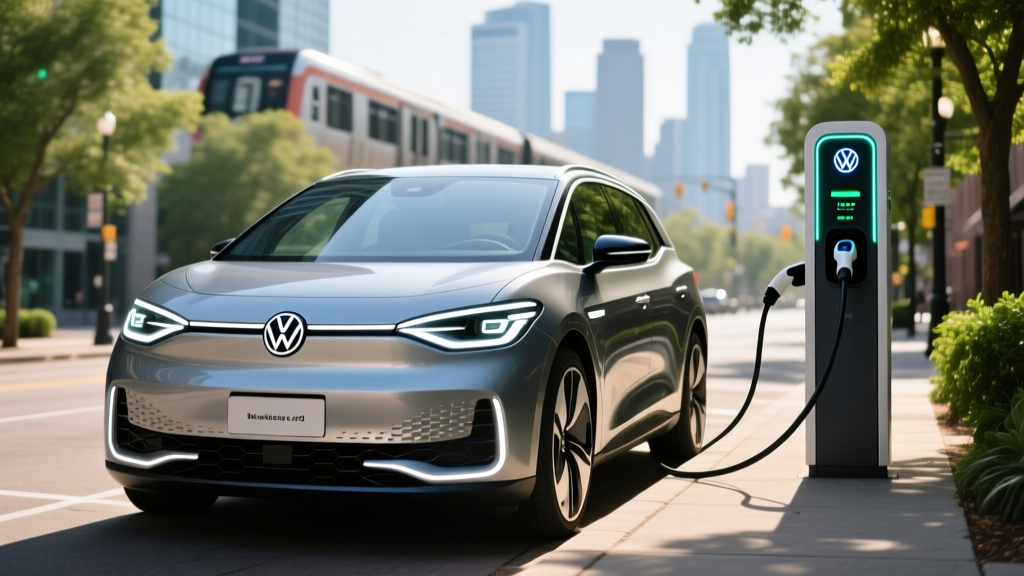
The Volkswagen ID. Buzz arrives in the U.S. as a three-row electric minivan wrapped in retro Microbus styling — but beneath the nostalgia sits a serious family hauler built on VW's MEB platform. For 2025, the VW electric ID. Buzz offers standard all-wheel drive, a 91 kWh battery pack, and seating for up to seven, positioning itself as one of the few three-row EVs under $70,000. But does the real-world range and charging speed justify the premium over gas-powered minivans? We break down every spec that matters.
Range, Efficiency, and Real-World Expectations
The 2025 ID. Buzz carries a usable battery capacity of 86 kWh (from a gross 91 kWh pack) using NMC (nickel manganese cobalt) lithium-ion chemistry. The EPA rates the all-wheel-drive Pro S trim at 234 miles of combined range. Rear-wheel-drive variants — available in select configurations — achieve up to 231 miles EPA combined, per fueleconomy.gov.
EPA sticker: 234 miles (AWD Pro S)
Real-world highway (70 mph, moderate weather): Expect ~200–215 miles. The ID. Buzz's boxy shape creates significant aerodynamic drag at highway speeds, reducing efficiency compared to sleeker crossovers.
Cold weather (below 32°F): Plan for 170–190 miles. The MEB platform uses a resistive PTC heater in U.S. models rather than a heat pump, which draws more energy from the pack in freezing conditions.
City/regenerative driving: Low-speed stop-and-go driving can push efficiency closer to the 234-mile EPA figure, thanks to regenerative braking recapturing energy.
Efficiency lands at approximately 87 MPGe combined (AWD), translating to roughly 38–40 kWh per 100 miles in mixed driving. That's noticeably less efficient than a Tesla Model Y (~122 MPGe) or Hyundai Ioniq 5 (~114 MPGe), but expected for a 5,400-pound minivan with the aerodynamics of a bread loaf.
Charging Speed: DC Fast Charge and Home Level 2
The ID. Buzz supports a maximum DC fast-charge rate of 170 kW via its CCS1 connector (NACS adapter expected for Supercharger access in future model years). At a sufficiently powerful station, VW claims a 10–80% charge in approximately 26 minutes.
| Charging Level | Power / Rate | Time or Miles Added |
|---|---|---|
| Level 1 (120V household) | ~1.4 kW | ~4 miles per hour of charging |
| Level 2 (240V, 40A circuit) | ~9.6 kW | ~27 miles per hour; full charge in ~9.5 hours |
| Level 2 (240V, 48A circuit) | ~11.5 kW | ~32 miles per hour; full charge in ~8 hours |
| DC Fast Charge (peak) | 170 kW | 10–80% in ~26 minutes |
| DC Fast Charge (sustained avg.) | ~110–120 kW | Real-world 10–80% closer to 30–33 min |
Charging curve reality check: The 170 kW peak only holds between roughly 10–30% state of charge. The curve tapers significantly above 50%, dropping below 80 kW past 70% SoC. If you're road-tripping and charging from 20–80%, expect session times closer to 30–33 minutes, not the advertised 26. Always precondition the battery via the vehicle's navigation-routed charging for optimal speeds.
For home charging, the ID. Buzz accepts up to 11 kW on Level 2. Most owners installing a 48-amp hardwired wall connector (requiring a 60-amp breaker) will wake up to a full charge overnight. A standard 40-amp Level 2 setup on a 50-amp circuit still delivers a full charge in under 10 hours — sufficient for daily use.
Performance and Drivetrain
U.S. models launch exclusively with Volkswagen's 4MOTION all-wheel-drive dual-motor setup. The combined system output is 282 horsepower and 339 lb-ft of torque. VW claims a 0–60 mph time of approximately 6.5 seconds.
That's quick enough for confident highway merging and surprisingly lively off the line — electric torque delivery masks the vehicle's 5,400-pound curb weight. However, this is a family cruiser, not a performance vehicle. The steering is light and numb, body roll is noticeable in corners, and the ride quality, while compliant, isn't as refined as a Kia EV9 or Rivian R1S.
The ID. Buzz has a maximum towing capacity of 2,500 pounds (when properly equipped), which is modest for the segment — enough for a small trailer or a pair of dirt bikes, but not a boat or camper.
Interior Space, Cargo, and Technology
The ID. Buzz's three-row cabin offers seating for up to seven passengers (2-3-2 configuration) or six with available second-row captain's chairs. Cargo volume breaks down as follows:
- Behind third row: 18.2 cu ft
- Behind second row (third row folded): 75.5 cu ft
- Behind front seats (all rear rows folded): 131.8 cu ft
Second-row legroom measures a generous 39.6 inches, and third-row legroom is 33.5 inches — genuinely usable for adults on shorter trips. The sliding second row and flat-load floor make the cargo area versatile for family gear, strollers, or camping equipment.
Technology highlights:
- 12.9-inch touchscreen infotainment with wireless Apple CarPlay and Android Auto
- IQ.DRIVE suite: adaptive cruise control, lane centering, automatic emergency braking, blind-spot monitoring
- Head-up display with augmented-reality navigation overlay (available on 1st Edition)
- Over-the-air software updates
- Harman Kardon premium audio (available)
Notable drawbacks: VW's capacitive-touch steering wheel controls are frustrating and lack tactile feedback — a widely criticized carryover from the European ID.4. The infotainment system, while improved for 2025, still exhibits occasional lag. There is no frunk (front trunk), as the MEB platform's electronics occupy that space.
Pricing, Trim Levels, and Federal Tax Credit
| Trim | MSRP | Est. After §30D Credit* |
|---|---|---|
| Pro S (AWD) | $59,995 | $52,495 |
| Pro S Plus (AWD) | $63,495 | $55,995 |
| 1st Edition (AWD) | $69,995 | $62,495 |
*Federal tax credit estimates assume full eligibility. Actual credit amount and availability depend on current IRS §30D rules.
The VW electric ID. Buzz qualifies for the $7,500 federal EV tax credit under IRS §30D, provided the buyer meets all current requirements. Key eligibility criteria include:
- MSRP cap: Vans/minivans must have an MSRP at or below $80,000 — all ID. Buzz trims qualify.
- Buyer income caps: Modified AGI must not exceed $300,000 (joint), $225,000 (head of household), or $150,000 (single).
- Battery sourcing: Critical minerals and battery components must meet phased-in domestic-content thresholds per IRS guidelines. VW has confirmed U.S. assembly (Chattanooga, TN) for the ID. Buzz, but buyers should verify current-year sourcing compliance at the point of sale.
- Point-of-sale transfer: Eligible buyers can transfer the credit to the dealer for an immediate price reduction rather than waiting to claim it on their tax return.
Always confirm eligibility with your tax professional and the dealer before purchase, as sourcing requirements tighten annually.
Warranty Coverage
Volkswagen backs the ID. Buzz with:
- Battery warranty: 8 years / 100,000 miles (guarantees minimum 70% state of health retention)
- Limited vehicle warranty: 4 years / 50,000 miles
- Roadside assistance: 3 years / 36,000 miles
The 70% battery SoH threshold is industry-standard but not generous — Hyundai/Kia offer 10-year/100,000-mile battery coverage. VW's 4-year bumper-to-bumper is competitive with European rivals but shorter than Kia's 5-year/60,000-mile plan.
How It Stacks Up: ID. Buzz vs. the Competition
| Spec | VW ID. Buzz (AWD) | Kia EV9 (AWD) | Chrysler Pacifica Hybrid (PHEV) |
|---|---|---|---|
| EPA Range | 234 mi | 283 mi | 32 mi (EV) + 520 mi (gas) |
| Battery (usable) | 86 kWh | 99.8 kWh | 16 kWh |
| DC Fast Charge | 170 kW | 239 kW | N/A (Level 2 only) |
| 10–80% Time | ~26 min | ~20 min | ~2 hrs (L2) |
| Seating | 6–7 | 6–7 | 7 |
| 0–60 mph | 6.5 sec | 5.0 sec | 7.1 sec |
| Base MSRP | $59,995 | $59,900 | $51,095 |
| Cargo (all folded) | 131.8 cu ft | 81.7 cu ft | 140.5 cu ft |
The ID. Buzz trades range and charging speed for character, interior volume, and a driving experience that feels more premium and planted than the Kia EV9. However, the EV9 charges faster (239 kW peak), goes further (283 miles EPA), and starts at a nearly identical price. The Chrysler Pacifica Hybrid appeals to buyers who can't commit to full electric — its 32-mile EV range covers most school runs, with a gas engine for road trips.
- Class-leading cargo volume among three-row EVs (131.8 cu ft)
- Genuinely usable third row for adults
- Smooth, quiet ride with confident AWD traction
- Iconic retro styling — nothing else looks like it
- U.S.-built (Chattanooga, TN) — supports §30D eligibility
- 234-mile EPA range is the lowest among three-row EVs
- 170 kW DC charging is slower than Kia EV9 and Hyundai Ioniq 5
- No heat pump (U.S. models) — cold-weather range suffers
- Capacitive steering controls are maddening
- No frunk; 2,500-lb towing limit is modest
Who Should Buy the VW ID. Buzz?
Choose the ID. Buzz if: You need a three-row EV with maximum cargo versatility, you mostly drive in urban or suburban settings where 200+ miles is plenty, you value unique styling, and you can charge at home nightly.
Look elsewhere if: You regularly take road trips exceeding 250 miles between chargers, you live in a cold climate where range loss is a dealbreaker, you need fast DC charging for highway travel, or you want a heat pump for winter efficiency.
The ID. Buzz is best suited as a family commuter and weekend activity vehicle — school drop-offs, grocery runs, soccer practice, and day trips. Its range is sufficient for daily life with home charging, but cross-country road trips will require careful planning around DC fast-charger locations and longer stops.
Frequently Asked Questions
What is the real-world range of the VW ID. Buzz?
The EPA rates the AWD ID. Buzz at 234 miles combined. In real-world highway driving at 70 mph, expect approximately 200–215 miles. In freezing weather, that drops to roughly 170–190 miles due to the lack of a heat pump in U.S.-spec models.
How fast does the ID. Buzz charge at home and on the road?
At home on a 48-amp Level 2 charger, the ID. Buzz adds about 32 miles of range per hour, achieving a full charge in roughly 8 hours. On a DC fast charger, it peaks at 170 kW, reaching 10–80% in approximately 26 minutes under ideal conditions — though real-world sessions average 30–33 minutes due to charge-curve tapering above 50% SoC.
Does the VW ID. Buzz qualify for the $7,500 federal EV tax credit?
Yes, the ID. Buzz is eligible for up to $7,500 under IRS §30D, subject to buyer income limits ($150K single / $300K joint), the $80,000 MSRP cap for vans (all trims qualify), and battery critical-mineral/component sourcing requirements. The credit can be transferred to the dealer at point of sale. Verify current-year eligibility at irs.gov and with your tax advisor.
Is the ID. Buzz worth buying over the Kia EV9?
It depends on your priorities. The ID. Buzz offers more cargo space (131.8 vs. 81.7 cu ft), a more distinctive design, and a slightly more premium interior feel. The Kia EV9 delivers longer range (283 vs. 234 miles), faster charging (239 kW vs. 170 kW), a quicker 0–60 time (5.0 vs. 6.5 sec), and a 10-year battery warranty. If road trips and charging speed matter most, the EV9 is the pragmatic choice. If cargo volume and character win out, the ID. Buzz delivers.
What are the biggest drawbacks of the ID. Buzz?
The main limitations are its 234-mile EPA range (lowest among three-row EVs), 170 kW DC charging speed (slower than key rivals), the absence of a heat pump in U.S. models (hurting cold-weather efficiency), frustrating capacitive-touch steering wheel controls, and a modest 2,500-pound towing capacity.
Does the ID. Buzz have self-driving capabilities?
No. The ID. Buzz comes with VW's IQ.DRIVE suite, which is an SAE Level 2 driver-assistance system. It includes adaptive cruise control with lane centering, but the driver must remain fully engaged — hands on or near the wheel, eyes on the road — at all times. It is not autonomous or self-driving.
| Specification | Value |
|---|---|
| EPA Range | 234 miles |
| Battery (gross / usable) | 91 kWh / 86 kWh (NMC) |
| Efficiency | 87 MPGe / ~39 kWh/100 mi |
| Max DC Fast Charge | 170 kW (CCS1) |
| 10–80% DC Charge Time | ~26 minutes (ideal) |
| Level 2 Charge Rate | Up to 11 kW |
| Drivetrain | Dual-motor AWD (4MOTION) |
| Horsepower | 282 hp |
| Torque | 339 lb-ft |
| 0–60 mph | ~6.5 seconds |
| Towing Capacity | 2,500 lbs |
| Seating | 6–7 passengers |
| Cargo (max) | 131.8 cu ft |
| Base MSRP | $59,995 |
| Battery Warranty | 8 years / 100,000 miles (≥70% SoH) |
| Vehicle Warranty | 4 years / 50,000 miles |