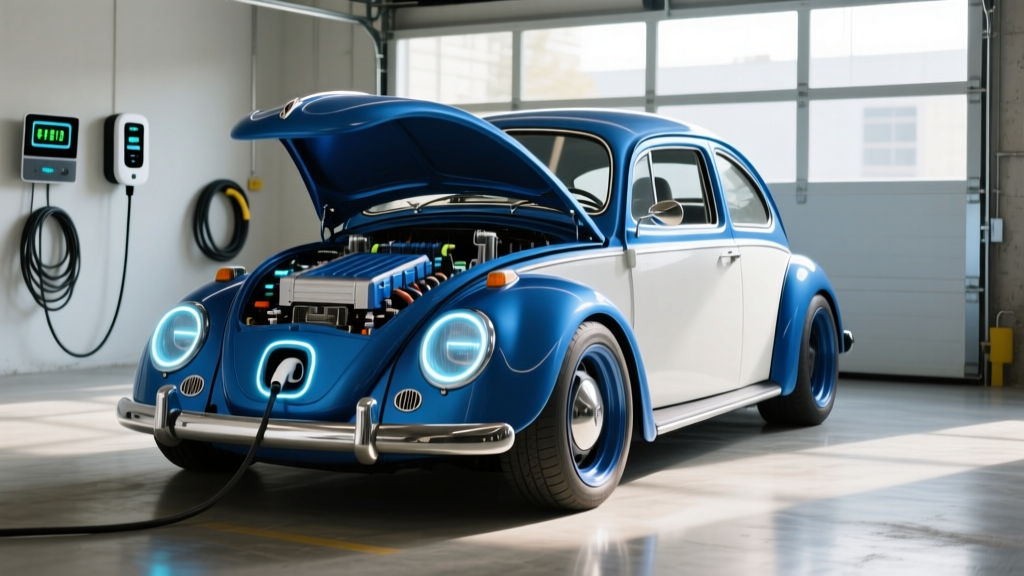
The classic Volkswagen Beetle is one of the most popular platforms for electric vehicle conversion. If you're researching a VW Bug EV conversion, here's the practical reality: a basic DIY conversion using salvaged components starts around $8,000–$12,000 and yields 40–60 miles of range, while a professional build with a modern lithium battery pack and CCS/NACS charging runs $25,000–$50,000+ and can deliver 100–150 miles of range. The converted Bug will not qualify for the federal §30D tax credit (which applies only to new and eligible used EVs from OEMs), and you'll still need a home Level 2 charger to make ownership practical.
For many enthusiasts, the VW Bug EV conversion is a passion project, not a cost-saving commute solution. But with the right expectations around range, charging, and budget, it can be a rewarding way to put a zero-tailpipe-emission classic on the road. This guide breaks down every number you need to decide if a conversion is the right move — or if a modern production EV makes more sense.
What a VW Bug EV Conversion Actually Involves
A conversion replaces the Beetle's air-cooled flat-four gasoline engine and fuel system with an electric motor, motor controller, battery pack, onboard charger, and associated wiring. The original transmission is sometimes retained (using an adapter plate to mate the electric motor to the stock gearbox), though many builders opt for a direct-drive setup with a single-speed reduction gear.
The core components in a typical 2026-era conversion include:
- Electric motor: Usually a salvaged or new AC induction or permanent-magnet motor in the 30–80 kW (40–107 hp) range. Popular choices include NetGain HyPer 9, HPEVS AC-50, or salvaged Nissan Leaf / Tesla drive units.
- Motor controller: Matched to the motor — Kelly Controllers, Sevcon, or OEM inverters from salvaged EVs.
- Battery pack: The biggest cost and weight variable. Options range from salvaged Nissan Leaf modules (24–40 kWh usable) to new LFP (lithium iron phosphate) packs from suppliers like EVE or CATL, or custom NMC (nickel manganese cobalt) builds.
- Onboard charger: A 3.3–6.6 kW charger enables Level 2 home charging. J1772 inlet is standard; some builders add NACS or CCS inlets for DC fast charging compatibility.
- BMS (Battery Management System): Essential for cell balancing, temperature monitoring, and safety cutoffs. Orion BMS, Simpson, or Thunderstruck are common choices.
- DC-DC converter: Steps down the high-voltage pack to 12V for lights, wipers, and accessories.
The Beetle's relatively light curb weight (roughly 1,800–2,100 lbs stock, adding 300–600 lbs for batteries and motor) and simple mechanical layout make it one of the most conversion-friendly vehicles ever built. However, the limited space for battery modules — primarily in the rear engine bay and the front "trunk" — constrains total pack capacity to roughly 15–40 kWh in most builds.
Conversion Cost Breakdown: DIY vs. Professional
The cost of a VW Bug EV conversion varies enormously depending on whether you source used components and do the work yourself or commission a turn-key build from a conversion shop. Here's a realistic 2026 cost breakdown:
| Component | Budget DIY | Mid-Range Build | Professional Turn-Key |
|---|---|---|---|
| Electric motor + controller | $1,500–$3,000 | $3,500–$6,000 | $5,000–$8,000 |
| Battery pack (LFP or NMC) | $2,500–$5,000 | $6,000–$12,000 | $10,000–$20,000 |
| BMS + DC-DC + charger | $800–$1,500 | $1,500–$3,000 | $3,000–$5,000 |
| Wiring, adapters, fabrication | $500–$1,500 | $1,500–$3,000 | $3,000–$6,000 |
| Labor (if professional) | $0 (DIY) | $2,000–$5,000 | $8,000–$15,000 |
| Total Estimated Cost | $5,300–$11,000 | $14,500–$29,000 | $29,000–$54,000 |
Important note on the donor vehicle: These costs assume you already own a Beetle or can source one for $2,000–$8,000. A clean, rust-free 1966–1974 Super Beetle in running condition commands premium prices. A non-running shell can be had for $1,000–$3,000 but may need brake, suspension, and bodywork that adds thousands more.
Range, Efficiency, and Charging: What to Expect
Range is the most common question — and the biggest source of disappointment for first-time converters. The Beetle's limited battery space means you're working with a small pack relative to modern production EVs.
| Metric | Original Gas (1600cc) | EV Conversion (20 kWh) | EV Conversion (35 kWh) |
|---|---|---|---|
| Usable range | ~250 mi (10-gal tank) | 80–100 mi | 140–175 mi |
| Energy cost per mile | ~$0.14 (30 MPG, $4.20/gal) | ~$0.04 (home L2, $0.14/kWh) | ~$0.04 |
| Horsepower | ~60 hp | 50–100 hp | 80–120 hp |
| 0–40 mph | ~8 sec (to 40) | ~4–5 sec (instant torque) | ~3–4 sec |
| Maintenance (annual est.) | $800–$1,500 | $100–$300 | $100–$300 |
| "Fuel" cost / 1,000 mi | $140 | $40 | $40 |
Charging Speeds for a Converted Beetle
Most conversions rely on home charging. Here's what to expect at each level:
- Level 1 (120V, 12A): ~1.4 kW — adds roughly 5–7 miles of range per hour. A full charge of a 20 kWh pack takes ~14–16 hours. Adequate for overnight top-ups if you drive under 40 miles daily.
- Level 2 (240V, 24–32A): 3.3–6.6 kW — adds 15–30 miles of range per hour. A full charge of a 20 kWh pack takes 3–6 hours. This is the practical standard for daily use. A home Level 2 installation (charger + electrician + permit) typically costs $800–$2,500, depending on whether your electrical panel needs an upgrade.
- DC Fast Charging (optional): Adding CCS or NACS DC fast-charge capability requires a compatible charge controller and high-voltage contactors — adding $3,000–$7,000 to the build. Peak rates of 20–40 kW are typical for small conversion packs (higher C-rates risk cell damage). At 30 kW, a 20 kWh pack charges 10–80% in roughly 30 minutes.
A critical concept: kW (kilowatts) measures charging power — how fast energy flows into the car. kWh (kilowatt-hours) measures battery energy capacity — the size of the "tank." A 6.6 kW charger fills a 20 kWh battery in roughly 3 hours. Don't let anyone conflate these units.
Registration, Insurance, and Legal Considerations
Converting a gas car to electric is legal in all 50 states, but the registration process varies. Most states require you to update the vehicle's title and registration to reflect the change in fuel type. Some states require a special inspection to verify the conversion was done safely — particularly the high-voltage wiring and battery enclosure.
Insurance is a real consideration. Most mainstream insurers will cover a converted vehicle under a standard policy, but you may need to provide documentation of the conversion components and their value. Specialty insurers like Hagerty or Grundy, which handle classic and modified cars, are often a better fit. Expect premiums of $600–$1,200/year for a converted Beetle used as a weekend/secondary vehicle, or $1,000–$1,800/year for daily-driver coverage — roughly 15–30% more than insuring a stock Beetle due to the modification value.
Safety inspections: The Beetle was designed in the 1930s–1960s. Even with an EV powertrain, you're driving a car with no crumple zones, no airbags, no ABS, and drum brakes (unless you've upgraded). This matters for daily driving in modern traffic. Many converters upgrade to front disc brakes, add a collapsible steering column, and install 3-point seatbelts — budget $1,000–$3,000 for these safety improvements.
Common Misconceptions About VW Bug EV Conversions
| Myth | Fact |
|---|---|
| "It'll go 200 miles on a charge." | The Beetle's physical space limits battery capacity to ~15–40 kWh. Even at peak efficiency, 150 miles requires a 35+ kWh pack, which is difficult to fit and adds 500+ lbs. Most builds realistically deliver 60–120 miles. |
| "You'll save money vs. buying a new EV." | A professional conversion at $35,000+ plus a $5,000 donor car totals $40,000+. A new 2026 Nissan Leaf starts at ~$29,000 (before incentives) with 149–212 miles of EPA range, full warranty, and modern safety features. The conversion is a passion project, not a budget choice. |
| "Conversions qualify for the $7,500 federal tax credit." | They do not. The IRS §30D credit applies only to qualifying new clean vehicles from certified manufacturers with specific battery-sourcing and MSRP requirements. DIY and aftermarket conversions are not eligible. |
| "Lead-acid batteries are fine for a conversion." | Lead-acid is heavy (~65 lbs per 12V module), has poor cycle life (200–400 cycles), and offers roughly 30–40% less range than lithium at 3× the weight. In 2026, LFP lithium cells cost under $80/kWh at the cell level. There's no practical reason to use lead-acid unless your budget is under $3,000 for batteries. |
| "I can charge at any public DC fast charger." | Only if your conversion includes a DC fast-charge inlet (CCS1 or NACS) and a compatible charge controller. Most budget conversions are Level 2 (J1772) only, which means public AC charging or home charging. Plan your routes accordingly. |
Battery Chemistry: LFP vs. NMC for Your Conversion
Your battery choice is the single most impactful decision in the build. In 2026, two lithium chemistries dominate the conversion market:
| Attribute | LFP (Lithium Iron Phosphate) | NMC (Nickel Manganese Cobalt) |
|---|---|---|
| Energy density | Lower (~140–170 Wh/kg) | Higher (~200–260 Wh/kg) |
| Cycle life | 3,000–5,000+ cycles | 1,000–2,000 cycles |
| Thermal safety | Excellent (very low thermal runaway risk) | Good (requires robust BMS and thermal management) |
| Cold-weather performance | Moderate range loss; slower charging below freezing | Better cold-weather charge acceptance |
| Cost per kWh (cell-level, 2026) | ~$60–$85 | ~$90–$130 |
| Best for | Daily-driver builds prioritizing longevity and safety | Maximum range in limited space (weight-sensitive builds) |
For most VW Bug conversions, LFP is the recommended choice. The Beetle's limited battery space means you'll max out around 20–30 kWh regardless, and LFP's superior cycle life (5,000+ cycles means the pack will likely outlast the car) and safety profile make it ideal for a vehicle with minimal crash protection.
VW Bug EV Conversion vs. Buying a Modern EV: Decision Framework
Choose the VW Bug EV conversion if:
- You already own a Beetle (or have one sourced for under $3,000) and it has sentimental or collector value
- Your daily driving is under 60 miles round-trip with home charging access
- You enjoy hands-on mechanical/electrical projects or have a trusted conversion shop
- You want a unique, head-turning vehicle and accept the trade-offs (no warranty, limited range, vintage safety)
- You understand the total spend ($15K–$50K) will not be recovered in fuel savings alone
Choose a modern production EV if:
- You need 200+ miles of range, DC fast charging for road trips, and modern safety features (AEB, airbags, stability control)
- You want federal tax credit eligibility — the §30D credit can reduce a qualifying new EV by up to $7,500 (subject to income, MSRP, and battery-sourcing rules)
- You need a warranty — modern EVs include 8-year/100,000-mile battery warranties
- Your budget is under $35,000 and you want maximum practicality per dollar
- You don't have the time, skills, or shop access for a multi-month conversion project
5-Year Cost Comparison: Converted Bug vs. Gas Beetle vs. Modern EV
To put the economics in perspective, here's a 5-year / 50,000-mile ownership comparison assuming 10,000 miles driven annually:
| Cost Category | Gas Beetle (Stock) | EV Conversion (20 kWh) | 2026 Nissan Leaf (new) |
|---|---|---|---|
| Purchase / conversion cost | $8,000 | $25,000 | $29,000 (−$7,500 credit = $21,500) |
| Fuel / electricity (50K mi) | $7,000 | $2,000 | $2,100 |
| Maintenance (5 years) | $5,500 | $1,000 | $1,500 |
| Insurance (5 years) | $4,500 | $5,500 | $6,000 |
| 5-Year Total | $25,000 | $33,500 | $31,100 |
The converted Beetle costs more over 5 years than both alternatives when you include the conversion expense. The fuel and maintenance savings are real (~$5,000–$9,500 over 5 years vs. gas), but they don't fully offset the upfront conversion investment. This is a project you do for the experience and the car itself — not as a financial optimization.
Frequently Asked Questions
How long does a VW Bug EV conversion take?
A DIY conversion by an experienced hobbyist typically takes 200–400 hours over 3–6 months. A professional shop will quote 4–12 weeks of calendar time, depending on backlog and build complexity. First-time builders should budget 6–12 months including parts sourcing, troubleshooting, and registration paperwork.
Can I use a Tesla drive unit in a Beetle conversion?
Yes, salvaged Tesla rear drive units (from Model S or Model 3) are popular for high-power conversions. However, they require a compatible inverter, custom half-shafts or adapter plates, significant fabrication, and a CAN-bus interface to make the controller communicate with your custom BMS. This is an advanced build — expect $15,000–$25,000 in components alone and a higher skill requirement.
Do I need to upgrade the Beetle's brakes for an EV conversion?
Strongly recommended. The added weight of batteries (300–600 lbs) and the higher speeds enabled by instant electric torque make the stock drum brakes inadequate for safe daily driving. A front disc brake conversion kit costs $400–$800 and is one of the first upgrades most builders perform. Rear drums are acceptable if the fronts are upgraded to discs.
What's the best battery pack for a Beetle conversion on a budget?
Salvaged Nissan Leaf battery modules (from 2013–2017 models with 24 kWh packs) are the most cost-effective option, often available for $2,500–$4,000 with 70–85% state of health remaining. For a new pack, LFP prismatic cells from EVE or CATL at ~$70/kWh offer the best value-to-longevity ratio. A 20 kWh LFP pack costs roughly $1,400–$1,800 in cells, plus $500–$800 for BMS, busbars, and enclosure.
Will a converted Beetle hold its value?
It depends on the build quality and documentation. A well-executed, professionally converted Beetle with detailed build records can sell for $25,000–$40,000 in the enthusiast market. A poorly documented DIY build with unknown battery health will be difficult to sell above $10,000–$15,000. Keep receipts, log battery cycles, and document every component — this directly impacts resale value.
Can I charge a converted Beetle at public charging stations?
Yes, at any public Level 2 (J1772) station, which includes most destination chargers at hotels, shopping centers, and workplaces. For DC fast charging, your conversion must include a CCS1 or NACS inlet and compatible charge controller — this is an expensive add-on ($3,000–$7,000) that most budget conversions omit. Check fueleconomy.gov and the Alternative Fuels Data Center for charging station maps.
Sources: IRS §30D Clean Vehicle Credit rules via irs.gov; vehicle efficiency and range data via fueleconomy.gov; Alternative Fuels Data Center via afdc.energy.gov. Tax credit eligibility depends on income, MSRP, battery sourcing, and other factors — consult a tax professional. Conversion costs are 2026 estimates and vary by region, component availability, and build complexity.