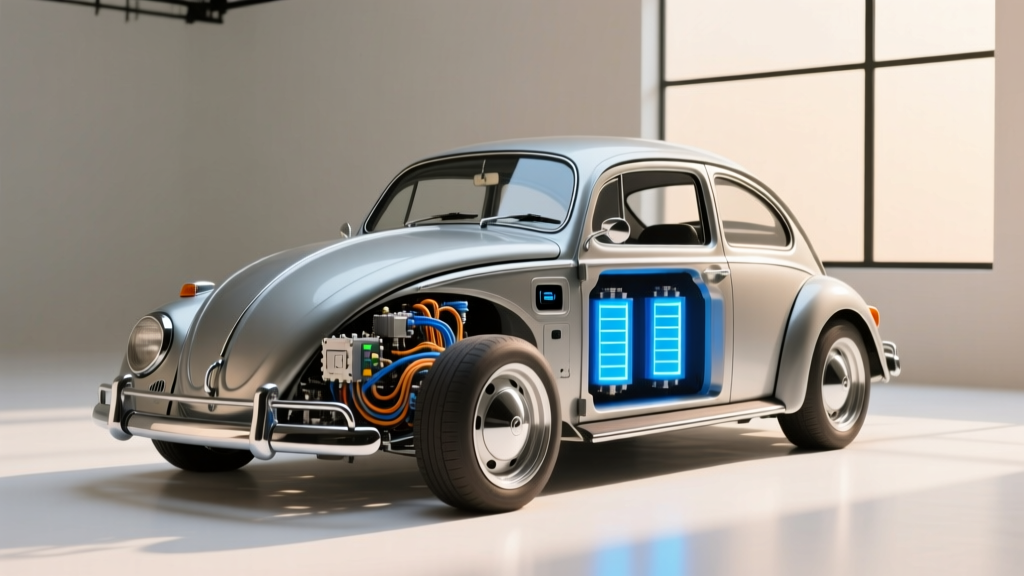
Converting a classic Volkswagen Beetle to electric power is one of the most popular EV-swap projects in the enthusiast world — lightweight chassis, simple mechanics, and timeless styling make the Bug an ideal candidate. But the headline VW Bug electric conversion kit price is only the starting point. Between the kit, donor battery pack, fabrication labor, charging infrastructure, insurance, and ongoing operating costs, the real financial picture is far more nuanced than a single line item.
This guide walks through every cost layer of a VW Beetle EV conversion in 2026 — from the kit itself through five years of ownership — and compares it against buying a production EV outright. Whether you're a weekend wrench or evaluating whether a conversion makes financial sense versus a used Tesla Model 3 or Chevrolet Bolt, the numbers below will give you a clear framework.
What a VW Bug Electric Conversion Kit Actually Includes
Before calculating total cost, it's essential to understand what you're buying. A typical VW Beetle electric conversion kit (from suppliers like EV West, CanEV, or Zero EV) includes:
- Electric motor — typically a NetGain Hyper9 or Tesla small drive unit (80–150 kW / 107–201 HP)
- Motor controller — matched to the motor, handling 96V–144V systems
- Throttle, contactors, and safety disconnects
- DC-DC converter — steps high-voltage pack down to 12V for lights, wipers, accessories
- Charger — onboard Level 2 charger (typically 3.3–6.6 kW)
- Battery boxes, mounts, and adapter plates
- Instrumentation — basic state-of-charge (SoC) gauge, voltage/current readouts
What's NOT in the kit: The battery cells themselves (the single largest cost), high-voltage cabling, thermal management components, custom fabrication beyond adapter plates, and labor. This distinction is critical — the "kit price" is roughly 30–40% of total project cost.
- Basic kit (motor, controller, charger, hardware): $4,500–$7,000
- Mid-tier kit (adds adapter plates, throttle, gauges): $7,000–$10,000
- Complete turnkey kit (excludes battery): $10,000–$14,000
Total Project Cost: Kit + Battery + Labor
The battery pack is where project budgets balloon. Most VW Beetle conversions use either salvaged Tesla Model S modules (NMC chemistry, ~5.3 kWh per module) or new LiFePO4 (LFP) prismatic cells. Here's the realistic total:
| Component | Budget Build | Mid-Range Build | High-End Build |
|---|---|---|---|
| Conversion kit | $5,000 | $8,500 | $13,000 |
| Battery pack (kWh) | $3,500 (20 kWh, salvaged NMC) | $7,000 (35 kWh, new LFP) | $12,000 (50 kWh, new NMC) |
| HV cabling & BMS | $800 | $1,500 | $2,500 |
| Fabrication & labor | $2,000 (DIY) | $6,000 (partial pro) | $15,000 (full shop) |
| Donor car (classic Beetle) | $3,000 | $6,000 | $12,000 |
| Total | $14,300 | $29,000 | $54,500 |
A realistic mid-range Beetle EV conversion with a 35 kWh LFP battery pack (roughly 70–85 miles of real-world range in a ~1,800 lb car), new components, and partial professional help lands around $25,000–$35,000. That's the number to use for ownership comparisons.
5-Year Total Cost of Ownership Breakdown
Here's where the conversion story gets interesting. Operating costs for an EV-converted Beetle are dramatically lower than the original air-cooled flat-four, and competitive with modern production EVs. The comparison below assumes a mid-range conversion ($29,000 total) driven 8,000 miles/year (realistic for a classic/weekend car) versus keeping a stock 1972 VW Beetle running on gasoline.
| Category | EV Conversion | Stock Gas Beetle |
|---|---|---|
| Purchase / build cost | $29,000 | $8,000 (restored) |
| Fuel / energy (5 yrs, 40,000 mi) | $1,920 (home charging at $0.16/kWh, 3.5 mi/kWh) | $5,714 (22 MPG avg, $3.15/gal) |
| Maintenance (5 yrs) | $600 (brake pads, cabin, suspension) | $4,500 (tune-ups, carb rebuilds, oil, exhaust, trans) |
| Insurance (5 yrs) | $7,500 (specialty classic + EV, ~$1,500/yr) | $4,200 (classic car policy, ~$840/yr) |
| Depreciation / resale | -$5,000 (niche market, limited buyer pool) | +$2,000 (appreciating classic) |
| Net 5-Year Cost | $34,020 | $20,414 |
Charging Cost vs. Gas: The Per-Mile Math
The strongest ongoing argument for the EV conversion is fuel cost. A converted Beetle with a 35 kWh pack typically achieves 3.0–4.0 miles per kWh (the car is light at roughly 1,800–2,000 lbs and has modest aerodynamic drag at city speeds). Let's use a conservative 3.5 mi/kWh:
| Vehicle | Efficiency | Energy Cost | $/Mile |
|---|---|---|---|
| EV-converted Beetle (home L2) | 3.5 mi/kWh | $0.16/kWh | $0.046 |
| EV-converted Beetle (DC fast charge) | 3.5 mi/kWh | $0.40/kWh | $0.114 |
| Stock gas Beetle (22 MPG) | 22 MPG | $3.15/gal | $0.143 |
| 2026 Chevy Bolt EV (production) | 3.6 mi/kWh (120 MPGe) | $0.16/kWh | $0.044 |
At home charging rates, the converted Beetle costs $0.046/mile — roughly one-third the cost of gasoline. Over 40,000 miles, that's a fuel savings of approximately $3,800 versus the gas Beetle. However, most conversions lack DC fast charging capability (the onboard chargers are typically 3.3–6.6 kW Level 2 only), so public charging is impractical for road trips. This is a commuter and weekend cruiser, not a road-trip vehicle.
Federal Tax Credit Eligibility for EV Conversions
This is where many conversion enthusiasts are disappointed. Under current IRS §30D rules, the federal clean vehicle credit of up to $7,500 applies to new qualifying vehicles purchased from a manufacturer. A DIY or shop-performed EV conversion of a classic car does not qualify for the §30D new-vehicle credit.
- Credit amount: Up to $7,500 ($3,750 for critical minerals + $3,750 for battery components)
- Vehicle must be NEW — purchased from an authorized dealer/manufacturer
- MSRP caps: $80,000 for SUVs/pickups/vans; $55,000 for sedans/other
- Buyer income caps (AGI): $300,000 joint / $225,000 head of household / $150,000 single
- Battery sourcing: Critical minerals and battery components must meet phased-in domestic/free-trade-partner thresholds
- Point-of-sale transfer: Eligible buyers can transfer the credit to the dealer for an immediate price reduction
- Conversion/retrofit vehicles: NOT ELIGIBLE under §30D
However, there are two potential financial offsets:
- Used EV credit (§25E): If you purchase a previously converted Beetle from a dealer for under $25,000, you may qualify for up to $4,000 (30% of sale price) under the used clean vehicle credit — subject to income caps and dealer reporting requirements.
- State and utility incentives: Some states and utilities offer rebates for EV conversions or for installing Level 2 home charging equipment. These vary widely by jurisdiction.
State, Local, and Utility Incentives
While federal credits don't cover conversions, other incentives may apply depending on your location:
- California: Some air quality management districts have offered rebates for vehicle electrification projects; check your local AQMD
- Colorado: State EV tax credit may apply to certain conversion components — consult a Colorado tax professional
- Utility rebates: Many utilities (PG&E, SCE, ConEd, Xcel Energy) offer $250–$1,000 rebates for Level 2 home charger installation — this applies regardless of what EV you charge
- Home electrical upgrade: Some jurisdictions offer incentives for panel upgrades needed to support Level 2 charging circuits
Incentive availability changes frequently. Always verify with your state energy office, utility provider, and a qualified tax professional before budgeting around rebates.
Maintenance Savings: Where the EV Conversion Pays Off
The original air-cooled VW flat-four is charming but maintenance-intensive by modern standards. The EV conversion eliminates most of that:
| Service Item | Gas Beetle (Annual Cost) | EV Conversion |
|---|---|---|
| Oil changes (2–3x/year) | $120–$180 | Eliminated |
| Carburetor tuning / rebuild | $200–$500 (every 1–2 yrs) | Eliminated |
| Exhaust system | $150–$400 (rust/replace) | Eliminated |
| Transmission / clutch | $300–$800 (periodic) | Eliminated (direct drive or single-speed) |
| Brake pads | $150–$250 | $100 (regen braking extends pad life 2–3x) |
| Ignition (plugs, points, wires) | $80–$150 | Eliminated |
| Coolant / cooling system | $50–$100 | Varies (some conversions are air-cooled motors) |
| Estimated annual total | $900–$1,200+ | $100–$200 |
Regenerative braking is a major hidden saver. The electric motor acts as a generator during deceleration, slowing the car while sending energy back to the battery. This means the friction brakes are used far less — many EV conversion owners report original brake pads lasting 60,000+ miles. For a car that originally required frequent brake and drivetrain attention, this is a substantial quality-of-life improvement.
Insurance Cost Reality for Converted EVs
Insurance is where the EV conversion costs more than the gas original, and more than most production EVs. Here's why:
- Modified vehicle classification: Insurers treat EV conversions as modified/specialty vehicles. Standard carriers like GEICO or Progressive may decline to quote, pushing you to specialty insurers (Hagerty, Grundy, American Modern).
- Agreed-value policies: Most classic car insurance uses agreed-value coverage, where you and the insurer set the car's value. The conversion investment can be factored in, but premiums rise accordingly.
- Limited actuarial data: Insurers have decades of data on stock Beetles and modern production EVs. A one-off conversion has no loss-history database, so insurers price conservatively.
- Higher repair costs: If the motor, controller, or battery pack is damaged, replacement parts are specialized and labor requires EV-certified technicians.
Expect to pay $1,200–$1,800/year for agreed-value coverage on a $30,000 converted Beetle — roughly 50–100% more than insuring a stock gas Beetle on a classic car policy. Some owners reduce premiums by limiting annual mileage (under 5,000 mi) and storing in a garage.
Depreciation and Resale Value: The Niche Market Problem
Production EVs like the Tesla Model 3 and Hyundai Ioniq 5 have established depreciation curves tracked by Kelley Blue Book and Edmunds. An EV-converted Beetle does not. Resale depends entirely on finding a buyer who values both the classic car and the conversion work — a narrow intersection.
Based on enthusiast market data (Bring a Trailer, Hemmings, EV conversion forums):
- Quality conversions by known shops (e.g., Zelectric, EV West) can command $35,000–$60,000+ at auction — sometimes appreciating
- DIY conversions with documentation typically sell for $15,000–$25,000 — representing a loss on the build investment
- Undocumented or poorly executed conversions may sell for less than the original gas car would have
The resale outlook for a mid-range conversion ($29,000 build) is typically $18,000–$24,000 after 5 years, representing a net depreciation of $5,000–$11,000. This is worse than most production EVs (which depreciate 40–55% over 5 years from a higher base but have a much larger buyer pool) and worse than a well-maintained stock Beetle (which has been appreciating as a collector car).
EV Conversion vs. Buying a Production EV: The Decision Framework
- You want a unique, head-turning classic with modern drivability
- You have fabrication skills or a trusted EV-swap shop
- You primarily drive locally (sub-80-mile round trips)
- You value the project experience as much as the end product
- You don't need fast charging, highway range, or ADAS features
- You need reliable daily transportation with 250+ miles of range
- You want DC fast charging for road trips (150–250 kW)
- You want the $7,500 federal tax credit (subject to §30D eligibility)
- You want warranty coverage (8-year/100,000-mile battery warranty is standard)
- You want modern safety (ABS, airbags, crash structure, Level 2 driver-assist)
- You want predictable depreciation and a large resale market
Frequently Asked Questions
How much does it really cost to own a VW Bug EV conversion over 5 years?
For a mid-range conversion ($29,000 build) driven 8,000 miles/year, expect approximately $34,000 in total 5-year cost including build, energy, insurance, maintenance, and depreciation. Operating costs (fuel + maintenance) are roughly $500/year — dramatically cheaper than the gas original — but the upfront build cost and higher insurance offset those savings at low annual mileage.
Do I qualify for the federal EV tax credit on a conversion?
No. The IRS §30D clean vehicle credit applies only to new vehicles purchased from qualified manufacturers. DIY and shop EV conversions do not qualify. The used EV credit (§25E, up to $4,000) may apply if you buy a previously converted vehicle from a dealer for under $25,000, subject to income caps. Consult a tax professional for your specific situation.
How much do I save on fuel and maintenance?
At 8,000 miles/year with home charging at $0.16/kWh, expect to spend roughly $384/year on electricity versus $1,143/year on gasoline for the original engine — a savings of about $759/year. Maintenance drops from $900–$1,200/year to $100–$200/year. Combined annual operating savings: approximately $1,500–$1,800.
Are EV-converted Beetles more expensive to insure?
Yes. Expect $1,200–$1,800/year for specialty agreed-value coverage, compared to $700–$900/year for a stock Beetle on a classic car policy. The increase reflects modified-vehicle risk, limited actuarial data, and higher potential repair costs for EV-specific components.
How well do EV-converted Beetles hold their value?
Resale depends heavily on build quality and documentation. Professional conversions by recognized shops can hold or appreciate in value. DIY conversions typically sell for $15,000–$24,000 after five years — below the total build investment. The buyer pool is narrow: enthusiasts who want both a classic Beetle and an EV. A stock, well-maintained gas Beetle has a broader and more established collector market.
What range can I expect from a VW Bug EV conversion?
With a 35 kWh LFP battery pack in a ~1,800 lb Beetle achieving 3.5 mi/kWh, expect 75–90 miles of real-world range in mixed city/highway driving. Highway speeds above 60 mph and cold weather (below 40°F) will reduce this by 15–25%. A 50 kWh NMC pack can push range to 110–130 miles but adds significant cost and weight.
Can I DC fast charge an EV-converted Beetle?
Most conversions use 3.3–6.6 kW onboard Level 2 chargers and do not support DC fast charging (CHAdeMO or CCS). Adding DC fast charging capability requires a compatible charge controller, additional hardware ($2,000–$4,000), and a battery pack that can accept high C-rates — significantly increasing project complexity and cost. Plan for Level 2 home charging and local driving only.