The Short Answer on VW Bug Electric Car Conversion Kits
A complete VW Bug electric car conversion kit typically costs between $8,000 and $22,000 in parts alone, with professional labor adding another $5,000 to $15,000. Most classic Beetle conversions yield 60 to 120 miles of real-world range from a 20–40 kWh battery pack, with Level 2 charging taking 4 to 8 hours for a full charge. Total project cost usually lands between $15,000 and $40,000+ depending on donor car condition, battery chemistry (LFP vs. NMC), motor selection, and whether you DIY or hire a shop. For most buyers, a conversion is a passion project—not a cost-effective alternative to a modern production EV like the Chevy Equinox EV (315 mi EPA, ~$33,600 MSRP).
What a VW Bug Electric Conversion Actually Involves
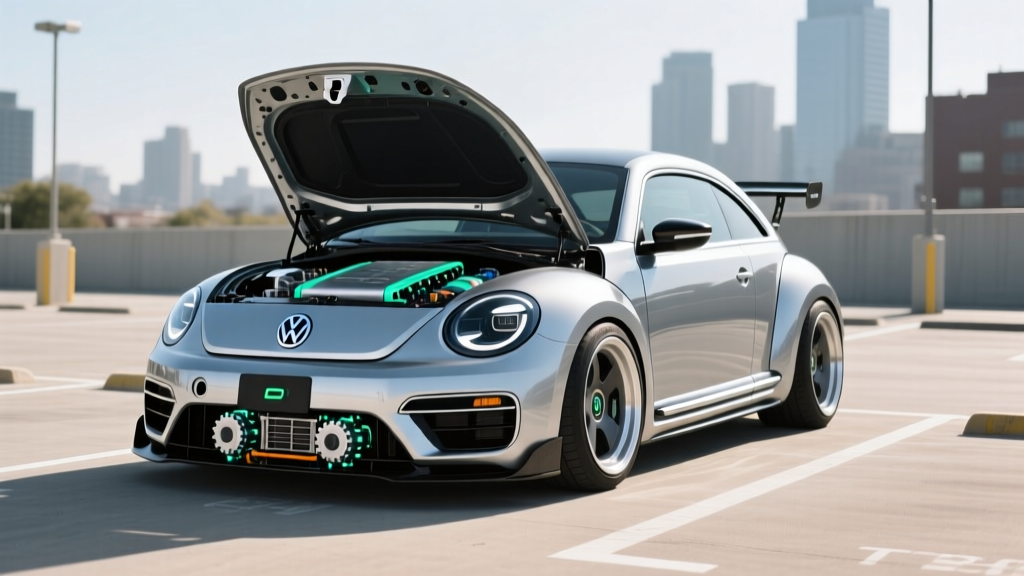
Converting a classic Volkswagen Beetle (typically 1966–1979 models) to electric power means removing the rear-mounted air-cooled flat-four engine, fuel tank, and exhaust system, then installing an electric motor, motor controller, battery pack, onboard charger, and DC-DC converter. The motor usually mounts where the original transaxle sat, driving the rear wheels through either the stock transmission (adapted) or a single-speed reduction gear.
Most kits on the market in 2026 fall into three tiers:
- Budget/DIY kits ($8,000–$12,000): Include a brushed or basic AC motor (15–30 kW / 20–40 HP), a simple motor controller, and wiring. You source batteries, BMS, and charger separately.
- Mid-range kits ($12,000–$18,000): Include an AC induction or permanent-magnet motor (40–60 kW / 55–80 HP), a matched controller, a basic lithium battery module set (20–30 kWh, often salvaged Nissan Leaf or Chevy Bolt modules), and a Level 1/Level 2 onboard charger (3.3–6.6 kW).
- Premium turnkey kits ($18,000–$25,000+): Include a high-output motor (60–85 kW / 80–115 HP), a sophisticated controller with regen tuning, a new LFP or NMC battery pack (30–45 kWh) with thermal management, a 6.6–7.2 kW onboard charger, a CCS or NACS charge port adapter, and a digital instrument cluster.
Popular kit suppliers in the EV conversion space include EV West, Canadian Electric Vehicles, and Zelectric Motors (which specializes in air-cooled VW conversions and typically charges $35,000–$56,000 for a complete turnkey build).
Range, Charging, and Real-World Performance
The Beetle's light weight (roughly 1,800–2,000 lbs curb weight post-conversion) is its biggest efficiency advantage. A well-executed conversion typically achieves 3.0–4.0 miles per kWh, meaning:
| Battery Size | Chemistry | Usable kWh | Est. Real-World Range | Level 2 Charge Time (0–100%) |
|---|---|---|---|---|
| 20 kWh pack | LFP | ~17 kWh | 50–68 miles | ~3–4 hours (6.6 kW charger) |
| 30 kWh pack | NMC (salvaged) | ~25 kWh | 75–100 miles | ~4–6 hours |
| 40 kWh pack | LFP or NMC | ~35 kWh | 105–140 miles | ~5–8 hours |
Real-World Range Caveats
Unlike EPA-rated production EVs, conversions have no standardized range testing. Expect the following reductions from ideal conditions:
- Highway driving (65+ mph): The Beetle's aerodynamics (drag coefficient ~0.48) are brutal. Highway range drops 25–35% compared to city driving.
- Cold weather (below 40°F): Without a battery thermal management system (most budget kits lack one), expect 20–40% range loss in freezing temperatures. LFP chemistry is more cold-sensitive than NMC.
- Hills and headwinds: The 40–60 kW motors in mid-range kits will work hard on grades. Mountain driving can cut range by 15–25%.
Performance: A 60 kW (80 HP) motor in a 2,000-lb Beetle delivers a 0–60 mph time of roughly 9–12 seconds—comparable to the original gas engine but with instant torque off the line. Higher-output 85 kW builds can hit 0–60 in 6–8 seconds, making them genuinely quick.
DC fast charging is rarely available on conversion kits. Most rely on Level 1 (120V, ~1.4 kW) or Level 2 (240V, 3.3–7.2 kW) charging only. A few premium builds add a CCS or NACS inlet with a 20–30 kW DC fast charge capability, but sustained fast charging stresses battery packs not designed with active thermal management.
Cost Breakdown: Conversion vs. Buying a Modern EV
Here's where the math gets real. A VW Bug EV conversion is almost never the cheaper path to electric driving.
| Cost Category | VW Bug EV Conversion | 2026 Chevy Equinox EV LT (315 mi) | 2026 Hyundai Kona Electric (261 mi) |
|---|---|---|---|
| Vehicle / Donor | $5,000–$15,000 (restored Beetle) | $33,600 MSRP | $32,975 MSRP |
| Conversion Kit / Powertrain | $8,000–$25,000 | N/A | N/A |
| Labor (if not DIY) | $5,000–$15,000 | N/A | N/A |
| Battery (included in kit or separate) | $4,000–$12,000 | Included | Included |
| Registration / Inspection | $200–$800 (varies by state) | ~$150–$300 | ~$150–$300 |
| Federal Tax Credit (§30D) | $0 (not eligible) | Up to $7,500 (if eligible) | Up to $7,500 (if eligible) |
| Total Estimated Cost | $18,000–$67,000 | ~$26,100–$33,600 | ~$25,475–$32,975 |
| Warranty (powertrain/battery) | None (kit mfr. varies, 1–2 yr typical) | 8 yr / 100,000 mi battery | 10 yr / 100,000 mi battery |
Key takeaway: A conversion can cost more than double what a warranty-backed, EPA-rated, DC-fast-charging-capable modern EV costs. The Equinox EV delivers 315 miles of EPA range, Level 2 and DC fast charging (up to ~150 kW, 10–80% in ~30 minutes), modern safety systems, and a full factory warranty—all for a net price potentially lower than a mid-tier Beetle conversion after the §30D federal tax credit (subject to MSRP caps, income limits, and battery-sourcing requirements; consult a tax professional).
Important tax credit note: EV conversion kits and converted vehicles do not qualify for the §30D Clean Vehicle Credit. The credit applies only to new vehicles meeting specific battery-component and critical-minerals sourcing requirements, MSRP caps ($55,000 sedans / $80,000 SUVs/trucks), and buyer income limits ($150K single / $300K joint). Details are published on irs.gov and change periodically.
Ongoing Ownership Costs: Charging, Maintenance, and Insurance
| Ongoing Cost | VW Bug EV Conversion | Original VW Bug (Gas) | 2026 Chevy Equinox EV |
|---|---|---|---|
| Fuel / Energy (per mile) | ~$0.04–$0.06 (home L2, $0.14/kWh avg) | ~$0.14–$0.18 (26 MPG, $3.50/gal) | ~$0.04–$0.06 |
| Annual fuel/energy (10,000 mi) | $400–$600 | $1,400–$1,800 | $400–$600 |
| Maintenance (annual) | $200–$600 (brakes, suspension, 12V, electrical troubleshooting) | $800–$1,500 (tune-ups, oil, carb, exhaust) | $100–$300 (cabin filter, wipers, tire rotation) |
| Insurance (annual, est.) | $1,200–$2,500 (specialty classic/custom vehicle) | $600–$1,200 (classic car policies available) | $1,400–$2,000 |
| Battery replacement reserve | $4,000–$12,000 (no warranty, 8–15 yr life) | N/A | Covered under 8–10 yr warranty |
Charging at home is practical for most conversions. A standard 120V outlet (Level 1) adds roughly 4–5 miles per hour of charging—enough to replenish 40–50 miles overnight. A 240V Level 2 home charger (3.3–7.2 kW) fills most conversion battery packs in 4–8 hours. Installation of a Level 2 home circuit (240V/40–50A) typically costs $800–$2,500 depending on panel capacity and run length; hire a licensed electrician and pull a permit.
Public charging is a limitation. Without DC fast charging, long-distance travel in a converted Beetle is a multi-hour-stop affair. A 100-mile trip might require an overnight stay. This is a significant practicality gap versus any modern EV with CCS or NACS fast-charge capability.
Maintenance reality: While you eliminate oil changes, spark plugs, and carburetor rebuilds, EV conversions introduce their own service needs. Expect to troubleshoot loose high-voltage connections, replace contactors, monitor battery cell balance (if your BMS is basic), and service aging 12V auxiliary systems. Finding a mechanic who services conversions is difficult—most owners do their own diagnostics.
Insurance for a converted vehicle often requires a specialty classic-car or custom-vehicle policy (Hagerty, Grundy, or similar). Premiums vary widely based on appraised value and agreed-value coverage. Some insurers may decline to cover a non-OEM high-voltage system.
Common Misconceptions About EV Conversions
| Myth | Fact |
|---|---|
| "Converting my Beetle to electric is cheaper than buying an EV." | Almost never true. Total conversion costs ($18K–$67K) typically exceed the net price of a new, warrantied, 250+ mile production EV after tax credits. |
| "I'll get 200+ miles of range." | The Beetle's small chassis limits battery capacity. Realistic range is 60–140 miles unless you sacrifice all cargo and rear-seat space to batteries—and even then, 150 miles is a stretch. |
| "Any mechanic can service it." | EV conversions use high-voltage DC systems (96V–400V). Most general mechanics won't touch them, and dealerships won't service non-OEM high-voltage vehicles. You are your own service department. |
| "It qualifies for the $7,500 tax credit." | No. The §30D credit applies only to qualifying new production EVs. Conversions are not eligible. |
| "I can fast-charge on road trips." | Most conversion kits lack DC fast-charge hardware. Even premium kits rarely exceed 20–30 kW DC charging—far below the 150–350 kW modern EVs accept. |
| "LFP batteries are always better for conversions." | LFP offers longer cycle life and thermal stability but is heavier and more cold-sensitive than NMC. In a weight-constrained Beetle, NMC's higher energy density may deliver more range per pound—though LFP's safety margin is preferable in a car without crash structures. |
Who Should (and Shouldn't) Convert a VW Bug to Electric
Decision Framework
Convert a Beetle to EV if:
- You already own a Beetle you love and want to drive it daily without carburetor headaches, fuel leaks, and emissions failures.
- You have a realistic budget of $25,000–$50,000+ and view this as a hobby/passion project, not a cost-saving measure.
- Your daily driving is under 50 miles round-trip, mostly city/suburban, in a moderate climate.
- You have access to home Level 2 charging and are comfortable doing your own electrical troubleshooting.
- You value the classic aesthetic and driving feel over modern safety features, infotainment, and range.
Buy a modern production EV instead if:
- Your primary goal is to save money on fuel and maintenance—modern EVs win on total cost of ownership.
- You need 250+ miles of range, DC fast charging, or all-weather reliability.
- You want a factory warranty, modern safety systems (AEB, lane-keeping, airbags), and crash-tested structure.
- You want to take advantage of the §30D federal tax credit (up to $7,500 for qualifying new EVs, subject to income and sourcing rules).
- You don't want to spend weekends diagnosing high-voltage faults or sourcing replacement battery modules.
Consider a plug-in hybrid (PHEV) if:
- You want some electric-only driving (typically 30–45 miles) but also need long-distance capability without charging stops.
- You lack reliable home charging access.
- You want lower upfront cost and the flexibility of gas for road trips.
Safety and Legal Considerations
A 1960s–1970s Beetle has no crumple zones, no airbags, no ABS, and no stability control. Converting it to electric doesn't change this. Adding a 500–800 lb battery pack (often mounted in the front trunk and/or rear engine bay) alters the car's weight distribution and handling. Ensure the battery enclosures are structurally secure and that high-voltage cables are properly shielded, fused, and routed away from crash-prone areas.
Most states require a special inspection for converted vehicles to verify that the high-voltage system is safe and that the vehicle meets basic equipment requirements (lights, brakes, windshield wipers). Check your state DMV's process for registering a converted or "specially constructed" vehicle. Some states (California, Oregon, Washington) have relatively clear pathways; others may require a bonded title or SEMA-style inspection.
The NHTSA does not crash-test conversions, and the IIHS does not rate classic vehicles. You accept full responsibility for occupant safety in a vehicle designed before modern crash standards existed.
Frequently Asked Questions
How long does a VW Bug electric conversion take?
A DIY conversion typically takes 200–400 hours spread over 3–12 months, depending on your skill level, donor car condition, and kit completeness. A professional shop build usually takes 2–4 months once parts are sourced.
Can I use Tesla battery modules in a Beetle conversion?
Yes—salvaged Tesla Model S/X modules are popular in the conversion community for their high energy density. However, they require a compatible BMS, careful cell-balancing, and fire-suppression planning. Many builders now prefer new LFP prismatic cells (e.g., EVE or CATL) for their safety margin and simpler integration.
What's the difference between kW and kWh in a conversion?
kW (kilowatts) measures power—the rate at which energy is delivered or consumed. A 60 kW motor can output 60 kilowatts of mechanical power (about 80 HP). kWh (kilowatt-hours) measures energy capacity—a 30 kWh battery can theoretically deliver 30 kilowatts for one hour, or 15 kilowatts for two hours. Think of kW as "how fast" and kWh as "how much." Confusing the two is the most common mistake in EV conversion planning.
Is a converted Beetle street-legal in all 50 states?
Registration requirements vary by state. Most states allow EV conversions but require a safety inspection and updated registration reflecting the electric powertrain. A few states have more restrictive processes. Check with your local DMV or a state-licensed inspection station before starting a build.
How does a converted Beetle compare to a Zelectric or eClassics build?
Companies like Zelectric Motors and Porsche-affiliated eClassics (e.g., the e-Buggy concept) produce professionally engineered, fully restored electric Beetles and related VWs. These builds typically cost $35,000 to $75,000+ and include new suspension, upgraded brakes, modern interiors, and thoroughly tested battery packs. They are essentially custom-built vehicles—not budget projects. A DIY kit conversion can be done for less but won't match their engineering depth, finish quality, or reliability.
What happens if the battery pack fails after a few years?
Unlike production EVs with 8–10 year battery warranties covering degradation below 70% capacity, conversion battery packs are warrantied (if at all) by the kit supplier for 1–2 years. Replacement costs range from $4,000–$12,000 depending on pack size and chemistry. Budget for a battery reserve fund if you plan to keep the car long-term. Proper care—avoiding frequent 100% charges, keeping the pack above 20% SoC, and storing in moderate temperatures—can extend LFP pack life to 15+ years and NMC to 10–12 years.
Bottom Line: Passion Project or Practical EV?
A VW Bug electric car conversion kit is a legitimate way to put a beloved classic on the road as a daily-drivable, zero-tailpipe-emission vehicle. The driving experience—instant torque, near-silent operation, and the charm of a 1970s Beetle—is genuinely unique. But from a purely financial and practical standpoint, a conversion cannot compete with a modern production EV. You'll spend more money, get a fraction of the range, have no factory warranty, no fast charging, and no modern safety features.
If the goal is emotional—saving a family Beetle, creating a one-of-a-kind weekend driver, or learning EV powertrain engineering hands-on—a conversion is a deeply rewarding project. If the goal is practical—reliable, affordable, long-range electric transportation—buy a 2026 Equinox EV, Kona Electric, or Tesla Model 3 and enjoy 250+ miles of range, DC fast charging, a full warranty, and potential tax credits. Both paths lead to electric driving; they just serve very different needs.