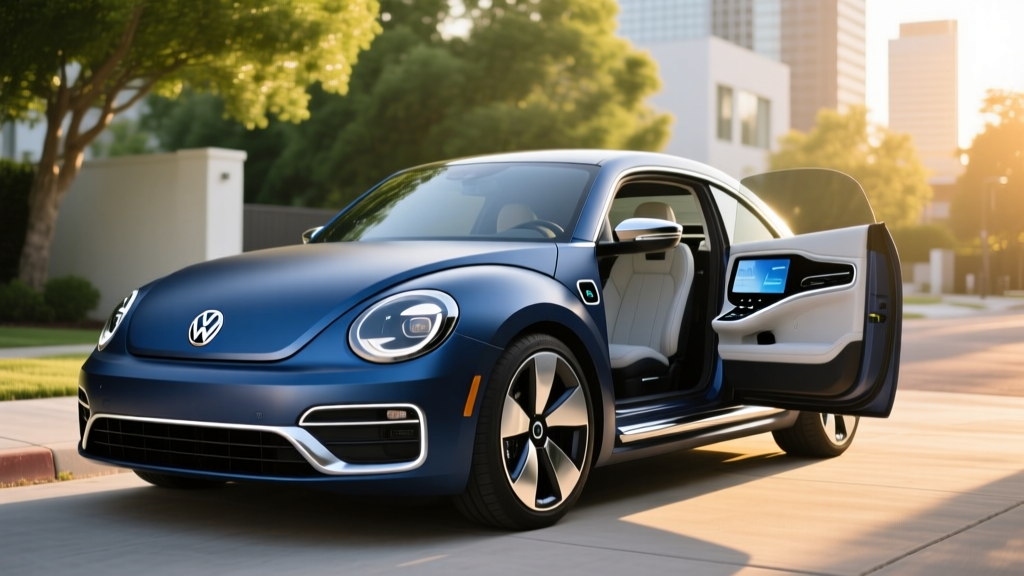
Converting a classic Volkswagen Beetle to electric power is one of the most popular EV-swap projects in the enthusiast world — and for good reason. The Beetle's lightweight chassis (roughly 1,800–2,200 lbs depending on year), simple mechanicals, and massive aftermarket support make it an ideal candidate. But before you pull the flat-four and start wiring battery modules, you need clear numbers on what this actually costs, what range you'll get, and whether the math works versus simply buying a modern EV.
The Short Answer
A professional VW Beetle electric conversion in 2026 typically costs between $20,000 and $45,000 on top of the donor car's price, yielding 60 to 150 miles of real-world range depending on battery pack size (typically 20–50 kWh). DIY builds using salvaged Nissan Leaf or Tesla modules can come in closer to $12,000–$18,000 in parts, but require significant electrical and fabrication skill. Charging is almost exclusively Level 1 or Level 2 (AC) — most conversions lack DC fast charging. For daily drivers needing reliable range and fast charging, a new or used production EV is usually the smarter financial choice. For enthusiasts who want a zero-emissions classic, a conversion is deeply rewarding.
What a VW Beetle Electric Conversion Actually Involves
An electric conversion (sometimes called an EV swap or e-conversion) replaces the Beetle's internal combustion engine, fuel tank, and exhaust system with an electric motor, motor controller, battery pack, and onboard charger. The general component list looks like this:
- Electric motor: Typically a DC series-wound motor (e.g., NetGain Hyper9) or an AC induction/permanent-magnet motor (e.g., from a salvaged Nissan Leaf, Tesla small drive unit, or HPEVS AC-50). Output ranges from 30 kW to 100+ kW depending on budget.
- Motor controller: Matches the motor — Curtis, Sevcon, or Tesla-derived units are common. This is the brain that modulates power delivery.
- Battery pack: The single biggest cost and weight variable. Builders use salvaged Nissan Leaf modules (LMO chemistry), Tesla Model S/X modules (NMC), Chevrolet Volt modules, or new LFP prismatic cells from suppliers like EVE or CATL. Usable capacity typically lands between 20 kWh and 50 kWh in a Beetle, constrained by space and weight.
- Battery Management System (BMS): Essential for safe operation — monitors cell voltage, temperature, and balancing. Orion BMS, SimpBMS, or Tesla-derived BMS units are typical.
- Onboard charger: Usually 1.5 kW to 6.6 kW AC. Elcon, TC charger, or salvaged Leaf/Volt chargers are common. DC fast charging is rare in conversions due to cost, complexity, and CCS/NACS protocol integration challenges.
- DC-DC converter: Steps down high-voltage pack to 12V for lights, wipers, and accessories.
- Throttle interface, adapter plate, and drivetrain coupling: The motor must mate to the Beetle's transaxle (or a single-speed reduction gearbox in more advanced builds).
Companies like EV West, Electric Classic Cars (UK), and Zelectric Motors (California) have built turnkey Beetle conversions, while the open-source EV community (documented on forums like DIY Electric Car and the EV Conversion subreddit) provides extensive build logs for those going the DIY route.
Real-World Range: What to Actually Expect
Range is where expectations often collide with physics. A classic Beetle is not aerodynamic (drag coefficient around 0.48), and conversion weight typically adds 400–800 lbs over the original curb weight. Here's what different pack sizes deliver in real-world mixed driving at 55–70 mph:
| Battery Capacity (Usable kWh) | Typical Chemistry | Est. Real-World Range (mi) | Efficiency (Wh/mi) | Pack Weight (lbs, approx.) |
|---|---|---|---|---|
| 20 kWh | Salvaged Leaf (LMO) | 55–75 | 280–350 | 350–450 |
| 30 kWh | NMC modules | 85–110 | 280–340 | 500–600 |
| 40 kWh | Tesla/NMC or new LFP | 110–145 | 280–330 | 600–750 |
| 50 kWh | New LFP prismatic | 130–170 | 290–340 | 700–900 |
Cold-weather caveat: If you're running LFP chemistry without active thermal management (common in conversions), expect 20–35% range loss in freezing temperatures. NMC modules from salvaged packs often include passive thermal mass that helps slightly, but most conversions lack the liquid heating/cooling loops found in production EVs like the Tesla Model 3 or Hyundai Ioniq 5. Highway driving at 75 mph will also reduce range by roughly 15–25% versus the EPA-style city-heavy estimates some builders quote.
Cost Breakdown: Conversion vs. Buying a Production EV
This is the decision point for most buyers. Let's compare a professional Beetle conversion against a used production EV and a new budget EV.
| Cost Category | VW Beetle Conversion (Professional) | Used Nissan Leaf (2019–2022, ~$14K–$20K) | New 2026 Chevrolet Equinox EV (base ~$33,000) |
|---|---|---|---|
| Vehicle / Donor Car | $8,000–$18,000 (clean title Beetle) | $14,000–$20,000 | $33,000 MSRP |
| Conversion / Purchase Cost | $20,000–$45,000 (parts + labor) | — | — |
| Total All-In | $28,000–$63,000 | $14,000–$20,000 | ~$25,500–$33,000 (after potential §30D credit if eligible) |
| Range (Real-World) | 60–150 mi | 100–140 mi (used, with degradation) | ~290–319 mi (EPA) |
| DC Fast Charging | Rarely (adds $3K–$6K if included) | Yes (CHAdeMO, 50–100 kW) | Yes (CCS/NACS, up to ~150 kW) |
| Warranty | None / Shop-specific limited | Remaining factory or none | 8 yr / 100K mi battery & powertrain |
| Insurance (Annual Est.) | $1,800–$3,200 (classic/specialty) | $1,200–$1,800 | $1,400–$2,000 |
| Maintenance (Annual Est.) | $500–$1,500 (specialty shop, parts sourcing) | $300–$700 | $200–$500 |
Charging cost comparison: At the U.S. average residential electricity rate of roughly $0.17/kWh (as of early 2026, per EIA data), fully recharging a 35 kWh Beetle conversion pack costs about $5.95. That's equivalent to roughly 100 miles of driving, or about $0.06 per mile. A gas Beetle getting 25 MPG at $3.30/gallon costs $0.13 per mile — so the conversion saves roughly $0.07/mile on energy. Over 8,000 miles/year (typical classic-car usage), that's about $560/year in fuel savings. The payback period on a $35,000 conversion, purely on fuel savings, is measured in decades — this is a passion project, not a cost-saving strategy.
Charging a Converted Beetle: What You Need at Home
Nearly all Beetle conversions rely on AC charging (Level 1 or Level 2). Here's what that means practically:
| Charging Level | Power (kW) | Miles of Range Added per Hour | 0–100% Time (approx.) | Infrastructure Needed |
|---|---|---|---|---|
| Level 1 (120V outlet) | 1.2–1.5 kW | 3–5 mi/hr | 24–30 hours | Standard household outlet |
| Level 2 (240V, 20A circuit) | 3.3 kW | 9–12 mi/hr | 10–12 hours | 240V outlet (NEMA 14-50 or hardwired EVSE) |
| Level 2 (240V, 32A+) | 6.6 kW | 18–24 mi/hr | 5–6 hours | Upgraded EVSE + 40A+ circuit |
Home installation cost: If you don't already have a 240V outlet near your parking spot, expect to pay $500–$2,500 for a licensed electrician to install a NEMA 14-50 outlet or hardwired Level 2 EVSE, depending on panel capacity and conduit run length. Older homes (common among classic-car owners) may need a panel upgrade from 100A to 200A service, adding $1,500–$4,000. Always get a load calculation from a licensed electrician before committing to a circuit.
Public charging limitation: Most conversions use a J1772 inlet for AC charging, which is compatible with the vast majority of public Level 2 stations (ChargePoint, Blink, Tesla Destination with adapter). However, without DC fast-charge capability, road trips require planning around multi-hour Level 2 stops. This is fine for a weekend cruiser, but a dealbreaker for a daily-commute vehicle if your round trip exceeds your pack's range.
Tax Credits, Registration, and Legal Considerations
A common misconception is that converting a classic car to EV qualifies for the federal §30D tax credit. It does not. The IRS §30D credit applies only to the purchase of new qualified plug-in electric vehicles from a manufacturer, meeting specific MSRP caps, buyer income limits, and battery-component/critical-mineral sourcing requirements. A conversion of an existing vehicle does not meet these criteria. Some states offer separate incentives for EV conversions — California's CC4A program and certain local air-district grants have historically included conversion provisions, but these are limited, change frequently, and vary by jurisdiction. Check your state's energy office or DMV for current programs.
Registration and inspection: Most U.S. states allow EV conversions to be registered, but the process varies widely. Some states (like California and Oregon) have relatively straightforward procedures for registering a converted vehicle, often requiring a brake-and-lamp inspection and a verification that the vehicle no longer has an ICE. Other states may require a rebuilt-title process or a special-construction vehicle inspection. Budget $200–$1,500 and several weeks for titling and inspection, and check your state DMV's requirements before starting the build.
Insurance: Specialty insurers like Hagerty, Grundy, and American Modern offer agreed-value policies for classic EV conversions, typically at $1,800–$3,200/year depending on the agreed value, your driving record, and annual mileage limits (often capped at 2,500–5,000 miles/year for classic policies). Documenting the conversion with receipts, photos, and a professional build sheet helps establish the agreed value.
Myths vs. Facts About Beetle EV Conversions
| Myth | Fact |
|---|---|
| "An EV conversion is cheaper than buying a used EV." | A professional conversion totals $28K–$63K all-in. A used 2019–2022 Nissan Leaf runs $14K–$20K with DC fast charging, warranty remnants, and no fabrication risk. The conversion only makes financial sense if you value the classic car itself. |
| "I'll get 200+ miles of range." | Not in a Beetle without an impractically large, heavy, and expensive pack. The car's weight budget and available space (front trunk, rear engine bay, and possibly a belly pan) realistically cap usable capacity at ~40–50 kWh, yielding 110–170 miles real-world. |
| "It'll charge at Tesla Superchargers." | No. Conversions almost universally lack DC fast-charge hardware and the communication protocol (CCS or NACS handshake) required by Superchargers or Electrify America stations. You're limited to Level 2 AC charging unless you invest $3K–$6K+ in a DC fast-charge add-on — and even then, NACS/CCS protocol integration is complex. |
| "It's maintenance-free." | While there's no oil change or timing belt, EV conversions require battery cell monitoring, contactor inspection, coolant loop maintenance (if liquid-cooled), brake service (regen reduces wear but doesn't eliminate it), and occasional controller firmware updates. Budget $500–$1,500/year. |
| "Any mechanic can service it." | Most general mechanics won't touch a custom high-voltage system. You'll rely on the conversion shop, specialized EV mechanics, or your own diagnostic skills. This is a real ownership constraint if you don't live near a shop that did the build. |
Decision Framework: Should You Convert or Buy?
Choose a VW Beetle EV Conversion If:
- You already own or deeply want a classic Beetle and the EV swap is about preserving the car while eliminating tailpipe emissions and fuel-system headaches.
- Your driving is primarily local (under 60 miles round-trip) and you have reliable home Level 2 charging.
- You enjoy the build process — or have a trusted conversion shop and a budget above $35,000 for a professional result.
- You understand this is a hobby/enthusiast decision, not a cost-optimization play. The financial payback versus buying a used EV does not exist on paper.
- You want a unique, head-turning vehicle that no production EV can replicate.
Choose a Production EV Instead If:
- You need reliable daily transportation with 200+ miles of range and DC fast charging for road trips.
- You want a warranty, standardized service network, and over-the-air updates.
- Your budget is under $30,000 total — a used Chevy Bolt EV ($12K–$18K), Nissan Leaf ($14K–$20K), or even a used Tesla Model 3 ($18K–$25K) delivers far more range, charging speed, and reliability per dollar.
- You don't have access to a specialist conversion shop within driving distance for inevitable service needs.
- You want eligibility for the federal §30D tax credit (up to $7,500 on qualifying new EVs, subject to IRS income, MSRP, and sourcing rules) or the used-EV credit (up to $4,000 on qualifying pre-owned EVs under $25,000).
Frequently Asked Questions
How long does a VW Beetle electric conversion take?
A professional shop typically quotes 3–6 months from start to delivery, depending on parts sourcing, fabrication complexity, and shop backlog. A skilled DIY builder working weekends can expect 6–12 months. Delays are common — custom adapter plates, BMS programming, and battery module sourcing often add weeks.
What happens to the Beetle's original transmission?
Most conversions retain the stock 4-speed manual transaxle, locked in 2nd or 3rd gear (or using a custom single-speed adapter). The electric motor's wide torque band (peak torque from 0 RPM in most setups) eliminates the need for gear changes in normal driving. Some advanced builds swap in a single-speed reduction gearbox from a salvaged EV for improved efficiency.
Can I use Tesla battery modules in a Beetle conversion?
Yes — Tesla Model S/X large-drive-unit modules (NMC, ~5.2 kWh each) are popular in conversions. A 5-module configuration yields ~26 kWh usable; a 6-module setup yields ~31 kWh. However, Tesla BMS integration requires specific knowledge (the community relies on open-source solutions like the Tesla BMS CAN bus adapters documented on GitHub and EV forums), and the modules are physically large, requiring custom mounting and cooling considerations.
Is a converted Beetle safe in a crash?
This is a legitimate concern. A 1960s–1970s Beetle has no crumple zones, no airbags, and no modern structural reinforcements. The battery pack adds mass (shifting weight distribution and increasing braking distances) and introduces high-voltage risk in a collision. Proper builds include a steel battery enclosure, an inertia cutoff switch (to disconnect the pack in a crash), and clearly marked high-voltage cabling. But the car itself remains a vintage vehicle by safety standards. Drive accordingly.
What's the resale value of a converted Beetle?
It varies enormously based on build quality, documentation, and buyer taste. Well-executed conversions by known shops (Zelectric, EV West) have sold in the $40,000–$80,000 range at auction (Bring a Trailer, Hemmings). Poorly documented DIY builds can actually reduce the car's value versus a clean original. If resale matters, invest in meticulous documentation, professional wiring, and a reputable shop.
How does conversion range compare to a modern EV like the Chevy Equinox EV or Tesla Model 3?
There's no real comparison on range or charging speed. A 2026 Chevy Equinox EV offers up to 319 miles EPA range and ~150 kW DC fast charging (10–80% in roughly 30 minutes). A Tesla Model 3 Long Range delivers 342 miles EPA and 250 kW peak DC charging. A Beetle conversion at 100–150 miles with overnight-only AC charging occupies a completely different use case — think of it as an electrified classic for local enjoyment, not a primary vehicle replacement.