Quick Verdict: The Compact Luxury EV That Punches Above Its Weight
The 2026 Volvo XC40 Recharge occupies a rare sweet spot in the EV market: it's a compact luxury crossover with legitimate road-trip range, brisk dual-motor performance, and a starting price that undercuts German rivals by thousands. After spending time with Volvo's latest 82 kWh battery pack update, we can confirm this is no longer the range-limited city runabout it once was. With an EPA-estimated 293 miles on a full charge and 200 kW DC fast-charging capability, the XC40 Recharge now competes directly with the Tesla Model Y, BMW iX1, and Hyundai Ioniq 5 in the mainstream-to-luxury crossover segment.
But the real question for buyers in 2026 is whether Volvo's Scandinavian-minimalist approach to EV ownership — Google built-in infotainment, one-pedal driving, and Pilot Assist Level 2 driver support — holds up against the increasingly capable competition. Here's our data-driven breakdown.
Range, Efficiency, and the Real-World Reality Check
The 2026 XC40 Recharge comes in two configurations that dramatically affect range. The single-motor Extended Range (rear-wheel drive) uses the larger 82 kWh battery and achieves an EPA-estimated 293 miles. The Twin Motor AWD variant, also on the 82 kWh pack, is rated at 261 miles EPA. Both represent significant improvements over the pre-2025 78 kWh battery, which topped out at 223 miles in dual-motor form.
- Single Motor Extended Range (RWD): EPA 293 mi — expect ~245-265 mi on sustained highway driving at 70+ mph; ~200-220 mi in sub-freezing winter conditions
- Twin Motor AWD: EPA 261 mi — expect ~215-235 mi highway; ~175-195 mi in cold weather
The XC40 Recharge's boxy SUV shape creates more aerodynamic drag than sleeker competitors like the Tesla Model Y, which is why real-world highway efficiency drops more noticeably above 65 mph. In mixed city/highway driving at moderate temperatures, hitting 85-90% of the EPA sticker is realistic.
Efficiency ratings tell the full story: the Twin Motor AWD returns 87 MPGe combined (39 kWh/100 mi), while the single-motor RWD achieves 95 MPGe combined (35 kWh/100 mi), per fueleconomy.gov. For context, the Tesla Model Y Long Range AWD achieves 111 MPGe — Volvo's efficiency penalty comes from both weight (4,868 lbs for the Twin Motor) and that upright, SUV-profile drag.
Battery Chemistry, Capacity, and Long-Term Health
Volvo equips the 2026 XC40 Recharge with an 82 kWh usable lithium-ion battery pack using NMC (nickel-manganese-cobalt) chemistry across all trims. Unlike Tesla's Standard Range models, which use LFP (lithium iron phosphate) chemistry for lower cost and longer cycle life at the expense of energy density, Volvo has stuck with NMC to maximize range in the compact platform.
The NMC trade-off: you get higher energy density (more range in a smaller physical pack) but slightly faster long-term degradation compared to LFP. In practice, modern NMC packs from suppliers like CATL and LG Energy Solution are proving durable — most owners report 5-8% degradation over the first 100,000 miles based on fleet data from similar platforms.
Volvo provides an 8-year/100,000-mile battery warranty covering defects and capacity loss below 70% of original capacity. This matches the industry standard set by federal emissions warranty requirements and aligns with competitors like BMW, Audi, and Hyundai.
Charging Speed: DC Fast Charging and Home Level 2
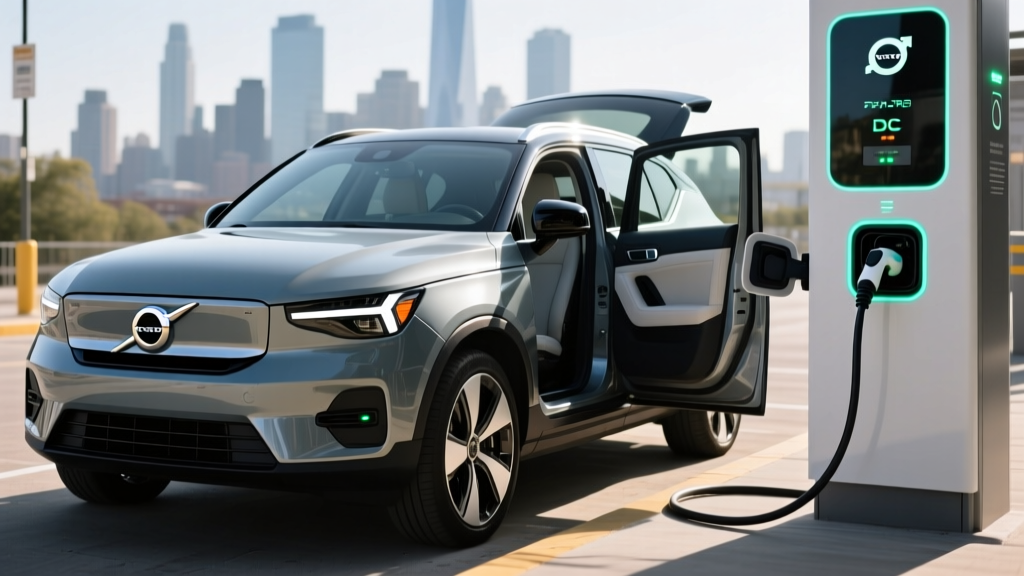
Charging capability is where the 2026 XC40 Recharge made its biggest generational leap. The updated platform now supports up to 200 kW peak DC fast charging, up from the previous generation's 150 kW ceiling. On a compatible 350 kW charger (Electrify America, EVgo, or Tesla Supercharger with NACS adapter), the 10-80% charge takes approximately 28 minutes.
| Charging Level | Power / Rate | Time / Miles Added | Connector |
|---|---|---|---|
| Level 1 (120V household) | ~1.4 kW | ~3-4 miles per hour | J1772 / NACS |
| Level 2 (240V home) | 11 kW (48A) | ~28-32 miles per hour; full charge in ~8 hours | J1772 / NACS |
| DC Fast Charge | 200 kW peak | 10-80% in ~28 min; ~120 mi in 15 min | CCS1 (NACS via adapter) |
Charging curve reality: Like most NMC-based EVs, the XC40 Recharge hits peak 200 kW only between roughly 10-30% state of charge. The rate tapers to ~150 kW by 50%, ~100 kW by 70%, and drops sharply above 80% to protect battery health. If you're road-tripping, plan your stops to charge from 10-80% rather than topping off to 100% — that last 20% can take as long as the first 70%.
For home charging, the onboard 11 kW AC charger is a strong point. On a properly installed 48-amp Level 2 circuit (NEMA 14-50 or hardwired wallbox), you'll add roughly 30 miles of range per hour — meaning a depleted battery fully replenishes overnight in about 8 hours. This is competitive with the best in class and faster than the Tesla Model Y's 11.5 kW (which sounds close but is effectively similar in practice).
Performance: 0-60, Horsepower, and Drivetrain Options
The 2026 lineup offers two distinct powertrain personalities:
| Specification | Single Motor Extended Range | Twin Motor AWD |
|---|---|---|
| Drivetrain | Rear-Wheel Drive (RWD) | Dual-Motor All-Wheel Drive |
| Horsepower | 248 hp | 402 hp |
| Torque | 361 lb-ft | 494 lb-ft |
| 0-60 mph | 6.7 seconds | 4.5 seconds |
| Top Speed | 112 mph (electronically limited) | 112 mph (electronically limited) |
| Battery (usable) | 82 kWh (NMC) | 82 kWh (NMC) |
| EPA Range | 293 miles | 261 miles |
| EPA Efficiency | 95 MPGe (35 kWh/100mi) | 87 MPGe (39 kWh/100mi) |
| Curb Weight | ~4,519 lbs | ~4,868 lbs |
| Max DC Charge Rate | 200 kW | 200 kW |
| Level 2 AC Charge | 11 kW | 11 kW |
| Battery Warranty | 8 yr / 100,000 mi | 8 yr / 100,000 mi |
| Base MSRP | $53,550 | $57,550 |
The Twin Motor's 4.5-second 0-60 time puts it firmly in quick-crossover territory — it'll merge onto highways and overtake with authority. The single-motor RWD at 6.7 seconds is no slouch either, and for daily commuting, the extra range and lower price make it the pragmatic pick. Volvo's electronic top-speed limiter at 112 mph is a corporate safety philosophy, not a performance limitation you'll notice in real driving.
One-pedal driving is standard and well-calibrated — lift off the accelerator and the regen braking brings you to a complete stop in most city driving scenarios. Volvo also includes a traditional "creep" mode for drivers transitioning from internal combustion.
Interior, Cargo Space, and Technology
The XC40 Recharge's cabin is where Volvo's Scandinavian design ethos shines — clean lines, sustainable materials (wool-blend upholstery available instead of leather), and an intuitive vertical touchscreen layout. The Google Built-in infotainment system includes Google Maps navigation with real-time EV range planning, Google Assistant voice control, and access to the Play Store for apps like Spotify and YouTube (parked only).
Cargo and passenger dimensions:
- Rear cargo (behind second row): 20.7 cu ft
- Cargo (rear seats folded): 47.2 cu ft
- Front trunk (frunk): 1.1 cu ft — enough for charging cables and a small bag
- Front legroom: 40.9 inches
- Rear legroom: 36.1 inches
- Rear headroom: 38.3 inches
Compared to the Tesla Model Y (30.2 cu ft rear cargo, 76.2 cu ft folded), the XC40 Recharge gives up meaningful cargo volume. If you regularly haul large items or need maximum family utility, the Model Y wins on space. But for daily commuting, grocery runs, and weekend trips for two to three people, the XC40's dimensions are well-judged and easier to park in urban environments.
Driver assistance: Volvo's Pilot Assist is a Level 2 system providing adaptive cruise control with stop-and-go, lane centering, and speed-limit recognition. Per NHTSA SAE classification, this is a driver-support system — you must keep hands on the wheel and eyes on the road at all times. It's competent for highway driving but doesn't offer hands-free capability like GM's Super Cruise or Ford's BlueCruise on mapped highways.
Pricing, Trim Levels, and Federal Tax Credit Eligibility
The 2026 Volvo XC40 Recharge is offered in three trim levels, with pricing before destination charges:
| Trim | Drivetrain | MSRP | Est. After §30D Credit* |
|---|---|---|---|
| Core | Single Motor RWD | $53,550 | $46,050 |
| Plus | Single Motor RWD | $56,050 | $48,550 |
| Ultimate | Twin Motor AWD | $62,050 | $54,550 |
*Estimated price assumes full $7,500 federal tax credit eligibility. Actual credit varies by buyer income, battery sourcing, and MSRP cap compliance. See details below.
Federal EV Tax Credit (§30D) — What You Need to Know:
The XC40 Recharge is assembled in Ghent, Belgium, which has historically complicated its federal tax credit eligibility under the battery sourcing and final assembly requirements of the Inflation Reduction Act. However, Volvo has been working to qualify through the critical minerals and battery component sourcing pathways. As of early 2026, certain XC40 Recharge configurations may qualify for the full $7,500 credit, but eligibility is not guaranteed across all trims and production batches.
Key IRS §30D requirements that affect your eligibility:
- MSRP cap: SUVs/crossovers must be below $80,000 — all XC40 Recharge trims comply
- Income cap: Modified AGI must not exceed $150,000 (single), $225,000 (head of household), or $300,000 (joint filing)
- Battery sourcing: Critical minerals and battery components must meet phased percentage thresholds from US or FTA-partner countries
- Point-of-sale transfer: Eligible buyers can transfer the credit to the dealer at purchase, reducing the purchase price directly rather than waiting for a tax refund
Always verify current eligibility on fueleconomy.gov and with your Volvo dealer before purchasing, as sourcing compliance can change between production runs. Consult a tax professional for your specific situation.
Pros, Cons, and Who Should Buy the XC40 Recharge
- 293-mile EPA range (single motor) eliminates range anxiety for most commutes and moderate road trips
- 200 kW DC fast charging with 10-80% in ~28 minutes makes road trips practical
- Scandinavian interior design with sustainable materials feels premium without ostentation
- Google Built-in infotainment with native EV route planning is seamless
- Standard one-pedal driving and strong regen calibration
- Competitive pricing undercuts BMW iX1 and Audi Q4 e-tron
- 8-year/100,000-mile battery and powertrain warranty
- IIHS Top Safety Pick+ rated (when equipped with specific headlights)
- Cargo space (20.7 cu ft) trails Tesla Model Y and Hyundai Ioniq 5 significantly
- Efficiency (87-95 MPGe) lags behind aerodynamic rivals — more kWh per mile means higher charging costs
- Real-world highway range drops noticeably above 65 mph due to boxy shape
- Pilot Assist is competent but offers no hands-free highway mode unlike Super Cruise or BlueCruise
- Frunk is tiny (1.1 cu ft) — essentially a cable storage cubby
- Belgian assembly may limit federal tax credit eligibility depending on production batch sourcing
- Rear seat legroom (36.1 in) is tight for taller passengers on long trips
Who the XC40 Recharge is best for:
- Urban and suburban commuters who value premium design, easy parking dimensions, and daily-driving comfort over maximum cargo space
- Two-person households or empty nesters who don't need third-row or maximum cargo utility
- Volvo brand loyalists transitioning from XC40 mild-hybrid or older XC60 models who want to go electric without relearning a new interface
- Cold-climate buyers who appreciate Volvo's Scandinavian-engineered heat pump and cabin preconditioning for winter efficiency
Look elsewhere if: You need maximum cargo volume (Model Y), hands-free highway driving (GM Super Cruise vehicles), or the lowest cost-per-mile efficiency (Hyundai Ioniq 5 or Tesla Model Y).
How It Compares to Key Competitors
The compact luxury EV crossover segment is crowded in 2026. Here's how the XC40 Recharge stacks up against the most common cross-shopped alternatives:
| Attribute | Volvo XC40 Recharge (Twin Motor) | Tesla Model Y LR AWD | BMW iX1 xDrive28 | Hyundai Ioniq 5 Limited AWD |
|---|---|---|---|---|
| EPA Range | 261 mi | 330 mi | 240 mi | 266 mi |
| Battery | 82 kWh NMC | ~75 kWh NMC | 64.7 kWh NMC | 77.4 kWh NMC |
| 0-60 mph | 4.5 sec | 4.8 sec | 5.0 sec | 5.1 sec |
| Max DC Charge | 200 kW | 250 kW | 130 kW | 240 kW |
| 10-80% DC Time | ~28 min | ~22 min | ~34 min | ~18 min |
| Cargo (rear) | 20.7 cu ft | 30.2 cu ft | 25.7 cu ft | 27.2 cu ft |
| Base MSRP | $57,550 | $48,990 | $59,995 | $54,500 |
| MPGe (combined) | 87 | 111 | 86 | 98 |
The Model Y wins on range, efficiency, cargo, and price — it's the rational choice for most buyers. But the XC40 Recharge competes on interior material quality, design distinctiveness, and a less tech-bro brand image. Against the BMW iX1, Volvo offers more range, faster charging, and a lower price. Against the Ioniq 5, Volvo trades charging speed and efficiency for a more premium cabin and brand cachet.
Frequently Asked Questions
What is the real-world range of the Volvo XC40 Recharge?
The EPA rates the single-motor RWD at 293 miles and the Twin Motor AWD at 261 miles. In real-world highway driving at 70+ mph, expect roughly 245-265 miles (single motor) or 215-235 miles (twin motor). In freezing temperatures, plan for 200-220 miles and 175-195 miles respectively. The heat pump helps mitigate winter losses but doesn't eliminate them.
How fast does the XC40 Recharge charge at home and on the road?
At home on a 48-amp Level 2 charger (240V), the XC40 Recharge charges at up to 11 kW, adding roughly 30 miles of range per hour — a full 0-100% charge takes about 8 hours. On a DC fast charger, it peaks at 200 kW and charges from 10-80% in approximately 28 minutes. Expect roughly 120 miles of range added in a 15-minute fast-charge stop.
Does the 2026 Volvo XC40 Recharge qualify for the $7,500 federal EV tax credit?
Eligibility depends on battery sourcing compliance, your income, and the MSRP cap. The XC40 Recharge's MSRP is well under the $80,000 SUV cap, and most buyers will fall within income limits. However, Belgian assembly and battery component sourcing have historically affected eligibility. Certain 2026 production batches may qualify for the full $7,500 credit, while others may qualify for a partial $3,750 credit or none at all. Verify on the IRS's official list at fueleconomy.gov and confirm with your dealer before purchasing.
Is the Volvo XC40 Recharge worth buying over the Tesla Model Y?
It depends on your priorities. The Model Y wins on range (330 vs. 261 mi), efficiency (111 vs. 87 MPGe), cargo space (30.2 vs. 20.7 cu ft), Supercharger network access, and price (~$8,500 less for AWD). The XC40 Recharge wins on interior material quality, distinctive Scandinavian design, Google-native infotainment, and a more traditional luxury dealership experience. If cargo space and lowest cost-per-mile matter most, buy the Model Y. If design, cabin quality, and brand identity are your top criteria, the XC40 Recharge justifies its premium.
What are the biggest drawbacks of the XC40 Recharge?
The three most common owner complaints are: (1) cargo space is tight compared to rivals — 20.7 cu ft behind the rear seats is modest for a crossover; (2) highway efficiency drops significantly above 65 mph due to the boxy aerodynamic profile, meaning road trips cost more per mile than in a Model Y or Ioniq 5; (3) the Pilot Assist driver-assistance system, while competent, doesn't offer hands-free highway driving like GM Super Cruise or Ford BlueCruise.
How does the XC40 Recharge handle cold weather?
Volvo's Scandinavian engineering heritage shows here. The standard heat pump efficiently warms the cabin without drawing heavily on the traction battery, and battery preconditioning activates automatically when you set a departure time or navigate to a charger. Expect 15-25% range loss in sustained sub-freezing temperatures compared to the EPA rating — roughly in line with industry averages for NMC packs. The AWD Twin Motor variant provides confident traction in snow and ice.