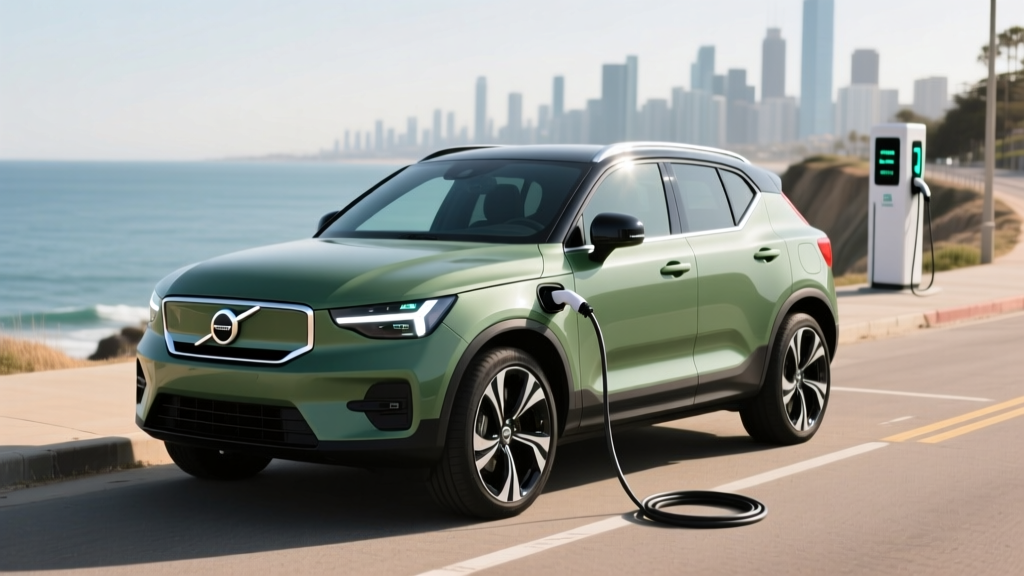
The Volvo XC40 Recharge (marketed as the XC40 Electric in some trims) remains one of the most practical luxury compact electric SUVs on the market for 2026. If you're searching for an xc40 volvo electric model and want to know whether it's worth buying, here's the direct answer: the XC40 Electric delivers 293 miles of EPA-estimated range (Single Motor), charges from 10–80% in roughly 28 minutes at a DC fast charger, and starts at $54,950 before incentives. It's a strong pick for buyers who want Scandinavian design, standard all-wheel-drive availability, and a mature charging ecosystem — but it faces stiff competition from the Tesla Model Y, Hyundai Ioniq 5, and BMW iX1 on efficiency and price.
Quick Verdict: 2026 Volvo XC40 Electric
Best for: Buyers prioritizing build quality, safety tech, and a refined driving experience over maximum range-per-dollar.
EPA Range: 293 mi (Single Motor RWD) / 261 mi (Twin Motor AWD)
Real-World Highway Range: ~240–260 mi (Single Motor); ~210–230 mi (Twin Motor AWD)
Base Price: $54,950 (Core trim, Single Motor)
Federal Tax Credit: Up to $7,500 via §30D — subject to MSRP cap, buyer income limits, and battery-sourcing requirements. Verify at IRS.gov.
Range, Battery, and Real-World Efficiency
For 2026, Volvo offers the XC40 Electric in two powertrain configurations. The Single Motor variant uses a rear-wheel-drive layout with an 82 kWh usable battery pack (NMC chemistry), while the Twin Motor AWD version pairs dual motors with the same pack, trading range for traction and performance.
| Spec | Single Motor (RWD) | Twin Motor (AWD) |
|---|---|---|
| EPA Range | 293 miles | 261 miles |
| Battery (usable) | 82 kWh (NMC) | 82 kWh (NMC) |
| Efficiency (MPGe combined) | 101 MPGe | 92 MPGe |
| kWh/100 mi | 33 kWh | 36 kWh |
| 0–60 mph | 6.2 sec | 4.5 sec |
| Horsepower | 248 hp | 402 hp |
Real-World Range Reality Check
The EPA sticker says 293 miles for the Single Motor, but plan for ~240–260 miles on sustained highway driving at 70+ mph. In cold weather (below 30°F), expect a further 15–25% reduction — meaning winter highway range could dip to roughly 190–220 miles. The heat pump (standard on 2026 models) helps mitigate cabin-heating energy draw, but physics still governs the battery. If your commute is under 50 miles round-trip with home charging, this is a non-issue. For frequent 250+ mile road trips, you'll need to plan DC fast-charging stops.
According to fueleconomy.gov, the XC40 Single Motor's 33 kWh/100mi efficiency is competitive within the luxury compact SUV segment but trails the Hyundai Ioniq 5 (29 kWh/100mi) and Tesla Model Y Long Range (28 kWh/100mi). That gap matters on road trips: over 300 miles, the XC40 uses roughly 12–15 kWh more than the Ioniq 5, which translates to an extra 8–10 minutes of charging time.
Charging Speed: DC Fast, Level 2, and the Charge Curve
Volvo equips the 2026 XC40 Electric with a CCS1 connector (or NACS on models built after mid-2025, depending on production batch — confirm with your dealer). DC fast-charging peaks at 200 kW, though sustained rates taper significantly above 80% State of Charge (SoC), as is typical for NMC batteries.
| Charging Level | Power (kW) | Miles Added per Hour | Notes |
|---|---|---|---|
| Level 1 (120V household) | ~1.4 kW | ~3–4 mi/hr | Emergency/trickle only; full charge takes ~60+ hours |
| Level 2 (240V home/public) | 11 kW (onboard charger) | ~28–32 mi/hr | Full charge in ~8–9 hours; ideal overnight |
| DC Fast Charging | Peak 200 kW | ~180–220 mi/hr (10–80%) | 10–80% in ~28 min; tapers sharply above 80% |
Understanding kW vs kWh: kW (kilowatts) is the rate of charging — like water flowing through a hose. kWh (kilowatt-hours) is the total energy stored in the battery — like the size of the tank. The XC40 has an 82 kWh battery and can accept up to 200 kW of charging power. These are not interchangeable terms.
The charge curve matters on road trips. The XC40 sustains roughly 150–175 kW between 10–50% SoC, then tapers to ~100 kW by 70%, and drops below 50 kW past 85%. This means charging from 80–100% can take nearly as long as 10–80%. Plan your stops to charge to 80% and drive on — don't wait for a full battery at a public charger.
Home charging reality: If you have a garage or driveway where a Level 2 (240V) charger can be installed, the XC40's 11 kW onboard charger is excellent — a full overnight charge is easily achievable on a standard 48-amp circuit. Installation typically costs $800–$2,500 depending on your electrical panel's capacity and the run length from panel to charger. If your home has a 200-amp panel with spare capacity, expect the lower end. Older homes with 100-amp panels may need a $1,500–$3,000 panel upgrade.
Pricing, Trims, and Federal Tax Credit Eligibility
The 2026 XC40 Electric lineup is structured across three trims for the Single Motor and two for the Twin Motor:
| Trim | Powertrain | MSRP |
|---|---|---|
| Core | Single Motor RWD | $54,950 |
| Plus | Single Motor RWD | $58,450 |
| Ultimate | Single Motor RWD | $62,950 |
| Plus | Twin Motor AWD | $61,450 |
| Ultimate | Twin Motor AWD | $65,950 |
Federal §30D Tax Credit — Eligibility Checklist (2026)
The XC40 Electric may qualify for up to $7,500 in federal tax credits, but eligibility is not automatic. Per IRS rules, you must meet ALL of the following:
- MSRP Cap: Vehicle MSRP must not exceed $80,000 for SUVs (all XC40 trims qualify).
- Buyer Income Cap: Modified AGI must not exceed $150,000 (single) / $300,000 (joint filing).
- Battery Sourcing: A percentage of critical minerals and battery components must be sourced from the U.S. or FTA partners — this shifts annually. Confirm current-year compliance on the IRS qualified vehicles list.
- Point-of-Sale Transfer: As of 2024+, you can transfer the credit to the dealer at purchase for an immediate price reduction, rather than waiting to claim it on your tax return.
- Final Assembly: Vehicle must undergo final assembly in North America. Volvo's Ghent, Belgium plant has been a point of concern — verify the VIN on fueleconomy.gov before purchasing.
Critical caveat: If the XC40 is assembled outside North America, it will NOT qualify for §30D. Always check the specific VIN. Some buyers have used the leasing loophole (§45W commercial credit passed through by the lessor) to capture a credit equivalent, but lease terms vary.
Total Cost of Ownership: XC40 Electric vs. Gas XC40 vs. Competition
The purchase price is only the starting point. Here's how the XC40 Electric stacks up against its gas-powered sibling and key EV rivals over five years and 75,000 miles of ownership.
| Cost Category | XC40 Electric (Single Motor) | XC40 B5 AWD (Gas) | Tesla Model Y LR |
|---|---|---|---|
| Purchase Price (base MSRP) | $54,950 | $41,950 | $48,990 |
| Federal Tax Credit | −$7,500 (if eligible) | $0 | −$7,500 (if eligible) |
| Effective Purchase Price | $47,450 | $41,950 | $41,490 |
| Fuel / Electricity (75k mi) | $3,150 (home charging @ $0.14/kWh) | $8,400 (25 MPG avg @ $3.50/gal) | $2,700 (home charging @ $0.14/kWh) |
| Maintenance (5 yr) | $1,200 | $3,800 | $1,000 |
| Insurance (5 yr est.) | $9,500 | $7,200 | $8,800 |
| Estimated Depreciation | $18,500 | $16,000 | $17,000 |
| 5-Year Total | $79,800 | $77,350 | $70,990 |
Key takeaways:
- The XC40 Electric saves roughly $5,250 in fuel and $2,600 in maintenance over five years vs. the gas XC40 — but higher insurance premiums and faster depreciation partially offset those savings.
- If you qualify for the full $7,500 tax credit, the effective purchase price drops to near the gas model. Without the credit (e.g., income above the cap, or VIN assembled outside North America), the cost gap widens significantly.
- The Tesla Model Y Long Range wins on pure economics: lower base price, better efficiency, and a robust Supercharger network.
- Home charging at $0.14/kWh is critical to these savings. If you rely entirely on DC fast charging at $0.40–$0.60/kWh, your electricity cost roughly triples to ~$9,000+ over 75,000 miles, erasing the fuel savings advantage.
Common Misconceptions About the XC40 Electric
| Myth | Fact |
|---|---|
| "It's fully self-driving with Pilot Assist." | Pilot Assist is a SAE Level 2 driver-assistance system. It provides lane centering and adaptive cruise but requires constant driver supervision. It is not autonomous. |
| "The battery will need replacing in 5 years." | Volvo warranties the battery for 8 years / 100,000 miles with a 70% capacity retention threshold. Industry data shows NMC packs typically retain 85–90% capacity at 100,000 miles under normal use. |
| "I can charge it at any Tesla Supercharger." | Only if your XC40 has the NACS port (post-mid-2025 production) or you carry a CCS-to-NACS adapter. Earlier CCS1 models cannot use Tesla Superchargers without an adapter. Confirm your port type. |
| "Electric cars don't work in cold climates." | They work, but range drops 15–25% in sub-freezing temperatures. The XC40's standard heat pump reduces cabin-heating energy draw. Preconditioning while plugged in restores much of the lost range. |
| "It qualifies for the $7,500 tax credit automatically." | Eligibility depends on your income, the vehicle's MSRP, battery mineral sourcing, and final assembly location. Always verify the VIN on the IRS qualified vehicle list before purchasing. |
Ownership Practicalities: What First-Time EV Buyers Should Know
Buying the XC40 Electric is only the beginning. Here are the practical realities that don't appear on the spec sheet:
Home charging is the foundation. Over 80% of EV charging happens at home. Before you buy, have a licensed electrician assess your panel. A 200-amp panel with available capacity can support a 48-amp Level 2 charger (like the ChargePoint Home Flex or Emporia Vue) for ~$800–$1,500 installed. A 100-amp panel may require an upgrade costing $1,500–$3,000+. If you live in an apartment or condo without dedicated parking, evaluate your public charging options before committing.
Public charging is improving but inconsistent. Electrify America, EVgo, and ChargePoint networks cover most interstate corridors, but reliability varies. The XC40's Google Built-in infotainment system includes route planning with charging stops, which helps. However, if you live in a charging desert (rural areas with limited DC infrastructure), road-trip planning becomes essential.
Insurance costs more. EVs typically cost 15–25% more to insure than comparable gas vehicles due to higher repair costs, specialized parts, and battery-replacement risk. Get quotes from your insurer before purchasing — the $150–$200/month premium difference adds up.
Maintenance is minimal but not zero. No oil changes, no spark plugs, no transmission fluid. You'll still need tire rotations (EVs wear tires faster due to instant torque and heavier weight), cabin air filter replacements, brake fluid checks (regen braking extends pad life significantly), and wiper/coolant service. Budget ~$200–$300/year.
Tire costs are higher. The XC40 Electric weighs roughly 4,700 lbs (Single Motor) to 4,900 lbs (Twin Motor). Combined with instant electric torque, expect tire life of 25,000–35,000 miles on standard all-season tires. Replacement sets of four run $800–$1,400.
Decision Framework: Is the XC40 Electric Right for You?
Choose the XC40 Electric If:
- You value premium build quality, minimalist Scandinavian design, and Volvo's top-tier safety ratings (IIHS Top Safety Pick+ historically).
- You have home charging access and a daily commute under 80 miles.
- You want a compact luxury EV SUV that's easy to park and maneuver in urban environments.
- You qualify for the §30D tax credit, bringing the effective price into the mid-$40K range.
- You prefer physical buttons and a more traditional cockpit layout over Tesla's minimalist approach.
Look Elsewhere If:
- Maximum range-per-dollar is your priority — the Hyundai Ioniq 5 (318 mi EPA, ~$46K) or Tesla Model Y Long Range (330 mi EPA, ~$49K) are more efficient.
- You regularly drive 300+ mile trips in cold weather and need the longest possible range between charges.
- You don't qualify for the federal tax credit (income above cap or VIN doesn't meet sourcing/assembly rules) — the price premium becomes hard to justify.
- You need third-row seating or maximum cargo space — consider the Volvo EX90, Kia EV9, or Tesla Model X.
- You want access to the full Tesla Supercharger network without an adapter.
Warranty and Battery Longevity
Volvo backs the 2026 XC40 Electric with:
- Basic Warranty: 4 years / 50,000 miles
- Powertrain Warranty: 4 years / 50,000 miles
- Battery Warranty: 8 years / 100,000 miles (70% capacity retention minimum)
- Corrosion Warranty: 12 years, unlimited miles
The 70% battery retention threshold is industry-standard but worth noting: if your 82 kWh pack drops below 57.4 kWh of usable capacity within 8 years or 100,000 miles, Volvo will repair or replace it. Real-world degradation data from NMC packs in similar vehicles (Polestar 2, which shares the CMA platform) suggests typical degradation of 8–12% over 100,000 miles, keeping most packs well above the warranty threshold.
To maximize battery longevity: avoid routinely charging to 100% (set daily limit to 80–90%), use preconditioning before DC fast charging, and minimize repeated back-to-back fast-charge sessions. The XC40's battery thermal management system is active, which helps protect the pack in extreme temperatures.
Frequently Asked Questions
Does the 2026 Volvo XC40 Electric qualify for the $7,500 federal tax credit?
It depends. The XC40 Electric's MSRP is under the $80,000 SUV cap, so it clears that hurdle. However, eligibility also requires that your modified AGI is below $150K (single) or $300K (joint), that the battery meets critical-mineral and component sourcing thresholds (which change yearly), and that final assembly occurred in North America. Since Volvo manufactures the XC40 in Ghent, Belgium, this has been a sticking point. Always verify the specific VIN on the IRS qualified vehicles list before purchasing. If buying through a lease, the lessor may pass through a commercial credit (§45W) instead.
How long does it take to charge the XC40 Electric at home?
On a Level 2 (240V) home charger delivering 11 kW, a full 0–100% charge takes approximately 8–9 hours. Most owners plug in overnight and wake up to a full battery every morning. On a standard 120V outlet (Level 1), expect roughly 3–4 miles of range per hour of charging — adequate only for emergency top-ups or very low daily mileage.
What is the real-world range of the XC40 Electric in winter?
In sustained sub-freezing temperatures (20–30°F), expect the Single Motor's range to drop from its 293-mile EPA rating to approximately 220–250 miles for mixed driving. On the highway at 75 mph in cold weather, plan for roughly 190–220 miles. The standard heat pump helps, but preconditioning the battery while still plugged in is the single most effective way to preserve winter range.
How does the XC40 Electric compare to the Tesla Model Y?
The Model Y Long Range AWD offers more range (330 mi EPA), faster charging (peak 250 kW, 10–80% in ~20 min), lower base price (~$48,990), and exclusive access to the Supercharger network. The XC40 Electric counters with superior interior material quality, more intuitive physical controls, standard Google Built-in navigation, and Volvo's safety reputation. If range and charging speed are paramount, the Model Y wins on paper. If build quality and driving refinement matter more, the XC40 is the stronger pick.
Is the XC40 Electric's Pilot Assist system self-driving?
No. Pilot Assist is a SAE Level 2 driver-assistance system. It combines adaptive cruise control with lane-centering assistance, but you must keep your hands on the wheel and eyes on the road at all times. It does not handle stoplights, construction zones, or complex urban intersections autonomously. The driver is legally and practically responsible for all vehicle operation.
What connector does the 2026 XC40 Electric use?
Volvos produced from mid-2025 onward are transitioning to the NACS (North American Charging Standard) port, which provides native access to Tesla Superchargers. Earlier 2026 model-year vehicles may still carry the CCS1 port. Confirm with your dealer which connector your specific vehicle has. If you have a CCS1 vehicle, Volvo and third-party suppliers offer CCS-to-NACS adapters for Supercharger access, though charging speed may be slightly reduced through the adapter.