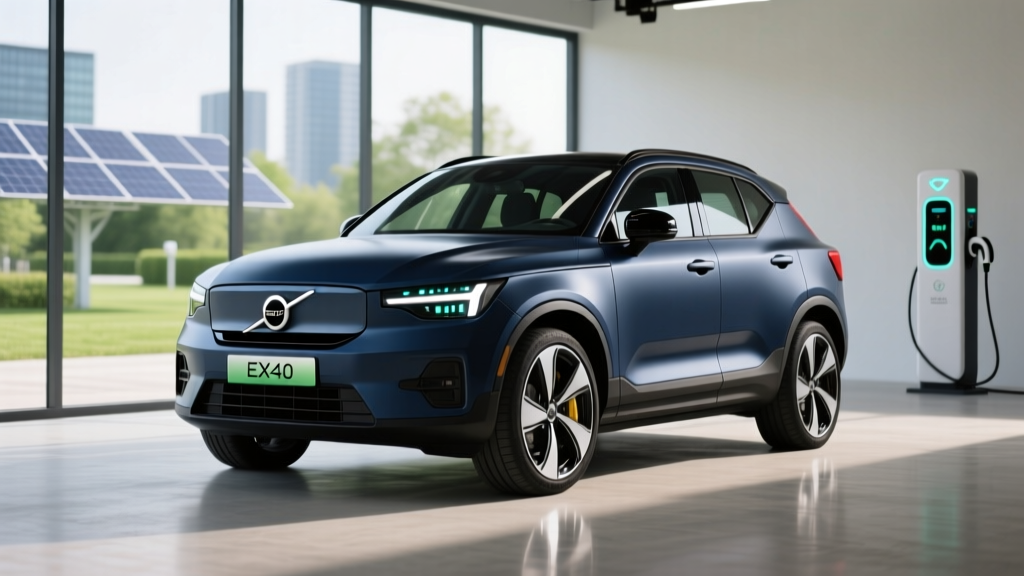
Quick Answer: The Volvo EX40 (formerly the XC40 Recharge Pure Electric, renamed for the 2025 model year) is a compact luxury EV with a 293-mile EPA range (Extended Range Single Motor) and a starting MSRP around $53,550 for 2026. It charges at up to 200 kW DC, reaching 10–80% in roughly 28 minutes. Compared to a gas XC40 B5 AWD, the EX40 saves an estimated $800–$1,200 annually in fuel and maintenance for a typical driver covering 12,000 miles per year, though the EV commands a $10,000–$15,000 higher purchase price before incentives. It's best suited for buyers with home Level 2 charging access in moderate climates who want a premium compact crossover without the Tesla aesthetic.
What Exactly Is the Volvo XC40 Electric (Now Called EX40)?
If you're searching for the "XC40 electric," you're looking at what Volvo now officially calls the EX40. Starting with the 2025 model year, Volvo consolidated its naming scheme: electric models get the "E" prefix (EX30, EX40, EX90), while the gas-powered XC40 retains its original badge. Under the skin, the EX40 is mechanically identical to the prior XC40 Recharge Pure Electric — same Compact Modular Architecture (CMA) platform, same battery options, same interior.
For the 2026 model year, the EX40 is offered in two powertrain configurations:
- Single Motor Extended Range (RWD): 293 miles EPA range, 248 hp, 361 lb-ft torque
- Twin Motor AWD: 276 miles EPA range, 402 hp, 490 lb-ft torque, 0–60 mph in 4.5 seconds
Both use an 82 kWh battery pack (79 kWh usable capacity) with NMC (nickel manganese cobalt) chemistry supplied by CATL/LG Energy Solution depending on build batch. The pack operates on a 400-volt architecture — not the 800V systems found in Hyundai/Kia's E-GMP vehicles, which affects peak charging speed.
| Spec | Single Motor ER (RWD) | Twin Motor (AWD) |
|---|---|---|
| EPA Range | 293 mi | 276 mi |
| Battery (Usable) | 79 kWh (NMC) | 79 kWh (NMC) |
| Horsepower | 248 hp | 402 hp |
| 0–60 mph | 6.7 sec | 4.5 sec |
| Max DC Charge Rate | 200 kW | 200 kW |
| 10–80% DC Time | ~28 min | ~28 min |
| Level 2 (AC) Rate | 11 kW | 11 kW |
| MPGe (Combined) | 98 MPGe | 92 MPGe |
| Base MSRP (2026 est.) | $53,550 | $58,050 |
| Battery Warranty | 8 yr / 100,000 mi | 8 yr / 100,000 mi |
Real-World Range Reality: The 293-mile EPA figure for the Single Motor is achievable in mild weather at city and suburban speeds. On sustained 75 mph highway driving, expect roughly 245–265 miles. In freezing temperatures (below 32°F), range drops to approximately 200–230 miles due to battery heating demands and cabin HVAC load. The Twin Motor AWD model loses roughly 15–20 miles in equivalent conditions. Volvo's heat pump (standard on 2026 models) helps mitigate cold-weather loss but doesn't eliminate it.
EX40 vs. Gas XC40: Cost and Efficiency Comparison
The gas-powered 2026 Volvo XC40 B5 AWD starts around $41,950 and delivers 26 MPG combined per EPA data on fueleconomy.gov. Here's how the numbers stack up over five years of ownership at 12,000 miles per year:
| Cost Factor | EX40 Single Motor | XC40 B5 AWD (Gas) |
|---|---|---|
| Base MSRP | $53,550 | $41,950 |
| Annual Fuel/Energy Cost | ~$540 (home charging, $0.14/kWh avg) | ~$1,660 ($3.45/gal, 26 MPG) |
| 5-Year Fuel/Energy Total | ~$2,700 | ~$8,300 |
| Annual Maintenance | ~$200 (cabin filter, tire rotation, fluid top-offs) | ~$650 (oil, filters, brake pads, spark plugs) |
| 5-Year Maintenance Total | ~$1,000 | ~$3,250 |
| Estimated Insurance (annual avg) | ~$2,100 | ~$1,750 |
| 5-Year Total Operating Cost | ~$24,200 | ~$20,300 |
The EV's fuel and maintenance savings are significant — roughly $7,850 over five years. However, the higher purchase price ($11,600 gap) and elevated insurance premiums (EVs typically cost 15–25% more to insure due to repair complexity and parts cost) narrow the gap. At this purchase-price differential, the EX40 reaches cost parity with the gas XC40 around year 7–8 of ownership, assuming stable electricity and gas prices.
If you're cross-shopping with a plug-in hybrid alternative like the Volvo XC60 Recharge PHEV (about $56,000, 35 miles electric-only, then 28 MPG combined), the EX40 makes more sense if your daily commute is under 40 miles round-trip and you have reliable home charging. The PHEV is the safer bet if you take frequent long road trips into areas with sparse DC fast-charging infrastructure.
Charging the EX40: Home, Public, and What to Expect
Charging speed is where the EX40's 400V architecture shows its age compared to 800V rivals like the Hyundai Ioniq 5 (which peaks at 240 kW and does 10–80% in 18 minutes). The EX40's 200 kW peak is respectable but tapers noticeably:
- 10–30% SoC: Sustains near 195–200 kW peak
- 30–60% SoC: Drops to ~150–165 kW
- 60–80% SoC: Falls to ~90–110 kW
- Above 80%: Trickle charges at 30–50 kW (avoid regular charging past 80% to preserve battery health)
This charge curve means the advertised 28-minute 10–80% time is realistic at a functioning 200+ kW charger with battery preconditioning active. In practice, many Electrify America and EVgo stations deliver inconsistent throughput, and without preconditioning (triggered by navigating to a charger in the infotainment system), expect 35–40 minutes in cold weather.
| Charging Level | Power | Miles Added per Hour | Best For |
|---|---|---|---|
| Level 1 (120V outlet) | ~1.4 kW | ~4–5 mi/hr | Emergency/top-up only |
| Level 2 (240V, 48A home charger) | ~11 kW | ~33–37 mi/hr | Daily home charging (full charge in ~7.5 hr) |
| DC Fast Charge | Up to 200 kW | ~550+ mi/hr (peak) | Road trips, 10–80% in ~28 min |
Home Charging Setup: The EX40's 11 kW onboard charger means you'll want a 48-amp Level 2 wallbox (like the ChargePoint Home Flex or Wallbox Pulsar Plus) on a 60-amp dedicated circuit. Installation costs range from $800–$2,500 depending on your electrical panel's capacity and the run length from panel to garage. If your home has a 100-amp main panel, a $1,500–$3,000 panel upgrade to 200 amps may be necessary — budget for this before purchasing the car.
Connector note: The 2026 EX40 ships with a NACS (North American Charging Standard) port, giving native access to Tesla's Supercharger network — the most reliable DC fast-charging infrastructure in the US. Volvo began transitioning to NACS for the 2025 model year. If you're buying a 2024 model on the used market, it will have a CCS1 port and require an adapter for Supercharger access.
Federal Tax Credit and Incentive Eligibility
The IRS §30D Clean Vehicle Credit offers up to $7,500 for qualifying new EVs, but eligibility is layered and changes with battery sourcing requirements. For the 2026 model year, the EX40's credit status depends on where its battery cells and critical minerals are sourced:
- MSRP cap: SUVs must be under $80,000 — the EX40 qualifies (top-trim Ultra Twin Motor is ~$62,000)
- Buyer income cap: Modified AGI must not exceed $150,000 (single), $225,000 (head of household), or $300,000 (joint)
- Battery sourcing: The $7,500 credit splits into $3,750 for critical minerals + $3,750 for battery component assembly, each with escalating domestic/free-trade-partner thresholds. Vehicles with battery components from a "foreign entity of concern" (FEOC) may be disqualified entirely
- Point-of-sale transfer: You can transfer the credit to the dealer at purchase to reduce the sale price directly, rather than waiting for a tax refund
As of early 2026, Volvo's US-built EX40 variants (production shifted to the Ridgeville, South Carolina plant) have qualified for partial or full credit depending on the specific build month and battery supplier. Always verify current eligibility on the IRS qualified vehicles list before signing a purchase agreement — sourcing requirements tighten annually, and a vehicle that qualified in 2025 may not qualify in 2026.
State incentives vary widely. California's CVRP rebate, Colorado's state tax credit, and various utility company incentives can stack on top of the federal credit. Check your state energy office and local utility for current programs.
Real-World Ownership: What First-Time EV Buyers Should Know
| Common Misconception | Fact |
|---|---|
| "The battery will need replacing in 5 years" | Volvo warranties the pack for 8 years/100,000 miles at 70%+ capacity retention. NMC degradation data from real-world fleets shows ~8–12% capacity loss at 100,000 miles with normal charging habits |
| "I can charge on any road trip" | DC fast-charging infrastructure remains sparse in rural areas of the Great Plains, Mountain West, and parts of the South. Plan routes using PlugShare or A Better Route Planner before long trips |
| "Regenerative braking means I never use my brake pads" | Regen handles ~85–90% of deceleration, but friction brakes are still needed for low-speed stops and emergency braking. Expect pad replacement around 80,000–120,000 miles instead of the 30,000–50,000 typical on gas cars |
| "Home charging is just plugging into a wall outlet" | A standard 120V outlet adds only 4–5 miles per hour — fine if you drive under 25 miles daily, but inadequate for most owners. Budget $1,000–$2,500 for proper Level 2 installation |
| "The EPA range is what I'll actually get" | EPA range is a laboratory estimate. Highway driving at 75+ mph, cold weather, roof cargo boxes, and aggressive acceleration all reduce real-world range by 15–30% |
Insurance and Depreciation Realities
EV insurance premiums run 15–25% higher than comparable gas vehicles. The EX40's estimated annual premium is $1,900–$2,400 depending on your state, driving record, and coverage level. This is driven by higher repair costs (battery-adjacent components, specialized body shop requirements) and elevated parts pricing. Get quotes from Geico, Progressive, and State Farm before committing to a purchase — the spread between insurers for EVs is wider than for gas cars.
Depreciation on luxury compact EVs has been steep in the 2024–2025 market. The EX40 holds approximately 48–55% of its value after three years, below the segment average for gas luxury crossovers (which retain 55–62%). If you plan to trade in within 3–4 years, leasing may be financially advantageous — Volvo frequently offers lease incentives that factor in the federal tax credit.
Decision Framework: Should You Buy the EX40?
Choose the EX40 if:
- You have access to Level 2 home charging (garage or dedicated driveway circuit)
- Your daily driving is under 80 miles round-trip, with occasional road trips under 300 miles between charging stops
- You want a compact luxury crossover with a traditional interior aesthetic (physical buttons, Google built-in, Scandinavian design) rather than a minimalist touchscreen-only approach
- NACS Supercharger access is a priority for your region
- You qualify for at least partial federal/state incentives to offset the purchase premium over the gas XC40
Look elsewhere if:
- You live in an apartment or condo without charging access and must rely entirely on public charging — the EX40's 200 kW peak charge rate means longer stops than 800V rivals like the Ioniq 5 or Kia EV6
- You regularly tow — the EX40 is rated for only 2,000 lbs (the gas XC40 manages 3,500 lbs)
- You need maximum cargo space — the EX40 offers 31.0 cu ft behind the rear seats and a small 1.2 cu ft frunk, less than the Hyundai Ioniq 5 (46.0 cu ft) or Tesla Model Y (34.3 cu ft + larger frunk)
- You take frequent winter road trips in the Mountain West or northern Great Plains where DC fast chargers are widely spaced and cold weather compounds range loss
- Budget is paramount — the gas XC40 B5 at ~$42,000 is a compelling luxury compact with a lower entry price and no charging infrastructure dependency
Frequently Asked Questions
Is the Volvo XC40 Recharge the same as the EX40?
Yes. Volvo renamed the XC40 Recharge Pure Electric to "EX40" starting with the 2025 model year to align with its electric naming convention (EX30, EX90). The vehicle is mechanically the same — same CMA platform, same battery options, same interior. If you're shopping used 2022–2024 models, they'll be badged as XC40 Recharge.
How long does it take to charge the EX40 at home?
On a Level 2 home charger (240V, 48 amps, 11 kW), a full 0–100% charge takes approximately 7.5 hours. Most owners plug in overnight and wake to a full battery. On a standard 120V outlet (Level 1), a full charge takes over 55 hours — only practical for emergency use or very low-mileage drivers.
Does the EX40 qualify for the $7,500 federal tax credit?
It depends on the specific build configuration, battery sourcing, and your income. The EX40's MSRP falls under the $80,000 SUV cap. However, battery component and critical mineral sourcing requirements under IRS §30D change annually. Verify eligibility on the IRS qualified clean vehicle list at the time of purchase, and consult a tax professional about your specific situation.
What is the real-world range in winter?
In sustained sub-freezing temperatures, expect the Single Motor EX40 to deliver approximately 200–230 miles (down from 293 EPA). The Twin Motor AWD drops to roughly 190–210 miles. Using seat heaters and steering wheel heat instead of blasting cabin HVAC can recover 10–15 miles. Preconditioning the battery while still plugged in at home also reduces the cold-weather penalty.
How does the EX40 compare to the Tesla Model Y?
The Model Y Long Range AWD offers 311 miles EPA range, starts at ~$48,990, and charges faster on the Supercharger network (250 kW peak, though the EX40 now has native NACS access too). The Model Y is also roomier (34.3 cu ft cargo). The EX40 counters with a more traditional luxury interior, physical climate controls, superior sound insulation, and Volvo's safety reputation. It comes down to whether you prioritize interior quality and ride comfort (EX40) or maximum range and interior space (Model Y).
What happens if the battery fails out of warranty?
Out-of-warranty battery replacement for the EX40 currently runs $15,000–$20,000 at a Volvo dealer, though prices are expected to decline as battery costs continue to fall. Complete pack failure is rare — most degradation is gradual capacity loss. Individual module replacement (rather than a full pack swap) may be possible at independent EV repair shops for significantly less. Volvo's 8-year/100,000-mile battery warranty covers defects and capacity below 70% of original.
Sources: EPA fuel economy data via fueleconomy.gov, Volvo USA official specifications, IRS §30D qualified vehicle list via irs.gov. Pricing and incentive figures are estimates based on available 2026 model-year data and are subject to change. Verify all figures with your dealer and tax advisor before purchasing.