The Quick Answer: Is a Volvo Electric Semi Truck Right for Your Fleet?
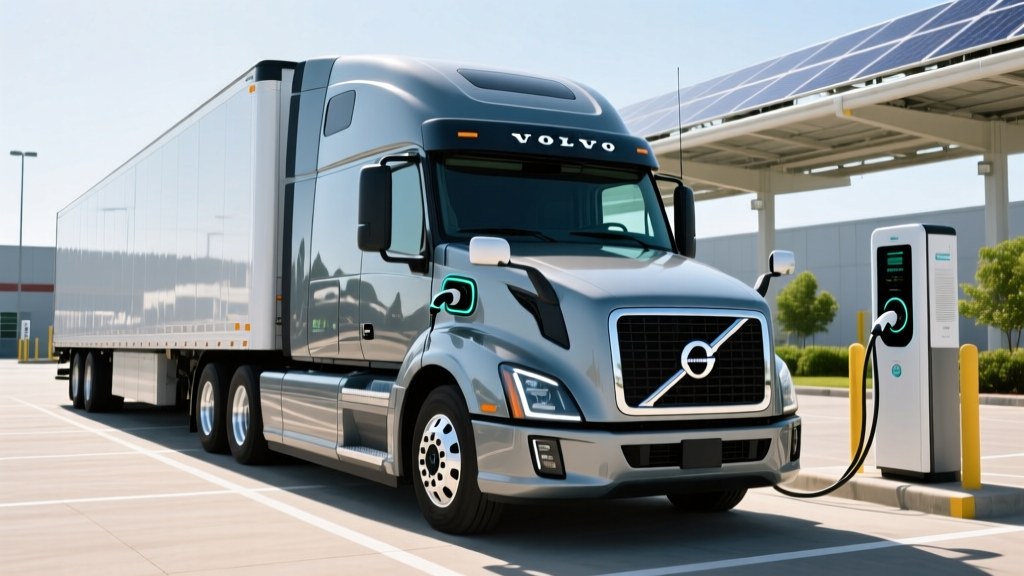
Volvo's electric semi truck lineup — the VNR Electric (Class 8 regional haul) and VNX Electric (heavy-haul/port) — delivers 150–275 miles of real-world range depending on battery configuration (up to six 37 kWh packs, ~221 kWh usable). A typical 6x4 VNR Electric tractor costs $350,000–$420,000 before incentives, roughly 2.5–3× the price of a diesel VNR. Payback depends heavily on duty cycle: fleets running under 200 miles/day with depot charging see the strongest economics, with electricity at ~$0.15–0.25/mile versus diesel at ~$0.55–0.75/mile (at $4.20/gal and 6.5 MPG). Federal IRC §45W provides up to $40,000 for qualifying Class 8 commercial vehicles, and state programs (California HVIP, New York Truck Voucher) can stack on top.
Volvo Electric Semi Truck Lineup: VNR vs VNX Electric
Volvo Trucks North America offers two battery-electric Class 8 models as of the 2026 model year. Both share Volvo's modular battery architecture and 2-speed EV transmission, but target very different duty cycles.
| Spec | VNR Electric (Regional) | VNX Electric (Heavy-Haul) |
|---|---|---|
| GVWR | Up to 82,000 lbs | Up to 82,000 lbs (GCWR higher for port) |
| Motor | 2× Volvo EV motors | 2× Volvo EV motors (higher torque rating) |
| Peak Output | 455 hp (339 kW) / 4,051 lb-ft | 455 hp (339 kW) / 4,051 lb-ft |
| Battery Packs | 4 or 6 packs (37 kWh each) | 6 packs (37 kWh each) |
| Usable Capacity | ~148 kWh (4-pack) / ~221 kWh (6-pack) | ~221 kWh |
| Chemistry | NMC (nickel manganese cobalt) | NMC |
| EPA-Est. Range | ~150 mi (4-pack) / ~275 mi (6-pack) | ~150 mi (loaded drayage) |
| DC Fast Charge (Peak) | 250 kW CCS1 | 250 kW CCS1 |
| 10–80% Charge Time | ~60 min (6-pack, 250 kW) | ~60 min (250 kW) |
| Base MSRP (Tractor Only) | $350,000–$420,000 | $380,000–$450,000 |
| Warranty (Battery) | 5 years / 600,000 mi (70% SoH) | 5 years / 600,000 mi (70% SoH) |
Real-world range caveat: Volvo's 275-mile figure for the 6-pack VNR Electric assumes a light payload, flat terrain, and moderate temperatures. In real fleet operations with full 80,000-lb loads, highway speeds, and HVAC use, expect 175–225 miles in temperate weather and 130–170 miles in sub-freezing conditions. Battery thermal management helps, but cold weather still saps 20–35% of range in Class 8 applications.
Total Cost of Ownership: Electric Semi vs Diesel
The upfront premium of a Volvo electric semi truck is substantial. The real question for fleet managers is whether the operational savings close the gap over a 7–10 year ownership cycle.
| Cost Category | VNR Electric (6-Pack) | VNR Diesel (D13) |
|---|---|---|
| Purchase Price (Tractor) | $390,000 | $155,000 |
| Federal Tax Credit (§45W) | –$40,000 | $0 |
| State Incentive (CA HVIP typical) | –$90,000 | $0 |
| Net Acquisition Cost | $260,000 | $155,000 |
| Fuel/Energy Cost per Mile | $0.18–0.25 (electricity) | $0.55–0.75 (diesel at $4.20/gal) |
| Annual Fuel (100k mi/yr) | $18,000–$25,000 | $55,000–$75,000 |
| Maintenance per Mile | $0.05–0.08 | $0.15–0.20 |
| Annual Maintenance (100k mi) | $5,000–$8,000 | $15,000–$20,000 |
| DEF / Emissions Equipment | $0 | $2,500–$4,000/yr |
| Depot Charger Install (per stall) | $80,000–$150,000 | $0 |
| 7-Year Net Fuel + Maint. Savings | $245,000–$385,000 (electric advantage) | |
The math works best for high-utilization, short-haul routes where trucks return to base nightly. A fleet running 250 days/year at 150 miles/day saves roughly $35,000–$50,000 annually per truck on energy and maintenance alone. That closes the incentive-adjusted acquisition gap in 2–4 years.
Charging Infrastructure: What Fleets Must Plan For
Charging is the single largest infrastructure variable in electric semi truck ownership. Unlike diesel, you can't rely on an existing nationwide fueling network for heavy-duty BEVs.
Depot Charging (Primary Strategy)
Most Volvo VNR Electric fleets charge overnight at depot using Level 2 AC (19.2–80 kW) or DC chargers (60–150 kW). A full 221 kWh pack charges in approximately:
- 19.2 kW AC: ~11.5 hours (0–100%) — viable for overnight if trucks return by 5 PM
- 60 kW DC: ~3.5 hours — adequate for shift-change top-ups
- 150 kW DC: ~1.5 hours — supports multi-shift operations
- 250 kW DC (public/en-route): ~60 min (10–80%) — for mid-day opportunity charging
Charging Cost Reality
Industrial electricity rates vary enormously. Fleets in California pay $0.18–0.35/kWh depending on time-of-use, while Pacific Northwest fleets may see $0.06–0.10/kWh. At 2.0 kWh/mile (a realistic Class 8 efficiency figure loaded), a 200-mile daily route consumes ~400 kWh, costing $24–$140/day depending on utility and TOU scheduling. Smart charging during off-peak hours is non-negotiable for cost control.
Utility Upgrades & Lead Times
Installing even a handful of 150 kW DC chargers typically requires a new dedicated transformer, switchgear, and trenching. Utilities in major metro areas are quoting 12–24 months for the service upgrades needed to support a 10-truck electric fleet. Fleets should engage their utility and a qualified electrical contractor at least 18 months before truck delivery.
Volvo Electric Semi vs Diesel: Head-to-Head
| Factor | VNR Electric | VNR Diesel (D13 TC) |
|---|---|---|
| Range (Practical) | 175–225 mi (6-pack, loaded) | 1,200+ mi |
| Refuel/Recharge Time | 1.5–12 hrs (depending on charger) | 15–20 min |
| Energy Cost/Mile | $0.18–0.25 | $0.55–0.75 |
| Maintenance Intervals | No oil, no DPF, no DEF; brake regen extends pad life | Oil every 40–50k mi; DPF/SCR service |
| Driver Experience | Quiet, no vibration, instant torque, single-speed feel | Engine noise, vibration, 12-speed I-Shift |
| Cold-Weather Range Loss | 20–35% | Negligible (diesel gelling managed w/ additives) |
| Resale Value (Projected) | Uncertain — battery SoH is the variable | Establishized used-truck market |
| Route Flexibility | Limited to depot + en-route charger network | Any route, any time |
| Regulatory Compliance | Zero tailpipe; CARB/IRAQMD compliant | Increasingly restricted in CA port zones |
Real-World Ownership: What Fleet Buyers Must Know
Duty Cycle Is Everything
The Volvo electric semi truck excels in a specific duty cycle: daily routes under 200 miles with predictable depot return. This covers drayage (port-to-warehouse), regional distribution, food/beverage delivery, and municipal fleet operations. It does not cover OTR (over-the-road) long-haul. If your trucks regularly exceed 250 miles/day or lack a fixed home base, diesel or hydrogen fuel-cell remains the pragmatic choice.
Payload Penalty
A 6-pack VNR Electric tractor weighs approximately 3,000–4,000 lbs more than its diesel counterpart due to the battery packs. Under the federal 80,000-lb GCWR limit, this means 3,000–4,000 lbs less freight capacity. Some states and the DOT offer weight exemptions for EVs (up to 2,000 lbs additional), partially offsetting this. For weight-critical loads (aggregate, liquids), the payload penalty directly affects revenue per trip.
Driver Acceptance
Fleet operators consistently report strong driver preference for electric trucks once experienced: no diesel smell, dramatically lower noise (beneficial in urban/nighttime delivery), instant torque from stop, and no gear hunting on grades. However, drivers must be trained on range management, regenerative braking behavior, and pre-trip SoC checks — a cultural shift from "fill the tank whenever" to managed energy planning.
Insurance and Financing
Insurance premiums for electric Class 8 trucks are currently 10–25% higher than diesel equivalents, driven by higher replacement values and limited actuarial data on battery-related claims. Financing is available through Volvo Financial Services and specialized green-fleet lenders, often with preferential rates tied to sustainability mandates.
Incentives and Tax Credits for Commercial Electric Trucks
Unlike consumer EVs (governed by IRS §30D), commercial electric trucks qualify under different programs:
- IRC §45W Commercial Clean Vehicle Credit: Up to $40,000 for Class 8 vehicles (30% of incremental cost over a comparable ICE vehicle, capped at $40,000). Subject to domestic content and battery sourcing requirements per IRS guidance.
- California HVIP: Vouchers of $60,000–$120,000 per Class 8 truck, with higher amounts for drayage and disadvantaged-community fleets.
- EPA Clean School Bus / DERA Grants: Available for specific vocational applications.
- Utility Make-Ready Programs: Many utilities (SCE, PG&E, ConEd) cover 50–100% of charger infrastructure costs for fleet depots.
Incentive availability varies by state, fleet size, and application. Consult a qualified tax professional and your state's clean-transportation office for current program status.
Decision Framework: Should You Buy a Volvo Electric Semi Truck?
Choose the VNR/VNX Electric if:
- Your daily routes are under 200 miles with a predictable depot return
- You operate in a state with strong HVIP or voucher incentives (CA, NY, NJ, WA, OR)
- Your fleet faces zero-emission mandates (CARB Advanced Clean Fleets, port drayage rules)
- You can secure depot charging infrastructure with utility support within 18 months
- Your duty cycle involves stop-and-go urban driving where regen maximizes efficiency
- Annual mileage exceeds 50,000 miles, accelerating the energy-cost payback
Stick with Diesel (or wait) if:
- Your trucks regularly exceed 250+ miles/day or run multi-day OTR routes
- You operate in regions with no en-route HD charging infrastructure
- Your loads are weight-critical and the 3,000–4,000 lb battery penalty hurts revenue
- Your utility quotes 24+ month lead times for depot power upgrades
- You need proven resale value with established used-truck market liquidity
- Your fleet runs in extreme cold climates (<10°F) where 30%+ range loss creates operational risk
Common Misconceptions About Electric Semi Trucks
| Myth | Fact |
|---|---|
| "Electric semis can't pull heavy loads." | The VNR Electric is rated for 82,000 lbs GCWR. Electric motors deliver peak torque at 0 RPM — they actually outperform diesel in low-speed pulling and grade starts. |
| "The batteries won't last." | Volvo warranties packs to 70% State of Health at 5 years / 600,000 miles. NMC chemistry in heavy-duty applications, with active thermal management, projects 8–10 year usable life before potential repurposing. |
| "Charging takes too long for freight." | For depot-based regional routes, overnight charging (8–12 hours on Level 2) aligns with existing driver rest periods. Opportunity charging at 250 kW adds ~100 miles in 30 minutes during driver breaks. |
| "Electricity is just coal in disguise." | Grid mix varies by region. In California, >60% of electricity is non-carbon (EIA). Even on a coal-heavy grid, centralized power plant efficiency + electric drivetrain efficiency yields lower CO₂/mile than diesel. |
| "There's no charging infrastructure." | Public HD charging is nascent but growing — WattEV, TeraWatt Infrastructure, and Greenlane are building 1+ MW corridor chargers. For most VNR Electric fleets, depot charging is the primary and sufficient strategy. |
Frequently Asked Questions
How long does a Volvo electric semi truck battery last?
Volvo warranties the battery packs at 70% State of Health for 5 years or 600,000 miles, whichever comes first. Real-world fleet data from early VNR Electric deployments suggests packs retain 80–85% capacity after 300,000 miles with proper thermal management and charging practices (avoiding sustained 100% SoC storage). Full pack replacement is estimated at $80,000–$120,000, though individual pack modules can be serviced for less.
Can the VNR Electric handle cold weather?
Yes, but with range reduction. The active thermal management system preconditions and maintains battery temperature, but physics dictates energy loss in extreme cold. Expect 20–35% range reduction below freezing. Fleets in Minnesota or Canada should spec the 6-pack configuration and plan routes conservatively at 130–160 miles in winter.
What's the actual cost per mile to operate?
Energy cost depends on your electricity rate. At a national average commercial rate of ~$0.14/kWh and a loaded efficiency of ~2.0 kWh/mile, energy costs approximately $0.28/mile. Combined with lower maintenance ($0.05–0.08/mile vs $0.15–0.20 for diesel), total operating cost is roughly $0.33–0.36/mile compared to $0.70–0.95/mile for a diesel VNR — a 50–60% operating cost reduction.
Do I need a special license or CDL endorsement?
No. A standard Class A CDL covers the VNR Electric and VNX Electric. However, Volvo and most fleet operators recommend EV-specific driver training covering range management, regenerative braking settings, pre-trip SoC verification, and emergency procedures for high-voltage systems.
How does the Volvo VNR Electric compare to the Tesla Semi or Freightliner eCascadia?
The Freightliner eCascadia is the VNR Electric's most direct competitor — similar Class 8 regional positioning, comparable battery options (194–291 kWh), and overlapping customer base. The Tesla Semi claims 500 miles of range (with a much larger battery pack) and a lower base price (~$250,000), but production volumes remain limited and it uses a proprietary connector rather than CCS1. The VNR Electric's advantage is Volvo's established dealer/service network and proven fleet support infrastructure across North America.
What charging connector does the Volvo electric semi use?
Both the VNR Electric and VNX Electric use the CCS1 (Combined Charging System) standard with a J1772-2009 AC inlet and DC pins rated up to 250 kW. This aligns with the broader heavy-duty industry standard, ensuring compatibility with public HD charging networks as they deploy. The Tesla Semi's proprietary NACS-based HD connector is an outlier.