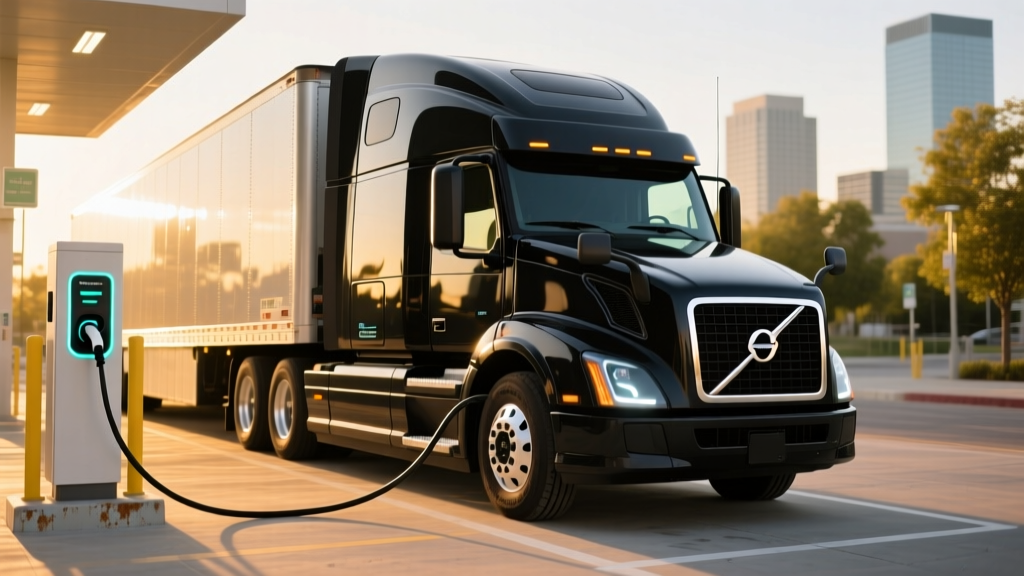
If you operate a regional distribution fleet or drayage route, the Volvo VNR Electric is one of the most established heavy-duty battery-electric trucks available in North America. As of the 2026 model year, the VNR Electric (now in its third generation) delivers an EPA-estimated range of up to 275 miles with the maximum 6-battery pack configuration, a 565 kWh usable battery capacity, and DC fast charging from 0–80% in approximately 90 minutes at 250 kW. Base pricing starts around $350,000 before incentives, though the IRS §45W commercial clean vehicle credit can offset up to $40,000 per unit for qualifying fleets.
Quick Verdict: Is the VNR Electric Right for Your Fleet?
Yes, if your routes are under 200 miles round-trip, you have depot charging access, and your trucks return to base nightly. Think twice if you run long-haul routes exceeding 250 miles, operate in extreme cold climates without battery preconditioning infrastructure, or lack the electrical capacity for 150–250 kW depot chargers.
VNR Electric Specs: Battery, Range, and Performance
The 2026 Volvo VNR Electric is offered in three configurations that directly determine range and payload trade-offs. Volvo uses lithium iron phosphate (LFP) cells in the latest generation — a chemistry that trades some energy density for longer cycle life (3,000+ cycles to 80% State of Health) and superior thermal stability compared to NMC packs used in earlier model years.
| Specification | 4-Battery Pack | 6-Battery Pack |
|---|---|---|
| Usable Battery Capacity | 375 kWh (LFP) | 565 kWh (LFP) |
| EPA-Estimated Range | ~175 miles | ~275 miles |
| Real-World Range (loaded, mixed) | 130–155 miles | 200–240 miles |
| Motor Output | 330 kW (442 hp) continuous / 450 kW (603 hp) peak | |
| Torque | 4,051 lb-ft at wheels (2-speed I-Shift) | |
| GVWR | 82,000 lbs (tractor + trailer combined) | |
| Max DC Fast Charge Rate | 250 kW (CCS1) | |
| 0–80% Charge Time | ~60 min | ~90 min |
| Base MSRP (approx.) | ~$320,000 | ~$350,000 |
| Battery Warranty | 5 years / 600,000 miles (70% SoH retention) | |
Real-World Range Reality Check
The 275-mile EPA figure assumes moderate ambient temperatures (65–75°F), partial loads, and mixed driving. In real fleet operations, expect 200–240 miles from the 6-battery configuration under typical conditions. In cold weather (below 32°F) or at full 80,000-lb GCW on sustained highway grades, range drops to 160–190 miles. Volvo's battery thermal management system and available cab heater preconditioning help mitigate winter losses, but dispatchers must plan for a 25–35% range reduction in sub-freezing climates.
Charging the VNR Electric: Depot vs. Public Infrastructure
Class 8 electric trucks like the VNR Electric require fundamentally different charging infrastructure than passenger EVs. You cannot rely on public Electrify America or Tesla Semi Megacharger networks alone — depot charging is the backbone of heavy-duty EV operations.
| Charging Method | Power (kW) | Miles Added per Hour | Best Use Case |
|---|---|---|---|
| Level 2 AC (J1772 / CCS1 AC) | 19.2 kW | ~10–12 mi/hr | Weekend top-offs; slow rotation |
| DC Fast (Depot CCS1) | 150 kW | ~80–95 mi/hr | Overnight fleet charging (8–10 hrs) |
| DC Ultra-Fast (Depot CCS1) | 250 kW | ~120–140 mi/hr | Mid-day opportunity charging |
| Volvo/Mack Public Megawatt (MCS)* | Up to 1,000 kW | ~400+ mi/hr | Announced; not widely deployed (2027+) |
*Megawatt Charging System (MCS) is still in pilot deployment as of 2026. CCS1 at 250 kW remains the standard for most fleet operations.
Depot Charging Installation Costs
Installing a single 150–250 kW DC fast charger at a fleet depot is a significant infrastructure investment. Here is what fleets typically budget per charging stall:
| Component | Cost Range (per stall) |
|---|---|
| 250 kW DC charger hardware | $85,000 – $130,000 |
| Electrical utility upgrade (transformer, switchgear) | $40,000 – $150,000 |
| Trenching, conduit, and concrete pad | $15,000 – $40,000 |
| Electrician labor and permitting | $20,000 – $50,000 |
| Networked charging software (annual) | $2,000 – $5,000 |
| Total per stall | $162,000 – $375,000 |
For a 10-truck fleet, expect a total infrastructure investment of $1.6M–$3.7M before utility rebates. Many utilities offer commercial EV charging incentives that can offset 30–50% of make-ready costs. Check with your local utility's commercial fleet electrification program before signing charger contracts.
Total Cost of Ownership: VNR Electric vs. Diesel VNR
The upfront cost of a VNR Electric is roughly 2.5× that of a comparable diesel VNR 660. However, operating cost savings close that gap significantly over a 7-year fleet lifecycle. Here is a data-driven comparison based on fueleconomy.gov equivalent efficiency data and fleet operator reports:
| Cost Factor | VNR Electric (6-Battery) | VNR 660 Diesel |
|---|---|---|
| Vehicle Purchase Price | ~$350,000 | ~$140,000 |
| Federal Tax Credit (§45W) | –$40,000 | $0 |
| Effective Purchase Price | ~$310,000 | ~$140,000 |
| Fuel/Energy Cost (per mile) | $0.18–$0.28 (at $0.12/kWh) | $0.55–$0.75 (at $4.20/gal diesel) |
| Annual Fuel/Energy (80,000 mi/yr) | $18,400 | $52,000 |
| Maintenance Cost (per mile) | ~$0.08 | ~$0.17 |
| Annual Maintenance (80,000 mi/yr) | $6,400 | $13,600 |
| DEF / Emissions Equipment | $0 | ~$2,800/yr |
| Estimated Insurance (annual) | $12,000–$15,000 | $8,000–$11,000 |
| 7-Year Total Operating Cost | ~$480,000 | ~$670,000 |
| 7-Year Total (Vehicle + Operating) | ~$790,000 | ~$810,000 |
The breakeven point typically arrives between year 4 and year 5 of operation, assuming 80,000 miles per year and stable electricity rates. Fleets running higher mileage or operating in states with lower commercial electricity rates (<$0.08/kWh) reach breakeven sooner. Fleets with lower utilization (<50,000 miles/year) may not justify the upfront premium within a standard truck lifecycle.
Tax Credits and Incentives for Commercial Fleets
The commercial EV incentive landscape is layered. Federal, state, and utility programs stack — but eligibility varies significantly. Here is the current framework as of 2026:
- IRS §45W Commercial Clean Vehicle Credit: Up to $40,000 for vehicles over 14,000 lbs GVWR. The credit equals the lesser of 30% of the vehicle cost or the incremental cost over a comparable ICE vehicle. See IRS guidance for sourcing and domestic-content requirements.
- State HVIP / Voucher Programs: California's Hybrid and Zero-Emission Truck and Bus Voucher Incentive Project (HVIP) has historically offered $60,000–$120,000 per Class 8 BEV. New York, New Jersey, and Oregon offer similar programs — amounts vary by jurisdiction and available funding.
- Utility Make-Ready Incentives: Many investor-owned utilities cover 50–100% of electrical infrastructure costs for fleet depot charging (the wiring and panels, not the charger hardware).
- EPA Clean Heavy-Duty Vehicles Program: Federally funded grants administered through state air districts; competitive application process with awards ranging from $100,000–$400,000 per vehicle in disadvantaged communities.
Note: Consult a tax professional for your specific fleet's eligibility. Incentive amounts, caps, and program availability change annually and vary by state.
Common Misconceptions About Heavy-Duty Electric Trucks
| Myth | Fact |
|---|---|
| "Electric trucks can't handle real freight loads." | The VNR Electric has a GCWR of 82,000 lbs and delivers 4,051 lb-ft of wheel torque. It pulls fully loaded 53-foot trailers daily in port drayage and regional distribution across North America. |
| "The batteries won't last." | LFP chemistry in the latest VNR Electric is rated for 3,000+ full cycles to 80% SoH. At 80,000 miles/year, that translates to roughly 7–9 years before significant capacity loss. Volvo's warranty covers 5 years / 600,000 miles at 70% retention. |
| "Charging takes too long for fleet operations." | At 250 kW, a 0–80% charge takes ~90 minutes. Most fleet operations charge overnight at 150 kW over 8–10 hours — trucks leave each morning fully charged. Opportunity charging during driver lunch breaks can add 60–80 miles. |
| "Electric trucks are always cheaper." | Not for every use case. Low-mileage fleets (<40,000 mi/yr), long-haul routes (>300 mi/day), and operations without depot charging access may not see favorable TCO. The math depends on utilization, electricity rates, and incentive stacking. |
| "Cold weather makes them unusable." | Cold weather does reduce range by 25–35%, but the VNR Electric's thermal management system and cab preconditioning mitigate losses. Fleets in Minnesota and Quebec operate them year-round with adjusted route planning. |
Decision Framework: Should Your Fleet Go Electric?
Choose the Volvo VNR Electric If:
- Your daily routes are under 200 miles round-trip (regional distribution, port drayage, food/beverage delivery)
- Trucks return to a central depot nightly where charging can be installed
- You operate in a state with strong HVIP/voucher incentives (CA, NY, NJ, OR, WA)
- Your fleet runs 60,000+ miles per truck per year (higher utilization = faster breakeven)
- You have or can obtain utility make-ready funding for depot electrical upgrades
- ESG reporting or zero-emission zone compliance is a business driver
Stick with Diesel or Consider Hybrid Alternatives If:
- Your routes regularly exceed 250 miles without return-to-base charging
- You operate in a region with no state/utility EV incentives and high commercial electricity rates (>$0.20/kWh)
- Your fleet averages fewer than 40,000 miles per truck annually
- Your depot's electrical service is below 800A and a utility upgrade is cost-prohibitive or timeline-uncertain
- You need maximum payload capacity — the 6-battery pack adds ~8,000 lbs of curb weight vs. diesel, reducing legal payload
Frequently Asked Questions
What is the real-world range of the Volvo VNR Electric?
With the 6-battery (565 kWh) pack, the EPA estimates 275 miles. In real fleet operations with full loads and mixed driving, expect 200–240 miles. In cold weather or sustained highway driving at full GCW, plan for 160–190 miles. Dispatch conservatively and build in a 20% buffer.
How long does it take to charge the VNR Electric?
At a 250 kW DC fast charger (CCS1), 0–80% takes approximately 90 minutes for the 6-battery pack. At 150 kW, the same charge takes roughly 2.5 hours. Most fleets charge overnight at depot over 8–10 hours, which is sufficient for a full 100% charge at 150 kW.
What does the VNR Electric cost after incentives?
The base 6-battery VNR Electric lists around $350,000. After the $40,000 federal §45W credit, the effective price is ~$310,000. In California with HVIP vouchers, fleets have reported effective prices as low as $190,000–$230,000 per unit. Actual incentive stacking depends on your state, utility, and application timing.
How does the VNR Electric compare to the Tesla Semi or Freightliner eCascadia?
The Tesla Semi claims up to 500 miles of range but remains in limited production with constrained availability. The Freightliner eCascadia is the VNR Electric's closest competitor, offering up to 230 miles of range (438 kWh battery) at a comparable price point. The VNR Electric has a broader dealer service network and more established parts availability. The eCascadia edges ahead on maximum battery capacity options. Both are proven platforms — the choice often comes down to dealer proximity and fleet management software preferences.
Do I need to upgrade my depot's electrical service?
Almost certainly, yes. A single 250 kW charger draws roughly the same power as 20–25 residential homes. A 10-truck fleet charging simultaneously at 150 kW requires approximately 1.5 MW of dedicated electrical capacity. Most commercial depots need a new utility transformer, switchgear, and possibly a medium-voltage service drop. Engage your utility early — lead times for transformer upgrades can be 12–24 months.
What happens when the battery degrades?
Volvo warrants the battery at 70% State of Health for 5 years / 600,000 miles. Beyond warranty, LFP batteries degrade slowly and predictably — a VNR Electric at 8 years may retain 65–75% of original capacity, which still supports shorter routes or can be repurposed for stationary storage. Full battery replacement costs are estimated at $80,000–$120,000 as of 2026, though module-level replacement for individual degraded cells is typically much less.
Can the VNR Electric tow and handle steep grades?
Yes. With 450 kW peak output and a 2-speed I-Shift transmission, the VNR Electric maintains highway speeds on 6% grades at full 82,000-lb GCW. Regenerative braking on descents recovers meaningful energy — some fleet operators report 5–10% range recovery on mountainous routes compared to flat-terrain estimates.
Sources: Volvo Trucks USA VNR Electric specifications, IRS §45W Commercial Clean Vehicle Credit, NHTSA. Pricing and incentive figures are approximate and subject to change. Verify current-year eligibility with your tax professional and state incentive administrator.