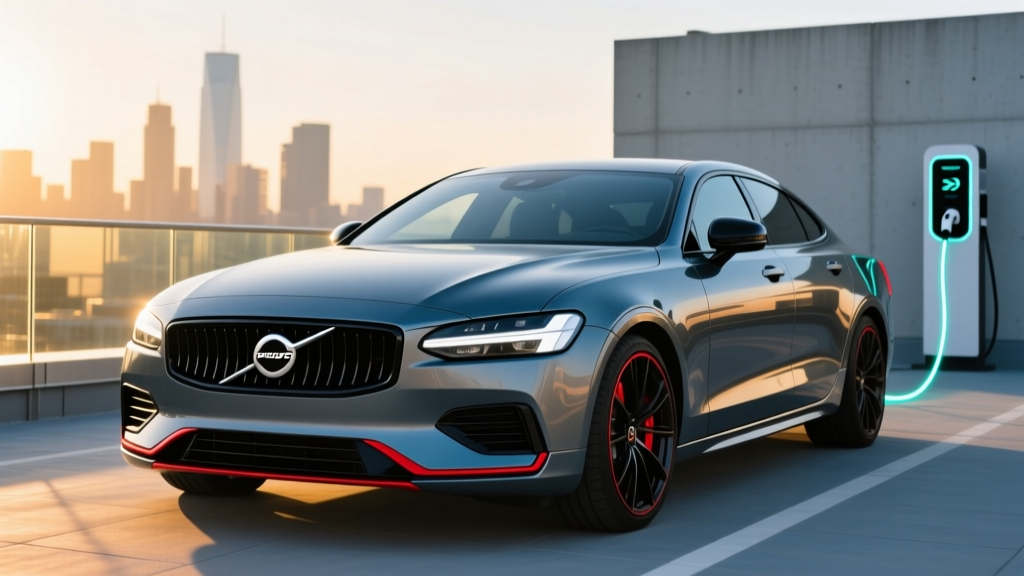
The Volvo V90 Polestar Engineered occupies a narrow but compelling lane in the electrified wagon market: a luxury estate with genuine electric-only commuting capability, a 455-horsepower twin-charged powertrain, and Polestar-tuned chassis dynamics. It is not a battery-electric vehicle — it is a plug-in hybrid (PHEV) wearing Volvo's most performance-oriented badge. For 2026, the V90 Recharge T8 Polestar Engineered remains one of the few PHEV wagons available in the U.S., competing against the Audi A6 allroad, the Mercedes-Benz E-Class wagon (mild-hybrid only), and BMW's 5 Series Touring (not sold stateside). Here is everything you need to know about living with one.
Quick Verdict: Who the V90 Polestar Engineered Is For
This wagon suits a very specific buyer: someone who wants a silent, zero-tailpipe-emission commute of up to 30 miles, the cargo versatility of a full-size wagon (69 cu ft with seats folded), Scandinavian luxury, and the ability to road-trip 500+ total miles without route-planning anxiety. If your daily drive is under 30 miles and you can charge at home, you will burn almost no gasoline on weekdays. If you need a pure EV with 300+ miles of electric range, look at the Tesla Model Y or Volvo's own EX90 instead.
- Your commute is under 30 miles round-trip and you have home Level 2 charging
- You want a wagon (not an SUV) with luxury appointments and AWD
- You take regular road trips and don't want DC fast-charging dependency
- You want a pure battery-electric vehicle with 250+ miles of range
- You need three rows of seating (consider the Volvo XC90 Recharge or EX90)
- Your budget is under $70,000
Powertrain, Performance & Drivetrain Specs
The 2026 V90 Recharge T8 Polestar Engineered uses Volvo's 2.0-liter twin-charged (turbocharged and supercharged) inline-four paired with an electric motor integrated into the rear axle. The Polestar Engineered treatment adds an Öhlins dual-flow valve dampers, gold-painted Brembo brake calipers, gold seatbelts, and a specific software tune that sharpifies throttle response and shift mapping.
| Spec | Value |
|---|---|
| Powertrain | 2.0L turbo+supercharged I4 + rear electric motor (PHEV) |
| Combined Output | 455 hp / 523 lb-ft torque |
| Drivetrain | eAWD (engine drives front wheels, electric motor drives rear) |
| 0-60 mph | 4.5 seconds (manufacturer est.) |
| Battery Capacity | 18.8 kWh usable (NMC lithium-ion) |
| EPA Electric Range | 31 miles |
| EPA MPGe (electric+gas) | 58 MPGe combined |
| EPA MPG (gas only, battery depleted) | 30 MPG combined |
| Total Range (gas + electric) | ~530 miles |
| Base MSRP | $76,450 (est.) |
The eAWD system is worth a note: unlike mechanical AWD, the rear axle is driven solely by the electric motor. When the battery is depleted below the hybrid buffer threshold, the gasoline engine generates electricity to power the rear motor under hard acceleration. In normal cruising with a depleted battery, the car operates primarily as a front-wheel-drive vehicle with the engine, engaging the rear motor only when traction or power demand requires it.
Electric Range, Efficiency & Real-World Expectations
Real-world expectation: 25-28 miles in mixed driving; 22-25 miles at sustained highway speeds (70+ mph); 18-22 miles in freezing temperatures (below 32°F) with cabin heat active.
EPA Combined MPGe: 58 MPGe (electric + gas blended).
Gas-only MPG (battery depleted): 30 MPG combined / 33 highway.
The 18.8 kWh battery (NMC chemistry) is positioned in the center tunnel and under the rear seats, preserving the V90's flat cargo floor. In our experience with Volvo's T8 Recharge powertrain across the S60, XC60, and XC90, the EPA electric range estimate is reasonably achievable in suburban driving at moderate speeds. Highway driving at 75 mph reduces electric range by roughly 20-25% due to aerodynamic drag — this is physics, not a Volvo-specific flaw. Cold weather hits PHEVs harder than BEVs proportionally, because the smaller battery has less thermal mass and the cabin heater draws directly from the 18.8 kWh pack.
One practical insight: Volvo's "Pure" drive mode maximizes electric-only operation, but the car will still fire the engine if you floor the throttle or if ambient temperature drops below roughly 14°F. In "Hybrid" mode, the car blends gas and electric intelligently based on navigation data if you enter a destination — it will save battery for city portions and use gas on highway segments.
For authoritative efficiency data, see the EPA's fueleconomy.gov listing for the V90 Recharge.
Charging Speed: DC Fast, Level 2 & Level 1
Charging a PHEV is fundamentally different from charging a BEV. The V90 Polestar Engineered's 18.8 kWh battery is small enough that home Level 2 charging is the primary refueling method, and DC fast charging is limited.
| Level | Power | Time (0-100%) | Miles of EV Range Added/Hour |
|---|---|---|---|
| Level 1 (120V household) | ~1.4 kW | ~13-14 hours | ~2 mi/hr |
| Level 2 (240V, 32A) | ~7.7 kW (onboard charger max) | ~2.5 hours | ~12 mi/hr |
| DC Fast Charge | Not supported (CCS port is AC-only on this model) | N/A | N/A |
Critical note for PHEV buyers: Most Volvo T8 Recharge models do not support DC fast charging. The CCS-style port on the vehicle accepts AC charging only. This is a common PHEV limitation — the small battery makes DC fast-charging hardware cost-prohibitive and thermally challenging. With a 7.7 kW onboard charger and an 18.8 kWh battery, a full charge takes roughly 2.5 hours on a Level 2 home charger. This means overnight charging easily replenishes the battery, but you cannot top up quickly on a road trip.
For home charging, a 32-amp Level 2 charger (such as a ChargePoint Home Flex or Wallbox Pulsar Plus) on a 40-amp circuit is ideal. Installation costs typically range from $500 to $2,000 depending on panel proximity and local permit requirements. If your electrical panel is at capacity, a panel upgrade can add $1,500-$3,000 — consult a licensed electrician for your specific situation.
Interior, Cargo & Technology
The V90's interior remains one of the most thoughtfully designed in the luxury wagon segment. The Polestar Engineered trim adds specific sport seats with Nappa leather and textile upholstery, gold seatbelts, a charcoal headliner, and aluminum mesh inlays.
| Measurement | Value |
|---|---|
| Cargo (rear seats up) | 23.8 cu ft |
| Cargo (rear seats folded) | 69.0 cu ft |
| Front legroom | 42.2 in |
| Rear legroom | 35.9 in |
| Seating capacity | 5 passengers |
The Google-based infotainment system (Google Built-In) includes Google Maps navigation, Google Assistant voice control, and access to the Play Store for apps like Spotify and Waze. The 9-inch portrait touchscreen is showing its age compared to the hyperscreens from Mercedes and the pillar-to-pillar displays from newer competitors, but it remains responsive and logically organized. Apple CarPlay is wireless; Android Auto is integrated via Google Built-In.
Driver assistance: The V90 comes standard with Volvo's Pilot Assist, a Level 2 driver-assistance system combining adaptive cruise control and lane-centering. Per NHTSA's SAE-level definitions, this is not self-driving — the driver must remain attentive with hands on the wheel. Pilot Assist works well on highways but does not support hands-free operation like GM's Super Cruise or Ford's BlueCruise. Volvo's Run-off Road Protection and intersection auto-braking remain class-leading safety features.
Pricing, Trims & Federal Tax Credit Eligibility
| Item | Amount |
|---|---|
| V90 Recharge T8 Plus (base PHEV trim) | ~$67,950 |
| V90 Recharge T8 Polestar Engineered | ~$76,450 |
| Destination charge | $1,295 |
| As-tested (with premium packages) | ~$79,000-$82,000 |
| Federal §30D Tax Credit (if eligible) | Up to $7,500 (see caveats below) |
| Effective price after max credit | ~$68,950-$74,500 |
The Polestar Engineered trim commands roughly an $8,500 premium over the Plus trim and includes the Öhlins dampers, Brembo brakes, 21-inch forged wheels, unique interior trim, and the Polestar performance software tune. Option packages (Premium, Climate, Bowers & Wilkins audio) can push the as-tested price past $82,000.
Federal Tax Credit: §30D Eligibility Checklist
The V90 Recharge T8 qualifies as a plug-in hybrid under IRS §30D, but the full $7,500 credit is not guaranteed. Per current IRS rules, eligibility depends on multiple factors:
- MSRP Cap: Vans, SUVs, and pickup trucks are capped at $80,000; sedans and wagons are capped at $55,000. The V90 is classified as a wagon — and its MSRP exceeds $55,000. This likely disqualifies the V90 Polestar Engineered from the §30D new-vehicle credit. Verify classification with your dealer and tax professional.
- Buyer Income Caps: AGI must not exceed $150,000 (single), $225,000 (head of household), or $300,000 (joint).
- Battery Sourcing: Critical minerals and battery components must meet escalating domestic-content thresholds.
- Point-of-Sale Transfer: If eligible, the credit can be transferred to the dealer at purchase, reducing the sale price directly.
Bottom line: The V90's classification as a wagon (not SUV) with an MSRP above $55,000 is a significant tax-credit disadvantage. Some buyers have successfully argued the V90 Cross Country is classified as an SUV (raising the cap to $80,000), but the standard V90 wagon faces the lower cap. Consult a tax professional before relying on this credit in your purchase decision.
Battery Warranty & Long-Term Ownership
Volvo covers the V90 Recharge's high-voltage battery with an 8-year/100,000-mile warranty, guaranteeing the battery will retain at least 70% of its original capacity during that period. The conventional powertrain is covered for 4 years/50,000 miles. Volvo's complimentary scheduled maintenance covers the first 3 years or 36,000 miles.
For PHEV batteries, degradation is generally less severe than in BEVs because the battery operates in a narrower state-of-charge window (the car maintains a hybrid buffer and rarely cycles from 0-100%). NMC chemistry in this application is well-proven across Volvo's Recharge lineup. Expect 5-10% capacity loss over 5 years with normal use — meaning your 31-mile EV range might become 28-29 miles by year five. This is modest and typical for the segment.
Insurance costs for the V90 Polestar Engineered run 15-25% higher than the non-Polestar V90 Recharge due to the performance trim designation, expensive Öhlins/Brembo components, and higher repair costs. Get quotes before purchasing.
Pros, Cons & How It Compares
- Genuine 31-mile EV range covers most commutes gas-free
- 455 hp with eAWD — quick, confident in all weather
- 69 cu ft cargo with seats folded — real wagon utility
- Öhlins dampers provide exceptional ride/handling balance
- No range anxiety on road trips — 530+ total miles
- Google Built-In infotainment is intuitive and fast
- Volva's safety suite is among the best in the industry
- No DC fast charging — Level 2 only
- MSRP above wagon §30D cap — likely no federal credit
- $76,450+ starting price is steep for a PHEV wagon
- 9-inch touchscreen feels dated vs. competitors
- Pilot Assist is competent but not class-leading (no hands-free)
- Rear legroom (35.9 in) trails the Mercedes E-Class wagon
- Insurance premiums are elevated for the Polestar trim
Key Competitor Comparison
The V90 Polestar Engineered has few direct rivals. The Audi A6 allroad is a mild-hybrid wagon (no EV range). The Mercedes E450 wagon is also mild-hybrid only. The closest functional comparison is the Volvo V60 Recharge Polestar Engineered, its smaller sibling, which offers similar powertrain specs in a more compact (and less expensive) package at ~$69,000 MSRP — still above the $55,000 wagon cap. If you want a PHEV with EV range, a wagon body, and luxury appointments, the V90 is essentially the only option in the U.S. market.
Frequently Asked Questions
What is the real-world electric range of the V90 Polestar Engineered?
The EPA rates it at 31 miles electric-only. In real-world suburban driving at moderate speeds, expect 25-28 miles. Sustained highway driving at 70+ mph reduces this to roughly 22-25 miles. In freezing weather with cabin heat, plan for 18-22 miles. The car transitions seamlessly to hybrid mode when the battery depletes.
Does the V90 Recharge support DC fast charging?
No. The V90 Recharge T8's CCS port accepts AC charging only, with a maximum onboard charger rate of approximately 7.7 kW. A full charge from empty takes about 2.5 hours on a Level 2 home charger. This is standard for PHEVs — the small battery does not justify the cost and thermal management complexity of DC fast-charging hardware.
How much does the V90 Polestar Engineered cost after tax credits?
The base MSRP is approximately $76,450 plus destination. Because the V90 is classified as a wagon, the §30D MSRP cap is $55,000, which the V90 exceeds. This means the V90 Polestar Engineered likely does not qualify for the federal new-vehicle tax credit. Some state and utility incentives may still apply — check your local programs. Consult a tax professional for your specific situation.
Is the V90 Polestar Engineered worth buying over an SUV PHEV?
If you prefer a wagon's lower center of gravity, easier garage clearance, and car-like driving dynamics, yes. The V90 handles better than Volvo's own XC90 Recharge despite sharing the same powertrain. However, the XC90 Recharge (classified as an SUV) has an $80,000 MSRP cap for §30D eligibility, making it more likely to qualify for the federal credit. If tax credit eligibility is a priority, the XC90 or XC60 Recharge may be smarter financial choices.
How long will the PHEV battery last?
Volvo warranties the high-voltage battery for 8 years/100,000 miles with a 70% capacity retention guarantee. PHEV batteries typically degrade more slowly than BEV batteries because they operate in a narrower charge window. Expect 5-10% range loss over 5 years. Full battery replacement, if needed out of warranty, typically costs $8,000-$12,000 including labor at a Volvo dealer.
Can I tow with the V90 Polestar Engineered?
The V90 Recharge T8 has a maximum towing capacity of approximately 2,000 pounds when properly equipped — adequate for a small utility trailer or a pair of dirt bikes, but not for a boat or camper. If you need serious towing, consider the Volvo XC90 Recharge (5,000 lbs) or a truck-based PHEV.