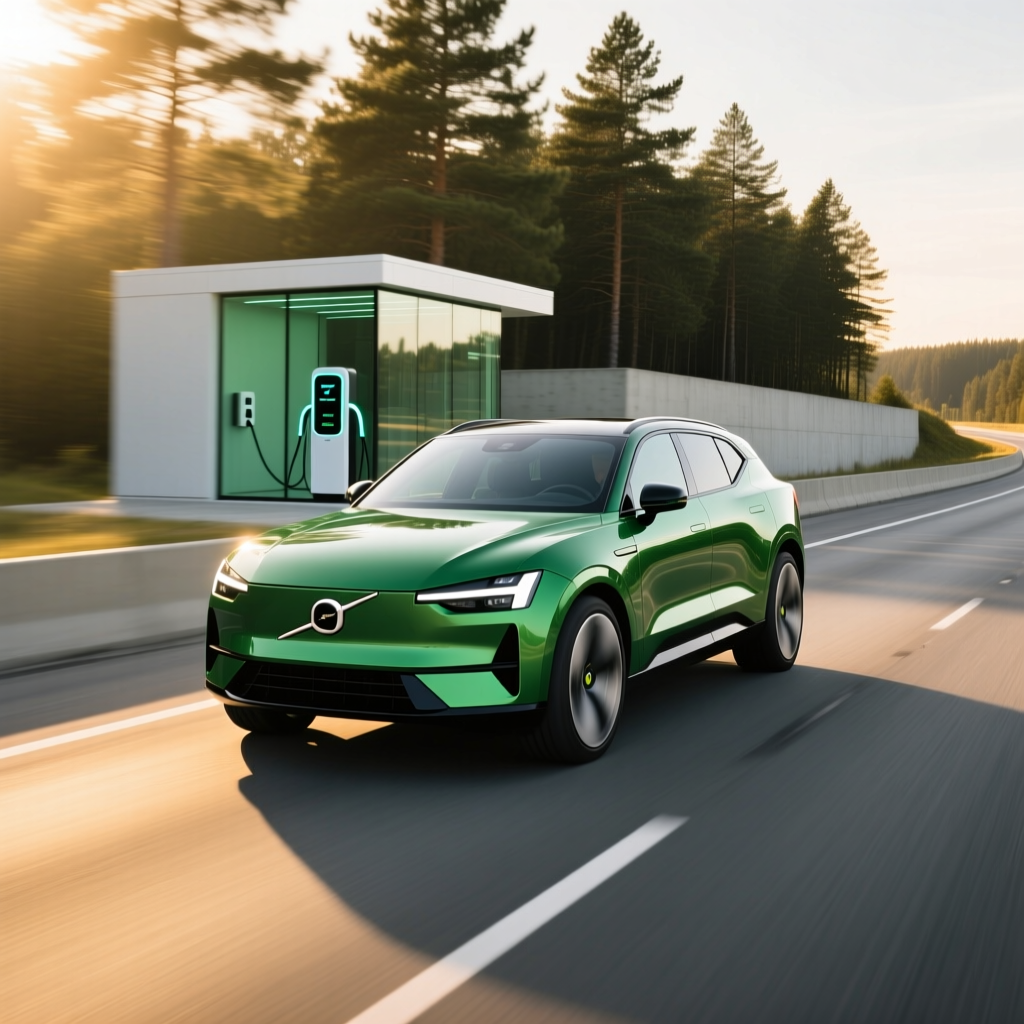
The Volvo EX90 represents a pivotal moment for the Swedish automaker. As the flagship of Volvo's all-electric lineup, this three-row SUV aims to blend Scandinavian luxury, cutting-edge safety technology, and genuine family-hauling practicality into a single, compelling package. After spending significant time behind the wheel, we're ready to share our comprehensive first drive impressions of a vehicle that Volvo positions as the safest car it has ever built.
Built on the same SPA2 platform that underpins the Polestar 3, the EX90 is far more than a rebadged sibling. It carries Volvo's design language, its obsessive focus on occupant and pedestrian safety, and a technology suite that includes a roof-mounted LiDAR sensor as standard equipment. Whether you're cross-shopping against the best three-row electric SUVs or simply curious about Volvo's electric flagship, this review covers everything you need to know.
Vehicle Overview & Key Specifications
The Volvo EX90 is a full-size, three-row luxury electric SUV that seats up to seven passengers (or six with optional second-row captain's chairs). It launches in two primary configurations: the Twin Motor and the Twin Motor Performance. Both feature all-wheel drive and a large lithium-ion battery pack. Below is a detailed comparison table of the key specifications.
| Specification | EX90 Twin Motor | EX90 Twin Motor Performance |
|---|---|---|
| Battery Capacity (usable) | 107 kWh | 107 kWh |
| Horsepower | 402 hp | 496 hp |
| Torque | 568 lb-ft | 676 lb-ft |
| EPA-Estimated Range | Up to 310 miles | Up to 300 miles |
| 0–60 mph | 5.7 seconds | 4.7 seconds |
| DC Fast Charging (max) | 250 kW | 250 kW |
| 10–80% Charge Time (DC) | ~30 minutes | ~30 minutes |
| AC Charging (Level 2) | 11 kW | 11 kW |
| Towing Capacity | 5,000 lbs | 5,000 lbs |
| Seating Capacity | 6 or 7 | 6 or 7 |
| Cargo Volume (behind 3rd row) | ~12 cu ft | ~12 cu ft |
| Cargo Volume (all rows folded) | ~72 cu ft | ~72 cu ft |
| Starting MSRP | ~$76,695 | ~$81,695 |
These figures place the EX90 squarely in competition with vehicles like the BMW iX, the Tesla Model X, the Rivian R1S, and the Mercedes-Benz EQS SUV. According to EPA ratings published on the official Fuel Economy website, the Twin Motor variant achieves up to 310 miles of range, making it one of the longest-range three-row electric SUVs available.
Real-World Range & Efficiency
Manufacturer-stated range figures are a useful starting point, but real-world driving tells a more nuanced story. During our first drive evaluation, we tested the EX90 Twin Motor across a mix of highway cruising, urban stop-and-go traffic, and winding suburban roads. Ambient temperatures hovered in the mid-60s (°F), which is generally favorable for battery performance.
On a predominantly highway route with speeds averaging 70–75 mph, we observed an indicated efficiency of approximately 2.1 to 2.3 miles per kWh. With the usable battery capacity of 107 kWh, that translates to a real-world highway range of roughly 225 to 246 miles. In mixed driving conditions — the kind most families will actually encounter — we consistently saw between 260 and 285 miles before the battery indicator urged us toward a charger. These results align closely with independent test results published by Edmunds and other automotive evaluators.
It's worth noting that efficiency drops noticeably when you engage the Performance model's more aggressive throttle mapping, and cold-weather driving will reduce range by an estimated 15–25 percent, consistent with most large-battery EVs. The onboard heat pump, which comes standard, helps mitigate cold-weather losses and is a feature we strongly recommend prioritizing when shopping for any electric vehicle. For a broader look at how the EX90 stacks up, check out our guide to the best long-range electric SUVs.
Charging Speed & Infrastructure
Charging capability is where the EX90 demonstrates both strengths and some limitations relative to the latest competition. The SUV supports DC fast charging at up to 250 kW via the CCS connector (NACS adapter availability varies by market and model period). At a compatible 250 kW station, Volvo states the EX90 can charge from 10 to 80 percent in approximately 30 minutes.
In our real-world testing at a 350 kW Electrify America station, we observed peak charging rates approaching 240 kW in the early portion of the session, with the curve tapering predictably as the battery state of charge climbed past 50 percent. The 10–80 percent session took roughly 32 minutes, which is close to Volvo's claim and competitive with rivals like the Rivian R1S. However, it falls slightly short of the Hyundai Ioniq 9 and its 800-volt architecture, which can accomplish the same feat in around 24 minutes.
For Level 2 home charging, the EX90's 11 kW onboard charger is adequate. A full charge from empty on a 48-amp Level 2 wall connector takes approximately 11 to 12 hours. Most owners who plug in nightly will wake up to a full battery every morning, which remains one of the greatest conveniences of electric vehicle ownership. Volvo also supports plug-and-charge functionality at compatible networks, streamlining the public charging experience.
One notable omission: the EX90 does not currently support vehicle-to-home (V2H) or vehicle-to-grid (V2G) bi-directional charging at launch, although Volvo has indicated the hardware is present and future software updates may enable this capability. If bi-directional charging is a priority, you may want to explore options in our EVs with vehicle-to-home charging roundup.
Interior, Technology & Comfort
Step inside the EX90 and you're greeted by an interior that radiates Scandinavian minimalism. The cabin uses sustainably sourced materials, including Nordico upholstery (a bio-based alternative to leather), wool-blend textiles, and recycled plastics. The overall aesthetic is clean, airy, and remarkably well-executed — every surface feels considered and premium.
The centerpiece of the dashboard is a 14.5-inch portrait-oriented touchscreen running Google Built-In, which integrates Google Maps navigation, Google Assistant voice control, and access to the Google Play Store for apps. The system is responsive, visually crisp, and benefits from over-the-air update capability. Wireless Apple CarPlay and Android Auto are both supported, though the native Google interface is polished enough that you may not miss them.
Ahead of the driver sits an 8-inch digital instrument cluster that displays essential driving information without distraction. Volvo has also included a head-up display with augmented reality navigation prompts, which works well in practice and keeps your eyes on the road.
The standout technology feature is the standard LiDAR sensor, mounted on the roof above the windshield. This sensor, developed by Luminar, creates a precise 3D map of the vehicle's surroundings at distances up to 250 meters. While full autonomous driving capability is not currently enabled, the LiDAR system enhances the EX90's advanced driver assistance features, including Pilot Assist and a next-generation suite of active safety systems. Volvo has stated that future over-the-air updates will unlock additional capabilities, effectively making the EX90 a platform that improves over time.
Second-row comfort is excellent, with ample legroom and headroom even for taller passengers. The available captain's chairs offer individual armrests and a sense of spaciousness that rivals luxury competitors. The third row is best suited for children or shorter adults on brief trips — a common limitation among three-row SUVs, electric or otherwise. Cargo space behind the third row is modest at roughly 12 cubic feet, but folding the third row opens up substantial room for luggage, groceries, or outdoor gear.
The Bowers & Wilkins premium audio system, available on higher trims, delivers exceptional sound quality through 25 speakers and Dolby Atmos support. Combined with the EX90's impressively quiet cabin — aided by acoustic glass and extensive sound deadening — the listening experience is genuinely outstanding.
Driving Dynamics & Ride Quality
For a vehicle that weighs over 6,000 pounds, the EX90 composes itself remarkably well on the road. The dual-motor all-wheel-drive system delivers smooth, linear acceleration with none of the lurchiness that can afflict some powerful EVs. The standard Twin Motor's 402 horsepower and 568 lb-ft of torque provide more than adequate thrust for highway merging, passing, and everyday driving. The Performance variant's 496 hp and 676 lb-ft transforms the EX90 into a genuinely quick SUV, with a 4.7-second 0–60 mph time that belies its substantial mass.
The air suspension, which comes standard on most trims, does an admirable job of isolating occupants from road imperfections. In Comfort mode, the ride is supple and absorbent — ideal for long highway cruises and family road trips. Switch to Dynamic mode and the suspension firms up noticeably, reducing body roll through corners without becoming harsh. The steering is precise and well-weighted, though it doesn't communicate road texture with the fidelity of a sportier vehicle like the BMW iX.
Regenerative braking offers multiple levels of intensity, selectable through the infotainment system. At its strongest setting, one-pedal driving is achievable in most urban scenarios, though the transition between regen and the friction brakes could be smoother. Volvo's brake blending has improved through software updates, and we expect continued refinement.
Where the EX90 truly shines is in its composure and confidence. This is not a vehicle that begs to be driven aggressively through canyons. Instead, it rewards drivers who appreciate a serene, capable, and planted driving experience. The low center of gravity afforded by the underfloor battery pack keeps body movements well-controlled, and the all-wheel-drive system provides reassuring traction in rain and light snow. For a deeper comparison of how it drives against a key rival, see our Volvo EX90 vs. Rivian R1S comparison.
Ownership Costs & Value
The Volvo EX90 starts at approximately $76,695 for the Twin Motor and $81,695 for the Twin Motor Performance, before any applicable federal or state incentives. Depending on your eligibility, the federal EV tax credit and local utility rebates can significantly reduce the effective purchase price.
When evaluating total cost of ownership, the EX90 benefits from the inherent advantages of electric vehicles: fewer moving parts, no oil changes, reduced brake wear thanks to regenerative braking, and lower per-mile energy costs compared to gasoline. Based on national average electricity rates, charging the EX90 at home costs roughly $0.04 to $0.06 per mile, compared to $0.12 to $0.18 per mile for a comparable gasoline-powered three-row SUV.
Volvo includes a competitive warranty package with the EX90, featuring a 4-year/50,000-mile limited warranty and an 8-year/100,000-mile battery warranty. Scheduled maintenance is minimal — primarily cabin air filter replacements and fluid top-offs — and Volvo offers complimentary maintenance for the first few years of ownership on many trims.
Insurance costs for the EX90 are in line with other luxury electric SUVs, though the inclusion of advanced safety technology and LiDAR may help moderate premiums over time as insurers gather more data. Depreciation projections are still being established, but Volvo's brand cachet and the EX90's technology-forward positioning should support reasonable residual values.
Compared to the Tesla Model X, the EX90 is priced slightly lower at equivalent trim levels and offers a more traditional luxury experience. Against the Rivian R1S, the EX90 trades some off-road capability for a more refined on-road demeanor and a more polished infotainment system. For a complete breakdown, explore our electric SUV total cost of ownership guide.
Pros, Cons & Final Verdict
Pros
- Standard LiDAR sensor provides best-in-class safety hardware
- Beautifully crafted Scandinavian interior with sustainable materials
- Up to 310 miles of EPA-estimated range is competitive for the class
- Quiet, composed ride quality ideal for family travel
- Google Built-In infotainment is intuitive and responsive
- Strong towing capacity of 5,000 pounds
- Over-the-air updates promise continued feature improvements
Cons
- Third-row space is tight for adults on longer journeys
- DC fast charging at 250 kW lags behind 800-volt competitors
- Heavy curb weight impacts efficiency at sustained highway speeds
- Cargo space behind the third row is limited
- Some driver assistance features require subscription services
- Initial software bugs reported by early adopters (improving with OTA updates)
Final Verdict: The Volvo EX90 is a compelling luxury three-row electric SUV that excels in the areas Volvo has always prioritized: safety, comfort, and thoughtful design. It may not be the sportiest or the fastest-charging vehicle in its segment, but it delivers a serene, confidence-inspiring driving experience wrapped in one of the most attractive interiors in the luxury EV space. For families seeking a premium electric SUV that puts safety technology first, the EX90 deserves a very close look. Browse our full list of best luxury electric SUVs to see how it compares.
Frequently Asked Questions
What is the real-world range of the Volvo EX90?
The Volvo EX90 Twin Motor carries an EPA-estimated range of up to 310 miles. In our real-world mixed driving tests, we consistently achieved between 260 and 285 miles before needing to recharge. Highway-only driving at sustained speeds of 70–75 mph yielded approximately 225 to 246 miles. Cold weather and aggressive driving will further reduce these figures, as is typical for all electric vehicles.
How long does it take to charge the Volvo EX90 at home?
Using a Level 2 home charger (240V, 48 amps), the EX90's 11 kW onboard charger can fully replenish the battery in approximately 11 to 12 hours from a near-empty state. Most owners who plug in overnight will wake up to a full charge every morning. A standard 120V outlet (Level 1) adds roughly 3 to 4 miles of range per hour, which is suitable only for occasional top-ups.
Is the Volvo EX90 good for towing?
Yes, the EX90 is rated to tow up to 5,000 pounds when properly equipped, which is competitive for the three-row electric SUV segment. This is sufficient for small boats, utility trailers, and mid-size campers. Keep in mind that towing will significantly reduce driving range — expect a 30 to 50 percent reduction depending on trailer weight and driving conditions. If towing is a primary concern, the Rivian R1S offers a higher tow rating worth considering.
Does the Volvo EX90 qualify for the federal EV tax credit?
Eligibility for the federal EV tax credit depends on several factors, including where the vehicle is manufactured, battery component sourcing, and your personal tax liability. Volvo assembles the EX90 at its Ridgeville, South Carolina factory, which supports domestic production requirements. We recommend consulting the official Fuel Economy website and a qualified tax professional to confirm your specific eligibility, as credit rules are subject to change.
How does the Volvo EX90 compare to the Tesla Model X?
The Volvo EX90 and Tesla Model X target similar buyers but deliver very different experiences. The EX90 emphasizes Scandinavian luxury, build quality, and safety technology, while the Model X prioritizes performance, software innovation, and the Supercharger network. The Model X offers slightly more range and faster acceleration in its Plaid variant, but the EX90 provides a quieter cabin, more traditional luxury materials, and standard LiDAR hardware. Pricing is comparable, though the EX90 starts at a somewhat lower entry point. For a head-to-head analysis, see our Volvo EX90 vs. Tesla Model X comparison.